
The Honden of Kitano Tenmangū and Yatsumune-zukuri
Key points
Four parts form one National Treasure building, the only Momoyama shrine building still at the scale it was built
The oldest Gongen-zukuri example in Japan, yet its floor plan keeps traditions from the Heian period
Gongen-zukuri refers to the floor plan, Yatsumune-zukuri to the combination of roofs
The Sankōmon is said to have no carved star, and this "missing star" is one of the Seven Wonders
Four parts designated as one National Treasure building
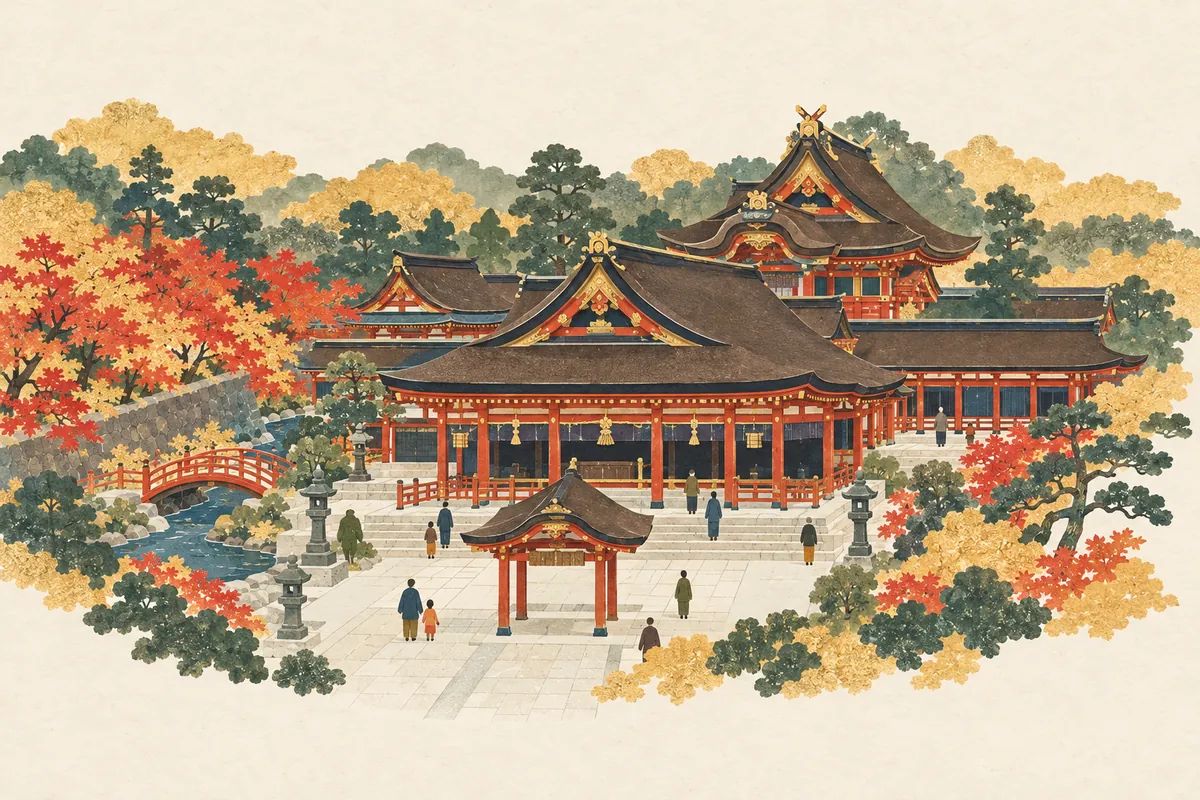
The National Treasure halls are designated as a single building made up of four parts: the Honden, Ishi-no-ma, Haiden, and Gaku-no-ma. They were designated an Important Cultural Property in 1897 (Meiji 30) and a National Treasure on June 27, 1959 (Shōwa 34), and six ridge tags (munafuda) are included in the designation as attachments (tsuketari). Among surviving Momoyama buildings, Kitano Tenmangū is the only shrine building preserved at the same scale as when it was built.
The halls stand beyond the torii, the Rōmon (tower gate), and the Chūmon (middle gate, the Sankōmon) as you go north from Imadegawa-dōri, and both the Haiden and the Honden face south.
Structure of Kitano Tenmangū's National Treasure halls
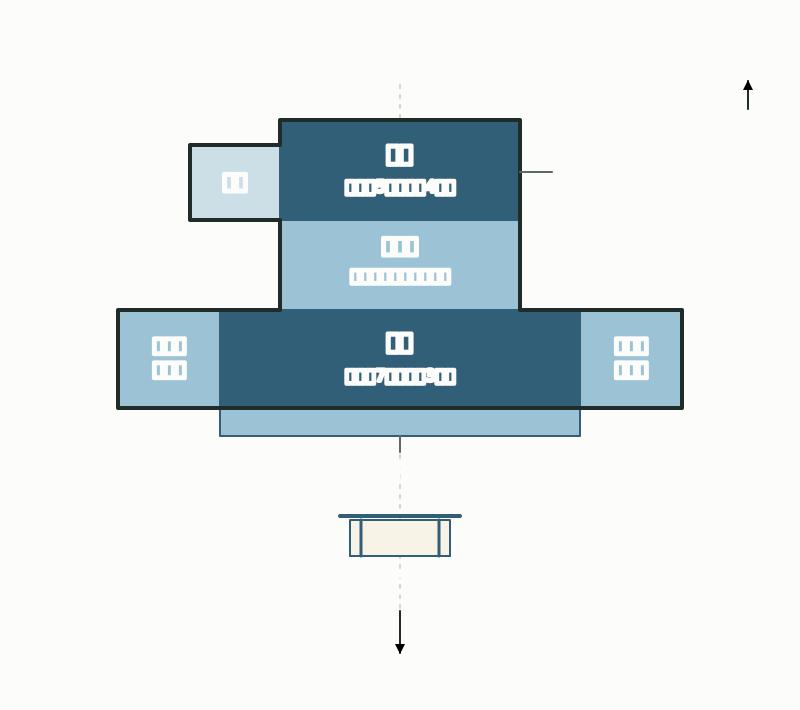
| Part | Size (bays) | Position and features |
|---|---|---|
| Honden (main sanctuary) | 5 bays wide, 4 bays deep | Innermost (north). The hall enshrining Sugawara no Michizane, with the Wakiden attached to the west |
| Ishi-no-ma (石の間) | 3 bays wide, 1 bay deep | Between the Honden and the Haiden. A low-floored, stone-paved room that joins the two buildings |
| Haiden (worship hall) | 7 bays wide, 3 bays deep; 7-bay kōhai (front porch roof) | In front (south). You enter it when receiving a prayer ritual |
| Gaku-no-ma (楽の間) | One each on the east and west. 2 bays wide at the front and 3 at the back, 2 bays deep | On both the east and west sides of the Haiden. One end has an irimoya roof, and the other end joins the Haiden |
Gongen-zukuri joined by the Ishi-no-ma
Kitano Tenmangū suffered repeated fires, and the present halls were built in 1607 by Hideyori, following the dying wishes of Toyotomi Hideyoshi.
The form in which the main sanctuary and worship hall are connected by an Ishi-no-ma is called Gongen-zukuri, and the halls of Kitano Tenmangū are considered the oldest example of it in Japan. These halls were the first where rituals were performed inside a spacious worship hall, and they became the prototype for later Gongen-zukuri. At the same time, the floor plan preserves archaic traditions dating back to the Heian period.
Above the Ishi-no-ma, a great rainbow beam (daikōryō) spans the long depth of the room, and a taiheizuka (vase-shaped strut) and kaerumata (frog-leg strut) hold up a high decorative ridge beam; this is one of the highlights of the halls.
Floor Plan of the Kitano Tenmangū Halls (Schematic of Gongen-zukuri)
The roofs called "Yatsumune-zukuri"
The Honden and Haiden both have irimoya roofs, the Ishi-no-ma between them has a ryōsage roof, the front of the Haiden has a chidori-hafu, and the kōhai porch has a nokikara-hafu. This combination of roofs is what is known as the Yatsumune-zukuri ("eight-ridge style") form. All the roofs are cypress bark (hiwadabuki), with a total area of about 500 tsubo.
The Sankōmon and the "missing star"
The middle gate between the Rōmon and the Honden is called the Sankōmon. It was built at the same time as the Honden and was designated an Important Cultural Property in 1898 (Meiji 31). It is a four-legged gate (shikyakumon) with cypress-bark roofing and chidori-hafu and nokikara-hafu at the front and back, and it bears an imperial plaque reading 天満宮 (Tenmangū) in the hand of Emperor Go-Sai.
Sankō means the "three lights": the sun, the moon, and the stars, and the gate takes its name from carvings of them between the beams. The star, however, is said not to be carved at all. It is taken to be the North Star shining in the sky: according to tradition, when the emperor prayed toward the shrine, the North Star shone right above this gate. The "Sankōmon missing its star" (hoshikake no Sankōmon) is counted among the Seven Wonders of Tenjin-san. Another of the Seven Wonders is the "off-axis main sanctuary" (sujikai no go-honden): the auxiliary shrine Jinushi-sha stands at the end of the approach from the Rōmon, and the Honden stands offset so that it does not face it directly.
The shrine's founding and Tenjin-san's fair
Kitano Tenmangū enshrines Sugawara no Michizane and is the head shrine of some 12,000 Tenmangū and Tenjin shrines across Japan; it was founded in 947 (Tenryaku 1). The 25th of every month is a fair day associated with Michizane's birthday and the day of his death. The treasure hall opens only on the 25th of each month and during certain other periods, and holds works such as the National Treasure Kitano Tenjin Engi picture scrolls (Jōkyū version).
The maple and plum gardens
On the west side of the grounds, part of the Odoi earthwork that Toyotomi Hideyoshi built in 1591 survives along the Kamiya River, forming the "Historic Site Odoi Maple Garden" with about 350 maple trees. You can look down on the autumn leaves from the top of the Odoi and up at them from below, and there is a viewing spot that overlooks the National Treasure Honden, as well as the "Three-Pronged Maple," more than 400 years old.
In 2026 the autumn opening runs from October 31 to December 6, 9:00–16:00 (last entry 15:40), with evening illumination from sunset to 20:00 from November 13. Admission is 1,500 yen for adults (junior high school students and older) and 700 yen for elementary school students (including tea and a sweet); preschool children are free. The grounds have about 1,500 plum trees of 50 varieties, and the plum garden "Hana no Niwa" is usually open for a fee from early February to late March.
Opening hours and access
The address is Bakuro-chō, Kamigyō Ward. Visiting the grounds is free; the gates are open 7:00–17:00, and the Sankōmon in front of the Honden closes 30 minutes before the gates. You normally worship at the National Treasure halls from in front of the Haiden, and you enter the Haiden when receiving a prayer ritual (reception 9:00–16:00).
To get there, take a city bus to "Kitano Tenmangū-mae," right by the shrine (about 35 minutes on Route 50 from Kyoto Station, or about 15 minutes on Routes 51 or 203 from Imadegawa Subway Station), or walk about 5 minutes from Kitano-Hakubaichō Station on the Randen (Keifuku Electric Railroad).
Mini quiz for this entry
The imperial plaque reading 天満宮 on Kitano Tenmangū's middle gate, the Sankōmon, is in the hand of which emperor?
Among surviving Momoyama-period shrine buildings, what is true only of the National Treasure halls of Kitano Tenmangū?
Sources and verification
Content checked: October 18, 2026
Updated: October 18, 2026
References are in Japanese.