
Minamiza and the Kaomise: Maneki-age and the History of the Theaters on the Shijō Riverbank
Other spellings and namesMinamiza (南座) / Kyoto Minamiza / Kaomise (顔見世) / Kichirei Kaomise Kōgyō (吉例顔見世興行) / Maneki-age (まねき上げ) / Maneki signboards (まねき看板) / Kantei-ryū (勘亭流)
Key points
The 2026 Kaomise runs from Tuesday, December 1 to Thursday, December 24. No performances on the 9th and 17th
Maneki-age is usually in late November. In both 2024 and 2025 it was on November 26
The present building was completed in 1929 (Shōwa 4) and registered as a Registered Tangible Cultural Property on December 20, 1996 (Heisei 8)
Right by Exit 6 of Keihan Gion-Shijō Station. Preschool children also need their own ticket from age 4
From the theaters on the Shijō riverbank to Minamiza
In 1603 (Keichō 8), Izumo no Okuni (出雲阿国) performed kabuki dance in Kyoto and became famous. Her stages are said to have included the Gojō riverbank and the remains of a kanjin nō (benefit Noh) stage in the grounds of the Kitano shrine, with the area screened off by straw mats (mushiro). One explanation says she started on the Shijō riverbank. Before long, theaters with yagura (櫓, drum turrets) lined the Shijō riverbank, and in the Genna era (1615–1624), Itakura Katsushige, the Kyoto shoshidai (shogunal deputy in Kyoto), is said to have licensed seven yagura. Minamiza is said to have its origins around this time, and only licensed theaters were allowed to raise a yagura.
The seven theaters gradually decreased in number, and by the Bunka and Bunsei eras (1804–1829) there were two, on the north side and south side, facing each other across Shijō-dōri east of Shijō Ōhashi. After the Kitaza (north theater) closed in 1893 (Meiji 26), only Minamiza, the theater on the south side, has remained. Minamiza is said to be the theater with the longest history in Japan, and also the only theater carrying on the tradition of the seven yagura licensed in the Genna era. What is said to be the oldest is its history as a theater, not the present building itself.
The history of Minamiza
| Year | Event |
|---|---|
| 1603 (Keichō 8) | Izumo no Okuni performs kabuki dance in Kyoto |
| Genna era (1615–1624) | Itakura Katsushige, the Kyoto shoshidai, is said to have licensed seven yagura on the Shijō riverbank |
| 1893 (Meiji 26) | The north-side theater (Kitaza) closes, leaving only Minamiza |
| 1906 (Meiji 39) | Shōchiku Gōmei Kaisha begins managing the theater |
| 1913 (Taishō 2) | Completely rebuilt in November. From the December Kaomise, performances become joint East–West productions |
| 1929 (Shōwa 4) | The present building is completed |
| 1991 (Heisei 3) | Reopens after renovation begun the previous year |
| 1996 (Heisei 8) | Registered as a national Registered Tangible Cultural Property |
| 2018 (Heisei 30) | Reopens with the November Kaomise after seismic reinforcement and major renovation begun in February 2016 (Heisei 28) |
The present building and its registration as a cultural property
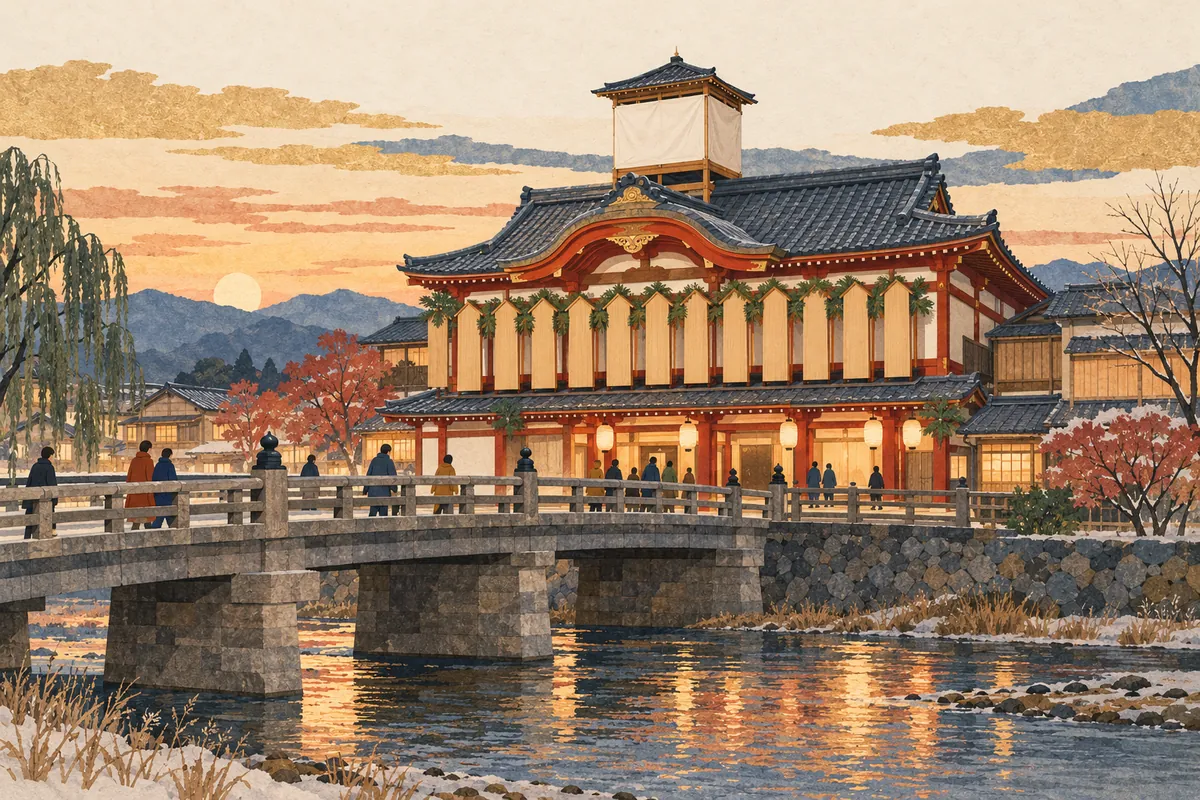
Today's Minamiza, completed in 1929 (Shōwa 4), is a theater in the Momoyama style with gables (hafu) and a yagura. It is built of steel-framed reinforced concrete and steel, with four stories above ground and one below, a tiled roof, and a building area of 1,797 m². In renovations in 1990–1991 (Heisei 2–3), its exterior was returned to its appearance at the time of completion.
On December 20, 1996 (Heisei 8), it was registered as a national Registered Tangible Cultural Property (building), with registration number 26-0001. The criterion for registration is that it "contributes to the historic landscape of the country," and it later also became a Kyoto City Building of Historic Design. The difference between registration and designation as a National Treasure or Important Cultural Property is covered in a separate entry.
What is the Kaomise? The first performance with the new company of actors
In the Edo period, contracts between actors and theaters lasted one year, and each company's lineup changed every 10th month. The kaomise (顔見世, "showing of faces") is said to take its name from the first performance in which the new company appeared together, at the beginning of the 11th month. In 1756 (Hōreki 6), Motoori Norinaga, who was in Kyoto, noted in his diary the bustle on the day the Kaomise began at the theater on the south side.
Today, Minamiza holds the Kichirei Kaomise Kōgyō (customary Kaomise performance) every December. The year-end Kaomise is said never to have been suspended, even during the war, and since December 1913 (Taishō 2) it has kept the form of a "Tōzai Gōdō" (joint East–West) production.
Maneki and maneki-age
Maneki (まねき, "beckoning" signboards) were one of the ways Edo-period theaters advertised. Each board has a roof-shaped top called iorigata, the actor's name is lettered in Kantei-ryū (勘亭流) style, and the actor's crest sits above the name. The boards are cypress, one ken (about 1.8 m) long, one shaku (about 30.3 cm) wide, and one sun (about 3 cm) thick.
Kantei-ryū is a typeface unique to kabuki. Its heavy strokes curve inward and leave little white space, reflecting the hope that the house will be full with no empty seats. The lettering of Minamiza's maneki was perfected by Takeda Kōsei, who wielded the brush for more than 50 years from 1922 (Taishō 11), into a thick form with few gaps so that it stands out even on large signboards; his school calls it "maneki moji" (maneki lettering) and uses it only for Minamiza's maneki. The ink is mixed with sake, to give it a good sheen, and glue (nikawa), to withstand wind and rain.
"Maneki-gaki" (writing the maneki) takes place in early November at Myōden-ji in Kyoto City, and hanging them on the front of the theater in late November is "maneki-age." The maneki are decorated with pine needles and strips of paper (tanzaku), and finally the signboards are purified in a salt-scattering ceremony. As of October 29, the date of maneki-age for 2026 has not yet been announced.
Maneki-age in recent years
| Year | Date of maneki-age | Number of maneki |
|---|---|---|
| 2024 | Tuesday, November 26 | 59 |
| 2025 | Wednesday, November 26 | 65 |
| 2026 | Not announced (as of October 29) | ― |
The 2026 Kaomise and rules for children
In 2026, it is held from Tuesday, December 1 to Thursday, December 24 as "Kyō no Nenjū Gyōji, Ataru Hitsuji-doshi (當る未歳), Kichirei Kaomise Kōgyō, Tōzai Gōdō Ōkabuki" (Kyoto's annual event, the Year of the Sheep, customary Kaomise, grand joint East–West kabuki). The matinee is scheduled from 10:30 a.m. to about 3:15 p.m. and the evening performance from 4:00 p.m. to about 9:10 p.m.; there are no performances on Wednesday the 9th and Thursday the 17th. The matinees on the 12th, 19th, and 20th and the evening performance on the 18th are reserved for private bookings.
Tickets go on sale online and by phone from 10:00 on Monday, November 9, and at the box office from 10:00 on Wednesday, November 11. Even preschool children need their own ticket from age 4. If a child makes noise or cries during the performance, you rest in the lobby.
Ticket prices for the 2026 Kichirei Kaomise Kōgyō (tax included)
| Seat | Price |
|---|---|
| Special seats | 28,000 yen |
| First-class seats | 26,000 yen |
| Second-class seats A | 13,000 yen |
| Second-class seats B | 10,000 yen |
| Third-class seats | 8,000 yen |
| Fourth-class seats | 6,000 yen |
Where can you see it now? / Getting there
Minamiza is at the east end of Shijō Ōhashi in Higashiyama Ward, on the south side of Shijō-dōri. It is right by Exit 6 of Keihan Gion-Shijō Station and 3 minutes on foot from Exit 1 of Hankyu Kyoto-Kawaramachi Station; by city bus, get off at "Shijō Keihan-mae," right by the stop. You need a ticket for a performance to go inside, but you can look up at the front with its yagura, and at the maneki hung from late November, from the sidewalk of Shijō-dōri.
On the west side of Minamiza, facing Kawabata-dōri, is a stone marker reading "Birthplace of Okuni Kabuki," erected by Shōchiku in 1953 (Shōwa 28). Across Shijō-dōri to the north, on the east side of Kawabata-dōri Shijō-agaru, stands a stone marker reading "Site of the Kitaza," a reminder of the two theaters that once faced each other. Walking south for about 5 minutes along Yamatoōji-dōri, which runs along the east side of Minamiza, brings you to Kyoto Ebisu Shrine.
Mini quiz for this entry
How many theater turrets (yagura) is Itakura Katsushige, the Kyoto shoshidai, said to have licensed on the Shijō riverbank in the Genna era?
From what Edo-period custom did the name of the performance called "kaomise" arise?
Sources and verification
Content checked: October 29, 2026
Updated: October 29, 2026
References are in Japanese.
- 松竹「南座の歴史」
- 文化庁 国指定文化財等データベース「南座」(登録有形文化財)
- 京都府立京都学・歴彩館(旧 総合資料館)「資料紹介コーナー『京の芝居 其の壱 -南座顔見世興行を中心として-』」
- 松竹 歌舞伎美人「京の年中行事 當る未歳 吉例顔見世興行 東西合同大歌舞伎」(南座 2026年12月)
- 松竹 歌舞伎美人「南座」(劇場案内・アクセス)
- 松竹 歌舞伎美人「観劇マナーについて」
- 松竹 歌舞伎美人「南座『吉例顔見世興行』でまねき上げ」(2024年11月28日)
- 松竹 歌舞伎美人「南座『吉例顔見世興行』まねき上げ、祝幕もお披露目」(2025年11月28日)
- 松竹 歌舞伎美人「南座『吉例顔見世興行』大入り願うまねき書き」(2025年11月11日)
- 松竹 歌舞伎美人「京都・南座の『まねき書き』始まる」(2007年11月7日)
- 松竹 歌舞伎美人「京都南座『まねき書き』始まる」(2009年11月14日)
- 京都市「京都のいしぶみデータベース HI022 阿国歌舞伎発祥地」
- 京都市「京都のいしぶみデータベース HI130 北座跡」
- 京都市観光協会 京都観光Navi「南座」
- 都七福神事務局「ゑびす神 京都ゑびす神社」