
Kyoto Ebisu Shrine and Tōka Ebisu: "Shōbai Hanjō de Sasa Motte Koi"
Other spellings and namesKyoto Ebisu Shrine (京都ゑびす神社) / 京都えびす神社 / Ebisu Jinja (恵美須神社) / Tōka Ebisu (十日ゑびす) / Hatsu Ebisu / Ebessan Kyoto / Yoi Ebisu / Nokori Fuku
Key points
Tōka Ebisu usually runs for 5 days, January 8–12. In 2026 the gates stayed open all night on the 9th and 10th
It is said to have begun in 1202 (Kennin 2), when Eisai enshrined the deity as the guardian of Kennin-ji as he founded that temple
At the Nokori Fuku Festival on the 11th, maiko hand out fukuzasa bamboo: from Gion-machi in the afternoon and from Miyagawa-chō at night
A 6-minute walk from Keihan Gion-Shijō Station, 8 minutes from Hankyū Kyoto-Kawaramachi Station
How to read "ゑびす," and the deities enshrined
"ゑ" (we) is a kana used in historical kana orthography, and in today's kana usage it corresponds to "え" (e). Kyoto Ebisu Shrine is also read "Kyōto Ebisu Jinja" (きょうとえびすじんじゃ), and it is also written 恵美須神社 (Ebisu Jinja). It enshrines Kotoshironushi-no-kami, Sukunahikona-no-kami, and Ōkuninushi-no-kami, and is worshiped as the local guardian deity (ubusuna-gami) of the area.
Together with the shrines in Nishinomiya and in Imamiya, Osaka, it is counted as one of the "Three Great Ebisu Shrines of Japan." In the Miyako Shichifukujin Mairi, a pilgrimage around the temples and shrines of the Seven Lucky Gods in Kyoto, it is in charge of Ebisu, the god of thriving business. Of the Seven Lucky Gods, Ebisu is said to be the only one born in Japan.
Eisai and the guardian of Kennin-ji: the story of its beginnings
Shrine tradition holds that in 1191 (Kenkyū 2), when Eisai was returning from Song China and his ship ran into a violent storm and was about to sink, the god Ebisu appeared on the sea and he escaped danger. When Eisai founded Kennin-ji in 1202 (Kennin 2), he enshrined Ebisu in the temple grounds as the temple's guardian deity, and this is regarded as the beginning of the shrine.
After the Ōnin War, when Kennin-ji was being rebuilt, the shrine too was rebuilt without moving from its site. In 2002 (Heisei 14) it marked 800 years since its founding. The history of Kennin-ji itself and the Twin Dragons painted on the ceiling of its Hattō are covered in a separate entry.
Five days of Tōka Ebisu: from the Shōfuku Festival to the Teppuku Festival
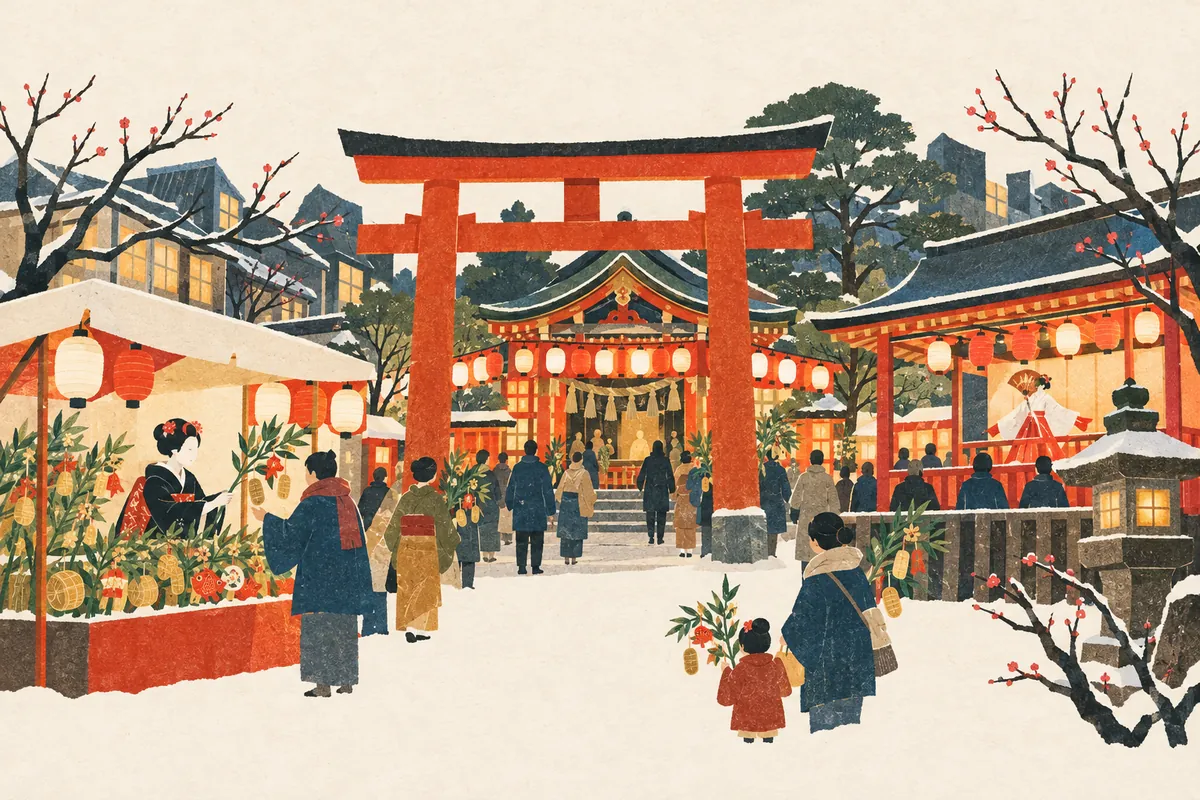
The Tōka Ebisu Grand Festival is held for five days centered on January 10, and its popular name is Hatsu Ebisu. Throughout the five days, kitchō-zasa (lucky bamboo) blessed with prayers for thriving business and family prosperity are given out, along with lucky charms such as ōdakara, fukudawara (lucky rice bales), fukumi (lucky winnowing baskets), fukukumade (lucky rakes), fukudai (lucky sea bream), and treasure ships, as well as fukuzeni coins and koban. Kagura dances are performed in the Kagura-den all day. The "Hatsuka Ebisu Grand Festival (Ebisu-kō)" on October 19 and 20 is the festival of the 20th day of the ninth month of the old calendar, when Ebisu came from the sea, and it is said to be paired with Tōka Ebisu, when he returns to the sea.
Usual events of Tōka Ebisu
| Date | Event | What happens |
|---|---|---|
| January 8 | Shōfuku Festival | Gates open at 9:00. Yudate kagura from 14:00. Gates close at 23:00 |
| January 9 | Yoi Ebisu Festival | Gates open at 9:00, and a "lucky tuna" (shōfuku maguro) is offered. Gates open all night |
| January 10 | Tōka Ebisu Grand Festival (Hatsu Ebisu) | Ceremony from 14:00 (closed to the public). Gates open all night |
| January 11 | Nokori Fuku Festival | Maiko from Gion-machi hand out fukuzasa from 14:00 to 16:00, and maiko from Miyagawa-chō from 20:00 to 22:00. Gates close at 24:00 |
| January 12 | Teppuku Festival | Gates open at 9:00. Gates close at 22:00 |
Why bamboo? Kitchō-zasa and "Shōbai hanjō de sasa motte koi"
As the phrase "Shōbai hanjō de sasa motte koi" ("For thriving business, bring your bamboo!") suggests, bamboo is at the center of Tōka Ebisu's lucky charms. Sasa is the leaf of the bamboo of the "pine, bamboo, and plum" trio, and it is said to have become a sign of family prosperity and thriving business because it grows straight with regular joints, bends without breaking, and keeps its leaves green all year round. One explanation holds that the link between Ebisu and bamboo spread from the form of a talisman (ofuda) originally unique to Kyoto Ebisu Shrine.
Highlights of the grounds, and events through the year
After praying at the main hall (honden), it is said to be good to tap gently on the wooden board at the side of the main hall and pray once more. The Iwamoto-sha in the grounds enshrines the Heian-period poet Ariwara no Narihira, and the Saifu-zuka (wallet mound) and Meishi-zuka (business card mound) are mounds where worn-out wallets and business cards are given memorial rites.
- Setsubun in February: from 17:00, a ritual to drive out demons in the main hall, and the throwing of lucky beans by the priests
- Nagoshi no Harae on June 30: passing through a chinowa (grass ring) about 3 m in diameter in front of the main hall
- Meishi Saifu Kansha-sai on September 15: business cards no longer needed are burned in a garden fire
- Ohitaki-sai on November 16: yudate kagura is performed from 14:00
Where can you see it now? / Getting there and tips for visiting with children
Kyoto Ebisu Shrine is at 125 Komatsu-chō, Yamatoōji-dōri Shijō-sagaru, Higashiyama Ward. It is a 6-minute walk from Keihan Gion-Shijō Station and an 8-minute walk from Hankyū Kyoto-Kawaramachi Station. By city bus, it is about a 5-minute walk from "Shijō Keihan-mae," or from Kyoto Station take route 17 or 205 for about 10 minutes to "Kawaramachi Matsubara" and walk about 5 minutes.
During Tōka Ebisu the shrine is crowded every day with people seeking kitchō-zasa. In 2026 the gates stayed open all night on the 9th and 10th, until 23:00 on the 8th, and until 24:00 on the 11th. If you go with small children, it is safer to check the times and choose the daytime. Prayers (gokitō) are by reservation, and during Tōka Ebisu they are accepted from 9:00 to 21:00 (until 19:00 on the 12th).
Mini quiz for this entry
In today's kana usage, which kana does the "ゑ" (we) in "京都ゑびす神社" (Kyoto Ebisu Shrine) correspond to?
During Tōka Ebisu at Kyoto Ebisu Shrine, maiko hand out fukuzasa (lucky bamboo) at the Nokori Fuku Festival on January 11. Which hanamachi (geisha districts) are they from?
Which Heian-period poet is enshrined at the Iwamoto-sha in the grounds of Kyoto Ebisu Shrine?
Sources and verification
Content checked: October 28, 2026
Updated: October 28, 2026
References are in Japanese.