
The Standing Statue of Kūya Shōnin at Rokuharamitsu-ji: Six Amida Buddhas Emerging from His Mouth
Other spellings and namesRokuharamitsu-ji (六波羅蜜寺) / Standing statue of Kūya Shōnin / Kūya Shōnin statue / Kūya (空也) / Reiwa-kan / Seated statue of Taira no Kiyomori / Rokuhara-san / Kūya Yuyaku Nenbutsu
Key points
The statue of Kūya Shōnin is a Kamakura-period work, designated an Important Cultural Property on August 13, 1917 (Taishō 6)
The Reiwa-kan opened on May 22, 2022 (Reiwa 4) and displays 17 statues, including 14 Important Cultural Properties
From October 1, 2026, Reiwa-kan admission is 700 yen for adults, 500 yen for junior high school to university students, and 400 yen for elementary school students
The principal image, a standing Eleven-Headed Kannon, became a National Treasure in 1999. It was last unveiled from November 3 to December 5, 2024
A temple founded in 951 to calm an epidemic
In 951 (Tenryaku 5), when an epidemic spread through the capital, Kūya (903–972) is said to have made a statue of the Eleven-Headed Kannon, placed it on a cart, and pulled it through the city, giving the sick tea that had been offered before the Buddha and calming the disease while chanting the nenbutsu. This tea is still given out as "Ōbukucha" (皇服茶) during the first three days of the New Year. In the eighth month of 963 (Ōwa 3), he invited 600 monks to dedicate a copy of the Great Wisdom Sutra (Daihannya-kyō) written in gold, and at night held a great lantern service to celebrate the completion of the halls. The temple was first called Saikō-ji, and Kūya's disciple Chūshin is said to have renamed it Rokuharamitsu-ji.
Kūya is said to have been a son of Emperor Daigo. After traveling through the provinces to practice, he spread the nenbutsu by chanting "Namu Amida Butsu" in the streets, and so he was called "Ichi no Hijiri" (市の聖, the holy man of the marketplace). The temple is the 17th temple of the Saigoku 33 Kannon pilgrimage. The name of Kōyaku-zushi in Shimogyō Ward is also said to be a corrupted form of the name of a hall for memorial services for Kūya.
The statue of Kūya Shōnin: what do the six Amida Buddhas represent?
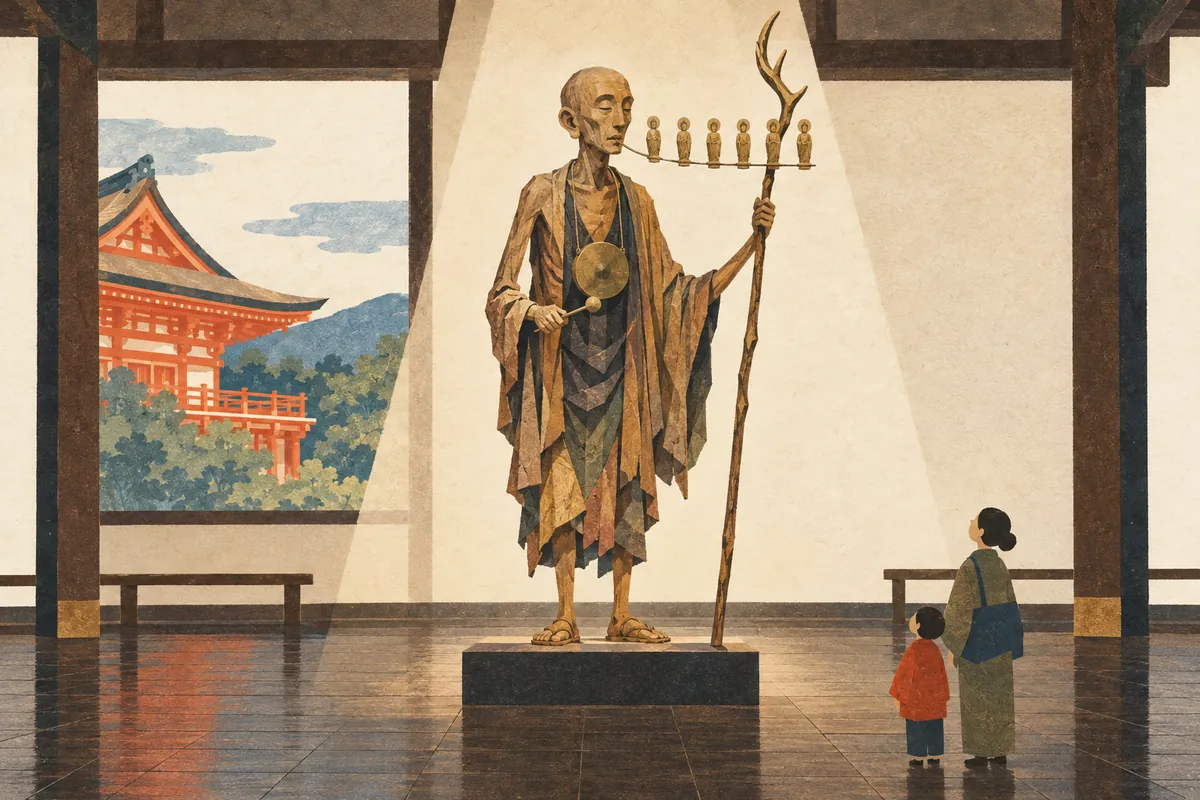
The standing statue of Kūya Shōnin was made by Kōshō (康勝), the fourth son of Unkei, the leading Buddhist sculptor of the Kamakura period, and it is regarded as the oldest surviving statue of Kūya. It shows him walking as he chants the nenbutsu: a gong (gongu) hangs on his chest, he holds a striker (shumoku) in his right hand, and in his left hand he leans on a staff topped with a deer antler; his knees are bare and he wears straw sandals. His hollow cheeks and thin body are shown realistically.
From his open mouth emerge six small standing Amida Buddhas in a row, supported by wire. They give form to the legend that when Kūya chanted "Namu Amida Butsu," his voice took the shape of Amida.
The deer antler on the staff also has a story. When Kūya was living in seclusion on Mount Kurama, he learned that a hunter named Sadamori had shot and killed a deer he had treated as a dear companion. In his grief, it is said, he made the hide into a robe and fixed the antler to the head of his staff, and never parted with them for the rest of his life. Sadamori is said to have become his disciple and gone around the streets of Kyoto beating a gourd (hisago) and chanting the nenbutsu, and this is said to lead to today's Rokusai Nenbutsu.
In 2022, 1,050 years after Kūya's death, the Tokyo National Museum held the special exhibition "Kūya Shōnin and Rokuharamitsu-ji" (March 1 – May 8), and the statue was shown in Tokyo for the first time in half a century.
Statues of Taira no Kiyomori, Unkei, and Tankei: statues remaining at the temple in Rokuhara
In the late Heian period, after Taira no Tadamori stationed his troops at a subtemple of this temple, the residences of the Taira clan came to line the area in the time of Kiyomori and Shigemori, said to number more than 5,200. When the Taira fled the capital in 1183 (Juei 2), the halls burned in the fires of war, and only the main hall (hondō) is said to have survived. The place name Rokuhara and the story of the Rokuhara Tandai are covered in the entry on the Taira at Rokuhara.
The seated statue said to be Taira no Kiyomori (Important Cultural Property), holding a sutra scroll, is a Kamakura-period statue and is said to show Kiyomori at the time he was copying sutras to pray for his clan's fortune in war. The seated statues of Unkei and his eldest son Tankei are said to have been enshrined beside the principal image of Jūrin-in, the family temple of Unkei's family, and that principal image, the seated Jizō Bosatsu (Yumemi Jizō), is said to be Unkei's work. The standing Jizō Bosatsu said to be by Jōchō is called "Kazurakake Jizō" (鬘掛地蔵) because of its unusual form, holding hair in its left hand.
National Treasure and Important Cultural Property statues of Rokuharamitsu-ji
| Name (designation name) | Sculptor | Period | Designation | Where to see it |
|---|---|---|---|---|
| Wooden standing Eleven-Headed Kannon (enshrined in the main hall) | — (thought to have been made in 951, Tenryaku 5) | Heian | National Treasure (June 7, 1999) | Shrine cabinet in the main hall. Hidden Buddha unveiled in the Year of the Dragon |
| Wooden standing Kūya Shōnin | Kōshō | Kamakura | Important Cultural Property (August 13, 1917) | Reiwa-kan |
| Wooden seated figure in monk's form (said to be Taira no Kiyomori) | — | Kamakura | Important Cultural Property (August 29, 1910) | Reiwa-kan |
| Wooden seated statues (said to be Unkei / said to be Tankei) (2 statues) | — | Kamakura | Important Cultural Property (December 28, 1897) | Reiwa-kan |
| Wooden seated Jizō Bosatsu (Yumemi Jizō) | Said to be Unkei | Kamakura | Important Cultural Property (August 2, 1901) | Reiwa-kan |
| Wooden standing Jizō Bosatsu (Kazurakake Jizō) | Said to be Jōchō | Heian | Important Cultural Property (August 13, 1917) | Reiwa-kan |
| Wooden seated Yakushi Nyorai | — | Heian | Important Cultural Property (June 27, 1959) | Reiwa-kan |
| Wooden standing Four Heavenly Kings (4 statues) | — | Heian (Zōchōten is thought to be a Kamakura-period replacement) | Important Cultural Property (August 13, 1917) | Reiwa-kan |
| Wooden standing Kisshōten | — | Kamakura | Important Cultural Property (August 13, 1917) | Reiwa-kan |
| Wooden seated King Enma | — | Kamakura | Important Cultural Property (August 13, 1917) | Reiwa-kan |
| Wooden seated Kōbō Daishi | — | Kamakura | Important Cultural Property (August 26, 1938) | Reiwa-kan |
The hidden principal image, the main hall, and annual events
The principal image, the standing Eleven-Headed Kannon (National Treasure), is thought to be the statue Kūya made when he founded the temple, and it is 258.0 cm tall. It is a hidden Buddha normally kept in a shrine cabinet at the center of the main hall and is unveiled once every 12 years, in the Year of the Dragon. The last unveiling was from November 3 to December 5, 2024 (Reiwa 6), and the next Year of the Dragon is 2036. The main hall (Important Cultural Property) was repaired and rebuilt in 1363 (Jōji 2), and in 1969 (Shōwa 44) it was dismantled and repaired to mark the 1,000th anniversary of the temple's founding; roof tiles thought to date from around the founding and 8,000 small clay pagodas (deitō) were found.
At the Mantōe (萬燈会) from August 8 to 10, the character "大" (dai) is lit with lamp wicks in the main hall, and the ancestral spirits welcomed then are sent off by the Gozan Okuribi on the 16th. Like Rokudō Mairi, held each year from August 7 to 10 at nearby Rokudō Chinkō-ji, it is an Obon event for welcoming the spirits of the dead. The Kūya Yuyaku Nenbutsu (空也踊躍念仏), from December 13 to 31, is handed down by the Rokuharamitsu-ji Kūya Yuyaku Nenbutsu Preservation Society as one of the "Rokusai Nenbutsu of Kyoto," a national Important Intangible Folk Cultural Property. In 1974, 2,163 items, including the clay pagodas and Ōbukucha tea bowls, were designated an Important Tangible Folk Cultural Property as "Materials of Popular Faith of Rokuharamitsu-ji."
Where can you see it now? / Getting there
Rokuharamitsu-ji is a 7-minute walk from Kiyomizu-Gojō Station on the Keihan line, or from Kyoto Station take city bus route 206 to "Kiyomizu-michi" and walk 7 minutes (15 minutes on foot from Hankyū Kawaramachi Station). The gate is open from 8:30 to 16:30. The statues of Kūya Shōnin and Taira no Kiyomori can be seen in the Reiwa-kan (Important Cultural Property storehouse). An admission fee is listed only for the Reiwa-kan (as of October 2026).
- Reiwa-kan: 9:00–16:15 (reception until 16:00). From October 1, 2026, 700 yen for adults (600 yen before then), 500 yen for university, high school, and junior high school students, and 400 yen for elementary school students. Groups of 30 or more get 50 yen off each, and people who show a disability certificate pay half price
- Principal image, the Eleven-Headed Kannon: a hidden Buddha. The next unveiling is expected in 2036, a Year of the Dragon
- Parking: 4 spaces
Mini quiz for this entry
Which Buddhist sculptor, the fourth son of Unkei, is said to have made the standing statue of Kūya Shōnin (Important Cultural Property) at Rokuharamitsu-ji?
The statue of Kūya Shōnin leans on a staff with his left hand. In the legend, what is attached to the top of the staff?
Sources and verification
Content checked: October 28, 2026
Updated: October 28, 2026
References are in Japanese.
- 文化庁「国指定文化財等データベース 木造空也上人立像」
- 文化庁「国指定文化財等データベース 木造十一面観音立像(本堂安置)」
- 文化庁「国指定文化財等データベース 木造僧形坐像(伝平清盛像)」
- 文化庁「国指定文化財等データベース 木造〈伝運慶/伝湛慶〉坐像」
- 文化庁「国指定文化財等データベース」(国宝・重要文化財〈美術工芸品〉、所有者「六波羅蜜寺」で検索)
- 文化庁「国指定文化財等データベース 六波羅蜜寺本堂」
- 文化庁「国指定文化財等データベース 六波羅蜜寺の庶民信仰資料」
- 文化庁「国指定文化財等データベース 京都の六斎念仏」
- 文化庁「国指定文化財等データベース 木造善導大師立像」(新潟・善導寺。解説で六波羅蜜寺の空也上人像に触れる)
- 六波羅蜜寺「六波羅蜜寺の歴史」
- 六波羅蜜寺「六波羅蜜寺の寺宝」
- 六波羅蜜寺「参拝案内・アクセス」
- 六波羅蜜寺「六波羅蜜寺の年中行事」
- 六波羅蜜寺「文化財収蔵庫『令和館』について」(2022年5月22日)
- 六波羅蜜寺「令和館(重要文化財収蔵庫)拝観料改定のお知らせ」(2026年8月1日)
- 六波羅蜜寺「秘仏御本尊 辰年御開帳のご案内」(2024年7月1日)
- 京都市観光協会「京都観光Navi 六波羅蜜寺」
- 京都市「平清盛の京を歩く 六波羅蜜寺」
- 東京国立博物館「特別展『空也上人と六波羅蜜寺』」(2022年)