
The Miroku Bosatsu of Kōryū-ji
Key points
"National Treasure No. 1" is a popular name for the representative of the many cultural properties designated on the day of the first National Treasure designations
There are two National Treasure Miroku statues: the crowned Hōkan Miroku and the Hōkei Miroku, known as the Weeping Miroku
Whether the Hōkan Miroku was made on the Korean Peninsula or in Japan is still unsettled
The two Miroku are always on view in the Reihōden; the National Treasure Keikyūin Main Hall is a separate building deeper in the grounds
Designated on the day of the first National Treasure designations
The wooden Miroku Bosatsu in half-lotus contemplation at Kōryū-ji became an Important Cultural Property (a designation under the system of the time) on December 28, 1897 (Meiji 30), and was designated a National Treasure on June 9, 1951 (Shōwa 26). That was the day the first National Treasure designations were made under the Law for the Protection of Cultural Properties, enacted in 1950 (Shōwa 25). The names "National Treasure No. 1" and "National Treasure Sculpture No. 1" come from this, but they are popular names, not serial number one.
On the same day, five buildings in Kyoto City alone became National Treasures, including the five-story pagoda of Daigo-ji, the Ginkaku and Tōgudō of Ginkaku-ji, and the Hiunkaku of Hongan-ji. Works of art and craft were designated together as well, and the Miroku Bosatsu came to be called "No. 1" as the representative of them all.
The Crowned Miroku and the Weeping Miroku
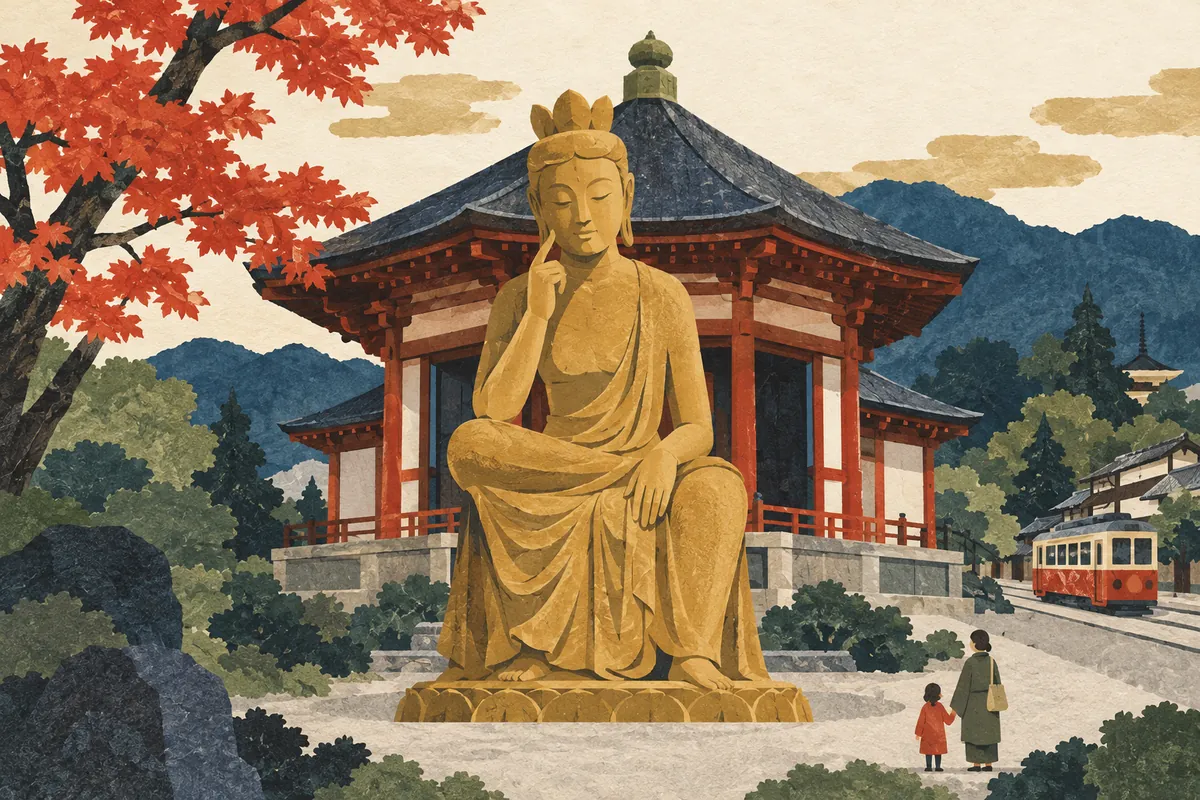
Kōryū-ji has two National Treasure wooden statues of Miroku Bosatsu in half-lotus contemplation. A hanka-zō is a statue seated with one foot resting on the other knee and the fingers raised toward the cheek in thought, also called a hanka-shii-zō (half-lotus contemplative statue). One wears a crown on its head and is called the Hōkan Miroku (宝冠弥勒, Crowned Miroku); this is the one known as National Treasure No. 1.
The other has its hair bound up high and is called the Hōkei Miroku (宝髻弥勒); from its expression, which looks as though it is weeping, it has the nickname Naki Miroku (泣き弥勒, Weeping Miroku). It too is an Asuka-period statue, and became a National Treasure the year after the Hōkan Miroku.
Theories on the statue's origin and identity
The Nihon Shoki records that in 603 (the 11th year of Empress Suiko) Hata no Kawakatsu received a Buddhist statue from Prince Shōtoku and built Hachioka-dera, and its entry for 623 (Suiko 31) also says that a statue sent from Silla was installed at the Hata temple in Kadono. One of these is thought to be today's Hōkan Miroku, and some researchers consider it highly likely to be a Silla statue brought over from the Korean Peninsula.
Whether it is the statue of 603 or that of 623, and whether it was made on the Korean Peninsula or in Japan, has still not been settled. As for the statue's name, in recent years some have argued that it is not Miroku, but research has also been presented showing that it was made as Miroku Bosatsu from the start, and study of the deity's identity continues today.
The Hata clan, builders of Kōryū-ji, and Uzumasa
The Hata were a clan that came to Japan from the Korean Peninsula in ancient times, probably as a group that arrived from Silla around the mid-5th century. Based around Uzumasa, they built the Kadono Ōi weir on the Katsura River to open up the Sagano area, and brought the techniques of sericulture and weaving. A tradition links the place name "Uzumasa" to the Hata presenting silk piled up high (uzutakaku) and being granted the surname Uzumasa (禹豆麻佐). Ōsake Shrine, which enshrines the ancestors of the Hata clan, originally stood within the grounds of Kōryū-ji and was moved to its present site at the Meiji-era separation of Shinto and Buddhism.
Hachioka-dera, built by Hata no Kawakatsu, is today's Kōryū-ji. The name "Kōryū-ji" first appears in documents in 838 (Jōwa 5), but the Asuka-period statues and the roof tiles excavated there place the temple's beginnings in the Asuka period. At the former Kōryū-ji precincts and the Tokiwa Nakanochō site to the north of the temple, the remains of many Asuka-period pit dwellings have been found.
Kōryū-ji's National Treasures and the Keikyū-in Hondō
Kōryū-ji has 9 National Treasures: 6 sculptures, 2 historical documents, and 1 building. Apart from the two Miroku, the sculptures are all from the Heian period, including statues enshrined in the Kōdō (lecture hall). The Kōdō itself is a late-Heian building and an Important Cultural Property.
The only National Treasure building is the Keikyū-in Hondō. It is an octagonal hall roofed with cypress bark (hiwadabuki), thought to have been built before 1251 (Kenchō 3) in the early Kamakura period, and is a valuable example of Kamakura-period round-hall architecture.
National Treasures of Kōryū-ji
| Name | Type | Date designated National Treasure |
|---|---|---|
| Wooden Miroku Bosatsu in half-lotus contemplation (Hōkan Miroku) | Sculpture (Asuka period) | June 9, 1951 (Shōwa 26) |
| Wooden Miroku Bosatsu in half-lotus contemplation (Hōkei Miroku, the Weeping Miroku) | Sculpture (Asuka period) | November 2, 1952 (Shōwa 27) |
| Wooden seated Amida Nyorai (enshrined in the Kōdō) | Sculpture (Heian period) | March 29, 1952 (Shōwa 27) |
| Wooden standing Fukūkenjaku Kannon (in the Kōdō) | Sculpture (Heian period) | November 22, 1952 (Shōwa 27) |
| Wooden standing Thousand-Armed Kannon (in the Kōdō) | Sculpture (Heian period) | March 31, 1953 (Shōwa 28) |
| Wooden standing Twelve Heavenly Generals (attributed to Chōsei), 12 statues | Sculpture (Heian period, 1064) | March 31, 1953 (Shōwa 28) |
| Kōryū-ji Engi Shizai-chō (temple history and inventory) | Historical document (Heian period) | March 31, 1953 (Shōwa 28) |
| Kōryū-ji Shizai Kōtai Jitsuroku-chō (inventory register) | Historical document (Heian period) | March 31, 1953 (Shōwa 28) |
| Kōryū-ji Keikyū-in Hondō | Building (early Kamakura period) | March 31, 1953 (Shōwa 28) |
Visiting the Reihōden, and the Uzumasa Ox Festival
Kōryū-ji is at 32 Uzumasa Hachioka-chō, Ukyō Ward: about 1 minute on foot from Uzumasa-Kōryūji Station on the Randen (Keifuku Electric Railroad Arashiyama Line), or about 13 minutes from Uzumasa Station on the JR Sagano Line. The National Treasure statues are on permanent display in the Reihōden treasure hall (built 1982) behind the main hall. Admission to the Reihōden is charged; it is open from 9:00 to 17:00 (until 16:30 from December through the end of February), every day, and from 10:00 on January 1.
Besides the two Miroku, the Reihōden displays Buddhist statues representative of each period from Asuka to Kamakura. The National Treasure Keikyū-in Hondō is at the far end of the grounds and is a separate building from the Reihōden. Check with the temple whether it is open.
The "Uzumasa Ox Festival" (Ushi Matsuri) in October is a nighttime event in which Matarajin, wearing a paper mask and riding an ox, circles the grounds and reads a long ritual text in front of the Yakushidō. It is counted among Kyoto's three great unusual festivals and is a Kyoto City Registered Intangible Folk Cultural Property. In recent years it was held on the night of October 10, but it is currently suspended (as of October 2026).
Mini quiz for this entry
Kōryū-ji's National Treasure Hōkei Miroku, known as the "Weeping Miroku," dates from which period?
What is the name of the octagonal Kamakura-period hall that is the only building at Kōryū-ji designated a National Treasure?
Sources and verification
Content checked: October 17, 2026
Updated: October 17, 2026
References are in Japanese.
- 文化庁「国指定文化財等データベース 木造弥勒菩薩半跏像(広隆寺・昭和26年国宝指定)」
- 文化庁「国指定文化財等データベース 木造弥勒菩薩半跏像(広隆寺・昭和27年国宝指定)」
- 文化庁「国指定文化財等データベース 木造阿弥陀如来坐像(講堂安置)」
- 文化庁「国指定文化財等データベース 木造不空羂索観音立像(所在講堂)」
- 文化庁「国指定文化財等データベース 木造千手観音立像(所在講堂)」
- 文化庁「国指定文化財等データベース 木造十二神将立像(伝長勢作)」
- 文化庁「国指定文化財等データベース 広隆寺縁起資財帳」
- 文化庁「国指定文化財等データベース 広隆寺資財交替実録帳」
- 文化庁「国指定文化財等データベース 広隆寺桂宮院本堂」
- 文化庁「国指定文化財等データベース 広隆寺講堂」
- 文化庁「国指定文化財等データベース 醍醐寺五重塔」
- 京都市「都市史01 秦氏」
- 京都市観光協会 京都観光Navi「広隆寺」
- 京都市観光協会 京都観光Navi「広隆寺霊宝殿」
- 京都市・京都観光推進協議会 きょうと修学旅行ナビ「広隆寺」
- 京都市埋蔵文化財研究所(第228回京都市考古資料館文化財講座、太秦・嵯峨野地域の遺跡6)
- 京都市文化観光資源保護財団「京都の歴史と文化 映像ライブラリー 太秦牛祭」
- 国立国会図書館 レファレンス協同データベース「太秦牛祭(うしまつり)に関する写真が見たい。」
- 文部科学省 科学研究費助成事業データベース「日本・朝鮮古代菩薩半跏像の図像と尊名に関する研究」