
Sanjūsangen-dō (Hondō of Rengeō-in)
Key points
The hall is 35 bays long overall, but leaving out the eave bay at each end, its core has 33, hence the name Sanjūsangen-dō
The present hall is a Kamakura-period building, rebuilt in 1266 after a fire in 1249
The principal image, the 1,001 standing Thousand-Armed Kannon, the Wind God and Thunder God, and the Twenty-Eight Attendants are all National Treasures
Admission is free on the day of the Ōmato Taikai in January and at the Momo-no-hōe on March 3
The number "thirty-three"
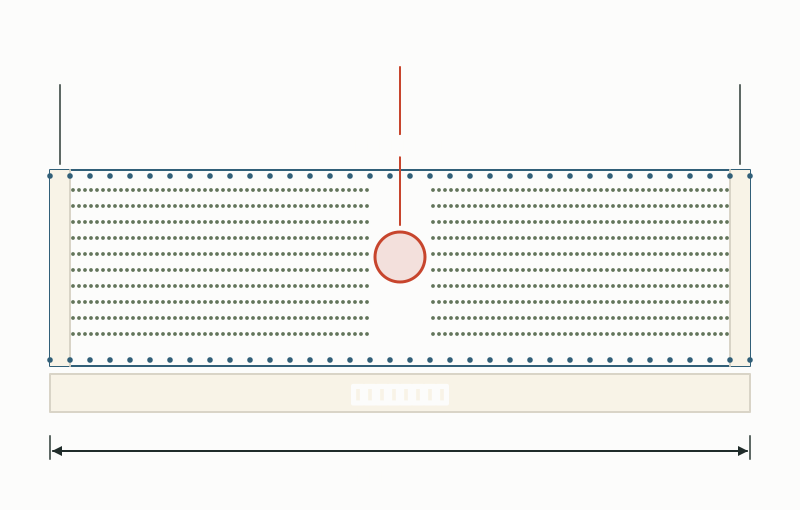
Sanjūsangen-dō is the main hall of Rengeō-in, a temple of the Tendai school. A ken (間) is a unit for counting the spaces between pillars, and the hall is commonly called Sanjūsangen-dō (三十三間堂, "hall of thirty-three bays") because the inner sanctuary has 33 bays. The building as a whole is 35 bays along its length, but the single bay at each end is an eave bay (hisashi), so counted as the core (moya) it comes to 33.
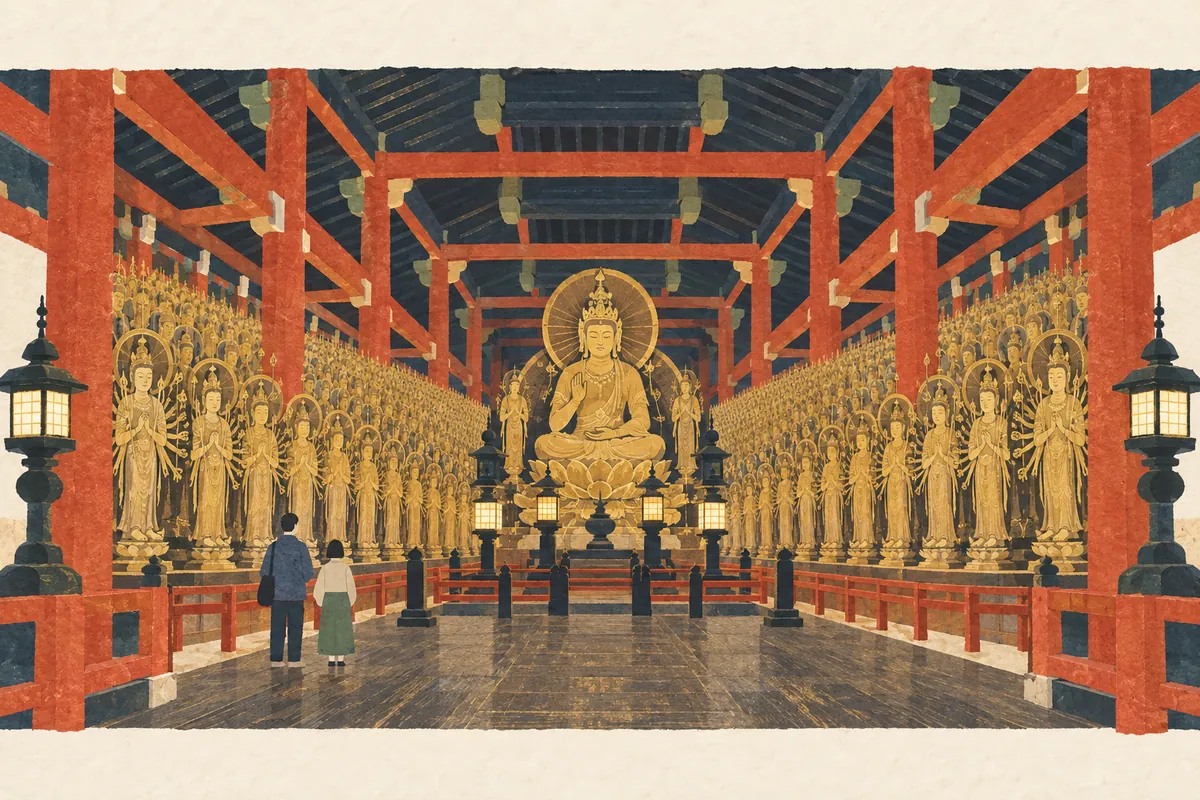
The hall measures about 120 m north to south, 22 m deep, and 16 m high, in the Japanese (wayō) style with a formal tiled roof (hongawarabuki). The three central bays hold the principal image, the seated Thousand-Armed Kannon, and in the 15 bays on either side are stepped platforms of ten tiers, each side holding 500 standing Thousand-Armed Kannon.
Excavations in 2016 found traces beneath the hall of rammed-earth foundation work called hanchiku, in which layers of earth are pounded firm one after another, showing that painstaking ground improvement was done so that the very long building would not sink.
Layout inside Sanjūsangen-dō (schematic)
Founded in the Heian period, rebuilt in the Kamakura period
Emperor Go-Shirakawa, who came to the throne in 1155, handed the throne to Emperor Nijō after only three years and ruled as a retired emperor. His palace was Hōjūji-dono, which stood around today's Higashiyama Shichijō. Rengeō-in was built in 1164 (Chōkan 2) inside this Hōjūji-dono, with funds provided by Taira no Kiyomori, then at the height of his power.
Kiyomori's father, Taira no Tadamori, had also built a thirty-three-bay hall called Tokuchōju-in for Retired Emperor Toba in 1132, and the hall of Rengeō-in followed that form. Kyoto at the time had three such thirty-three-bay halls, but the other two collapsed in the great earthquake of 1185.
The hall of Rengeō-in, too, burned down in the third month of 1249 (Kenchō 1), about 80 years after its completion, when a fire that started around Aneyakōji Muromachi was carried by strong winds. Retired Emperor Go-Saga began rebuilding at once, and the dedication ceremony was held in 1266 (Bun'ei 3). This is the present hall. In the time of Toyotomi Hideyoshi, the Great Buddha Hall of Hōkō-ji was built to the north, and the hall was absorbed into its grounds. The South Great Gate and the Taikō Wall (Taikō-bei), built at that time, are Important Cultural Properties.
The National Treasure statues lined up inside
The central seated Thousand-Armed Kannon is 355 cm tall, made of cypress in the joined-block (yosegi) technique, and was completed by the great sculptor Tankei leading his workshop at the time of the Kamakura-period rebuilding. Of the 1,001 standing Thousand-Armed Kannon on either side, 124 date from the founding in 1164, and the rest were made anew over 16 years in the Kamakura period. About 500 bear the names of their makers, and besides the Kei school known for Unkei and Kaikei, sculptors of the In and En schools also took part.
The standing statues became Important Cultural Properties in 1935, and in 2018, after about 50 years of repair, all of them were designated a National Treasure. To mark this, statues that had been on deposit at national museums returned to the hall, and the full set now stands there together. In the same year, the placement of the Twenty-Eight Attendants and the Wind God and Thunder God was restored to its original arrangement based on Kamakura-period prints and other evidence.
The Wind God and Thunder God are masterpieces that fixed the later image of these two deities, and Tankei is thought to have been deeply involved in them. The same two gods also appear in Tawaraya Sōtatsu's "Wind God and Thunder God" folding screens at Kennin-ji. The Twenty-Eight Attendants are deities who follow the Thousand-Armed Kannon and protect the Buddhist law and its believers, and a complete set of 28 is a rare example.
National Treasures of Rengeō-in
| Name | Number | Period | National Treasure designation |
|---|---|---|---|
| Hondō of Rengeō-in (Sanjūsangen-dō) | 1 building | Kamakura period | March 29, 1952 |
| Wooden seated Thousand-Armed Kannon (by Tankei) | 1 statue | Kamakura period (1251–1254) | June 9, 1951 |
| Wooden standing Thousand-Armed Kannon | 1,001 statues | Heian to Kamakura periods | October 31, 2018 |
| Wooden Wind God and Thunder God | 2 statues | Kamakura period | February 2, 1955 |
| Wooden standing Twenty-Eight Attendants | 28 statues | Kamakura period | February 2, 1955 |
Tōshiya archery and today's "Ōmato Taikai"
Tōshiya (通し矢, "passing arrows") was a contest in which archers shot arrows from the south end of the hall's west veranda to a target 120 m away and competed on the number that passed. In the Edo period the "Ōyakazu" became popular with the townspeople: archers competed on how many arrows they could send through in a full day and night, from evening until the same time the next day, and the rivalry for honor between the Owari and Kishū domains made it a famous Kyoto event.
The "Yakazu-chō" record books note the names, dates, and arrow counts of Edo-period contestants. The best record was set in the fourth month of 1686 (Jōkyō 3) by Wasa Daihachirō of Kishū (reportedly 18 at the time): 13,053 arrows shot in all, of which 8,133 passed.
The kyūdō archery tournament that recalls this tōshiya is the "Ōmato Taikai" (Great Target Tournament), held on a Sunday in mid-January each year. About 2,000 archers take part from across Japan, and new adults shoot in formal kimono. On the same day the "Yanagi no Okaji" rite is held, in which holy water is sprinkled with willow branches to pray for good health.
Hours and free admission days
Sanjūsangen-dō is at 657 Sanjūsangendō-mawari-chō, Higashiyama Ward, across from the Kyoto National Museum. It is right by the "Hakubutsukan Sanjusangendo-mae" city bus stop (about 10 minutes from Kyoto Station on routes 100, 206, and 208), or about 7 minutes on foot east of Keihan Shichijō Station.
Opening hours are 8:30–17:00 from April 1 to November 15 and 9:00–16:00 from November 16 to March 31, with admission until 30 minutes before closing, open every day (as of October 2026). Admission is 600 yen for adults, 400 yen for junior and senior high school students, and 300 yen for elementary school students. Kindergarten and nursery school outings are free. Shoes are not allowed inside the hall; there are shoe lockers at the entrance.
There are ramps along the corridor inside the hall and the paths on the grounds, wheelchairs are available to borrow, and there is a restroom with a diaper-changing table. Admission is free on the day of the Ōmato Taikai in January and at the Momo-no-hōe on March 3; at the Satsuki-e on May 14, the Oku-shoin, the garden, and other areas are also opened to visitors for free.
Mini quiz for this entry
Why is the main hall of Rengeō-in called Sanjūsangendō ("Hall of Thirty-Three Bays")?
When Retired Emperor Go-Shirakawa built Rengeō-in (Sanjūsangen-dō) inside his palace, Hōjūji-dono, in 1164, who provided the funds and helped with its construction?
Which rite, held at Sanjūsangen-dō every January on the same day as the Ōmato Taikai, prays for good health by sprinkling holy water?
Sources and verification
Content checked: October 17, 2026
Updated: October 17, 2026
References are in Japanese.
- 蓮華王院 三十三間堂「仏像」
- 蓮華王院 三十三間堂「千体千手観音立像」
- 蓮華王院 三十三間堂「千手観音坐像」
- 蓮華王院 三十三間堂「風神雷神像」
- 蓮華王院 三十三間堂「二十八部衆像」
- 蓮華王院 三十三間堂「境内」
- 蓮華王院 三十三間堂「国宝 本堂」
- 蓮華王院 三十三間堂「歴史」
- 蓮華王院 三十三間堂「拝観」
- 蓮華王院 三十三間堂「楊枝のお加持と大的大会」
- 蓮華王院 三十三間堂「年中行事」
- 文化庁「文化遺産データベース 蓮華王院本堂(三十三間堂)」
- 文化庁「国指定文化財等データベース 木造千手観音立像(蓮華王院本堂安置)」
- 文化庁「文化遺産データベース 木造千手観音坐像〈湛慶作/(蓮華王院本堂安置)〉」
- 文化庁「文化遺産データベース 木造〈風神/雷神〉像(所在蓮華王院本堂)」
- 文化庁「文化遺産データベース 木造二十八部衆立像(所在蓮華王院本堂)」
- 京都市埋蔵文化財研究所「リーフレット京都 No.14 三つの三十三間堂」
- 京都市埋蔵文化財研究所「リーフレット京都 No.347 三十三間堂の調査」
- 京都市「京都市歴史的風致維持向上計画(2期)資料編 別表1 国指定等文化財の一覧」
- 京都市観光協会「京都観光Navi 蓮華王院<三十三間堂>」
- 京都市観光協会「京都観光Navi 大的全国大会(通し矢)【三十三間堂】」
- 京都市観光協会「京都観光Navi エリア別観光情報 三十三間堂・東福寺」
- 京都市観光協会「京都観光Navi 平清盛の京を歩く 蓮華王院(三十三間堂)」
- 京都国立博物館「交通アクセス」