
Hasegawa Tōhaku's Wall Paintings at Chishaku-in: A Treasure Hall Where the National Treasure Originals Are Always on View
Other spellings and namesChishaku-in (智積院) / Chishaku-in Treasure Hall / Chishaku-in Storehouse (Shūzōko) / Maple Tree (Kaede-zu) / Cherry Blossoms (Sakura-zu) / Cherry Blossoms and Maple (Ōfū-zu) / Hasegawa Tōhaku / Hasegawa Kyūzō / Shōun Zenji / Chishaku-in Garden
Key points
The wall paintings are 4 subjects, including "Cherry Blossoms and Maple," designated together as one National Treasure; a pair of two-panel folding screens is another National Treasure (both designated March 29, 1952)
Maple Tree is said to have been painted by Tōhaku at 55, and Cherry Blossoms by his son Kyūzō at 25
The Treasure Hall and the garden (a Place of Scenic Beauty) each cost 500 yen for adults, 300 yen for junior high and high school students, and 200 yen for elementary school students (as of October 2026)
The Treasure Hall is closed for display changes on April 30, July 31, October 31, and January 31
What kind of temple is Chishaku-in? From Negoro to Higashiyama Shichijō, inheriting the lands of Shōun Zenji
Chishaku-in began as a gakutō temple, a temple heading the scholar monks, built in the Nanboku-chō period on Mount Negoro in Kishū (Wakayama Prefecture). After it was hit by fighting in 1585 (Tenshō 13), its monks fled to Kyoto, and it is said to have been established there in 1601 (Keichō 6). After the fall of Osaka Castle, Tokugawa Ieyasu donated to it the temple lands of Shōun Zenji (祥雲禅寺), a temple Toyotomi Hideyoshi had built to pray for his beloved young son Tsurumatsu. The temple was renamed Iohozan Negoro-ji Chishaku-in and flourished as a place for studying Buddhism.
Today it is a head temple with about 3,000 branch temples across Japan, and in the Edo period it received strong support from the Tokugawa family. The Kondō, which serves as its main hall, burned in a fire in 1882 (Meiji 15) and was rebuilt in 1975 (Shōwa 50) to mark the 1,200th anniversary of Kūkai's birth.
The National Treasure wall paintings: Maple Tree by the father, Tōhaku, and Cherry Blossoms by the son, Kyūzō
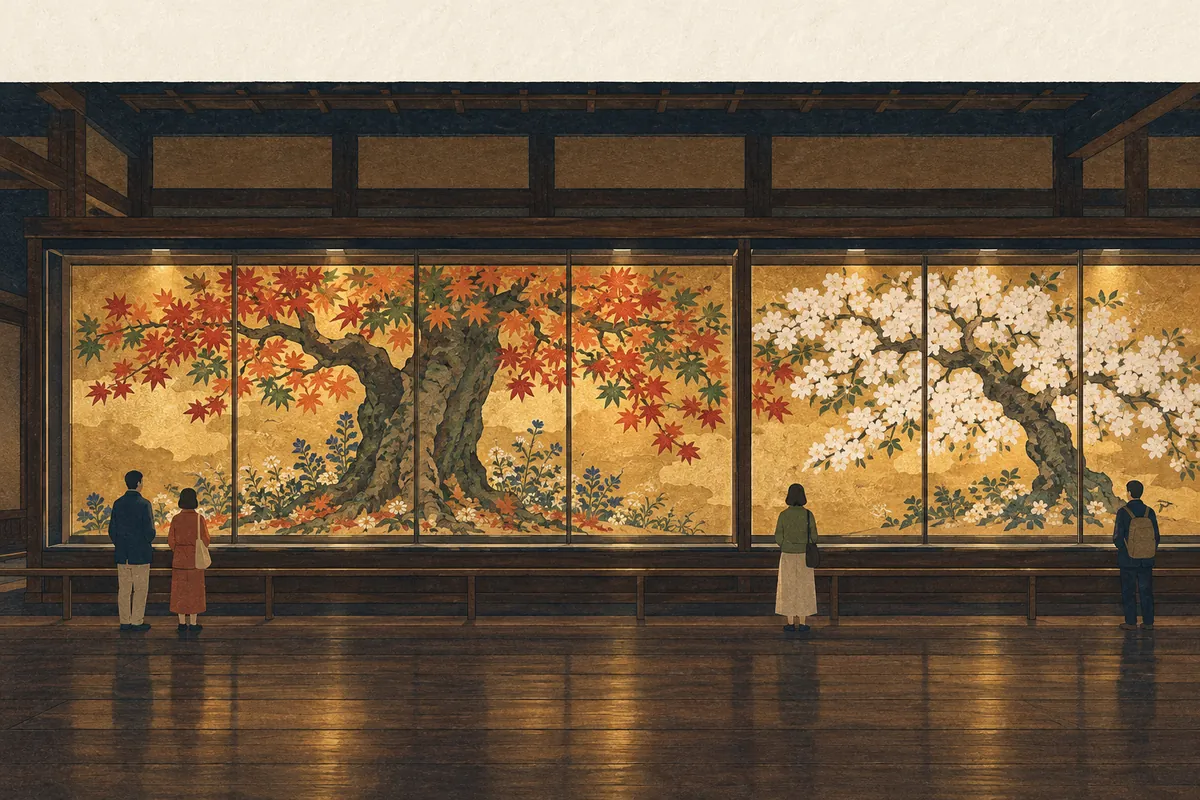
The wall paintings in the Treasure Hall were made at the end of the 16th century by Hasegawa Tōhaku (1539–1610), his son Kyūzō (久蔵), and their school. Painted with pigments such as azurite blue and malachite green on a ground of gold leaf, they are praised as the finest examples of kinpeki (金碧) wall painting. In the national designation, four sets of paintings on walls and sliding doors in color on gold paper, "Cherry Blossoms and Maple," "Pine and Plum," "Pine, Hollyhock (Tororo-aoi), and Chrysanthemums" (松に黄蜀葵及菊図, Matsu ni Tororoaoi oyobi Kiku-zu), and "Pine and Flowering Plants," are together one National Treasure, and a pair of two-panel folding screens of Pine and Flowering Plants is a separate National Treasure; some explanations count them as 5 works in all.
The best known are Maple Tree and Cherry Blossoms, which are part of "Cherry Blossoms and Maple." Cherry Blossoms is said to have been painted by Kyūzō at the age of 25, and the petals of the white double cherry blossoms use a technique of building up gofun (胡粉, shell white) in relief. Kyūzō died the year after it was finished, at 26. Maple Tree is said to have been painted by Tōhaku at 55, while he was grieving. The highlight is the pairing of the sturdy maple trunk standing in the middle with the delicate branches and leaves that reach out from it to either side. Around the reddened leaves, autumn grasses in a range of colors are painted in as well.
The wall paintings were once displayed without cases, but viewing was stopped from November 17, 2022, to April 3, 2023, and a plan was carried out to protect them in dedicated glass cases in a new storehouse that keep the temperature, humidity, and light level stable.
Where can you see Chishaku-in's National Treasures and Important Cultural Properties?
The nationally designated fine arts and crafts are 3 National Treasures (the wall paintings, the folding screens, and the Diamond Sutra written by Zhang Jizhi, 張即之, Chō Sokushi) and 5 Important Cultural Properties, and the garden is a Place of Scenic Beauty (as of October 2026). Only the wall paintings are always on view in the Treasure Hall; for the screens, Buddhist paintings, and sutras, you need to ask the temple whether they can be seen.
National Treasures, Important Cultural Properties, and the Place of Scenic Beauty at Chishaku-in (as of October 2026)
| Name | Type | Period | Where to see it |
|---|---|---|---|
| Cherry Blossoms and Maple, Pine and Plum, Pine, Hollyhock, and Chrysanthemums, and Pine and Flowering Plants, in color on gold paper (wall paintings) | National Treasure, painting (1 item) | Momoyama | On display in the Treasure Hall (storehouse) |
| Pine and Flowering Plants, in color on gold paper (two-panel folding screens), one pair | National Treasure, painting | Momoyama | Check with the temple |
| Diamond Sutra (written by Zhang Jizhi), 1 album | National Treasure, calligraphy | Southern Song (1253) | Check with the temple |
| Pine and Plum, in color on gold ground (two-panel folding screen), one of a pair | Important Cultural Property, painting | Momoyama | Check with the temple |
| Peacock Wisdom King (Kujaku Myōō), in color on silk, 1 hanging scroll | Important Cultural Property, painting | Kamakura | Check with the temple |
| Mandala of the Sutra for Protecting Children (Dōjikyō Mandara), in color on silk, 1 hanging scroll | Important Cultural Property, painting | Kamakura | Check with the temple |
| Waterfall, ink on silk, 1 hanging scroll | Important Cultural Property, painting | Southern Song | Check with the temple |
| Ekottara Āgama (Zōichi Agongyō), scroll 29, 1 scroll | Important Cultural Property, book | Nara (759) | Check with the temple |
| Chishaku-in Garden | Place of Scenic Beauty (designated February 22, 1945) | Early Edo | Garden viewing (charged) |
The garden, a Place of Scenic Beauty: a stroll garden with a pond modeled on Mount Lu
The garden just behind the Kōdō (lecture hall) is an early Edo-period stroll garden with a pond (chisen kaiyū-shiki) said to be modeled on Mount Lu (廬山, Rozan) in China, and it is the national Place of Scenic Beauty "Chishaku-in Garden." Seen from the north end of the long, narrow pond, the pond, the waterfall, and the artificial hill come together and give a strong sense of depth. From May to June, azaleas and satsuki azaleas bloom all at once. You can look at the garden from the veranda, and there is a story that Sen no Rikyū was fond of this garden.
Where can you see it now? / Getting there
The address is 964 Higashigawara-chō, Higashiōji Shichijō-sagaru, Higashiyama Ward. It is a 10-minute walk east of Keihan Shichijō Station, or from Kyoto Station take city bus route 206 or 208 to "Higashiyama Shichijō" and walk 3 minutes. Walking west along Shichijō-dōri also takes you to the Kyoto National Museum and Sanjūsangen-dō.
- Viewing hours: 9:00–16:30 (reception until 16:00). Closed December 29–31
- Treasure Hall: 500 yen for adults, 300 yen for junior high and high school students, 200 yen for elementary school students. Closed for display changes on April 30, July 31, October 31, and January 31; in 2026, October 31 falls on a Saturday
- Garden (Place of Scenic Beauty): a separate fee from the Treasure Hall, 500 yen for adults, 300 yen for junior high and high school students, 200 yen for elementary school students (fees as of October 2026)
- Free to attend: the morning service every day (from 6:00 from March to November and from 6:30 from December to February, in the Kondō and Myōō-den). It may be canceled or changed because of events
Mini quiz for this entry
After the fall of Osaka Castle, Tokugawa Ieyasu donated to Chishaku-in the temple lands of a temple Toyotomi Hideyoshi had built to pray for his beloved young son Tsurumatsu. What was that temple?
Sources and verification
Content checked: October 28, 2026
Updated: October 28, 2026
References are in Japanese.
- 京都市観光協会「智積院」(京都観光Navi)
- 総本山智積院(トップページ・アクセス)
- 観光庁「地域観光資源の多言語解説文データベース 智積院 概要」
- 観光庁「地域観光資源の多言語解説文データベース 智積院 金堂」
- 観光庁「地域観光資源の多言語解説文データベース 智積院 名勝庭園」
- 観光庁「地域観光資源の多言語解説文データベース 智積院 収蔵庫 国宝障壁画 桜図」
- 観光庁「地域観光資源の多言語解説文データベース 智積院 収蔵庫 国宝障壁画 楓図」
- 内閣府大臣官房政府広報室「Highlighting Japan 智積院の金碧障壁画の傑作」(2022年10月)
- 文化庁「国指定文化財等データベース 紙本金地著色桜楓図」
- 文化庁「国指定文化財等データベース 紙本金地著色松に草花図(床貼付・壁貼付)」
- 文化庁「国指定文化財等データベース 紙本金地著色松に梅図」
- 文化庁「国指定文化財等データベース 紙本金地著色松に黄蜀葵及菊図」
- 文化庁「国指定文化財等データベース 紙本金地著色松に草花図(二曲屏風)」
- 文化庁「国指定文化財等データベース 金剛経〈張即之筆〉」
- 文化庁「国指定文化財等データベース 金地著色松ニ梅図(二曲屏風)」
- 文化庁「国指定文化財等データベース 絹本著色孔雀明王像(智積院)」
- 文化庁「国指定文化財等データベース 絹本著色童子経曼荼羅図」
- 文化庁「国指定文化財等データベース 絹本墨画滝図」
- 文化庁「国指定文化財等データベース 增一阿含経〈巻第廿九〉」
- 文化庁「国指定文化財等データベース 智積院庭園」