
National Treasure Paintings in Kyoto City
Key points
The works range from the Nara to the Edo period, with the Kamakura period most represented at 15
Many originals are deposited with museums, and the Kyoto National Museum also lends them to exhibitions elsewhere
Half of the 8 paintings made in Song China have come down through Zen temples such as Daitoku-ji
Counts by owner
Kyoto City has 24 owners of National Treasure paintings, holding 42 items in all. Some items group several scrolls together: Jingo-ji's portraits said to be Minamoto no Yoritomo, Taira no Shigemori, and Fujiwara no Mitsuyoshi are 3 scrolls as 1 item, and Chion-in's Illustrated Biography of Hōnen Shōnin is 48 scrolls as 1 item.
Tōfuku-ji's Five Hundred Arhats (by Myōchō; of the 47 scrolls, 2 are replacements painted by Kanō Takanobu) was recommended for designation as a National Treasure on March 26, 2026, but it remains an Important Cultural Property until the designation is announced in the Official Gazette.
Number of National Treasure Paintings in Kyoto City (by Owner, as of October 2026)
- Daigo-ji
- Tō-ji (Kyōōgokoku-ji)
- Jingo-ji
- Kōzan-ji
- Daitoku-ji
- Chion-in
- Chishaku-in
- Konchi-in
List (1): 18 items at Tō-ji, Daigo-ji, Jingo-ji, and Kōzan-ji
The murals on the first story of Daigo-ji's five-story pagoda (18 panels) were completed in the 10th month of 951 (Tenryaku 5); they are Heian-period murals depicting the deities of the Mandalas of the Two Worlds and the Eight Shingon Patriarchs on the pillars and boards inside the pagoda. Of Tō-ji's Portraits of the Seven Shingon Patriarchs (7 scrolls), 5 were painted by Li Zhen and other Tang court painters and were given to Kūkai by his teacher Huiguo (Keika).
National Treasure paintings at Tō-ji, Daigo-ji, Jingo-ji, and Kōzan-ji
| Owner (ward) | Official designation name (number of pieces) | Period | Viewing |
|---|---|---|---|
| Tō-ji (Kyōōgokoku-ji), Minami Ward | Mandalas of the Two Worlds, color on silk (the so-called Shingon-in Mandalas), 2 scrolls | Heian | Display dates not yet set |
| Tō-ji | Portraits of the Seven Shingon Patriarchs, color on silk, 7 scrolls | Tang and Heian | Display dates not yet set |
| Tō-ji | Five Great Wisdom Kings (Godaison), color on silk, 5 scrolls | Heian | Display dates not yet set |
| Tō-ji | Twelve Devas (Jūniten), color on silk (attributed to Takuma Shōga; six-panel screens), 1 pair | Kamakura (1191) | Display dates not yet set |
| Daigo-ji, Fushimi Ward | Murals on the first story of the five-story pagoda (color on wooden panels), 18 panels | Heian (951) | Inside the first story of the pagoda |
| Daigo-ji | Five Great Wisdom Kings (Godaison), color on silk, 5 scrolls | Kamakura | Check with the temple |
| Daigo-ji | Enmaten, color on silk, 1 scroll | Kamakura | Check with the temple |
| Daigo-ji (formerly owned by Sanbō-in) | Kariteimo (Hārītī), color on silk, 1 scroll | Kamakura | Check with the temple |
| Daigo-ji (formerly owned by Hōon-in) | Monju Crossing the Sea, color on silk, 1 hanging | Kamakura | Check with the temple |
| Daigo-ji (formerly owned by Hōon-in) | Illustrated Sutra of Cause and Effect (E-Ingakyō), color on paper, 1 scroll | Nara | Check with the temple |
| Jingo-ji, Ukyō Ward | Portraits said to be Minamoto no Yoritomo, Taira no Shigemori, and Fujiwara no Mitsuyoshi, color on silk, 3 scrolls | Kamakura | The portraits said to be Yoritomo and Shigemori are specially shown May 1–5 |
| Jingo-ji | Mandalas of the Two Worlds in gold and silver on purple twill (Takao Mandala), 2 scrolls | Heian | Check with the temple |
| Jingo-ji | Shaka Nyorai, color on silk, 1 scroll | Heian | Check with the temple |
| Jingo-ji | Landscape screen, color on silk (six-panel screen), 1 single screen | Kamakura | Check with the temple |
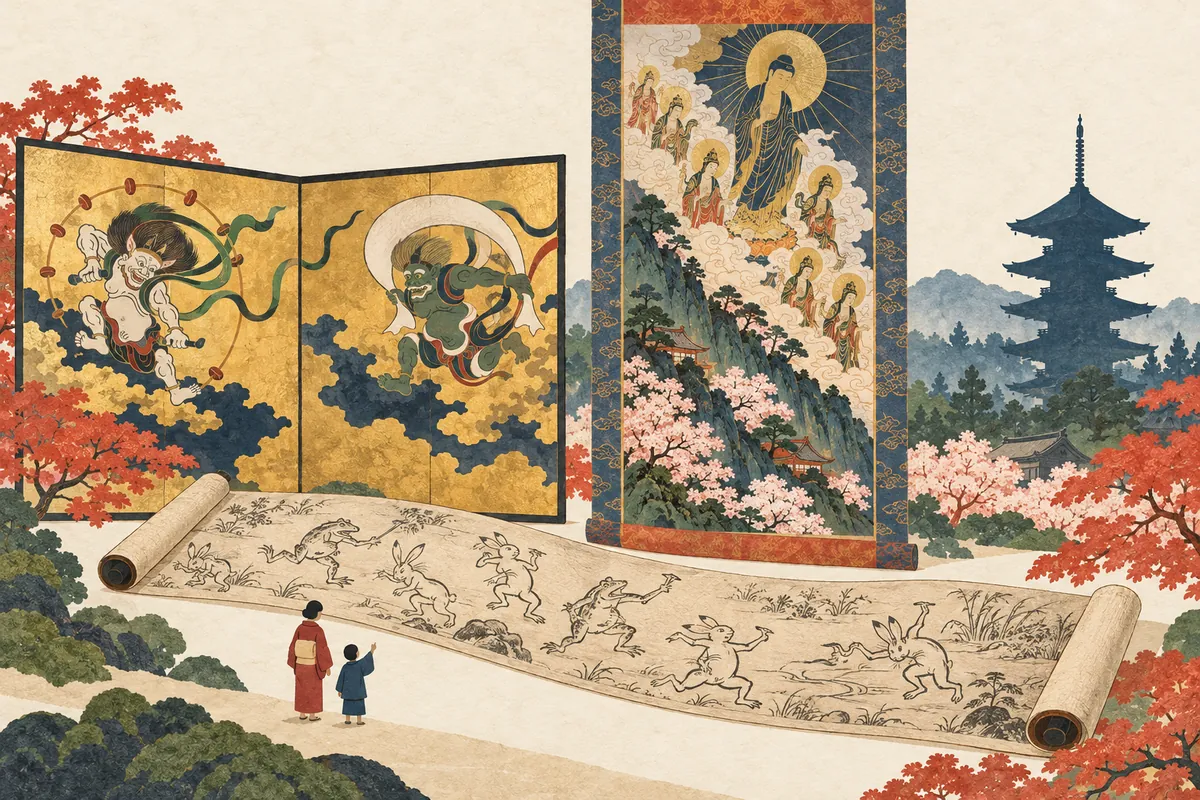
| Kōzan-ji, Ukyō Ward | Chōjū-jinbutsu-giga (Scrolls of Frolicking Animals and Humans), ink on paper, 4 scrolls | Heian and Kamakura | Reproductions on display at the Sekisuiin. The originals are sometimes shown at museum exhibitions |
| Kōzan-ji | Illustrated Biographies of the Patriarchs of the Kegon School (Kegon Engi), color on paper, 7 scrolls | Kamakura | Check with the temple |
| Kōzan-ji | Portrait of Myōe Shōnin, color on paper, 1 scroll | Kamakura | Check with the temple |
| Kōzan-ji | Butsugen Butsumo (Buddha-Eye Buddha-Mother), color on silk, 1 scroll | Kamakura | Check with the temple |
List (2): 15 items in Kita, Kamigyō, Shimogyō, and Higashiyama wards
Daitoku-ji and its subtemples (tatchū) Jukō-in and Kōtō-in hold paintings from Southern Song China, portraits of Zen monks, and Muromachi-period wall and sliding-door paintings from a hōjō. The wall and sliding-door paintings of Chishaku-in are Momoyama-period works painted in rich colors on gold grounds by Hasegawa Tōhaku and his school. Chion-in's Descent of Amida with Twenty-Five Bodhisattvas is called "Hayaraigō" (Swift Descent) because Amida and the bodhisattvas are shown hurrying to welcome the dying.
National Treasure paintings in Kita, Kamigyō, Shimogyō, and Higashiyama wards
| Owner (ward) | Official designation name (number of pieces) | Period | Viewing |
|---|---|---|---|
| Daitoku-ji, Kita Ward | Kannon, Monkeys, and Cranes, ink and light color on silk (by Muqi), 3 scrolls | Southern Song | Shown in the first half (until November 8) of a special exhibition at the Tokyo National Museum |
| Daitoku-ji | Portrait of Daitō Kokushi, color on silk, 1 scroll | Nanboku-chō (1334) | Shown in the first half of the same special exhibition (titled "Portrait of Shūhō Myōchō") |
| Jukō-in, Kita Ward | Hōjō wall and sliding-door paintings, 38 panels | Muromachi | 8 panels in the same special exhibition (4 each in the first and second halves) |
| Kōtō-in, Kita Ward | Landscapes, ink on silk, 2 scrolls | Southern Song | Shown in the second half (from November 10) of the same special exhibition |
| Jōbon Rendai-ji, Kita Ward | Illustrated Sutra of Cause and Effect (E-Ingakyō), color on paper, 1 scroll | Nara | Check with the temple |
| Kitano Tenmangū, Kamigyō Ward | Kitano Tenjin Engi (Illustrated Legends of Kitano Tenjin), color on paper, 8 scrolls | Kamakura (1219) | In the collection of the Treasure Hall. Check with the shrine about display |
| Shōjōke-in, Kamigyō Ward | Amida Triad, color on silk (by Pu Yue / Fuetsu), 3 scrolls | Southern Song | Normally on deposit at a national museum. Cannot be viewed at the temple |
| Hongan-ji (Nishi Hongan-ji), Shimogyō Ward | Portrait of Shinran Shōnin, ink on paper (Kagami no Goei, "Mirror Portrait"), 1 scroll | Kamakura | Check with the temple |
| Chion-in, Higashiyama Ward | Descent of Amida with Twenty-Five Bodhisattvas, color on silk (Hayaraigō, "Swift Descent"), 1 scroll | Kamakura | Normally not on public view |
| Chion-in | Illustrated Biography of Hōnen Shōnin, color on paper, 48 scrolls | Kamakura | Normally not on public view |
| Shōren-in, Higashiyama Ward | Fudō Myōō with Two Attendants, color on silk (Ao Fudō, "Blue Fudō"), 1 scroll | Heian | Enshrined in the inner hall of Shōgunzuka Seiryūden, with a reproduction in front |
| Kennin-ji, Higashiyama Ward | Wind God and Thunder God, color on gold-leafed paper (by Tawaraya Sōtatsu; two-panel screens), 1 pair | Edo | On deposit at the Kyoto National Museum. The temple displays a high-resolution reproduction |
| Tōfuku-ji, Higashiyama Ward | Portrait of Wuzhun Shifan (Bushun Shiban), color on silk, 1 scroll | Southern Song (1238) | Check with the temple |
| Chishaku-in, Higashiyama Ward | Wall and sliding-door paintings (Cherry and Maple; Plum and Pine; Pine with Hollyhock and Chrysanthemums; Pine and Flowering Plants) | Momoyama | On display in the Treasure Hall (fee) |
| Chishaku-in | Pine and Flowering Plants, color on gold-leafed paper (two-panel screens), 1 pair | Momoyama | Check with the temple |
List (3): 9 items in Sakyō and Ukyō wards
Taizō-in's Hyōnen-zu (Catching a Catfish with a Gourd) is by Josetsu, and Seiryō-ji's Sixteen Arhats (16 scrolls) are Northern Song works.
National Treasure paintings in Sakyō and Ukyō wards
| Owner (ward) | Official designation name (number of pieces) | Period | Viewing |
|---|---|---|---|
| Manshu-in, Sakyō Ward | Fudō Myōō, color on silk, 1 scroll | Heian | Check with the temple |
| Konchi-in, Sakyō Ward | Autumn and Winter Landscapes, color on silk, 2 scrolls | Southern Song | Shown at a special exhibition at Sen-oku Hakuko Kan Tokyo, November 3 to December 13, 2026 |
| Konchi-in | Small Retreat in the Shade by a Mountain Stream (Keiin Shōchiku-zu), ink on paper, 1 scroll | Muromachi (1413) | Check with the temple |
| Zenrin-ji (Eikandō), Sakyō Ward | Amida Coming over the Mountain (Yamagoshi Amida-zu), color on silk, 1 scroll | Kamakura | Check with the temple |
| Sen-oku Hakuko Kan, Sakyō Ward | Herding Cattle in an Autumn Field, color on silk, 1 scroll | Southern Song | In the museum's collection. Check with the museum about display |
| Ninna-ji, Ukyō Ward | Peacock Wisdom King (Kujaku Myōō), color on silk, 1 scroll | Southern Song | Check with the temple |
| Seiryō-ji, Ukyō Ward | Sixteen Arhats, color on silk, 16 scrolls | Northern Song | Check with the temple |
| Taizō-in, Ukyō Ward | Catching a Catfish with a Gourd (Hyōnen-zu), ink and light color on paper (by Josetsu), 1 scroll | Muromachi | Check with the temple |
| Chōfuku-ji, Ukyō Ward | Portrait of Emperor Hanazono, color on paper (by Gōshin), 1 scroll | Nanboku-chō (1338) | Check with the temple |
Counts by period
By period, the Kamakura period has the most with 15, followed by the Heian period with 7, the Muromachi period with 3, the Nara, Nanboku-chō, and Momoyama periods with 2 each, and the Edo period with 1. The oldest are the 2 Nara-period copies of the Illustrated Sutra of Cause and Effect (E-Ingakyō) (at Jōbon Rendai-ji and Daigo-ji), and the newest is the Edo-period Wind God and Thunder God screens.
Paintings made in China number 8: 7 from the Southern Song and 1 from the Northern Song, and 4 of them are handed down at Zen temples: Daitoku-ji, Kōtō-in, Konchi-in, and Tōfuku-ji. In addition, there is 1 item each spanning two periods: Tō-ji's Portraits of the Seven Shingon Patriarchs (Tang and Heian) and the Chōjū-jinbutsu-giga (Heian and Kamakura). By year of designation as a National Treasure, 39 were designated in 1951–57; since then there have been only Jingo-ji's landscape screen in 1967, Daigo-ji's murals in 1976, and Shōjōke-in's Amida Triad in 2012.
National Treasures on deposit at museums
The Kyoto National Museum holds more than 6,500 items on deposit from temples, shrines, and individuals, as well as 9 National Treasure paintings owned by the National Institutes for Cultural Heritage, such as Sesshū's View of Ama-no-Hashidate.
Chion-in's 2 items, Jingo-ji's three portraits, Jōbon Rendai-ji's Illustrated Sutra of Cause and Effect, Konchi-in's Autumn and Winter Landscapes, and others are lent by the Kyoto National Museum to exhibitions outside the museum.
Originals at temples, reproductions, and special exhibitions
About the only originals you can see at a temple at any time are the wall and sliding-door paintings in Chishaku-in's Treasure Hall. The others are shown for limited periods, displayed as reproductions, or shown at museum exhibitions.
- Chishaku-in (Higashiōji Shichijō-sagaru, Higashiyama Ward; a 10-minute walk east of Keihan Shichijō Station): Treasure Hall admission is 500 yen for adults, 300 yen for junior high and high school students, 200 yen for elementary school students. Closed for display changes on April 30, July 31, October 31, and January 31.
- Shōgunzuka Seiryūden (at the top of the Higashiyama Driveway): Admission to see the Blue Fudō is 600 yen for adults, 400 yen for junior high and high school students, 200 yen for elementary school students (free for elementary school students accompanied by a parent or guardian).
- Daigo-ji Reihōkan (Daigo Higashiōji-chō, Fushimi Ward): The former four central pillars of the five-story pagoda, an attachment (tsuketari) to the National Treasure, are shown in the autumn special exhibition (October 17 to December 6, 2026). A ticket for 1 area costs 600 yen for adults and 400 yen for junior high and high school students; free for elementary school students and younger.
- Kyoto National Museum (Chaya-machi, Higashiyama Ward): The Meihin Gallery costs 700 yen for adults; free for high school students and younger and anyone under 18. It is closed during the special exhibition "The Tale of Genji: The Splendor of the Court" (October 6 to November 29, 2026).
Mini quiz for this entry
Daigo-ji has National Treasure murals (18 panels) completed in 951 (Tenryaku 5). Inside which building are these murals painted?
Shōjōke-in in Kamigyō Ward owns the National Treasure "Amida Triad" (3 scrolls) by Pu Yue (Fuetsu). Where was it painted?
Sources and verification
Content checked: October 22, 2026
Updated: October 22, 2026
References are in Japanese.
- 京都市文化財保護課「京都市内文化財件数」(令和8年4月1日現在)
- 文化庁「国指定文化財等データベース」(国宝・重要文化財(美術工芸品)、絵画、国宝、所有者住所 京都府で検索)
- 文化庁 国指定文化財等データベース「五重塔初重壁画(板絵著色)」(醍醐寺)
- 文化庁 国指定文化財等データベース「絹本著色阿弥陀二十五菩薩来迎図(早来迎)」(知恩院)
- 文化庁 国指定文化財等データベース「絹本著色阿弥陀三尊像〈普悦筆〉」(清浄華院)
- 文化庁 国指定文化財等データベース「絹本著色伝源頼朝像」(神護寺)
- 文化庁 国指定文化財等データベース「絹本著色眞言七祖像」(教王護国寺)
- 文化庁 国指定文化財等データベース「紙本金地著色松に草花図〈床貼付四/壁貼付二〉」(智積院)
- 文化庁 国指定文化財等データベース「絹本墨画淡彩猿鶴図〈牧谿筆〉」(大徳寺)
- 文化庁 国指定文化財等データベース「紙本墨画淡彩天橋立図〈雪舟筆〉」(国立文化財機構)
- 文化庁「文化審議会の答申 I.答申内容」(令和8年3月26日)
- 文化庁「文化審議会の答申 II.解説」(令和8年3月26日)
- 東寺「寺宝」
- 知恩院「知恩院の宝物」
- 建仁寺「建仁寺の文化財」
- 清浄華院「清浄華院の文化財」
- 清浄華院「アクセス」
- 青蓮院門跡 将軍塚青龍殿「青不動」
- 青蓮院門跡 将軍塚青龍殿「拝観アクセス」
- 北野天満宮「宝物殿」
- 醍醐寺「拝観時間 / 料金」
- 醍醐寺「霊宝館秋期特別展 展示目録」(2026年)
- 京都国立博物館「京博の研究・収蔵品」
- 京都国立博物館「館外での作品公開」
- 京都国立博物館「休館日・開館時間・観覧料」
- 東京国立博物館「開創700年記念 特別展『大徳寺 本朝無双之禅苑』出品目録」
- 京都市観光協会 京都観光Navi「智積院」
- 京都市観光協会 京都観光Navi「神護寺」