
Jingo-ji and the "Portrait Said to Be Minamoto no Yoritomo"
Key points
The scrolls are traditionally attributed to Fujiwara no Takanobu, but some see them as 13th-century works made after his death
In 1995 a theory was published that the sitter is Ashikaga Tadayoshi, and Jingo-ji has responded that Yoritomo is the more likely sitter
Besides the three portraits, the principal Yakushi statue and the Takao Mandala, the oldest surviving Two Realms mandala, are National Treasures
Each treasure has its own viewing period: the Yoritomo and Shigemori portraits in early May, while the National Treasure bell is never shown
Beginning as Wake no Kiyomaro's Takaosan-ji
Jingo-ji is a Shingon temple in Takao, in the northern outskirts of Kyoto, known as a famous spot for autumn leaves. It began as Takaosan-ji, built by Wake no Kiyomaro; the temple was founded in 781 (Ten'ō 1), and it was originally the clan temple of the Wake family.
Kūkai (Kōbō Daishi), after returning from Tang China, made this temple the base of his activities and served as its head priest for 14 years from 809 (Daidō 4). For this reason Jingo-ji is regarded as the starting point of Shingon Esoteric Buddhism, and in 824 (Tenchō 1) it officially became an Esoteric temple. The "Kanjō Rekimyō" (Register of Consecration Recipients) of 812 (Kōnin 3), in Kūkai's own hand, is also handed down as a National Treasure.
The temple later fell into ruin, but at the end of the Heian period it was revived by the priest Mongaku. The Kamakura-period "Mongaku Shijūgo-kajō Kishōmon" (Mongaku's Forty-Five-Article Pledge) is also a National Treasure.
The three scrolls of the "Jingo-ji Three Portraits"
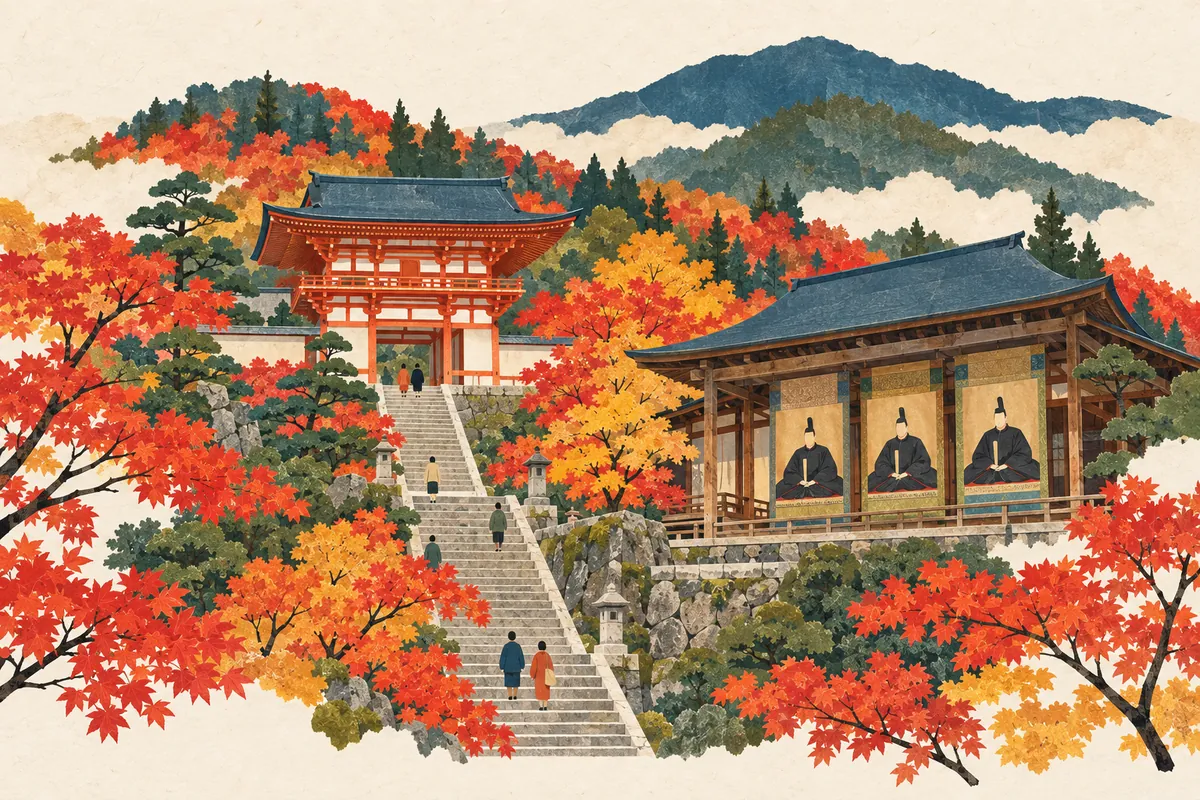
Jingo-ji has handed down portraits of three nobles. Their National Treasure names are "Portrait said to be Minamoto no Yoritomo, color on silk," "Portrait said to be Taira no Shigemori, color on silk," and "Portrait said to be Fujiwara no Mitsuyoshi, color on silk"; all are Kamakura-period works painted in color on silk. Together the three scrolls are called the "Jingo-ji Three Portraits" (Jingoji Sanzō).
The portraits said to be Yoritomo and Shigemori both show a seated figure in sokutai (formal court dress), holding a shaku (ceremonial baton) and wearing a sword. The portrait said to be Yoritomo has long been widely known as the portrait of Minamoto no Yoritomo, the first shogun of the Kamakura shogunate. Taira no Shigemori was the eldest son of Taira no Kiyomori and played an active part in the Hōgen and Heiji Disturbances.
The Tadayoshi and Yoritomo theories on the sitter
The three scrolls had been handed down as paintings made by the end of the 12th century by Fujiwara no Takanobu, who was both a poet and a painter. From the late 1980s, however, doubts were raised, mainly from the standpoint of art history, that they might be 13th-century works made after Takanobu's death in 1205 (Genkyū 2).
In 1995, the art historian Yonekura Michio published a theory that the person depicted in the portrait said to be Yoritomo is Ashikaga Tadayoshi, the younger brother of Ashikaga Takauji, who founded the Muromachi shogunate. After examining the painting style, subject matter, and coloring techniques and concluding that the cap (kanmuri) dates from the late Kamakura period or later, he focused on a document by Tadayoshi dated the 4th month of Kōei 4 (1345) stating that he had dedicated two portraits to Jingo-ji. In this theory, the portrait said to be Yoritomo is likely to be Tadayoshi, and the portrait said to be Shigemori his elder brother Takauji.
In response, Jingo-ji has cited the views of other art historians and others and argued that the sitter is most likely Yoritomo. The national designation name is still "Portrait said to be Minamoto no Yoritomo." At the special exhibition at the Tokyo National Museum in 2024, too, it was displayed under the name "Portrait said to be Minamoto no Yoritomo" as a Kamakura-period, 13th-century work.
Jingo-ji's other National Treasures
The principal image, a wooden standing Yakushi Nyorai (Heian period, 8th–9th century), was enshrined at a predecessor temple of Jingo-ji and is also said to be the finest masterpiece of sculpture from the early Heian period. The wooden seated statues of the Five Great Kokūzō Bosatsu in the Tahōtō pagoda are five statues enshrined in the time of Shinzei, Kūkai's successor; they are said to have been commissioned in a prayer by Emperor Ninmyō and are the oldest surviving complete set of five made in Japan.
The "Ryōkai Mandara-zu in gold and silver paint on purple twill" (Takao Mandala) is a mandala of the Two Realms about 4 meters square. It is the oldest surviving Two Realms mandala, made during Kūkai's lifetime, and it has completed its first repair in about 230 years, since the Edo period. The temple bell is the "Sanzetsu no Kane" (Bell of the Three Excellences), inscribed with the date 875 (Jōgan 17). Other National Treasures include a landscape screen in color on silk (early Kamakura period), used as a furnishing in the kanjō (consecration) rite of the Shingon school, and a Heian-period painting of Shaka Nyorai in color on silk.
National Treasures of Jingo-ji (fine arts and crafts)
| Name (designated name) | Type | Period | Date designated a National Treasure |
|---|---|---|---|
| Wooden standing statue of Yakushi Nyorai (enshrined in the Hondō) | Sculpture | Heian | June 9, 1951 |
| Portraits said to be Minamoto no Yoritomo, Taira no Shigemori, and Fujiwara no Mitsuyoshi, color on silk (1 scroll each) | Painting | Kamakura | June 9, 1951 |
| Kanjō Rekimyō (Register of Consecration Recipients), by Kōbō Daishi | Historical document | Heian | June 9, 1951 |
| Wooden seated statues of the Five Great Kokūzō Bosatsu (enshrined in the Tahōtō) | Sculpture | Heian | March 29, 1952 |
| Shaka Nyorai, color on silk | Painting | Heian | March 29, 1952 |
| Temple bell | Craft | Heian | March 29, 1952 |
| Ryōkai Mandara-zu in gold and silver paint on purple twill (Takao Mandala) | Painting | Heian | March 20, 1954 |
| Mongaku's Forty-Five-Article Pledge, by Fujiwara no Tadachika | Historical document | Kamakura | March 20, 1954 |
| Landscape screen, color on silk (six-panel screen) | Painting | Kamakura | June 15, 1967 |
Getting to Jingo-ji and the days its treasures are shown
Jingo-ji is at 5 Umegahata Takao-chō, Ukyō Ward, about a 20-minute walk from the "Takao" stop of JR buses or city buses. Viewing hours are 9:00–16:00, and admission is charged (as of October 2026).
Each of the temple's treasures is shown only during its own set period (gokaichō). Dates may change from year to year, so check with the temple before you go.
- Portraits said to be Yoritomo and Shigemori: specially shown May 1–5
- Seated Five Great Kokūzō Bosatsu (Tahōtō): shown May 13–15 in spring and on the three-day holiday weekend in October in autumn, 10:00–15:00
- Relief-carved statue of Kōbō Daishi (principal image of the Daishidō, Important Cultural Property): special display November 1–7
- National Treasure temple bell: not open to the public
Mini quiz for this entry
Jingo-ji's National Treasure portraits, the "Portrait said to be Minamoto no Yoritomo" and two more scrolls, are together called the "Jingo-ji Three Portraits." What are the other two scrolls?
In the 1995 theory that the sitter of the National Treasure "Portrait said to be Minamoto no Yoritomo" is Ashikaga Tadayoshi, one piece of evidence was a 1345 (Kōei 4) document by Tadayoshi. What did it record?
Which priest revived Jingo-ji, which had fallen into ruin, at the end of the Heian period?
Sources and verification
Content checked: October 22, 2026
Updated: October 22, 2026
References are in Japanese.
- 文化庁「国指定文化財等データベース 絹本著色伝源頼朝像」
- 文化庁「国指定文化財等データベース 木造薬師如来立像(本堂安置)」
- 文化庁「国指定文化財等データベース 木造五大虚空蔵菩薩坐像(多宝塔安置)」
- 文化庁「国指定文化財等データベース 紫綾金銀泥絵両界曼荼羅図(高雄曼荼羅)」
- 文化庁「国指定文化財等データベース 絹本著色釈迦如来像」
- 文化庁「国指定文化財等データベース 潅頂歴名〈弘法大師筆〉」
- 文化庁「国指定文化財等データベース 文覚四十五箇条起請文〈藤原忠親筆〉」
- 文化庁「国指定文化財等データベース 絹本著色山水屏風」
- 文化庁「国指定文化財等データベース 梵鐘(神護寺)」
- 文化庁「国指定文化財等データベース 神護寺大師堂」
- 東京国立博物館(創建1200年記念特別展「神護寺」)
- nippon.com「源頼朝の肖像画:『教科書で見た頼朝像は別人』説を追った」(2022年2月27日)
- 京都市観光協会 京都観光Navi「神護寺」