
Kyoto's Temple Bells and the New Year's Eve Bell
Other spellings and namestsurigane (hanging bell)
Key points
Of the two National Treasure bells, Myōshin-ji's is the oldest in Japan with a dated inscription, and Jingo-ji's is the "Bell of the Three Excellences," its inscription the work of three noted men
The bells of Myōshin-ji and of Kanzeon-ji in Dazaifu have bodies of almost the same dimensions and are sometimes called a pair
Chion-in's great bell weighs about 70 tonnes and is rung only at the Gyoki Daie in April and on New Year's Eve, when 17 people ring it
The "kokka ankō" and "kunshin hōraku" inscription on Hōkō-ji's bell led to the Siege of Osaka
The National Treasure bells of Myōshin-ji and Jingo-ji
Myōshin-ji and Jingo-ji are both in Ukyō Ward. Elsewhere in Kyoto Prefecture, the bell of Byōdō-in in Uji City is a National Treasure.
The bell of Myōshin-ji has an inscription on its inside that begins "the 13th day of the 4th month of the year tsuchinoe-inu (戊戌)," and that year is generally taken to be the 2nd year of Emperor Monmu (698). It is the oldest bell in Japan with a dated inscription (kinenmei), and the inscription also names a district (gun) in what is now Fukuoka Prefecture. It has a slender shape, 151.0 cm in total height and 86.0 cm in mouth diameter. The National Treasure bell of Kanzeon-ji in Dazaifu City, Fukuoka Prefecture, has a body of almost exactly the same dimensions apart from its decoration; the two are thought to have been made at the same foundry at around the same time, and they are sometimes called a pair of bells.
The bell of Jingo-ji is inscribed with the year 875 (Jōgan 17) and is 147.6 cm high, with a mouth diameter of 80.3 cm. It is called the "Sanzetsu no Kane" (Bell of the Three Excellences) because the preface to its inscription was composed by Tachibana no Hiromi, the inscription itself by Sugawara no Koreyoshi, and the calligraphy was by Fujiwara no Toshiyuki.
- Bells owned by temples in Kyoto City that are Important Cultural Properties number 9: Tōfuku-ji (Nara period), Hōon-ji and Shōrin-in (Heian period), Nishi Hongan-ji (1150), the iron bell of Kōryū-ji (1217), Kiyomizu-dera (1478), Shunkō-in (inscribed with the year 1577 of the "Yaso" [耶蘇, Jesus] era), Kōdai-ji (1606), and Hōkō-ji (1614)
The parts of a bell
The Names of the Parts of a Temple Bell
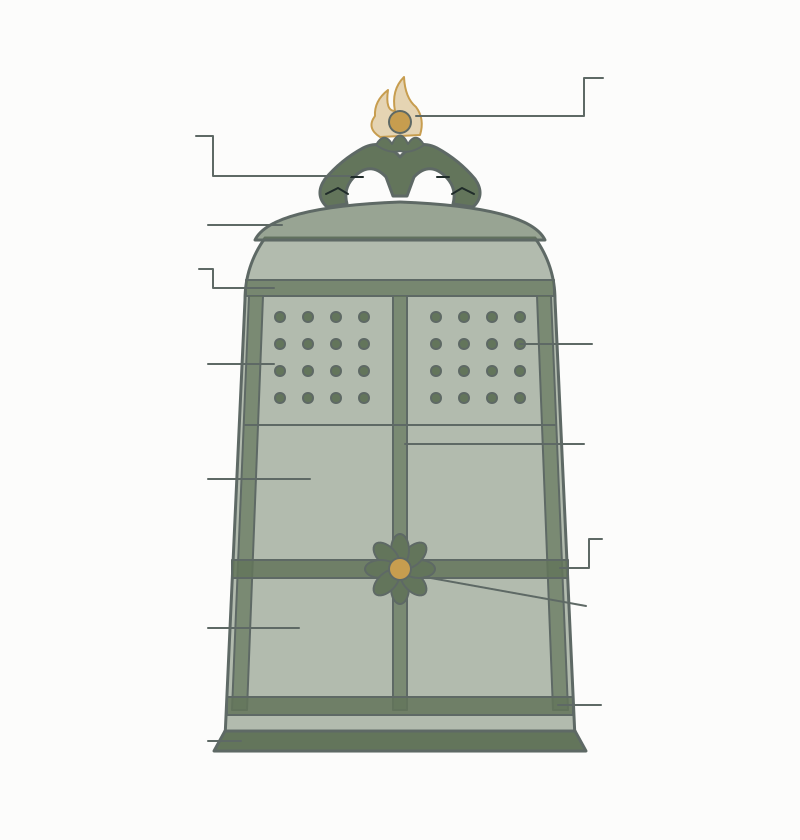
- Ryūzu (竜頭): the hanger at the very top. Two beast heads joined back to back form a loop, topped with a sacred jewel (hōju)
- Kasagata (笠形): the part below the ryūzu that forms the bell's top cover
- Jōtai, chūtai, and katai (上帯・中帯・下帯, upper, middle, and lower bands): bands that run horizontally around the bell. The bands that divide the area between the upper and lower bands vertically into four are the jūtai (縦帯, vertical bands)
- Chi-no-ma (乳の間): the rectangular panels (4 sections) just below the upper band, lined with knobs called chi (乳)
- Ike-no-ma (池の間): the nearly square panels (4 sections) below the chi-no-ma. Inscriptions are mainly placed here
- Tsukiza (撞座): the spot struck with the shumoku (撞木, wooden striking beam). It is placed where the middle band crosses a vertical band and is often shown as a lotus design
- Kusa-no-ma (草の間): the small panels below the middle band and above the lower band
- Koma-no-tsume (駒の爪): the projecting band around the bottom rim of the bell
Chion-in's great bell and the 108 strokes of the New Year's Eve bell
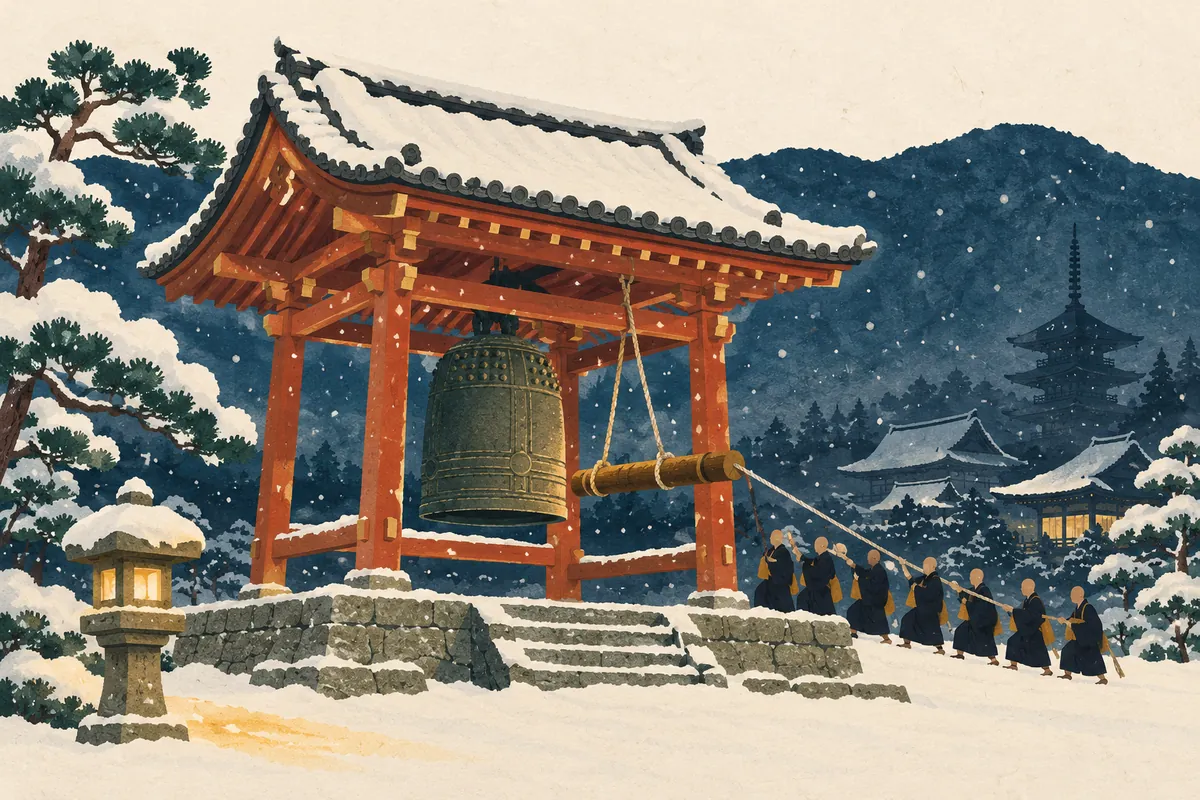
The hanging bell of Chion-in in Higashiyama Ward was cast in 1636 (Kan'ei 13) and is 3.3 m high, 2.8 m in diameter, and about 70 tonnes in weight; it is known as one of the great bells alongside those of Hōkō-ji and Tōdai-ji. What is designated an Important Cultural Property is the bell tower (the Daishōrō), built in 1678 (Enpō 6). The great bell is rung only at the Gyoki Daie in April and for the Joya no Kane (New Year's Eve bell), and on New Year's Eve 17 people ring it: one on the oyazuna (main rope) and 16 on the kozuna (sub-ropes).
The New Year's Eve bell is said to be rung to remove the 108 worldly desires (bonnō) so that people can greet a pure new year. There are various theories about how 108 is counted. One multiplies the six senses (eye, ear, nose, tongue, body, and mind) by pleasant, neutral, and unpleasant, by tainted and pure, and by past, present, and future: 6 × 3 × 2 × 3 = 108. Another adds the 12 months, the 24 solar terms (sekki), and the 72 micro-seasons (kō) to make 108.
Some temples let the public ring their bells on New Year's Eve, but whether you can ring the bell and whether numbered tickets or advance applications are needed vary by temple and by year, so check each temple's information.
The "kokka ankō" bell of Hōkō-ji
Hōkō-ji in Higashiyama Ward is the temple of the Great Buddha Hall built by Toyotomi Hideyoshi, and its present grounds have shrunk to the northwest corner of the former temple precincts. In 1614 (Keichō 19), a bonshō was completed along with Hideyori's rebuilding of the Great Buddha Hall, but the Tokugawa side objected that the phrases in its inscription, "kokka ankō" (国家安康, "may the nation be peaceful and secure") and "kunshin hōraku" (君臣豊楽, "may lord and subjects prosper"), split the name of Ieyasu (家康) and cursed him, and the eye-opening ceremony for the Great Buddha was postponed. This dispute led to the Winter and Summer Campaigns of the Siege of Osaka and the fall of the Toyotomi family.
The bell also bears the names of Toyotomi Hideyori as chief patron (daidanna) and of the casters, and it became an Important Cultural Property in 1968 (Shōwa 43). It still hangs in its bell tower, where it can be seen from outside, and the inscription is clearly visible. The name of the guild (za) of casters who cast temple bells and tea kettles survives in the street name Kamanza-dōri in Nakagyō Ward.
"The oldest bell" and "the three Famous Bells"
By dated inscription, the oldest is the bell of Myōshin-ji. The bell of Kanzeon-ji has no date in its inscription, but it is attributed to the late 7th century and is sometimes called the oldest surviving temple bell in Japan. From the end of the Asuka period through the Nara period, three bells bear inscriptions: the bell of Myōshin-ji, the bell of Tsurugi Shrine in Fukui Prefecture, and the bell of Kōfuku-ji in Nara, dated 727 (Jinki 4).
The "Three Famous Bells of Japan" are counted in several ways. One saying lines up the bell of Byōdō-in with those of Onjō-ji (Mii-dera) and Tōdai-ji: "Onjō-ji for its tone, Tōdai-ji for its resonance, Byōdō-in for its form." In some counts, the bell of Jingo-ji is also one of the three.
Viewing the bells at Myōshin-ji, Jingo-ji, Chion-in, and Hōkō-ji
- Myōshin-ji (Hanazono Myōshinji-chō, Ukyō Ward): the bell is inside the Hattō (Dharma Hall), which can be viewed 9:00–16:00, 500 yen for adults and 200 yen for elementary and junior high school students (as of October 2026). A 5-minute walk from Hanazono Station on the JR Sagano Line to the South Gate
- Jingo-ji (Umegahata Takao-chō, Ukyō Ward): the bell is never open to the public. Viewing hours are 9:00–16:00. About a 20-minute walk from the "Takao" stop of JR buses and city buses
- Chion-in (Rinka-chō, Higashiyama Ward): the Daishōrō stands in the grounds, which are free; only Yūzen-en and the Hōjō Garden charge a fee. An 8-minute walk from Higashiyama Station on the Tōzai Subway Line, or a 5-minute walk from the "Chion-in-mae" city bus stop
- Hōkō-ji (Chaya-machi, Higashiyama Ward): just north of Toyokuni Shrine, north of the Kyoto National Museum. Within walking distance of Shichijō Station on the Keihan Main Line
Mini quiz for this entry
Where can visitors now see Myōshin-ji's National Treasure bonshō, the oldest bell in Japan with a dated inscription?
Why is the National Treasure bonshō of Jingo-ji called the "Sanzetsu no Kane" (Bell of the Three Excellences)?
Sources and verification
Content checked: October 19, 2026
Updated: October 19, 2026
References are in Japanese.
- 文化庁「国指定文化財等データベース 梵鐘(妙心寺)」
- 文化庁「文化遺産オンライン 梵鐘(妙心寺)」
- 文化庁「国指定文化財等データベース 梵鐘(神護寺)」
- 文化庁「国指定文化財等データベース 梵鐘(平等院)」
- 文化庁「国指定文化財等データベース 梵鐘(観世音寺)」
- 文化庁「国指定文化財等データベース 梵鐘(興福寺)」
- 文化庁「国指定文化財等データベース 梵鐘(方広寺)」
- 文化庁「国指定文化財等データベース 知恩院大鐘楼」
- 文化庁「国指定文化財等データベース 梵鐘(東福寺)」
- 文化庁「国指定文化財等データベース 銅鐘(本願寺)」
- 文化庁「国指定文化財等データベース 鉄鐘(広隆寺)」
- 文化庁「国指定文化財等データベース 銅鐘〈耶蘇紀元一千五百七十七年ノ銘アリ〉(春光院)」
- 文化庁「国指定文化財等データベース 梵鐘(清水寺)」
- 文化庁「国指定文化財等データベース 梵鐘(高台寺)」
- 文化庁「国指定文化財等データベース 梵鐘(報恩寺)」
- 文化庁「国指定文化財等データベース 梵鐘(勝林院)」
- 文化庁「国指定文化財等データベース」(国宝・重要文化財(美術工芸品)、所有者住所 京都府、「鐘」で検索)
- 文化庁「文化遺産オンライン 方広寺大仏殿跡及び石塁・石塔」
- 観光庁「地域観光資源の多言語解説文データベース 観世音寺 梵鐘」
- 観光庁「地域観光資源の多言語解説文データベース 梵鐘(平等院)」
- 観光庁「地域観光資源の多言語解説文データベース 方広寺鐘楼」
- 京都市・京都市埋蔵文化財研究所「京都歴史散策マップ10 東山鴨東」
- 京都市埋蔵文化財研究所「第219回京都市考古資料館文化財講座 方広寺」(2010年7月24日)
- 知恩院「大鐘楼【建造物】」
- 知恩院「拝観情報」
- 知恩院「交通アクセス」
- 妙心寺「拝観について」
- 妙心寺「アクセス」
- 京都市観光協会 京都観光Navi「妙心寺」
- 京都市観光協会 京都観光Navi「神護寺」
- 京都市観光協会 京都観光Navi「浄土宗総本山知恩院」
- 国立国会図書館 レファレンス協同データベース「除夜の鐘で108回鐘を突くが、108の根拠が知りたい。」(相模原市立相模大野図書館)
- 国立国会図書館 レファレンス協同データベース「除夜の鐘の一〇八回とは何を指すのか知りたい。」(南アルプス市立図書館)