
The Sanmon of Tōfuku-ji and Chion-in
Key points
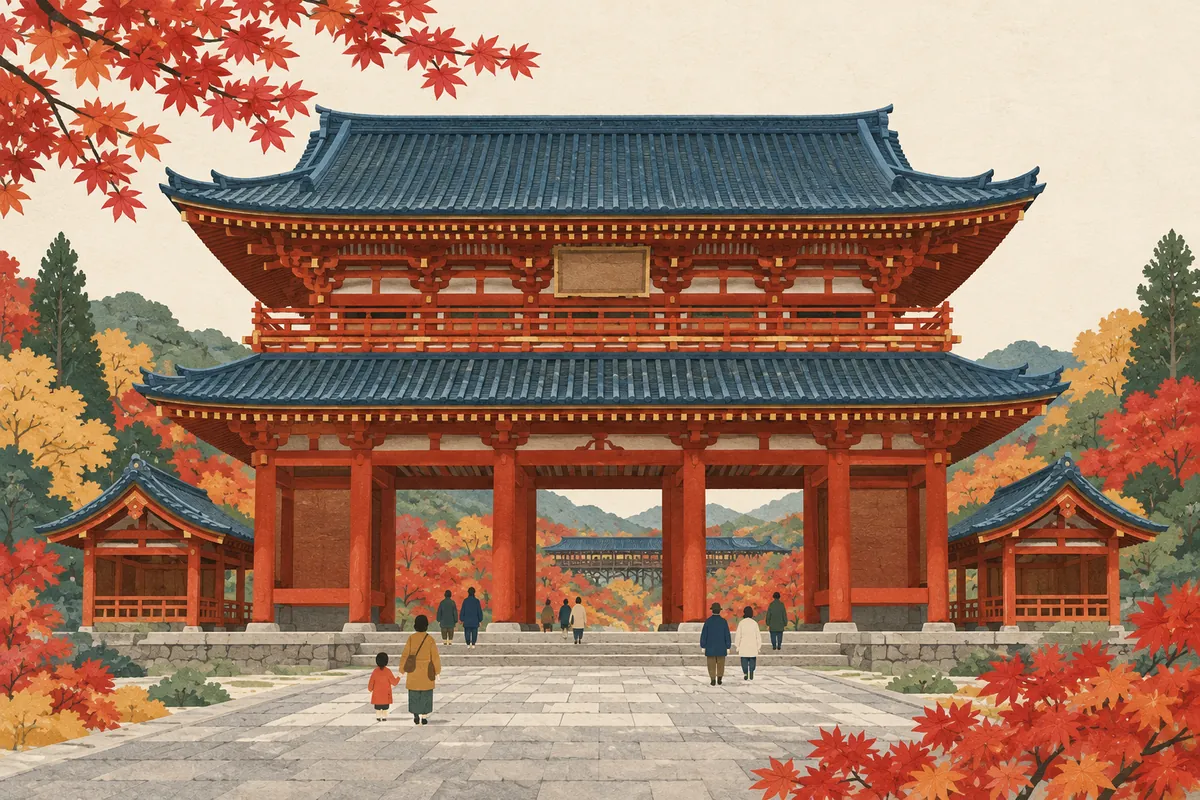
Both sanmon have the same five-bay, three-entrance, two-story double-gate form, reached by stairs inside the sanrō on each side
Tōfuku-ji's is a Zen temple gate built mostly in the Daibutsuyō style; Chion-in's belongs to a Pure Land temple yet follows the Zen style in its details
Chion-in's Sanmon, with the Sanmon of Nanzen-ji and the Niōmon of Ninna-ji, is called one of the "Three Great Gates of Kyoto"
The upper stories of both gates hold a crowned Shaka Nyorai and the Sixteen Arhats and are normally closed
The seven National Treasure gates and the double-gate form
Kyoto City's 44 National Treasure buildings include 7 gates: 4 are karamon (gates with cusped gables), 1 is the Rengemon of Tō-ji, and the 2 two-story sanmon are those of Tōfuku-ji and Chion-in.
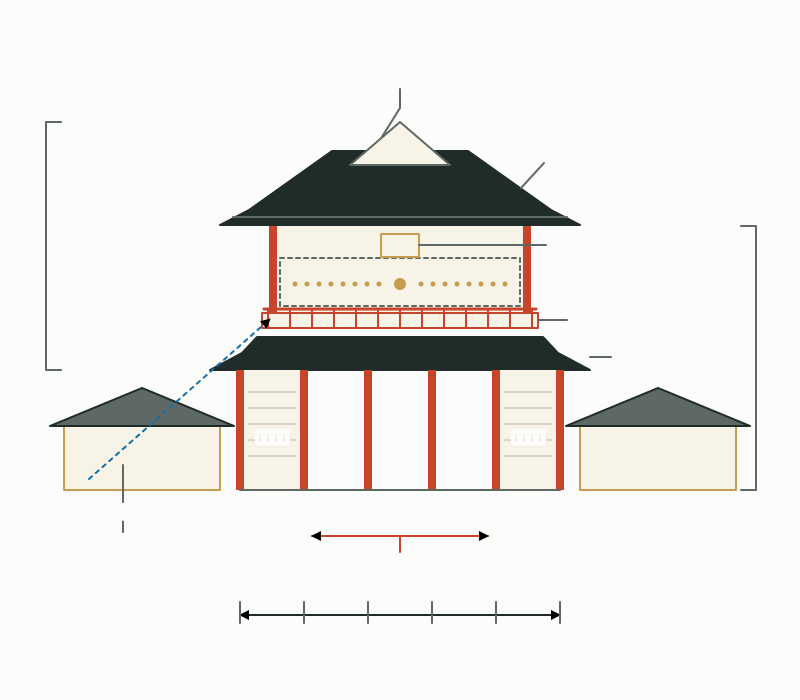
The two gates share the same form: both are five-bay, three-entrance, two-story double gates (gokan sanko nikai nijūmon) with hip-and-gable (irimoya) roofs of hon-kawara tiles, and a sanrō on each side. "Five-bay, three-entrance" means there are five bays between pillars across the front, with the central three usually serving as entrances; a "two-story double gate" has two stories, each with its own roof. The sanrō are single-story structures on the left and right of the gate that house the stairs up to the upper story.
How a Five-Bay, Three-Entrance, Two-Story Double Gate Works (Schematic Diagram)
Sanmon is short for sangedatsumon
三門 (sanmon) is short for 三解脱門 (sangedatsumon), representing the three states of liberation passed through on the way to enlightenment: kū (emptiness), musō (signlessness), and mugan (wishlessness). It is also written 山門 (also read sanmon, "mountain gate"), and while temple gates in general are most often written 山門, the gates of Chion-in and Tōfuku-ji are written 三門.
At Zen temples, the sanmon is the main gate, counted as one of the seven principal halls (shichidō garan) along with the Buddha hall, the Dharma hall, and others. The sanmon of Chion-in, a temple of the Jōdo-shū (Pure Land school), is also based on the Zen style in its details.
Tōfuku-ji's Sanmon
Tōfuku-ji is a temple founded in 1236 at the wish of Kujō Michiie (today the head temple of the Tōfuku-ji branch of the Rinzai school), and its sanmon was rebuilt after three fires in the first half of the 14th century. Ink inscriptions and other evidence found during dismantling and repair beginning in 1969 (Shōwa 44) showed that the roof tiling and the work on the upper story went on until around 1405–1413, and the gate is dated to 1405 (Ōei 12), in the mid-Muromachi period. When it tilted in an earthquake in 1585, Toyotomi Hideyoshi had it repaired.
It stands just over 22 m to the ridge. Although it is the gate of a Zen temple, its structure is closer to the Daibutsuyō (Great Buddha style), and its massive timbers and grand appearance are unusual in Japanese architecture; it is the oldest and largest sanmon of a Zen temple. It was designated a Specially Protected Building (a National Treasure under the old law) under the Ancient Shrines and Temples Preservation Law on December 28, 1897, and on March 29, 1952, it became the first sanmon to be designated a National Treasure. The plaque on the upper story reading 玅雲閣 (Myōunkaku) is in the hand of Ashikaga Yoshimochi; the upper floor holds a seated crowned Shaka Nyorai (Hōkan Shaka Nyorai) and statues of the Sixteen Arhats, and its ceilings and pillars bear richly colored paintings by Minchō (明兆) and his disciples. The upper story can be entered only during paid special openings.
Chion-in's Sanmon
The sanmon of Chion-in, the head temple of the Jōdo-shū, was conceived in 1619 by Tokugawa Hidetada, the second shogun, and completed in 1621 (Genna 7). It is 24 m high and 50 m wide, with about 70,000 roof tiles, making it the largest surviving two-story double gate. It was designated a Specially Protected Building on July 31, 1902, and became a National Treasure on May 23, 2002, together with the Hondō (Miedō).
The plaque on the outside, reading 華頂山 (Kachōzan, the temple's mountain name), is larger than two tatami mats. The upper story is a Buddha hall enshrining a crowned Shaka Nyorai and the Sixteen Arhats (all Important Cultural Properties), and its ceilings, pillars, and walls are painted in rich colors with kalavinkas (karyōbinga, celestial birds), heavenly maidens, and flying dragons. The plain wooden coffins counted among the temple's Seven Wonders, and wooden statues of the construction commissioner Gomi Kin'emon (五味金右衛門) and his wife, are also kept here. The upper story is normally closed and is opened during special viewing periods and on similar occasions.
Great gates that are not National Treasures
The Sanmon of Nanzen-ji (Important Cultural Property, 1628), about 22 m high, was rebuilt by Tōdō Takatora to pray for the repose of his retainers who fell in the Summer Siege of Osaka; its upper story, too, enshrines a crowned Shaka Nyorai and the Sixteen Arhats. The Niōmon of Ninna-ji (Important Cultural Property, 1641–1645) is 18.7 m high and, unlike the Zen-style sanmon of Chion-in and Nanzen-ji from around the same time, is built in the Wayō (traditional Japanese) style. The Goeidō Gate of Higashi Hongan-ji (Important Cultural Property, 1911) is only three bays wide at the front but 27 m high, the tallest wooden double gate in Japan.
The Niōmon of Ninna-ji, together with the gates of Chion-in and Nanzen-ji, is called one of the "Three Great Gates of Kyoto," and the Sanmon of Nanzen-ji is also said to be counted among the "Three Great Gates of Japan."
Autumn leaves at Tsūtenkyō and the autumn viewing period
Tōfuku-ji is a famous spot for autumn foliage, known for the view down over the maples in the valley from Tsūtenkyō (通天橋), the bridge linking the Hōjō and the Kaisandō (Founder's Hall). According to the temple, its three-lobed maples, which turn golden, are Chinese maples brought from Song China by the founder, Shōichi Kokushi. During the 2026 autumn viewing period (November 14–December 6), admission to Tsūtenkyō and the Kaisandō is 1,000 yen for adults and 500 yen for elementary and junior high school students (some notices give 300 yen, so check with the temple), and during this period Tsūtenkyō opens from 8:30.
Getting to Tōfuku-ji and Chion-in, and admission
Tōfuku-ji (15-chōme Honmachi, Higashiyama Ward) is about a 10-minute walk from Tōfukuji Station on the JR Nara Line and the Keihan Main Line. The paid areas are the Honbō Garden (Hōjō) and Tsūtenkyō with the Kaisandō; the Sanmon stands outside them and can be seen for free.
Chion-in (Rinka-chō, Higashiyama Ward) is an 8-minute walk from Higashiyama Station on the Tōzai Subway Line, or take City Bus 206 from Kyoto Station to "Chion-in-mae" and walk 5 minutes. The gates are open 6:00–16:00, and the paid areas are the Yūzen-en garden and the Hōjō Garden (as of October 2026). The temple complex is laid out on three levels, upper, middle, and lower; the Sanmon is on the lower level and the Hondō on the middle, and a free shuttle bus runs from the Sanmon to the Miedō (9:00–16:00, except 13:00–14:00). During the autumn 2026 evening illumination (paid), only the balcony corridor of the upper story is open.
Mini quiz for this entry
The gates of Chion-in and Tōfuku-ji are written 三門 rather than 山門 (both read sanmon). What does the "three" (三) stand for?
Which characters are written on the huge plaque, larger than two tatami mats, that hangs on the National Treasure Sanmon of Chion-in?
Which description of the style of the National Treasure Sanmon of Tōfuku-ji is correct?
Sources and verification
Content checked: October 18, 2026
Updated: October 18, 2026
References are in Japanese.
- 文化庁「国指定文化財等データベース」(国宝・重要文化財(建造物)、京都府、国宝で検索)
- 文化庁「国指定文化財等データベース 東福寺三門」
- 文化庁「国指定文化財等データベース 知恩院三門」
- 文化庁「国指定文化財等データベース 南禅寺三門」
- 文化庁「国指定文化財等データベース 仁和寺 二王門」
- 文化庁「国指定文化財等データベース 真宗本廟東本願寺 御影堂門」
- 京都市文化財保護課「京都市内文化財件数」(令和8年4月1日現在)
- 東福寺「国宝 東福寺三門ガイド」
- 東福寺「拝観案内」
- 東福寺「国宝三門 特別公開」(2025年秋)
- 東福寺「アクセス」
- 東福寺「縁起」
- 知恩院「三門」
- 知恩院「拝観情報」
- 知恩院「交通アクセス」
- 知恩院「よくあるご質問」
- 知恩院「秋のライトアップ2026」
- 南禅寺「三門(重要文化財)」
- 仁和寺「境内のご案内」
- 真宗大谷派(東本願寺)「境内のみどころ」
- 観光庁「地域観光資源の多言語解説文データベース 二王門(仁和寺)」
- JAANUS(日本建築・美術用語辞典)「goken-sanko 五間三戸」
- JAANUS(日本建築・美術用語辞典)「nijuumon 二重門」
- JAANUS(日本建築・美術用語辞典)「sanrou 山廊」