
The Goeidō of Higashi Hongan-ji and Shōsei-en
Other spellings and namesShinshū Honbyō (真宗本廟) / Kikokutei / O-Higashi-san
Key points
Founded in 1602 by Kyōnyo, who had been made to retire by Hideyoshi, on land in Karasuma donated by Ieyasu
Burned four times in the Edo period; followers nationwide donated timber and ropes of hair to rebuild the two halls by 1895
Six buildings including the two halls became Important Cultural Properties in 2019, and 14 more, including the shoin and the Gijidō, were added in 2023
Shōsei-en, a pond-and-stroll garden that began as Sennyo's retirement residence, is a national Place of Scenic Beauty
Head temple of the Shinshū Ōtani school
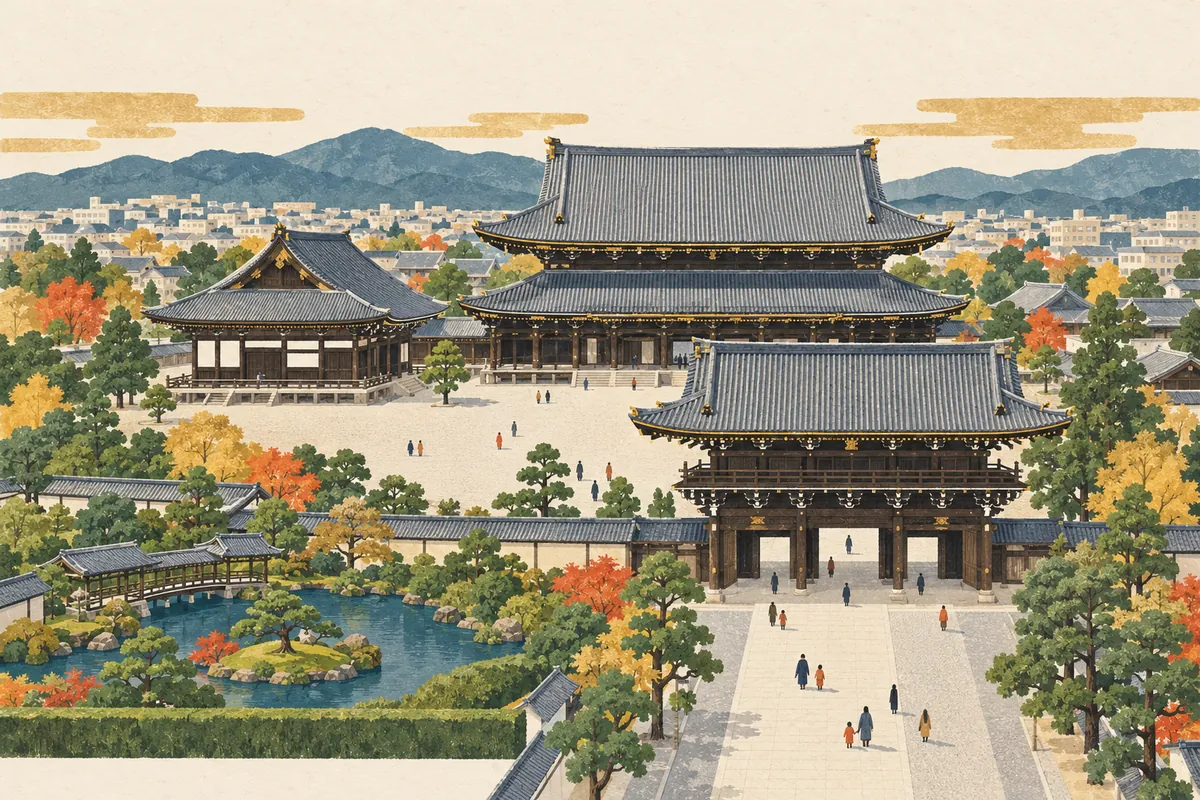
Higashi Hongan-ji is the head temple of the Shinshū Ōtani school of Jōdo Shinshū (Shin Buddhism), and its formal name is Shinshū Honbyō. It is a temple with a two-hall layout: the Goeidō, which enshrines the goshinnei (sacred image) of Shinran Shōnin, stands side by side with the Amidadō, which enshrines the principal image, Amida Nyorai. In Kyoto it is called "O-Higashi-san."
In 1591 (Tenshō 19), Hongan-ji was granted temple land by Toyotomi Hideyoshi and moved to Horikawa, and after the death of Kennyo it was succeeded by his third son, Junnyo. This is today's Nishi Hongan-ji (head temple of the Jōdo Shinshū Hongwanji school). The eldest son, Kyōnyo, who had briefly succeeded his father, was made to retire on Hideyoshi's orders but continued his activities; in 1602 (Keichō 7) he was granted land between Rokujō and Shichijō on Karasuma by Tokugawa Ieyasu, and he built the Amidadō in 1603 and the Goeidō in 1604.
The two halls burned four times
In the Edo period, Higashi Hongan-ji burned four times: in the great Kyoto fire of 1788 (Tenmei 8), in a fire that started in the grounds in 1823 (Bunsei 6), in the great Kyoto fire of 1858 (Ansei 5), and in the Kinmon Incident of 1864 (Genji 1). The fighting and fire of the Kinmon Incident (the Dondon-yake) destroyed every building in the grounds, and rebuilding the two halls took until 1895 (Meiji 28).
For the rebuilding, about 50,000 pieces of timber were donated from all over Japan, along with roof tiles, foundation stones, and tatami mats. The ropes used to haul the huge timbers were kezuna (毛綱, "hair ropes"), made by twisting together hemp and human hair donated by followers across the country. A kezuna is displayed in the covered corridor linking the Goeidō and Amidadō, together with an ōzori (great sled) said to have been used to move timber through the snow.
The Goeidō, the Amidadō, and their two gates
The Goeidō carries on the scale and form it has had since the mid-17th century. Measuring 76 m across the front, 58 m on the side, and 38 m high, it has the largest floor area of any traditional wooden building in Japan and is said to be one of the largest wooden buildings in the world. The tatami of the inner sanctuary (naijin) and outer hall (gejin) together come to 927 mats.
The Amidadō, 52 m across the front, 47 m on the side, and 29 m high, stands to the south of the Goeidō. Each hall has its own gate in front, facing Karasuma-dōri. The Goeidō Gate, 21 m across the front, 13 m on the side, and 27 m high, is regarded as the tallest wooden two-story double gate (nijūmon) in Japan. On its upper story hangs a plaque reading "Shinshū Honbyō." The Amidadō Gate is a four-legged gate (shikyakumon) with Chinese-style curved gables (karahafu) front and back, and in the Edo period it was called the "Karamon."
Buildings designated as Important Cultural Properties
Six buildings, the Goeidō, Amidadō, Goeidō Gate, Amidadō Gate, bell tower, and temizuya, were designated Important Cultural Properties on September 30, 2019 (Reiwa 1).
On September 25, 2023 (Reiwa 5), 14 more buildings were designated, including the Ōgenkan and Ōshinden; the Shiroshoin, Kuroshoin, and Kikumon designed by Kameoka Suekichi; and the Gijidō (Assembly Hall). On the same day, three buildings of the Naiji, the residence of the head of the school and his family, designed by Takeda Goichi, also became Important Cultural Properties as a separate item.
When the main buildings were built
| Building | Year built |
|---|---|
| Goeidō | 1895 (Meiji 28) |
| Amidadō | 1895 (Meiji 28) |
| Goeidō Gate | 1911 (Meiji 44) |
| Amidadō Gate | 1911 (Meiji 44) |
| Bell tower | 1894 (Meiji 27) |
| Temizuya (purification fountain pavilion) | 1895 (Meiji 28) |
| Ōgenkan (Grand Entrance) and Ōshinden (Grand Residence Hall) | 1867 (Keiō 3) |
| Shiroshoin | 1911 (Meiji 44) |
| Kuroshoin | 1911 (Meiji 44) |
| Kikumon (Chrysanthemum Gate) | 1911 (Meiji 44) |
| Gijidō (Assembly Hall) | 1935 (Shōwa 10) |
| Western-style building of the Naiji (a separate item) | 1923 (Taishō 12) |
Shōsei-en (Kikokutei)
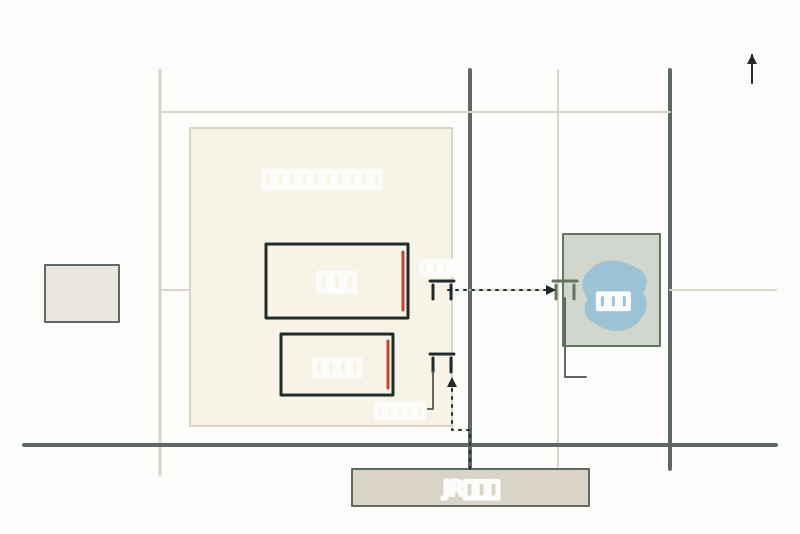
Shōsei-en is a detached precinct (tobichi keidai) of Higashi Hongan-ji, reached by leaving through the Goeidō Gate, crossing Karasuma-dōri, and walking a few minutes east along Shōmen-dōri. It began when the 13th head priest, Sennyo, received the land as a donation from the third shogun, Tokugawa Iemitsu, and started laying it out as his retirement residence when he retired in 1653 (Jōō 2). Sennyo named it after a line from "Returning Home" (帰去来辞) by the Chinese poet Tao Yuanming (陶淵明, Tō Enmei in Japanese), and because karatachi (枳殻, trifoliate orange) was planted around it as a hedge, it is also called Kikokutei (枳殻邸).
It is a pond-and-stroll garden (chisen kaiyū-style) of about 10,600 tsubo (a tsubo is about 3.3 m²), with tea houses such as the Shukuentei standing on an island in the Ingetsu-chi pond and along its shores. Its design is attributed by tradition to Ishikawa Jōzan, and it was designated a national Place of Scenic Beauty on December 16, 1936 (Shōwa 11). The site is believed to be that of the Rokujō Kawara-no-in, the residence of the Minister of the Left, Minamoto no Tōru, but there is also a theory that denies the connection, holding that the Kawara-no-in lay north of Shōmen-dōri.
Opening hours and getting there
Higashi Hongan-ji is at Karasuma-dōri Shichijō agaru, Shimogyō Ward: a 7-minute walk from JR Kyoto Station, a 5-minute walk from Gojō Subway Station, and a 1-minute walk from the "Karasuma Shichijō" city bus stop. The gates are open 5:50–17:30 from March to October and 6:20–16:30 from November to February. While they are open you can worship without applying, including inside the Goeidō and Amidadō. Guided tours of the two halls start from beneath the Goeidō Gate at 9:30 and 15:00 (not held on some days), and none of this costs anything (as of October 2026). The upper story of the Goeidō Gate is normally closed to the public.
Shōsei-en (Higashi-Tamamizu-chō, Shimojuzuyamachi-dōri Ainomachi higashi-iru, Shimogyō Ward) is a 10-minute walk from JR Kyoto Station, and the entrance is the West Gate. It is open 9:00–17:00 from March to October (reception until 16:30) and 9:00–16:00 from November to February (reception until 15:30), every day of the year. A garden maintenance donation of at least 700 yen for adults and at least 300 yen for junior high and high school students is requested, and elementary school children and younger are free. Normally only the garden (outdoors) can be visited, and you cannot go inside the buildings.
Where Higashi Hongan-ji and Shōsei-en Are (Schematic Map)
Mini quiz for this entry
In the Goeidō hall of Higashi Hongan-ji, whose goshinnei (sacred image) is enshrined at the center front?
The kezuna (毛綱), hauling ropes made by twisting hemp together with hair donated by followers, were used in the Meiji-era rebuilding of Higashi Hongan-ji's two halls. Where is one displayed today?
The name of Shōsei-en, the garden in Higashi Hongan-ji's detached precinct, was taken from the line 園日渉而以成趣 in a work by a certain Chinese poet. Who was the poet?
Sources and verification
Content checked: October 19, 2026
Updated: October 19, 2026
References are in Japanese.
- 文化庁「国指定文化財等データベース 真宗本廟東本願寺 御影堂」
- 文化庁「国指定文化財等データベース 真宗本廟東本願寺 阿弥陀堂」
- 文化庁「国指定文化財等データベース 真宗本廟東本願寺 御影堂門」
- 文化庁「国指定文化財等データベース 真宗本廟東本願寺 阿弥陀堂門」
- 文化庁「国指定文化財等データベース 真宗本廟東本願寺 鐘楼」
- 文化庁「国指定文化財等データベース 真宗本廟東本願寺 手水屋形」
- 文化庁「国指定文化財等データベース 真宗本廟東本願寺 大玄関及び大寝殿」
- 文化庁「国指定文化財等データベース 真宗本廟東本願寺 白書院」
- 文化庁「国指定文化財等データベース 真宗本廟東本願寺 黒書院」
- 文化庁「国指定文化財等データベース 真宗本廟東本願寺 議事堂」
- 文化庁「国指定文化財等データベース 真宗本廟東本願寺 菊門」
- 文化庁「国指定文化財等データベース 真宗本廟東本願寺内事 洋館」
- 文化庁「国指定文化財等データベース」(国宝・重要文化財〈建造物〉、真宗本廟で検索)
- 文化庁「国指定文化財等データベース 名勝 渉成園」
- 文化庁「国宝・重要文化財(建造物)の指定について」(令和元年5月17日答申 報道発表)
- 文化庁「国宝・重要文化財(建造物)の指定について」(令和元年5月17日答申 別紙)
- 文化庁「文化審議会の答申(国宝・重要文化財(建造物)の指定)」(令和5年6月23日 報道発表)
- 文化庁「文化審議会の答申(国宝・重要文化財(建造物)の指定)」(令和5年6月23日 別紙)
- 真宗大谷派(東本願寺)「東本願寺について」
- 真宗大谷派(東本願寺)「東本願寺の歴史」
- 真宗大谷派(東本願寺)「境内のみどころ」
- 真宗大谷派(東本願寺)「開門・閉門、アクセス」
- 真宗大谷派(東本願寺)「参拝ツアーに参加する」
- 真宗大谷派(東本願寺)「よくあるご質問」
- 東本願寺 渉成園「渉成園について」
- 東本願寺 渉成園「渉成園の歴史と特徴」
- 東本願寺 渉成園「園内のみどころ」
- 東本願寺 渉成園「参観のご案内」
- 京都市観光協会「京都観光Navi 真宗本廟(東本願寺)」