
The National Treasure Buildings of Nishi Hongan-ji
Key points
Three date from the Momoyama period and four from the Edo period; the Goeidō and Amidadō were added in 2014
Moved to its present site in 1591 on land donated by Hideyoshi; the eastern temple split off in 1602
The Goeidō is one of the largest surviving Edo-period halls, and the Amidadō one of the largest Amida halls of any Shin temple in Japan
The grounds, the Goeidō, and the Amidadō are free; the Hiunkaku and North Noh Stage are normally closed to the public
Three from Momoyama and four from Edo
The national designation name is "Hongan-ji," and all of its National Treasure buildings stand in the same grounds. Three are from the Momoyama period, three from the early Edo period, and one from the late Edo period. The Kuroshoin and Denrō are two structures counted as one item, so there are eight structures in all.
Five of them became National Treasures in the 1950s, and the Goeidō and Amidadō were added in 2014. Among the 44 National Treasure buildings in the city, Tō-ji (Kyōōgokoku-ji) and Daigo-ji have four each, so Hongan-ji's seven is the largest number at any one site.
National Treasure Buildings of Hongan-ji (Nishi Hongan-ji)
| Designated name | Period and date | Structures | National Treasure since |
|---|---|---|---|
| Hongan-ji Hiunkaku | Momoyama (1573–1614) | 1 | June 9, 1951 |
| Hongan-ji Karamon | Momoyama (1573–1614) | 1 | March 31, 1953 |
| Hongan-ji North Noh Stage | Momoyama (1581) | 1 | March 31, 1953 |
| Hongan-ji Shoin (Taimenjo and Shiroshoin) | Early Edo (1618) | 1 | November 22, 1952 |
| Hongan-ji Kuroshoin and Denrō | Early Edo (1657) | 2 | June 28, 1956 |
| Hongan-ji Goeidō | Early Edo (1636) | 1 | September 18, 2014 |
| Hongan-ji Amidadō | Late Edo (1760) | 1 | September 18, 2014 |
The 1591 move and the east–west split
Hongan-ji moved to its present site in 1591 (Tenshō 19) on land donated by Toyotomi Hideyoshi. In 1602, Kyōnyo was granted land at Karasuma Rokujō by Tokugawa Ieyasu and moved east, splitting the temple into east and west; Kyoto people have called them "O-Nishi-san" and "O-Higashi-san" ever since. After the buildings burned in 1617, rebuilding followed, and by around 1633 the temple had taken on roughly its present appearance.
The Momoyama-period Hiunkaku, Karamon, and North Noh Stage
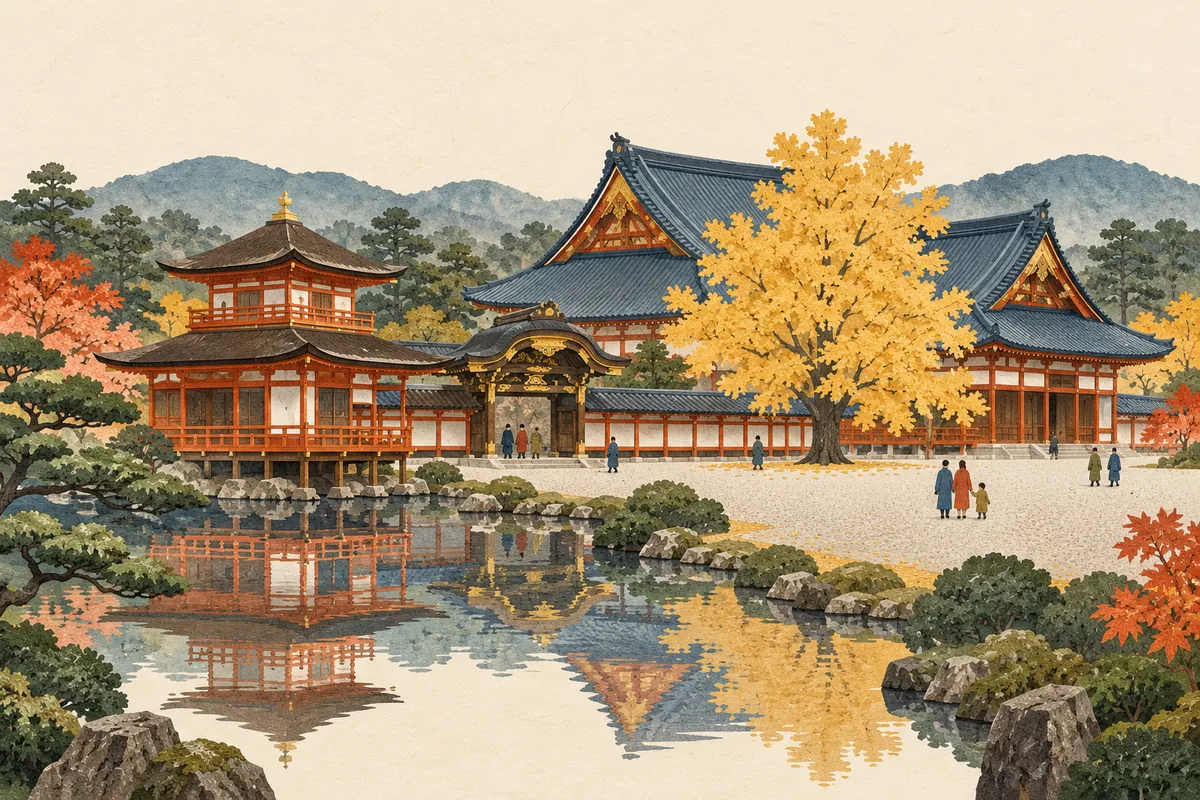
The Hiunkaku is a three-story pavilion standing beside the pond of the Tekisuien garden in the southeast corner of the grounds. According to tradition, it was built at the Jurakudai palace, which Hideyoshi constructed around 1586–87, and moved here in the Kan'ei era (1624–44) after the Jurakudai was demolished in 1595, but the details are not known. Its name, "Flying Cloud Pavilion," is traditionally explained by the way its slender pillars and many paper screens make it look like a cloud floating in the sky.
The Karamon is a four-legged gate (shikyakumon) with Chinese-style curved gables (karahafu) front and back, in the same form as the Karamon of Toyokuni Shrine; it is thought to have been moved from in front of the Goeidō to its present site in 1618. It is also called the "Higurashimon" (Sunset Gate), because its carvings and colors are so splendid that one forgets the day is ending; it was restored between June 2018 and September 2021. The North Noh Stage stands in the front garden north of the Shiroshoin; because its gable pendant (gegyo) reportedly bore an inscription dated 1581 (Tenshō 9), it is considered the oldest surviving Noh stage, and the simple construction of its stage and bridgeway (hashigakari) preserves an older form from before the Edo period.
The shoin and the Kuroshoin
The Shoin's date in its designation is 1618 (Genna 4), and it was altered in 1633, when it was moved to the west and turned 90 degrees. The Taimenjo (Kō-no-ma, Stork Room) on the south side is a 162-tatami-mat hall, named for the openwork carving of storks (kō) in the transom above the front of the raised dais. The main room of the Shiroshoin on the north side, the Shimei-no-ma, has 24 mats, and most of its wall paintings are attributed to Watanabe Ryōkei and his school.
The Kuroshoin was built in 1657 (Meireki 3) and is linked to the northeast of the Shiroshoin by the Denrō corridor. In contrast to the public audience halls, it appears to have been an inward-facing building; while keeping the formality of shoin-zukuri it incorporates tea-house (sukiya) techniques, and behind its First Room is a six-mat tea room. The dry landscape garden east of the Shoin, the "Kokei Garden," is a Special Place of Scenic Beauty, and the Tekisuien garden where the Hiunkaku stands is a Place of Scenic Beauty.
The Goeidō and the Amidadō
The Goeidō, whose roof was raised in 1636 (Kan'ei 13), is one of the largest surviving halls of Edo-period architecture: 48 m east–west, 62 m north–south, and 29 m high. A wooden statue of Shinran is enshrined at its center, and the outer hall (gejin) has about 441 tatami mats so that many followers can be seated. A major restoration was completed in 2009.
The Amidadō stands north of the Goeidō, and the two halls are connected by a covered corridor. It was rebuilt in 1760 (Hōreki 10) on a larger scale than the earlier hall of 1618, and measures 42 m east–west, 45 m north–south, and 25 m high. It is among the largest Amida halls of any Shin Buddhist temple in Japan and is considered to have served as a model for Shin main halls across the country. It was restored between August 2017 and March 2022.
A World Heritage component and a temple town lined with Buddhist supply shops
Hongan-ji is one of the 17 components of the World Cultural Heritage Site "Historic Monuments of Ancient Kyoto," inscribed in December 1994, and its grounds are also a national Historic Site. Around it spreads a temple town (jinaimachi) formed when temple officials, merchants, and craftsmen moved here along with the temple's relocation; shops selling Buddhist altars, ritual implements, and priests' robes, as well as lodgings for pilgrims, still line the streets, and the area is designated by Kyoto City as the "Hongan-ji and Tō-ji Neighborhood Landscape Improvement District." The great ginkgo in front of the Goeidō, about 400 years old, is a city-designated Natural Monument; from the legend that it spouted water and protected the Goeidō during the Great Tenmei Fire of 1788, it is also called the "Water-Spouting Ginkgo."
Buildings open to worshippers, and access
Nishi Hongan-ji is at Horikawa-dōri Hanayachō-sagaru, Shimogyō Ward. The gates open at 5:30 and close at 17:00 (as of October 2026). Anyone may visit the grounds free of charge. The National Treasure Goeidō and Amidadō can be entered at any time while the gates are open, and the morning service (jinjō) from 6:00 every day is also free to join. The Hiunkaku and North Noh Stage are normally closed to the public, and the Shoin and Kuroshoin are not buildings you can enter freely either. The exterior of the Karamon can be seen from Kitakōji-dōri.
To get there, it is about 15 minutes on foot from JR Kyoto Station, or take city bus routes 9, 28, or 75 to "Nishi Honganji-mae," or a Keihan Bus to "Nishi Honganji." Parking is in the northern grounds, with the entrance on the Hanayachō-dōri side.
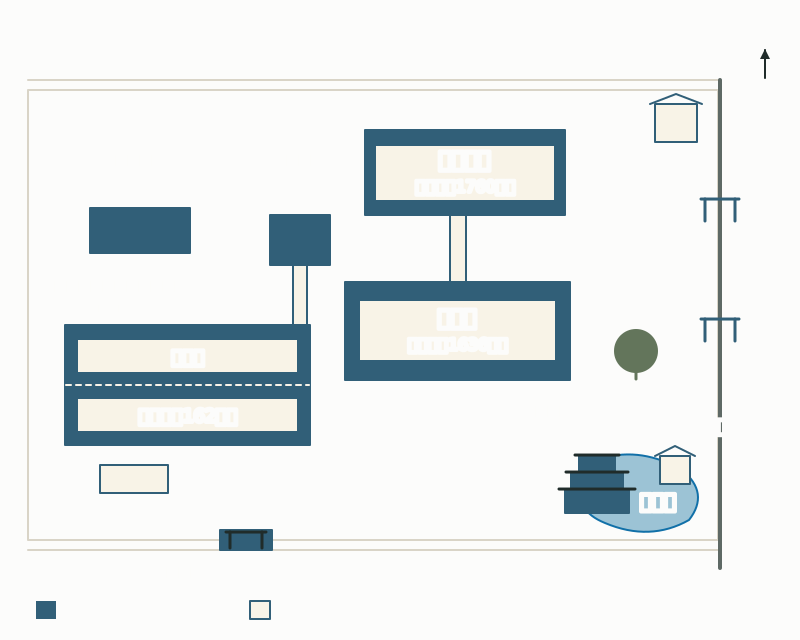
Layout of the National Treasure Buildings in the Grounds of Nishi Hongan-ji (Schematic)
Mini quiz for this entry
Nishi Hongan-ji's National Treasure Karamon is a four-legged gate with cusped karahafu gables front and back. Where is the karamon said to be of the same type?
Nishi Hongan-ji's North Noh Stage, a National Treasure, is considered the oldest surviving Noh stage. Which building is the audience room (kensho) from which it is watched?
In which garden in the southeast corner of Nishi Hongan-ji's grounds does the National Treasure Hiunkaku stand beside the pond?
Sources and verification
Content checked: October 18, 2026
Updated: October 18, 2026
References are in Japanese.
- 文化庁「国指定文化財等データベース」(国宝・重要文化財(建造物)、京都府、国宝で検索)
- 文化庁「国指定文化財等データベース 本願寺飛雲閣」
- 文化庁「国指定文化財等データベース 本願寺唐門」
- 文化庁「国指定文化財等データベース 本願寺書院(対面所及び白書院)」
- 文化庁「国指定文化財等データベース 本願寺北能舞台」
- 文化庁「国指定文化財等データベース 本願寺阿弥陀堂」
- 文化庁「国指定文化財等データベース 本願寺御影堂」
- 文化庁「国指定文化財等データベース 本願寺黒書院及び伝廊」
- 本願寺「境内と建造物」
- 本願寺「書院・能舞台」
- 本願寺「飛雲閣」
- 本願寺「参拝案内」
- 本願寺「アクセス」
- 京都市観光協会「本願寺(西本願寺)」(京都観光Navi)
- 京都府「世界遺産(世界文化遺産) 本願寺(西本願寺)」
- 京都市「世界遺産『古都京都の文化財(京都市、宇治市、大津市)』」
- 京都市「本願寺(西本願寺)周辺エリア」(歴史的資産周辺の景観プロファイル)
- 京都市都市計画局「本願寺・東寺地区の界わい景観整備地区指定について」(平成17年8月22日)
- 京都市埋蔵文化財研究所「リーフレット京都 No.90 西本願寺境内の庭園遺構」
- 京都市文化財保護課「京都市内文化財件数」(令和8年4月1日現在)