
National Treasure and Important Cultural Property Tea Rooms in Kyoto: Mittan, Ryōkaku-tei, Hitōtei, and Others
Other spellings and namesTea room (chashitsu, 茶室) / Chaseki (茶席) / Mittan-seki (密庵席) / Three National Treasure tea rooms / Ryōkaku-tei (遼廓亭) / Hitōtei (飛濤亭) / Karakasa-tei / Shigure-tei / Kan'in-seki (閑隠席) / En'an (燕庵)
Key points
The three National Treasure tea rooms are Taian (Ōyamazaki), Jo-an (Inuyama), and Mittan-seki (Ryōkō-in, Kita Ward, Kyoto City)
There are 20 National Treasures and Important Cultural Properties from before the modern era in Kyoto City that include tea rooms (as of October 2026; counting those whose structure or description in the national data mentions a tea room, and similar)
The most common size of tea room is four and a half tatami mats. Smaller ones are called koma, and larger ones hiroma
Jukō-in's Kan'in-seki: special opening in autumn 2026 until December 6 (500 yen for elementary, junior high, and high school students)
What is a tea room? Four and a half mats, daime, and nijiriguchi
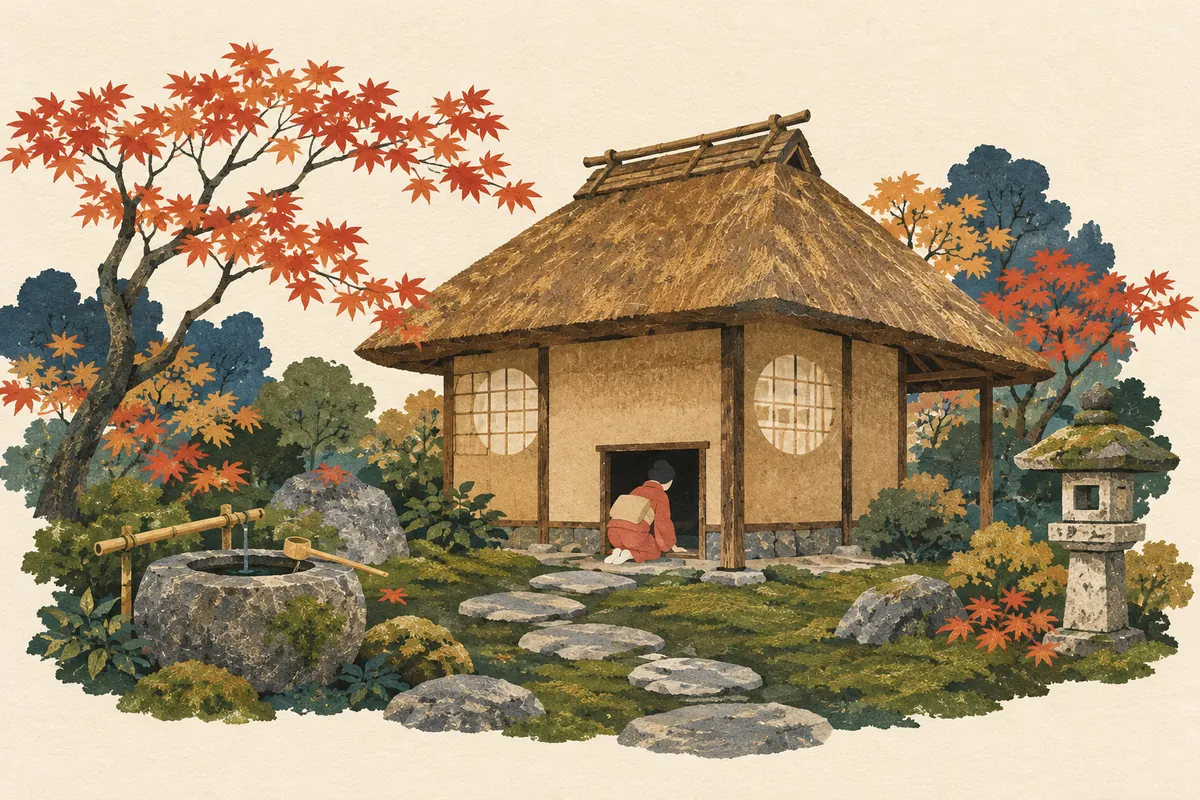
A tea room (chashitsu) is a room for the tea ceremony (chanoyu), or a building centered on such a room, and it is also called a chaseki, sukiya (数寄屋), or kakoi (囲). The most common size is four and a half tatami mats; smaller rooms are called koma (小間) and larger ones hiroma (広間) (some explanations include four and a half mats among koma). The mat where the host makes tea is often a daime mat (台目畳), about three-quarters the length of an ordinary mat, and "three mats and a daime" (sanjō daime) means three mats plus one daime mat.
A tea room has a tokonoma alcove and separate entrances for the guests and the host. In rustic, hermitage-style (sōan) tea rooms, the small entrance the guests stoop to enter is the nijiriguchi (躙口), said to have been first used by Sen no Rikyū in a two-mat tea room.
Three tea rooms are counted as National Treasures; in Kyoto City, only Mittan-seki
The tea rooms counted as National Treasures are Taian (待庵) at Myōki-an (妙喜庵) in Ōyamazaki Town, Otokuni District, Kyoto Prefecture; Jo-an (如庵) at Urakuen in Inuyama, Aichi Prefecture; and Mittan-seki (密庵席) in the shoin of Ryōkō-in (龍光院), a subtemple of Daitoku-ji. They are also called the "Three National Treasure Tea Rooms." Taian is in Ōyamazaki, so it is outside Kyoto City.
Taian is a two-mat tea room built around the Tenshō era (1573–92) to Rikyū's taste, and many copies of it were made in later times. Jo-an is a tea room that Oda Urakusai built at Shōden-in of Kennin-ji in 1618 (Genna 4); at the end of the Meiji era it came to the Mitsui family and was moved to Tokyo, then moved to Kanagawa Prefecture in 1938 (Shōwa 13) and to its present site in Inuyama in 1972 (Shōwa 47). Mittan-seki is a tea room of four and a half mats and a daime, said to reflect the taste of Kobori Enshū.
Among the National Treasure buildings in Kyoto City, the first floor of Nishi Hongan-ji's Hiunkaku has a tea room, "Ikujaku" (憶昔), added later, and there is also a six-mat tea room behind the Ichi no Ma (first room) of the Kuro Shoin. In both cases the whole building is designated a National Treasure.
List of National Treasure and Important Cultural Property tea rooms in Kyoto City
National Treasure and Important Cultural Property buildings in Kyoto City dating up to the Edo period include the following 20 tea rooms (as of October 2026). In Kita Ward, there are 5 at four subtemples of Daitoku-ji, Ryōkō-in, Shinju-an (眞珠庵), Jukō-in (聚光院), and Gyokurin-in (玉林院), and in Kamigyō Ward the tea rooms of Omotesenke and Urasenke stand side by side at Ogawa-dōri Teranouchi. The count changes if the conditions for counting change.
Number of National Treasure and Important Cultural Property Tea Rooms in Kyoto City (by Period)
- Momoyama
- Early Edo
- Mid-Edo
- Late Edo
- End of Edo
National Treasure and Important Cultural Property tea rooms in Kyoto City (before the modern era)
| Tea room (national designation name) | Owner (ward) | Date | Type | Viewing (as of October 2026) |
|---|---|---|---|---|
| Tea room (Hongan-ji Hiunkaku) | Hongan-ji (Shimogyō) | Momoyama (tea room added later) | National Treasure | Normally closed |
| Karakasa-tei (Kōdai-ji Karakasa-tei [Ankan-kutsu] and Shigure-tei) | Kōdai-ji (Higashiyama) | Momoyama | Important Cultural Property | In the grounds of Kōdai-ji (admission charged) |
| Shōnan-tei (Saihō-ji Shōnan-tei) | Saihō-ji (Nishikyō) | Momoyama | Important Cultural Property | Visits to Saihō-ji by application |
| Mittan-seki (Ryōkō-in Shoin) | Ryōkō-in (Kita) | Early Edo, Kan'ei era (1624–43) | National Treasure | — |
| Hassō-no-seki (Konchi-in Tea Room) | Konchi-in (Sakyō) | Early Edo, 1628 (Kan'ei 5) | Important Cultural Property | — |
| Six-mat tea room (Hongan-ji Kuro Shoin) | Hongan-ji (Shimogyō) | Early Edo, 1657 (Meireki 3) | National Treasure | — |
| Shigure-tei (Kōdai-ji Karakasa-tei [Ankan-kutsu] and Shigure-tei) | Kōdai-ji (Higashiyama) | Early Edo | Important Cultural Property | In the grounds of Kōdai-ji (admission charged) |
| Teigyoku-ken (Shinju-an Tsūsen-in) | Shinju-an (Kita) | Early Edo | Important Cultural Property | — |
| Fushimi Inari Taisha Ochaya | Fushimi Inari Taisha (Fushimi) | Early Edo | Important Cultural Property | — |
| Tea room (designated as an attachment [tsuketari] to the Manshu-in Shoin) | Manshu-in (Sakyō) | Early Edo (shoin 1656, Meireki 2) | Important Cultural Property | — |
| Ryōkaku-tei (Ninna-ji) | Ninna-ji (Ukyō) | Mid-Edo | Important Cultural Property | — |
| Three-mat tea room (Saiō-in Tea Room) | Saiō-in (Sakyō) | Mid-Edo, Jōkyō era (1684–87) | Important Cultural Property | — |
| Kan'in-seki and Masudoko-seki (Jukō-in Tea Rooms) | Jukō-in (Kita) | Mid-Edo, around 1739 (Genbun 4) | Important Cultural Property | Open in a special opening (until December 6) |
| Sa-an (Gyokurin-in Nanmei-an and Tea Rooms) | Gyokurin-in (Kita) | Mid-Edo, 1742 (Kanpō 2) | Important Cultural Property | — |
| Kasumidoko-seki (Gyokurin-in Nanmei-an and Tea Rooms) | Gyokurin-in (Kita) | Mid-Edo, 1742 (Kanpō 2) | Important Cultural Property | — |
| Two-mat-and-daime tea room (Sumiya) | Sumiya Preservation Society (Shimogyō) | Mid- to late Edo | Important Cultural Property | Open during Sumiya's opening periods (until December 13) |
| Tensetsu-dō and Hogobari-seki (Omotesenke Sodō) | Fushin'an (Kamigyō) | Late Edo, 1789 (Kansei 1) | Important Cultural Property | — |
| En'an | Yabunouchi En'an (Shimogyō) | End of Edo, around 1831 (Tenpō 2) | Important Cultural Property | — |
| Konnichian, Yūin, and others (Urasenke Residence) | Konnichian (Kamigyō) | End of Edo, around 1839 (Tenpō 10) (Kan'un-tei 1788) | Important Cultural Property | — |
| Hitōtei (Ninna-ji) | Ninna-ji (Ukyō) | End of Edo | Important Cultural Property | Normally closed (groups can view it from outside by reservation) |
Rikyū, Oribe, Enshū, and tea rooms: tea masters whose "taste" they are said to reflect
Tea rooms are described in terms of konomi (好み), the "taste" that reflects the ideas of a particular tea master. Taian is said to reflect Rikyū's taste, En'an (燕庵) that of Furuta Oribe, and Mittan-seki that of Kobori Enshū. The Yabunouchi family's En'an is a tea room that preserves Oribe's style, but the present building is said to be a copy moved from Yuiba Village in Settsu.
The Kan'in-seki (閑隠席) of Jukō-in, known as Sen no Rikyū's family temple, is a three-mat tea room said to have been donated by Joshinsai (如心斎), the seventh head of Omotesenke, for the 150th anniversary of Rikyū's death. The Omotesenke Sodō houses a statue of Rikyū, the school's founder, and is where tea is offered to him; it has the four-and-a-half-mat Tensetsu-dō (点雪堂) and the one-mat-and-daime Hogobari-seki. The most important tea rooms of the Urasenke residence are the four-and-a-half-mat Yūin (又隠) and the one-mat-and-daime Konnichian (今日庵). Ninna-ji's Hitōtei (飛濤亭) is said to have been a favorite of Emperor Kōkaku, and instead of a nijiriguchi it has a kinin-guchi (貴人口), an entrance you can walk through without stooping.
Tea rooms of modern villas are also Important Cultural Properties
Some tea rooms set up at modern villas are also designated Important Cultural Properties. They include the tea room of the Former Mitsui Family Shimogamo Villa in Shimogamo, Sakyō Ward; the tea room of Seifūsō (清風荘), owned by Kyoto University (1914, Taishō 3); the ryūrei-seki (table-style tea room) of Seiryūtei near Nanzen-ji (around 1913, Taishō 2); and the Kahantei of the Nomura Hekiunsō (1927, Shōwa 2). The tea room of the Former Mitsui Family Shimogamo Villa is a remodeled part of a residence from before the end of the Edo period that stood there before the Mitsui family bought the land, and it is normally closed to the public.
Where can you see them now?
Viewing differs for each tea room. The following could be confirmed as of October 2026.
- Jukō-in (Murasakino Daitokuji-chō, Kita Ward): the Kan'in-seki and other rooms are shown in the autumn 2026 special opening (September 18 – December 6, reception 9:30–15:30). 1,000 yen for adults and 500 yen for elementary, junior high, and high school students; preschool children cannot enter. Some days closed. About a 5-minute walk from the "Daitokuji-mae" city bus stop
- Kōdai-ji (Higashiyama Ward): the Karakasa-tei and Shigure-tei stand in the grounds. Admission is 800 yen for adults and 400 yen for junior high and high school students; free for elementary school age and under when accompanied by an adult guardian (at least 1 adult per 5 elementary school children)
- Ninna-ji (Ukyō Ward): the Hitōtei stands on the artificial hill in the north garden of the Goten and is normally not open to the public. Groups with advance reservations can walk through the garden and see it from outside
- Nishi Hongan-ji (Shimogyō Ward): the Hiunkaku is normally closed
- Sumiya (Shimogyō Ward): opens during its opening periods as the Sumiya Motenashi Museum of Art and Culture. In autumn 2026, Fridays to Sundays and holidays from September 18 to December 13
- Of the three National Treasure tea rooms, Jo-an in Inuyama has an interior viewing once a month, by advance reservation
Mini quiz for this entry
The guests' entrance to Hitōtei, a tea room at Ninna-ji, is not a nijiriguchi that you stoop to enter, but tall enough to walk through standing. What is this kind of entrance called?
Sources and verification
Content checked: October 28, 2026
Updated: October 28, 2026
References are in Japanese.
- JAANUS(日本美術・建築用語データベース)「chashitsu 茶室」
- JAANUS(日本美術・建築用語データベース)「koma 小間」
- JAANUS(日本美術・建築用語データベース)「nijiriguchi 躙口」
- 愛知県「Aichi Now 日本庭園 有楽苑(国宝茶室「如庵」)」
- 文化庁「国指定文化財等データベース 妙喜庵書院及び茶室(待庵)」
- 文化庁「国指定文化財等データベース 如庵」
- 文化庁「国指定文化財等データベース 龍光院書院」
- 文化庁「国指定文化財等データベース 本願寺飛雲閣」
- 文化庁「国指定文化財等データベース 本願寺黒書院及び伝廊(黒書院)」
- 文化庁「国指定文化財等データベース 高台寺傘亭(安閑窟)及び時雨亭(傘亭)」
- 文化庁「国指定文化財等データベース 高台寺傘亭(安閑窟)及び時雨亭(時雨亭)」
- 文化庁「国指定文化財等データベース 西芳寺湘南亭」
- 文化庁「国指定文化財等データベース 金地院茶室」
- 文化庁「国指定文化財等データベース 眞珠庵通仙院」
- 文化庁「国指定文化財等データベース 伏見稲荷大社御茶屋」
- 文化庁「国指定文化財等データベース 曼殊院(書院)」
- 文化庁「国指定文化財等データベース 仁和寺(遼廓亭)」
- 文化庁「国指定文化財等データベース 仁和寺(飛濤亭)」
- 文化庁「国指定文化財等データベース 西翁院茶室」
- 文化庁「国指定文化財等データベース 聚光院茶室」
- 文化庁「国指定文化財等データベース 玉林院南明庵及び茶室(蓑庵)」
- 文化庁「国指定文化財等データベース 玉林院南明庵及び茶室(霞床席)」
- 文化庁「国指定文化財等データベース 角屋」
- 文化庁「国指定文化財等データベース 表千家祖堂」
- 文化庁「国指定文化財等データベース 燕庵」
- 文化庁「国指定文化財等データベース 裏千家住宅」
- 文化庁「国指定文化財等データベース 孤篷庵本堂(方丈)、書院及び忘筌(忘筌)」
- 文化庁「国指定文化財等データベース 旧三井家下鴨別邸(茶室)」
- 文化庁「国指定文化財等データベース 清風荘(茶室)」
- 文化庁「国指定文化財等データベース 清流亭(立礼席)」
- 文化庁「国指定文化財等データベース 野村碧雲荘(花泛亭)」
- 文化庁「国指定文化財等データベース」(検索)
- 本願寺「飛雲閣」
- 仁和寺「境内のご案内」
- 観光庁「地域観光資源の多言語解説文データベース 飛濤亭」
- 高台寺「歴史」
- 高台寺「拝観」
- 京都市観光協会「京都観光Navi 大徳寺 聚光院 開創460年 特別公開」
- 西芳寺「よくあるご質問」
- 角屋保存会「角屋もてなしの文化美術館」
- 京都市観光協会「京都観光Navi 旧三井家下鴨別邸について」