
Yōhen Tenmoku and Ryōkō-in
Other spellings and namesyōhen tenmoku tea bowl / Ryōkō-in (竜光院)
Key points
Ryōkō-in's bowl has small spots and short, fine streaks of light; only the Fujita bowl shows yōhen inside and out
Ryōkō-in does not accept general visitors, so its bowl can be seen almost only at exhibitions (in 2026, at the Tokyo National Museum until November 8)
In spring 2019, exhibitions in Shiga, Tokyo, and Nara put every National Treasure bowl on view in the same season
Kuroda Nagamasa founded Ryōkō-in in memory of his father, and many treasures of the Tennōjiya still remain there
Yōhen tenmoku, fired at the Jian kilns of the Southern Song
Tenmoku are the most formal of the bowls used for drinking matcha, and are characterized by a funnel-like shape and black glaze. The black-glazed bowls fired at the Jian kilns in Fujian Province during China's Southern Song dynasty (12th–13th centuries) are called kensan (建盞, Jian ware), and among the vast numbers of kensan produced, those on which beautiful iridescence happened to appear in the kiln are yōhen tenmoku. The word yōhen (曜変) is said to have originally been 窯変 (yōhen, "kiln transformation"), with the character 曜, meaning brilliance, substituted; in Muromachi-period Japan these bowls were ranked as the very finest of tea bowls.
Only three intact yōhen tenmoku exist in the world, all of them in Japan and all National Treasures: the "Inaba Tenmoku" of the Seikadō Bunko Art Museum in Tokyo, the bowl of the Fujita Museum in Osaka, and the bowl of Ryōkō-in in Kyoto. The three are also praised as the "three peerless yōhen" (yōhen-chū no sanzetsu).
The three National Treasure yōhen tenmoku tea bowls
| Owner | Location | Size (height, mouth diameter) | Provenance | Designated National Treasure |
|---|---|---|---|---|
| Seikadō Bunko Art Museum (Inaba Tenmoku) | Marunouchi, Chiyoda-ku, Tokyo (Seikadō@Marunouchi) | 6.8 cm, 12.0 cm | Passed through the Inaba, Ono, and Iwasaki families to the Seikadō | June 9, 1951 |
| Fujita Museum | Amijima-chō, Miyakojima-ku, Osaka | 6.8 cm, 13.6 cm | Passed from Tokugawa Ieyasu to the Mito Tokugawa family; acquired by Fujita Heitarō in 1918 (Taishō 7) | November 14, 1953 |
| Ryōkō-in (a subtemple of Daitoku-ji) | Murasakino Daitokuji-chō, Kita Ward, Kyoto | 6.6 cm, 12.1 cm | Passed through Daitsū-an, a subtemple of Daitoku-ji, to Ryōkō-in | June 9, 1951 |
How the three differ
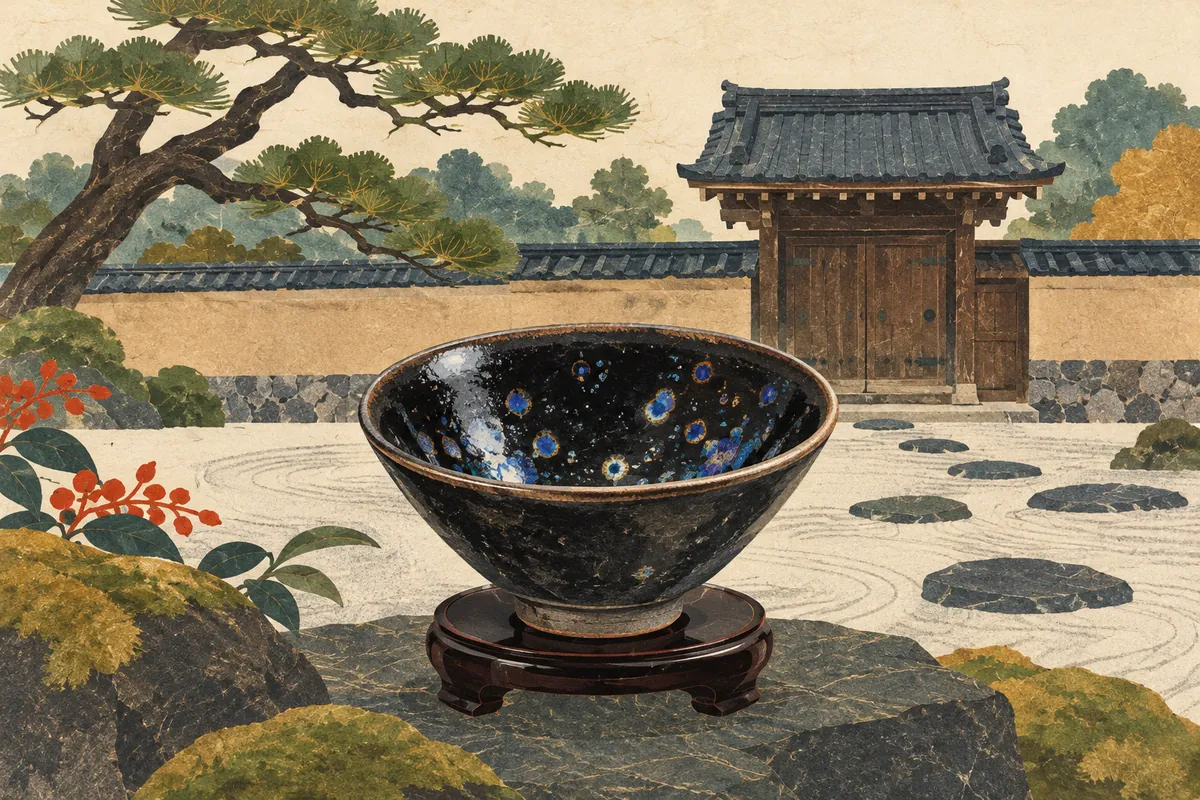
Ryōkō-in's bowl has at its rim the nejikaeshi (a slightly inturned lip) characteristic of kensan and a low, small foot, and its jet-black glaze is applied thickly, with yōhen appearing over almost the entire inside. Its star-like spots are small and its blue light thin and short, so although it lacks the brilliance of the Inaba Tenmoku, it has deep character and dignity.
The Inaba Tenmoku has spots inside that shine blue and yellow, and it bears this name because from the Edo period onward it was handed down in the Inaba family, lords of the Yodo domain. The Fujita Museum's bowl is the only one of the three with beautiful yōhen both inside and outside.
The Important Cultural Property "yōhen tenmoku tea bowl" and fragments
A tea bowl designated as a national Important Cultural Property under the name "Yōhen Tenmoku Tea Bowl" is at the MIHO MUSEUM in Kōka City, Shiga Prefecture. Handed down in the Maeda family of Kaga, it has spots called yuteki ("oil spots") floating inside and out, and part of its inside shows yōhen. Fragments of yōhen tenmoku have also been found in China, near the site of the Southern Song palace in Hangzhou, Zhejiang Province.
All three National Treasures on view in spring 2019
Because Ryōkō-in does not accept general visitors, its treasures, including the yōhen tenmoku, had rarely been seen. In spring 2019, the MIHO MUSEUM in Kōka City, Shiga Prefecture, held a special exhibition bringing together Ryōkō-in's treasures, "Daitokuji Ryōkōin: National Treasure Yōhen Tenmoku and Hasōai" (破草鞋, "worn-out straw sandals") (March 21–May 19), and the yōhen tenmoku was shown.
At the same time, National Treasure yōhen tenmoku were also on display at the Seikadō Bunko Art Museum in Tokyo (April 13–June 2) and in the Fujita Museum exhibition at the Nara National Museum (April 13–June 9), making it possible to see all three National Treasures in the same spring.
Ryōkō-in, founded by Kuroda Nagamasa
Ryōkō-in is one of the subtemples (tatchū) of Daitoku-ji, a head temple of the Daitoku-ji branch of the Rinzai school, and stands on the southwest side of the main temple. It was founded in 1606 (Keichō 11) by Kuroda Nagamasa to pray for the repose of his father, Yoshitaka (Josui), with Shun'oku Sōen (春屋宗園) as its founding patriarch and Kōgetsu Sōgan (江月宗玩) invited as its first abbot. Kōgetsu was the second son of Tsuda Sōgyū of the Tennōjiya, a wealthy Sakai merchant and tea master, and many of the famous treasures handed down in the Tennōjiya are still at Ryōkō-in. The grounds also contain the Kuroda family mausoleum (tamaya), an Important Cultural Property thought to have been completed in 1608.
The National Treasure shoin is a building roofed with kokera (thin wooden shingles), formed when a large room and a wide veranda were added around 1649 (Keian 2) around the Mittan-seki (密庵席), a tea room of four and a half mats plus a daime (three-quarter) mat built as a separate structure in the Kan'ei era (1624–43). It became a National Treasure on April 27, 1961. The Mittan-seki is a somewhat shoin-style tea room said to reflect the taste of Kobori Enshū (小堀遠州). It has two tokonoma alcoves, intended for hanging the calligraphy of the Southern Song Zen monk Mi'an Xianjie (密庵咸傑, Mittan Kanketsu in Japanese; the calligraphy is a National Treasure) and a letter by Sen no Rikyū. It is a representative tea room of the early Edo period.
Daitoku-ji's other National Treasures and the number of craft National Treasures
Besides the Ryōkō-in Shoin, Daitoku-ji's National Treasure buildings are the Hōjō and Genkan of the main temple (1635–36), the Karamon, and the Hondō of its subtemple Daisen-in (1513), so 4 of Kita Ward's 5 National Treasure buildings are concentrated at Daitoku-ji. The gardens of the Hōjō and of the Daisen-in Shoin are Special Places of Scenic Beauty, and among paintings, works such as Kannon, Monkeys, and Cranes by Muqi (牧谿, Mokkei) are also National Treasures.
In Kyoto City's tally dated April 1, 2026, 13 of the 217 National Treasures in the city are crafts (254 nationwide), and Ryōkō-in's yōhen tenmoku is one of them.
Daitoku-ji's buildings from outside and yōhen tenmoku at exhibitions
You can freely enter the grounds of Daitoku-ji (Murasakino Daitokuji-chō, Kita Ward) and view from outside the temple complex, where the Chokushimon, Sanmon, Butsuden (Buddha hall), and Hattō (Dharma hall) line up from south to north.
- Getting there: Take a city bus to "Daitokuji-mae." Ryōkō-in is on the southwest side of the main temple.
- The main temple (Hōjō and Karamon) is normally closed. The subtemple Daisen-in is open year-round, 9:00–16:30; 500 yen for adults, 300 yen for elementary and junior high school students (as of October 2026).
- Seeing a real yōhen tenmoku: chances to see Ryōkō-in's bowl are almost entirely limited to exhibitions. In 2026 it is shown at the Heiseikan of the Tokyo National Museum in a special exhibition marking the 700th anniversary of Daitoku-ji's founding (October 14 – December 6), during the first term only, until November 8. During the first term the museum is closed on Mondays but open on Monday, November 2. The bowls of the Seikadō Bunko Art Museum (Marunouchi, Tokyo) and the Fujita Museum (Miyakojima-ku, Osaka) are sometimes shown in their own museums' exhibitions.
Mini quiz for this entry
On the National Treasure yōhen tenmoku tea bowl owned by Ryōkō-in at Daitoku-ji in Kyoto, where does the yōhen (star-like spots and iridescence) appear?
At which Chinese kilns were yōhen tenmoku tea bowls fired?
How large is the Mittan-seki, the tea room said to reflect Kobori Enshū's taste in the National Treasure shoin of Ryōkō-in at Daitoku-ji?
Sources and verification
Content checked: October 18, 2026
Updated: October 27, 2026
References are in Japanese.
- 文化庁「国指定文化財等データベース 曜変天目茶碗(竜光院)」
- 文化庁「国指定文化財等データベース 曜変天目茶碗(静嘉堂)」
- 文化庁「国指定文化財等データベース 曜変天目茶碗(藤田美術館)」
- 文化庁「国指定文化財等データベース 曜変天目茶碗(MIHO MUSEUM、重要文化財)」
- 文化庁「国指定文化財等データベース 龍光院書院」
- 文化庁「国指定文化財等データベース 密庵咸傑墨蹟」
- 文化庁「国指定文化財等データベース 龍光院黒田家霊屋」
- 文化庁「国指定文化財等データベース」(国宝・重要文化財(建造物)、京都府、国宝で検索)
- 静嘉堂文庫美術館「国宝『曜変天目』三碗 同時期公開!」(2019年1月)
- 静嘉堂文庫美術館「黒の奇跡・曜変天目の秘密」プレスリリース(2025年)
- MIHO MUSEUM「大徳寺龍光院 国宝 曜変天目と破草鞋(はそうあい)」
- MIHO MUSEUM「大徳寺龍光院 国宝曜変天目と破草鞋 陳列一覧」
- 文化庁広報誌ぶんかる「国宝の殿堂 藤田美術館展 曜変天目茶碗と仏教美術のきらめき」
- 美術手帖「400年間守られてきた寺宝を、初の一挙公開。『大徳寺龍光院 国宝 曜変天目と破草鞋(はそうあい)』がMIHO MUSEUMで開催」
- nippon.com「京都・大徳寺本坊:国宝の唐門や狩野探幽の天井画を特別公開」(2018年10月4日)
- 臨済宗黄檗宗連合各派合議所「大徳寺」(臨黄ネット)
- 京都市観光協会「大徳寺」(京都観光Navi)
- 京都市観光協会「曝凉展(ばくりょうてん)【大徳寺本坊】」(京都観光Navi)
- 文化庁「国指定文化財等データベース 大徳寺方丈庭園」
- 文化庁「国指定文化財等データベース 大仙院書院庭園」
- 大仙院「拝観案内・アクセス」
- 京都市文化財保護課「京都市内文化財件数」(令和8年4月1日現在)
- 東京国立博物館ほか「開創700年記念 特別展「大徳寺 本朝無双之禅苑」」
- 特別展「大徳寺 本朝無双之禅苑」出品目録(PDF)