
Kyoto's National Treasure Karamon
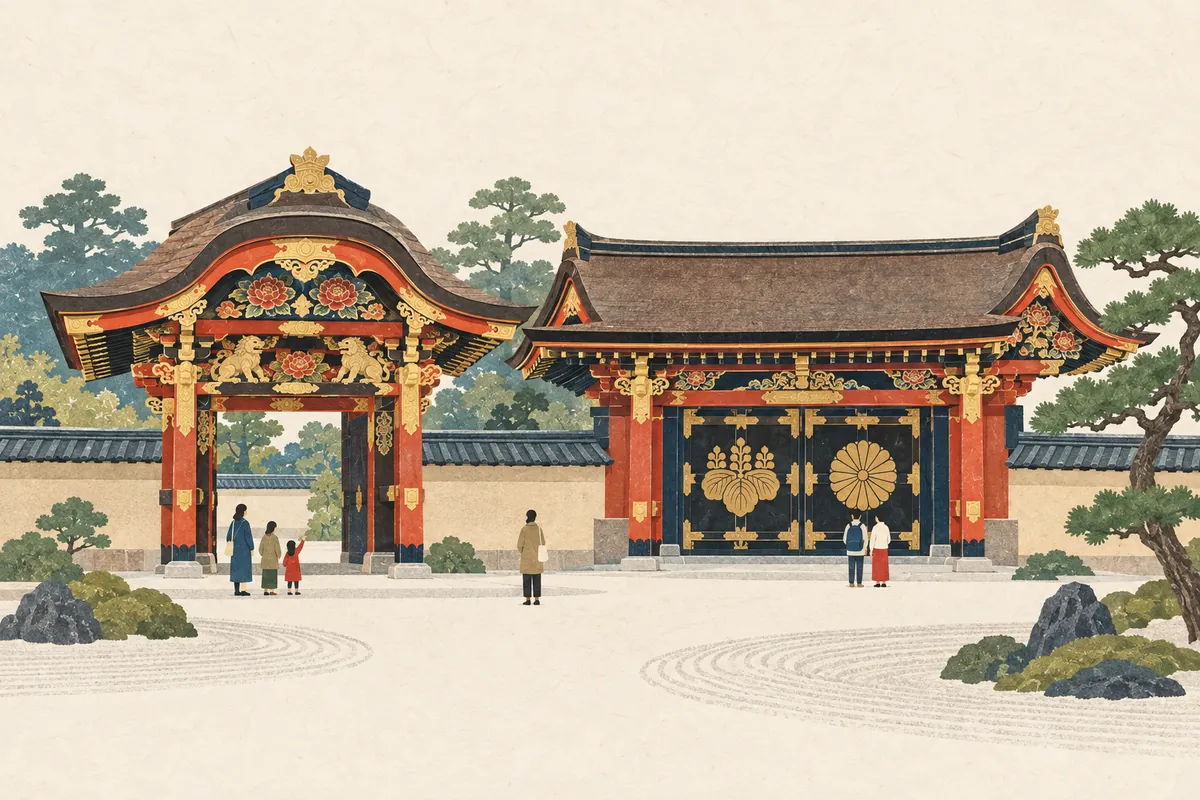
Key points
All are Momoyama-period gates with cypress-bark roofs, made National Treasures one after another in 1952–54
A mukai-karamon has its karahafu at the front and back, a hira-karamon on the left and right sides. Only the Sanbō-in karamon is a hira-karamon
By tradition, Toyokuni Shrine's karamon was moved from Fushimi Castle and Daitoku-ji's from the Jurakudai
At Nishi Hongan-ji (from Kitakōji-dōri) and Toyokuni Shrine (grounds open freely) you can see the karamon for free. The main temple of Daitoku-ji is normally closed
Mukai-karamon and hira-karamon
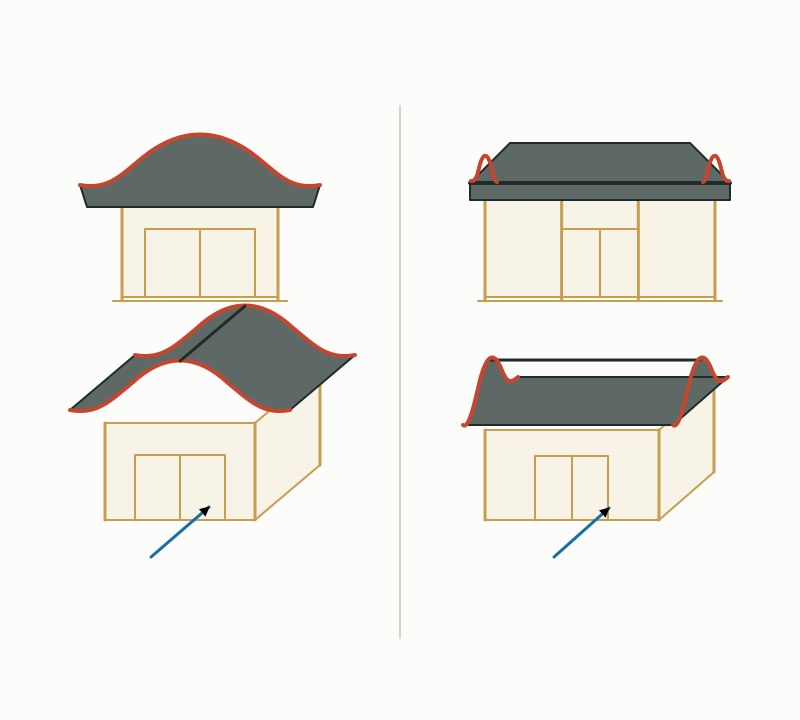
"Karamon" is a general name for gates with a karahafu. A karahafu is a curved gable whose center arches up like a bow and whose ends curve back to near horizontal, and the rafters (taruki) follow the same curve. Although it contains the character 唐 (kara, "Tang" or "Chinese"), it does not necessarily mean Chinese style; it indicates the use of this curved gable. Such gates are often placed at the entrances of monzeki temples (temples headed by imperial or noble abbots) or in front of abbot's quarters (hōjō).
The name depends on where the karahafu is. A gate that shows its karahafu at the front and back, that is, in the direction you pass through, is a mukai-karamon (向唐門), while a gate with karahafu on its left and right sides (the gable ends), so that from the front you see a long horizontal eave, is a hira-karamon (平唐門). Among Kyoto City's National Treasures, the karamon of Hongan-ji, Daitoku-ji, and Toyokuni Shrine are mukai-karamon, and that of Daigo-ji Sanbō-in is a hira-karamon. Even among those with karahafu at the front and back, details differ from gate to gate: the karamon of Hongan-ji and Toyokuni Shrine have irimoya (hip-and-gable) sides, while Daitoku-ji's has a kirizuma (gabled) roof with karahafu added to the front and back eaves.
Mukai-karamon vs. Hira-karamon (Schematic Diagram)
Four National Treasure Karamon
Of the National Treasure buildings in Kyoto City, four are karamon: Hongan-ji Karamon, Daitoku-ji Karamon, Toyokuni Shrine Karamon, and Sanbō-in Karamon. All four are classified as Momoyama period (1573–1614), and all have cypress-bark (hiwadabuki) roofs. They became National Treasures on March 29, 1952 (Daitoku-ji), March 31, 1953 (Hongan-ji and Toyokuni Shrine), and March 20, 1954 (Sanbō-in).
The three at Nishi Hongan-ji, Daitoku-ji, and Toyokuni Shrine are called the "Three Karamon of Kyoto." The karamon of Daigo-ji Sanbō-in is not included in that name.
Relocation records and traditions
How the four karamon were moved
| Karamon (temple/shrine) | History |
|---|---|
| Hongan-ji Karamon (Nishi Hongan-ji) | Moved in 1618 (Genna 4) from in front of the Goeidō to its present site. There is also a tradition that it came from Fushimi Castle |
| Daitoku-ji Karamon | Said to be one of the gates of the Jurakudai, given by Hideyoshi to Murakami Suō-no-kami and later donated to the temple, but there is no reliable record. In 1891 (Meiji 24) it stood west of the Chokushimon, facing east; it was later moved to the spot left empty when the Akechimon was moved to Konchi-in |
| Toyokuni Shrine Karamon | Traditionally a relic of Fushimi Castle. Moved from Nijō Castle to Konchi-in, a subtemple of Nanzen-ji, and then to its present site in 1880 (Meiji 13), when the shrine was revived |
| Sanbō-in Karamon (Daigo-ji) | Built in 1599 (Keichō 4) as a heichūmon (a gate set in a wall) and moved twice, in 1615 and around the An'ei era. There is a tradition that it came from Fushimi Castle, but repairs in 2010 confirmed that parts of a gate from another location were reused when it was built |
Carvings and colors of the four
The Hongan-ji Karamon is covered with Momoyama-period decorative carvings, and because people forget that the sun is setting while looking at them, it is also called the "Higurashi-mon" (日暮らし門, Sunset Gate). The Daitoku-ji Karamon now faces south as the front gate of the Hōjō and is also known as the "Higurashi-no-mon" (日暮の門).
The whole karamon of Toyokuni Shrine (豊国神社, Toyokuni Jinja; also read "Hōkoku Jinja") was originally coated in black lacquer, and the figures carved in high relief were decorated with gold leaf and colors, but today only faint traces of color remain. The plaque at the center of the gate bears writing by Emperor Go-Yōzei.
When the Sanbō-in Karamon was built, the whole gate was lacquered black, and its four large chrysanthemum and paulownia crests were covered in gold leaf. Repairs that took about a year and a half were completed in July 2010 (Heisei 22), returning it to that appearance.
Locations and admission for the four karamon
- Nishi Hongan-ji (Horikawa-dōri Hanaya-chō sagaru, Shimogyō Ward): The karamon stands on the south side of the grounds, facing Kitakōji-dōri, and from the street you can see its carvings, whose restoration was completed in September 2021. The grounds open at 5:30 (as of October 2026). About a 15-minute walk from JR Kyoto Station, or take a city bus to "Nishi Honganji-mae."
- Toyokuni Shrine (Yamatoōji Shōmen Chaya-machi, Higashiyama Ward): The karamon stands in front of the main sanctuary. The treasure house is open 9:00–17:00 (last entry 16:30); 500 yen for adults and high school and university students, 300 yen for elementary and junior high school students. About a 10-minute walk from Keihan Shichijō Station, or about 5 minutes from the city bus stop "Hakubutsukan Sanjūsangendō-mae."
- Daitoku-ji (Murasakino Daitokuji-chō, Kita Ward): The karamon stands in front of the Hōjō, but the main temple is normally closed to the public. The Bakuryōten, at which the main temple's treasures were shown while being aired, has also been suspended since 2021 because of restoration work and will not be held in fiscal 2026. The Chokushimon (Important Cultural Property), which has karahafu at the front and back, can be seen at any time. Take a city bus to "Daitokuji-mae."
- Daigo-ji Sanbō-in (Daigo Higashiōji-chō, Fushimi Ward): The karamon is said to have been opened only to welcome imperial messengers. Admission to Sanbō-in is 600 yen for adults, 400 yen for junior high and high school students, and free for elementary school students and younger (regular season). About a 10-minute walk from Exit 2 of Daigo Station on the Tōzai Subway Line.
Mini quiz for this entry
With what was the whole of Toyokuni Shrine's National Treasure karamon originally coated?
What shape is the karahafu (cusped gable) from which the karamon gets its name?
The National Treasure karamon of Toyokuni Shrine, said to be a relic of Fushimi Castle, stood at which temple before it was moved to its present site in the Meiji era?
Sources and verification
Content checked: October 18, 2026
Updated: October 18, 2026
References are in Japanese.
- 文化庁「国指定文化財等データベース」(国宝・重要文化財(建造物)、京都府、国宝で検索)
- 文化庁「国指定文化財等データベース 本願寺唐門」
- 文化庁「国指定文化財等データベース 大徳寺唐門」
- 文化庁「国指定文化財等データベース 豊国神社唐門」
- 文化庁「国指定文化財等データベース 三宝院唐門」
- 京都市文化財保護課「京都市内文化財件数」(令和8年4月1日現在)
- JAANUS(日本建築・美術用語辞典)「karamon 唐門」
- JAANUS(日本建築・美術用語辞典)「mukaikaramon 向唐門」
- JAANUS(日本建築・美術用語辞典)「hirakaramon 平唐門」
- JAANUS(日本建築・美術用語辞典)「karahafu 唐破風」
- 豊国神社「神社について」
- 豊国神社「交通」
- 豊国神社「宝物館・見どころ紹介」
- 京都市観光協会「豊国神社」(京都観光Navi)
- 観光庁「地域観光資源の多言語解説文データベース 豊国神社 唐門」
- 本願寺「境内と建造物」
- 本願寺「参拝案内」
- 京都市観光協会「本願寺(西本願寺)」(京都観光Navi)
- 臨済宗黄檗宗連合各派合議所「大徳寺」(臨黄ネット)
- 京都市観光協会「大徳寺」(京都観光Navi)
- 京都市観光協会「曝凉展(ばくりょうてん)【大徳寺本坊】」(京都観光Navi)
- nippon.com「京都・大徳寺本坊:国宝の唐門や狩野探幽の天井画を特別公開」(2018年10月4日)
- 京都市・京都市埋蔵文化財研究所「京都歴史散策マップ9 伏見 桃山」
- 醍醐寺「三宝院」
- 醍醐寺「拝観時間 / 料金」
- 醍醐寺「交通案内」