
The National Treasures of Daigo-ji
Key points
The National Treasure buildings span the Heian-period pagoda and Yakushi-dō, the Muromachi-period Seiryūgū Haiden, and the Momoyama-period Omote-shoin and Karamon
The grounds are a national Historic Site and part of the World Heritage Site "Historic Monuments of Ancient Kyoto"
A recommendation in March 2026 would make the "Daigo-ji Monjo Shōgyō" a National Treasure of 94,192 items
Kami-Daigo is about an hour's climb from the Nyonin-dō, and the only way up is on foot
Kami-Daigo and Shimo-Daigo
Daigo-ji has extensive grounds on the east side of the Yamashina Basin, stretching up to the summit of Mount Kasatori. The summit area is called Kami-Daigo and the foot of the mountain Shimo-Daigo. The temple began when Shōbō enshrined statues of Juntei Kannon and Nyoirin Kannon and built a small hermitage at Kami-Daigo, and its founding dates from 874. A founding legend tells of an old man who drank the spring water on the mountain and praised it as "daigomi" (the finest of flavors); the water is called Daigosui and still flows today.
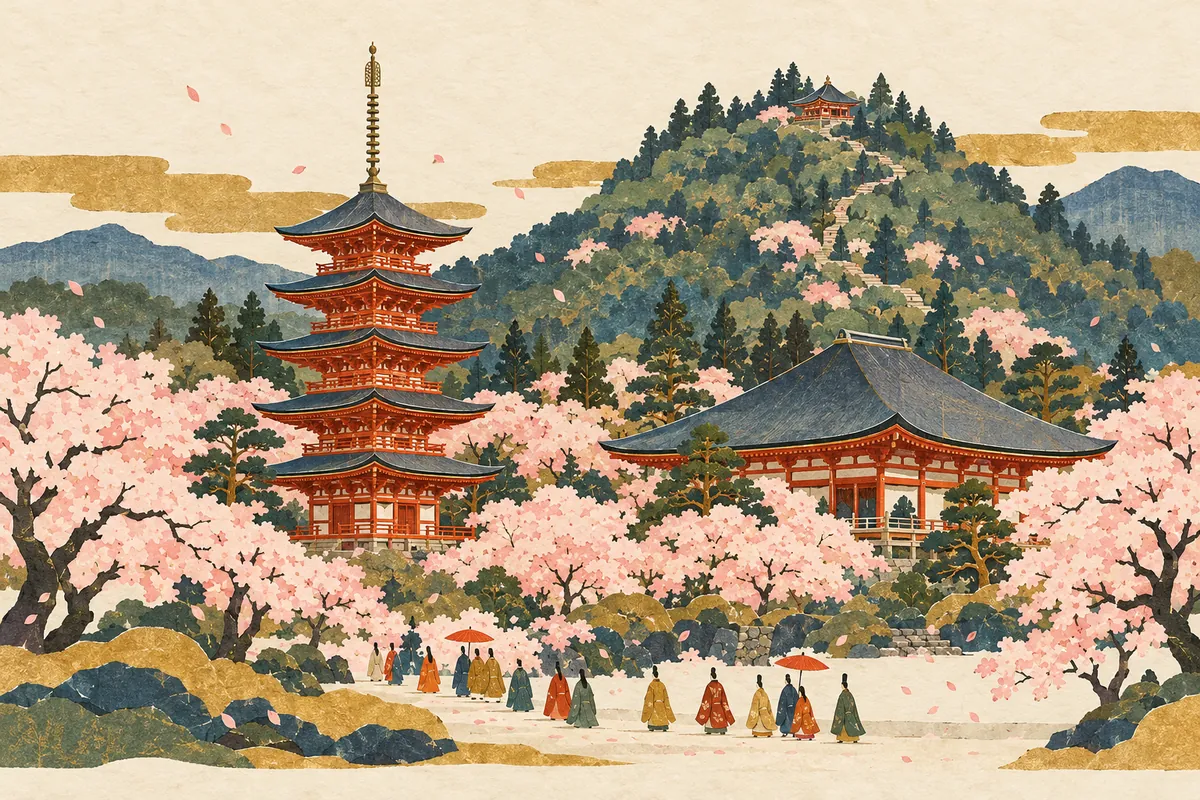
Later, at the wish of Emperor Daigo, the Yakushi-dō and Godai-dō were built at Kami-Daigo, and the Shaka-dō (the predecessor of today's Kondō) was built at Shimo-Daigo. In the reigns of Emperor Suzaku and Emperor Murakami, the five-story pagoda and other buildings were added, completing a temple that spans both the mountaintop and the foot of the mountain. The grounds are a national Historic Site, and in December 1994 (Heisei 6) they were registered as a World Heritage Site as part of the "Historic Monuments of Ancient Kyoto."
Layout of the grounds
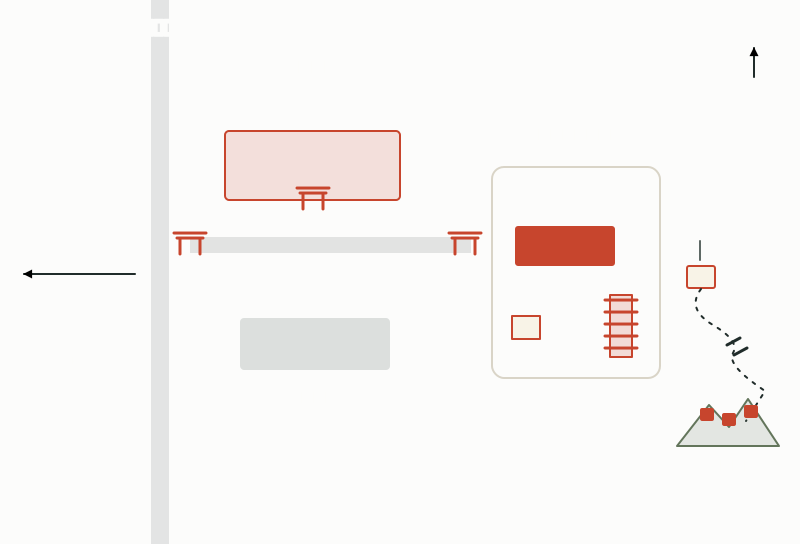
In Shimo-Daigo, an approach runs east from the Sōmon (main gate), which faces the old Nara Kaidō road to the west. Sanbō-in is on the north side of the approach and the Reihōkan (treasure hall) on the south side. Passing through the Nishi-ōmon (Niōmon gate; rebuilt by Toyotomi Hideyori in 1605) at the end of the approach brings you to the lower precinct, with the Kondō straight ahead and the five-story pagoda to its southeast. Further east, the Nyonin-dō (Jōshin-in) is the trailhead to Kami-Daigo; from there, a climb of about an hour on a steep mountain path brings you to Kami-Daigo.
Locations of Shimo-Daigo, Sanbō-in, and Kami-Daigo at Daigo-ji (Schematic)
The six National Treasure buildings
The five-story pagoda, the oldest wooden building in Kyoto Prefecture, was completed in 952 (Tenryaku 6). The Kondō is a hall moved from Yuasa in Kishū (Wakayama Prefecture) on Toyotomi Hideyoshi's orders after its predecessor, the Shaka-dō, burned in 1295 (Einin 3) and 1470 (Bunmei 2); the work was finished in 1600 (Keichō 5). The year it was built in Yuasa is not known, but its main structure retains the style of the late Heian period.
The Yakushi-dō at Kami-Daigo is one of the few surviving Heian-period buildings: its reconstruction began in 1121 (Hōan 2), and a dedication ceremony was held in 1124 (Hōan 5). The Seiryūgū Haiden at Kami-Daigo is a Muromachi-period worship hall whose pillars were raised in 1434 (Eikyō 6); it is built in the kakezukuri (cantilevered) style, projecting out over a steep cliff. The Omote-shoin of Sanbō-in dates from 1598 (Keichō 3) and shows the features of Momoyama-period shoin-zukuri architecture well. The Karamon was built in 1599 (Keichō 4) and is a hira-karamon gate that stands in its present spot after being moved twice.
Daigo-ji's National Treasure buildings
| Building (official designation name) | Location | Date designated a National Treasure |
|---|---|---|
| Daigo-ji Five-Story Pagoda | Shimo-Daigo | June 9, 1951 |
| Daigo-ji Kondō | Shimo-Daigo | March 20, 1954 |
| Daigo-ji Yakushi-dō | Kami-Daigo | June 27, 1959 |
| Daigo-ji Seiryūgū Haiden | Kami-Daigo | March 20, 1954 |
| Sanbō-in Halls (Omote-shoin) | Sanbō-in | March 20, 1954 |
| Sanbō-in Karamon | Sanbō-in | March 20, 1954 |
National Treasures besides the buildings
The National Treasure wooden Yakushi Nyorai with two attendants (3 statues), formerly the principal image of the Yakushi-dō at Kami-Daigo, was moved to the Reihōkan for preservation in 2001, and a newly made triad has been enshrined in the Yakushi-dō since 2012. Other National Treasures include the Heian-period murals (18 panels) decorating the interior of the pagoda's first story, a wooden standing Kokūzō Bosatsu designated in 2015, and Kamakura-period paintings in color on silk: the Godaison (Five Great Wisdom Kings), Kariteimo (Hārītī), Enmaten, and Monju Crossing the Sea.
The documents and sacred texts (shōgyō) handed down together at the temple became a National Treasure on June 19, 2013, as the "Daigo-ji Monjo Shōgyō" (69,393 items). On March 26, 2026, the Council for Cultural Affairs made a recommendation to merge in the items designated as Important Cultural Properties and add further tangible cultural properties, making a National Treasure of 94,192 items. The designation becomes official once it is announced in the Official Gazette.
The Daigo flower-viewing and the Hōtaikō Hanami Gyōretsu
It was in the spring of 1598 (Keichō 3) that Toyotomi Hideyoshi held a grand flower-viewing party at Daigo. For the occasion, 700 cherry trees gathered from the Kinai region were planted, and the buildings and garden of Sanbō-in were laid out. More than 1,300 people are said to have taken part, among them Hideyori, Kita no Mandokoro, Yodo, and the ladies of the household. The inspection visit came the year before, in 1597 (Keichō 2), when Hideyoshi climbed up to Kami-Daigo together with Tokugawa Ieyasu; the head priest of the time, Gien, wrote it down in his diary. Hideyoshi died in the summer of the flower-viewing year, and the autumn leaf-viewing was never realized.
Hideyoshi himself drew up the basic design of the Sanbō-in garden for the flower-viewing. The garden is a national Special Historic Site and Special Place of Scenic Beauty. Following the Daigo flower-viewing, the "Hōtaikō Hanami Gyōretsu" (Taikō's Flower-Viewing Procession) is usually held on the second Sunday of April.
Access and admission
Daigo-ji is at 22 Daigo Higashiōji-chō, Fushimi Ward. It is about a 10-minute walk from Exit 2 of Daigo Station on the Tōzai subway line, and you can also get off at "Daigoji-mae" on Keihan Bus routes 22 and 22A. Visiting hours are 9:00 to 17:00 from March 1 to the first Sunday of December, and 9:00 to 16:30 in the rest of the winter season; admission ends 30 minutes before closing (as of October 2026). Tickets are sold at the Sanbō-in reception.
There are 3 paid areas, Sanbō-in, the Garan (Shimo-Daigo), and the Reihōkan, and fees differ between the spring season and the regular season. Special exhibitions are held at the Reihōkan in spring and autumn.
- Regular season (April 20 to March 19 of the following year): a combined ticket for 3 areas costs 1,500 yen for adults and 1,000 yen for junior high and high school students; 2 areas, 1,000 yen and 700 yen; 1 area, 600 yen and 400 yen
- Spring season (March 20 to the third Sunday of April): a combined ticket for 3 areas costs 1,800 yen for adults and 1,300 yen for junior high and high school students; 1 area, 800 yen and 600 yen
- Free for elementary school students and younger. Also free for people who bring proof of disability, plus one companion
- Special viewing of the Sanbō-in Goten: 500 yen for adults and junior high and high school students
- Kami-Daigo: accessible on foot only; admission is 9:00 to 15:00 in the summer season and 9:00 to 14:00 in the winter season. Visitors must be back down at the foot of the mountain by 17:00
Mini quiz for this entry
In spring 1598 (Keichō 3), what lavish event did Toyotomi Hideyoshi hold at Daigo-ji?
Daigo-ji's National Treasure Kondō was moved from elsewhere on Toyotomi Hideyoshi's orders. Where was it originally?
The National Treasure Yakushi triad, formerly the principal image of the Yakushi-dō at Kami-Daigo, was moved for preservation in 2001 (Heisei 13). Where was it moved to?
Sources and verification
Content checked: October 22, 2026
Updated: October 22, 2026
References are in Japanese.
- 醍醐寺「歴史 / 縁起 / 祖師」
- 醍醐寺「寺宝/文化財」
- 醍醐寺「伽藍」
- 醍醐寺「上醍醐」
- 醍醐寺「三宝院」
- 醍醐寺「霊宝館」
- 醍醐寺「境内案内」
- 醍醐寺「豊太閤花見行列」
- 醍醐寺「秀吉が果たせなかったモミジ狩りの名所」
- 醍醐寺「拝観時間 / 料金」
- 醍醐寺「交通案内」
- 文化庁「国指定文化財等データベース 醍醐寺五重塔」
- 文化庁「国指定文化財等データベース 醍醐寺金堂」
- 文化庁「国指定文化財等データベース 醍醐寺薬師堂」
- 文化庁「国指定文化財等データベース 醍醐寺清滝宮拝殿」
- 文化庁「国指定文化財等データベース 三宝院殿堂(表書院)」
- 文化庁「国指定文化財等データベース 三宝院唐門」
- 文化庁「国指定文化財等データベース 醍醐寺文書聖教」
- 文化庁「国指定文化財等データベース 木造薬師如来及両脇侍像(薬師堂安置)」
- 文化庁「国指定文化財等データベース 五重塔初重壁画(板絵著色)」
- 文化庁「国指定文化財等データベース 木造虚空蔵菩薩立像」(醍醐寺)
- 文化庁「国指定文化財等データベース 絹本著色五大尊像」(醍醐寺)
- 文化庁「国指定文化財等データベース 絹本著色訶梨帝母像」
- 文化庁「国指定文化財等データベース 絹本著色文殊渡海図」
- 文化庁「国指定文化財等データベース 絹本著色閻魔天像」
- 文化庁「国指定文化財等データベース 醍醐寺境内」
- 文化庁「国指定文化財等データベース 醍醐寺三宝院庭園」
- 文化庁「文化審議会の答申(国宝・重要文化財(美術工芸品)の指定等)」(令和8年3月26日)
- 文化庁「文化審議会の答申 I.答申内容」(令和8年3月26日)