
The Five-Story Pagodas of Tō-ji and Daigo-ji
Key points
Only the five-story pagodas of Tō-ji and Daigo-ji are National Treasures; the Yasaka Pagoda and Ninna-ji's pagoda are Important Cultural Properties
Built to withstand earthquakes but vulnerable to lightning, Tō-ji's pagoda burned four times; the present one was rebuilt with the support of Tokugawa Iemitsu
Daigo-ji's pagoda survived the wars of the 15th century and keeps its Heian-period appearance
At Tō-ji, entering the grounds just to see the pagoda from outside is free. The interior of the first story can be entered only during special openings
Tō-ji's five-story pagoda, Japan's tallest wooden pagoda
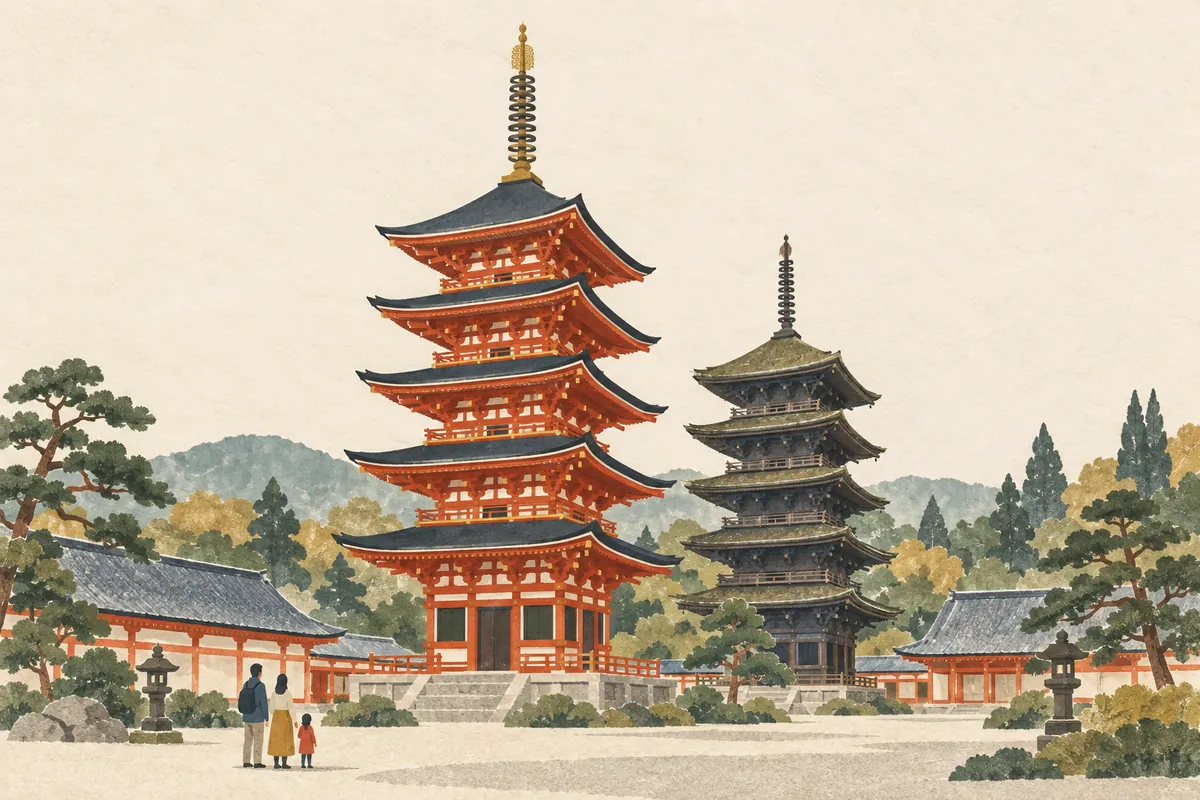
The formal name of Tō-ji's five-story pagoda as a cultural property is the "Kyōōgokoku-ji five-story pagoda," and it stands about 55 m tall. It is the tallest of Japan's surviving historic buildings and is also the tallest wooden pagoda in Japan. Kōbō Daishi Kūkai began work on the pagoda around 826 (Tenchō 3), following the Kōdō (lecture hall).
The pagoda burned down four times, from lightning strikes and other causes, and was rebuilt each time. The present pagoda is the fifth, completed in 1643 (Kan'ei 20) after the fire of 1641 (Kan'ei 18). The rebuilding was supported by the third shogun, Tokugawa Iemitsu, and the structure is in the Japanese (wayō) style, following the older form. It was designated an Important Cultural Property on December 28, 1897 (Meiji 30), and a National Treasure on November 22, 1952 (Shōwa 27).
Daigo-ji's five-story pagoda, the oldest wooden building in Kyoto Prefecture
The five-story pagoda at Daigo-ji in Fushimi Ward was begun by Emperor Suzaku, a son of Emperor Daigo, to pray for his father's repose, and completed in 952 (Tenryaku 6) in the reign of the next emperor, Murakami. It is the oldest surviving wooden building in Kyoto Prefecture, and on June 9, 1951 (Shōwa 26) it was among the first buildings designated National Treasures under the Law for the Protection of Cultural Properties.
It is about 38 m tall, and the finial (sōrin) standing on the roof alone is about 13 m, one third of the pagoda's total height. The interior of the first story is painted with the Mandalas of the Two Realms and the Eight Patriarchs of Shingon, known as the wellspring of Japanese esoteric Buddhist painting. In the wars of the 15th century the lower temple of Daigo-ji lost almost all its buildings, but this pagoda survived and still conveys the appearance of the Heian period.
The central pillar, the first story, and the risk of lightning
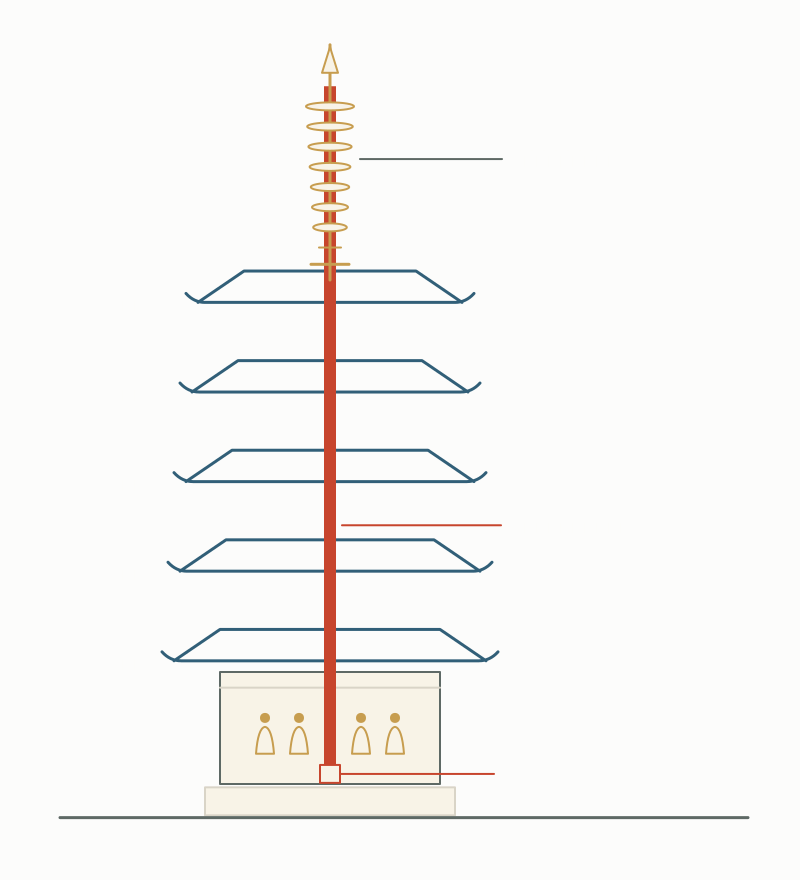
At the center of a five-story pagoda stands a thick pillar called the shinbashira (central pillar), which supports the finial. At Tō-ji the central pillar represents Dainichi Nyorai, and according to tradition, relics of the Buddha that Kūkai brought back from Tang China are enshrined in it. The interior of the first story is a space for Buddhist statues; at Tō-ji four Nyorai and eight Bodhisattvas are placed around the central pillar.
Tō-ji's pagoda has only a small difference between the widths of its upper and lower roofs, a feature shared by the pagoda of Ninna-ji. Despite their slender look, such pagodas are strong against earthquakes but vulnerable to lightning. On the walls of Tō-ji's first story are painted dragons, expressing the wish to protect the pagoda from fire.
Cross-Section of a Five-Story Pagoda (Schematic)
Other wooden pagodas in Kyoto City
The National Treasure five-story pagodas in Kyoto City are the two at Tō-ji and Daigo-ji, but other old wooden pagodas survive as well. The five-story pagoda of Hōkan-ji in Higashiyama Ward is known as the "Yasaka Pagoda." The present pagoda is the fourth: after the fire of 1436 (Eikyō 8), it was rebuilt in 1440 (Eikyō 12) with the support of Ashikaga Yoshinori, and it is designated an Important Cultural Property. Before that it had also burned in 1179 and 1291 and been rebuilt with the support of Minamoto no Yoritomo and Emperor Go-Uda.
The five-story pagoda of Ninna-ji in Ukyō Ward was built in 1644 (Kan'ei 21), with a body of 32.7 m and a total height of 36.18 m, and is an Important Cultural Property. The three-story pagoda of Kiyomizu-dera was rebuilt in 1632 (Kan'ei 9) and is also an Important Cultural Property.
Heights of Wooden Pagodas in Kyoto City
- Tō-ji five-story pagoda
- Yasaka Pagoda (Hōkan-ji)
- Daigo-ji five-story pagoda
- Ninna-ji five-story pagoda
- Kiyomizu-dera three-story pagoda
A Kyoto landmark at the entrance to Heian-kyō
Tō-ji was built in 796, two years after Heian-kyō was founded, as a state temple east of the Rajōmon, the main gate of the capital, paired with Sai-ji (the West Temple). Tō-ji is the only temple that still stands where it was founded with Heian-kyō, and its five-story pagoda stands right beside the southern entrance to Heian-kyō. The pagoda is visible from many places in the city and has long been known as a Kyoto landmark.
Visiting Tō-ji, Daigo-ji, and the Yasaka Pagoda
Tō-ji is at 1 Kujō-chō, Minami Ward: about 10 minutes on foot from Kintetsu Tōji Station, about 15 minutes from the Hachijō exit of JR Kyoto Station, or right by the "Toji Higashimon-mae" city bus stop. The gates are open from 5:00 to 17:00, and entering the grounds just to view the pagoda from outside is free (as of October 2026). In the regular season, admission to the Kondō and Kōdō is 800 yen for adults, 400 yen for high school students, and 300 yen for junior high school students and younger. The interior of the pagoda's first story is not open year-round; it can be entered only during special openings at New Year and in spring and autumn. A combined ticket for the first story, Kondō, and Kōdō is 1,200 yen for adults, 700 yen for high school students, and 500 yen for junior high school students and younger.
Daigo-ji is at 22 Daigo Higashiōji-chō, Fushimi Ward, about 10 minutes on foot from exit 2 of Daigo Station on the Tōzai subway line. Admission to the Garan area, where the five-story pagoda stands, is 600 yen for one area (400 yen for junior and senior high school students), free for elementary school students and younger. A combined ticket for the three areas of Sanbō-in, Garan, and the Reihōkan museum is 1,500 yen for adults (regular season; fees change during the spring cherry blossom season). Hours are 9:00 to 17:00 (until 16:30 in winter).
The Yasaka Pagoda (Hōkan-ji) is in Yasaka Kamimachi, Higashiyama Ward, 5 minutes on foot from the "Higashiyama Yasui" or "Kiyomizu-michi" city bus stops. Admission is charged to see the interior (check with Hōkan-ji for the opening days). Anyone can view the exterior from the street.
Mini quiz for this entry
Daigo-ji's five-story pagoda is about 38 m tall. About what fraction of its total height is the finial (sōrin) standing on the roof?
In which architectural style was the present five-story pagoda of Tō-ji (completed in 1643) built?
Sources and verification
Content checked: October 17, 2026
Updated: October 17, 2026
References are in Japanese.
- 東寺「五重塔」
- 東寺「拝観のご案内」
- 東寺「交通のご案内」
- 東寺「東寺の歴史」
- 文化庁「国指定文化財等データベース 教王護国寺五重塔」
- 文化庁「国指定文化財等データベース 醍醐寺五重塔」
- 文化庁「国指定文化財等データベース 法観寺五重塔(八坂塔)」
- 文化庁「世界遺産 古都京都の文化財 推薦書 教王護国寺(通称:東寺)内容説明」
- 文化庁「世界遺産 古都京都の文化財 推薦書 醍醐寺 内容説明」
- 文化庁「世界遺産 古都京都の文化財 推薦書 建造物・庭園目録(仁和寺)」
- 文化庁「世界遺産 古都京都の文化財 推薦書 建造物・庭園目録(清水寺)」
- 醍醐寺「伽藍」
- 醍醐寺「拝観時間・拝観料」
- 醍醐寺「アクセス」
- 仁和寺「境内のご案内」
- 清水寺「境内案内」
- 京都市観光協会 京都観光Navi「教王護国寺(東寺)」
- 京都市観光協会 京都観光Navi「法観寺(八坂の塔)」
- 京都市観光協会 京都観光Navi「醍醐寺」
- 京都市・京都観光推進協議会 きょうと修学旅行ナビ「法観寺」
- 京都市埋蔵文化財研究所「第304回京都市考古資料館文化財講座 北白川廃寺と法観寺」
- 京都市「清水寺周辺エリア(歴史的資産の調査資料)」
- 観光庁「地域観光資源の多言語解説文データベース 東寺 五重塔」