
The Rittai Mandara of Tō-ji's Kōdō
Other spellings and nameskatsuma mandara
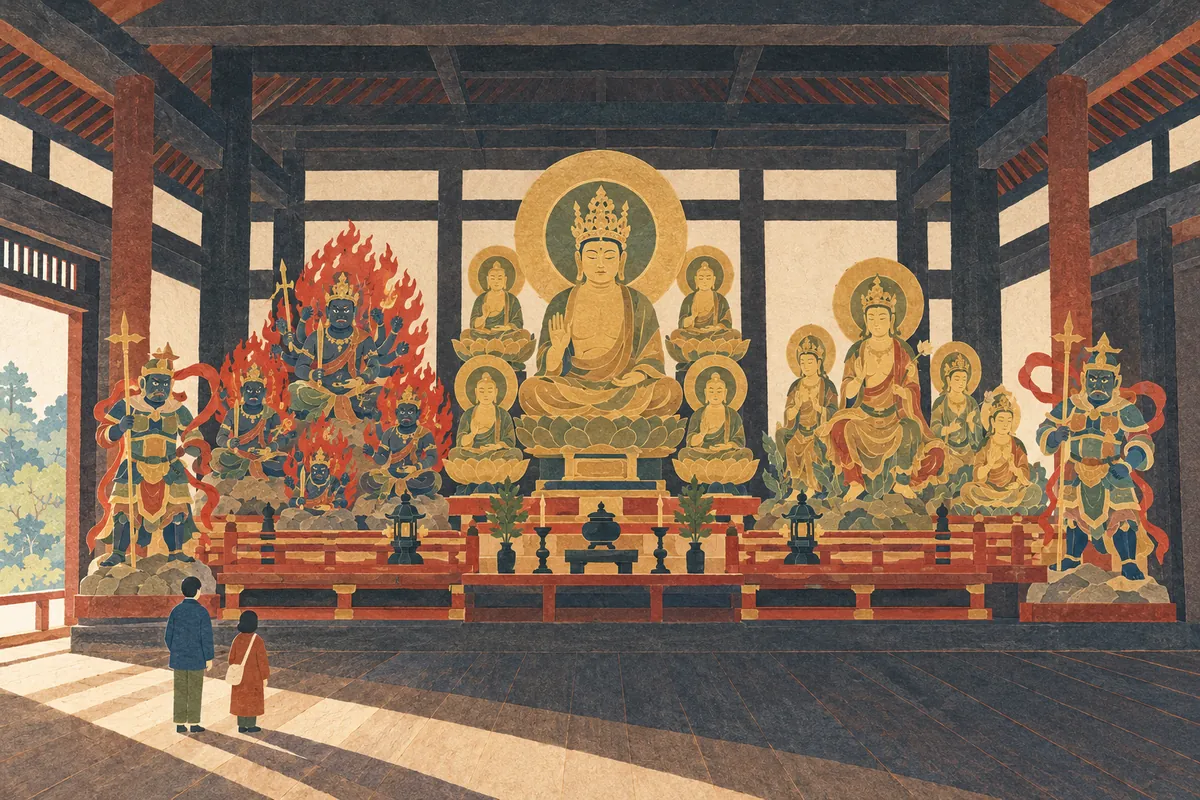
Key points
The National Treasures are the Heian-period Five Great Bodhisattvas, Five Great Wisdom Kings, and six guardian deities; the central Five Wisdom Buddhas, re-created in the Muromachi and Edo periods, are Important Cultural Properties
Dainichi Nyorai, drawn at the center of a painted mandala, sits at the center of the shumidan, turning the mandala into an arrangement of statues
The statues form five groups on the shumidan: bodhisattvas and wisdom kings flank the central Buddhas, and the Four Heavenly Kings guard the corners
The Kōdō, burned in 1486, was rebuilt five years later, while the Kondō, burned around the same time, had to wait until 1603
A mandala expressed through statues
Tō-ji (Kujō-chō, Minami Ward) was built in 796 (Enryaku 15) as an official temple of Heian-kyō and was entrusted to Kōbō Daishi Kūkai in 823 (Kōnin 14). In its grounds, the Nandaimon (Great South Gate), Kondō (Main Hall), Kōdō (Lecture Hall), and Jikidō (refectory) are lined up on a north–south axis, with the Kōdō standing north of the Kondō. Kūkai first set to work on building the Kōdō as the central building for transmitting Esoteric Buddhism.
A mandala is a depiction that makes the teachings of Esoteric Buddhism easier to understand, and there are the Womb Realm (Taizōkai) mandala and the Diamond Realm (Kongōkai) mandala. Kūkai thought of making the world of this mandala visible through an arrangement of statues. This is the katsuma mandara, generally called the rittai mandara (three-dimensional mandala). Just as Dainichi Nyorai is painted at the center of a mandala, Dainichi Nyorai is placed at the center of the shumidan (altar platform), surrounded by statues of buddhas (nyorai), bodhisattvas (bosatsu), wisdom kings (myōō), and devas (ten).
The eye-opening ceremony for the deities of the Kōdō was held in 839 (Jōwa 6), four years after Kūkai entered eternal meditation (nyūjō) on Mount Kōya in 835 (Jōwa 2).
How the statues are arranged
The 21 statues stand on a long east–west shumidan, divided into five groups. Facing the central Dainichi Nyorai, the right side is east and the left side is west.
Layout of the Rittai Mandara in Tō-ji's Kōdō (Schematic Diagram)
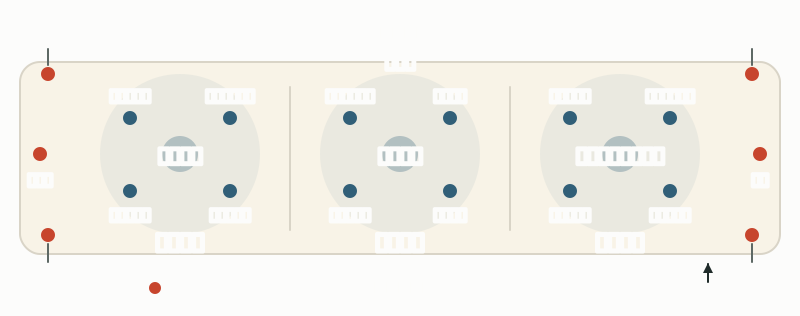
- Center: the Five Wisdom Buddhas (Gochi Nyorai). Dainichi Nyorai of the Diamond Realm, forming the chiken-in (wisdom-fist mudra), is surrounded by four buddhas: Ashuku, Hōshō, Amida, and Fukūjōju
- Right as you face it (east): the Five Great Bodhisattvas. Kongō Haramitta Bosatsu at the center, with the bodhisattvas Kongō Satta, Kongōhō (Vajra Jewel), Kongōhō (Vajra Dharma), and Kongōgō
- Left as you face it (west): the Five Great Wisdom Kings. Fudō Myōō at the center, with the wisdom kings Gōzanze, Gundari, Daiitoku, and Kongō Yasha
- East and west ends: Bonten (Brahmā) at the east and Taishakuten (Indra) at the west
- The four corners of the shumidan: the Four Heavenly Kings. At the front (south), Jikokuten in the east and Zōchōten in the west; at the back (north), Kōmokuten in the west and Tamonten in the east
National Treasures and Important Cultural Properties
Of the statues in the rittai mandara, the 15 from the Heian period are National Treasures. The 6 statues of Bonten, Taishakuten, and the Four Heavenly Kings are guardian deities, placed so as to protect the buddhas, bodhisattvas, and wisdom kings at the center.
The seated statue of Kongō Haramitta Bosatsu, the central figure of the Five Great Bodhisattvas, is not an original statue from the time of the founding and is thought to be a Muromachi-period work. In 2012 (Heisei 24) it was added to the National Treasure "Wooden Seated Statues of the Five Great Bodhisattvas" (4 statues) as a tsuketari, an item designated together with the main property as an attachment.
The seated Dainichi Nyorai at the center burned in a fire caused by a peasant uprising (tsuchi ikki) in 1486 (Bunmei 18), and was re-created in 1493–1497 (Meiō 2–6) by Kōchin, a Buddhist sculptor of the Shichijō Bussho workshop, and others. One of the small transformation Buddhas (kebutsu) on its halo is thought to date from the original founding. The four surrounding buddhas are Edo-period works except for the head of Amida Nyorai (late Heian period), and they are included in the Important Cultural Property as attachments to the Dainichi Nyorai.
Cultural property designations of the statues in Tō-ji's Kōdō
| Group | Number | Designation (year) |
|---|---|---|
| Five Wisdom Buddhas | 5 statues | Important Cultural Property (1993) |
| Five Great Bodhisattvas | 5 statues | National Treasure (1954) |
| Five Great Wisdom Kings | 5 statues | National Treasure (1952) |
| Bonten and Taishakuten | 2 statues | National Treasure (1954) |
| Four Heavenly Kings | 4 statues | National Treasure (1954) |
The Kōdō, rebuilt in the Muromachi period
According to Tō-ji's own account, work on the Kōdō began in 823 (Kōnin 14) and was completed in 839 (Jōwa 6), the same year as the eye-opening ceremony for the deities. That Kōdō also burned in the fire caused by the peasant uprising of 1486 (Bunmei 18), but whereas the rebuilding of the Kondō, which burned around the same time, had to wait until 1603 (Keichō 8), the Kōdō was rebuilt quickly, five years later, in 1491 (Entoku 3). This is the present Kōdō.
The building is nine bays wide and four bays deep, with an irimoya roof and full tile roofing (hongawarabuki). It was designated an Important Cultural Property on October 14, 1940 (Shōwa 15), and was dismantled and repaired in 1953–1958 (Shōwa 28–33). The statues in the hall were long kept as hidden Buddhas (hibutsu), and it was only in 1965 (Shōwa 40) that the doors of the Kondō and Kōdō were opened and they were shown to the public.
Admission and the special opening of the shumidan's north side
Tō-ji is at 1 Kujō-chō, Minami Ward. It is a 10-minute walk (about 0.6 km) from Kintetsu Tōji Station or a 15-minute walk (about 1.1 km) from the Hachijō exit of JR Kyoto Station, and the nearest city bus stops include "Tōji Higashimon-mae." The gates open 5:00–17:00, and the Kondō and Kōdō can be visited 8:00–17:00 (reception until 16:30) (as of October 2026).
The Kondō and Kōdō are open year-round for a fee: in the regular season, 800 yen for adults, 400 yen for high school students, and 300 yen for junior high school students and younger. During special openings of the first story of the five-story pagoda, the fee includes the first story (1,200 yen for adults, 700 yen for high school students, and 500 yen for junior high school students and younger). Visiting the Jikidō and some other buildings is free.
From October 31 to December 13, 2026, the north side of the Kōdō's shumidan is specially opened, so you can walk all the way around the rittai mandara. During the same period there is also a special evening viewing (18:00–21:30, reception until 21:00; 1,000 yen for adults and high school students, 500 yen for junior high school students and younger).
Mini quiz for this entry
On the shumidan (altar platform) of Tō-ji's Kōdō, which group of statues stands to the right (east) as you face the central Dainichi Nyorai?
Of the four buddhas seated around Dainichi Nyorai in Tō-ji's Kōdō, which one has a head thought to date from the late Heian period?
Sources and verification
Content checked: October 19, 2026
Updated: October 19, 2026
References are in Japanese.
- 東寺「講堂」
- 東寺「立体曼荼羅」
- 東寺「天、菩薩、明王、如来」
- 東寺「東寺の歴史」
- 東寺「よくあるご質問」
- 東寺「拝観のご案内」
- 東寺「交通のご案内」
- 東寺「2026秋期特別公開」
- 文化庁「国指定文化財等データベース 木造五大明王像(講堂安置)」
- 文化庁「国指定文化財等データベース 木造五大菩薩坐像(講堂安置)」
- 文化庁「国指定文化財等データベース 木造〈梵天坐像/帝釈天半跏像〉(講堂安置)」
- 文化庁「国指定文化財等データベース 木造四天王立像(講堂安置)」
- 文化庁「国指定文化財等データベース 木造大日如来坐像〈康珍作/講堂安置〉」
- 文化庁「国指定文化財等データベース 教王護国寺講堂」
- 文化庁「国指定文化財等データベース 教王護国寺金堂」
- 文化庁 文化遺産オンライン「木造大日如来坐像〈康珍作/講堂安置〉」
- 文化庁 文化遺産オンライン「世界遺産推薦書 古都京都の文化財 C 教王護国寺」
- 観光庁「地域観光資源の多言語解説文データベース 講堂の中:立体曼荼羅」