
The Subtemples of Daitoku-ji: Open All Year or Only for Special Openings (Daisen-in, Ryōgen-in, Zuihō-in, Kōtō-in)
Other spellings and namesDaitoku-ji (大徳寺) / Ryūhōzan Daitoku-ji / Daitoku-ji subtemples (tatchū) / Daisen-in / Ryōgen-in / Zuihō-in / Kōtō-in / Ōbai-in / Sōken-in / Kōrin-in / Jukō-in / Murasakino
Key points
The grounds hold 2 branch temples (betsuin) and 20 subtemples (as of October 2026)
Daisen-in is open all year, 9:00–16:30; 500 yen for adults and 300 yen for elementary and junior high school students (as of October 2026)
The main temple (Hōjō and Karamon) is normally closed. The annual airing exhibition (Bakuryōten) has been canceled since 2021 for restoration work and is canceled again in fiscal 2026
At the Tokyo National Museum's special exhibition (until December 6, 2026), Ryōkō-in's yōhen tenmoku bowl and Kannon, Monkeys, and Cranes are shown until November 8 (first term), and Kōtō-in's landscape paintings from November 10 (second term)
What kind of temple is Daitoku-ji? Shūhō Myōchō, Ikkyū, Rikyū, and the warlords
Daitoku-ji, in Murasakino, Kita Ward, is the head temple of the Daitoku-ji branch of the Rinzai school, and its mountain name (sangō) is Ryūhōzan (龍寶山). It is said to have been founded in 1315 (Shōwa 4), at the end of the Kamakura period, by Shūhō Myōchō (宗峰妙超), known as Daitō Kokushi (大燈国師). With the devotion of Emperors Hanazono and Go-Daigo it became a temple for imperial prayers (chokuganjo) and was called "Honchō Musō Zen'en," the finest Zen temple in the land. There is also a way of counting that makes 2026 the 700th anniversary of its founding, which takes 1326 as the year the temple was opened.
The temple buildings, left in ruins by the Ōnin War, were restored by Ikkyū Sōjun (一休宗純). In the Momoyama period Toyotomi Hideyoshi held Oda Nobunaga's funeral here, built Sōken-in to pray for Nobunaga's soul, and donated temple lands; after this, warlords built subtemples one after another. The upper story of the Sanmon gate was added by Sen no Rikyū, who named it Kinmōkaku (金毛閣). It is said that placing a statue of Rikyū there angered Hideyoshi and was one of the reasons Rikyū was ordered to take his own life.
What is a tatchū? Twenty subtemples in the grounds
A tatchū (塔頭) was originally a small building with a stupa holding the remains of a Zen temple's founder or an eminent monk. Over time these became subtemples belonging to the head temple and also served as the family temples (bodaiji) of daimyō and wealthy merchants. As of October 2026, the grounds of Daitoku-ji hold 2 branch temples and 20 subtemples.
Ryōgen-in was built in 1502 (Bunki 2) by Hatakeyama Yoshimoto, military governor (shugo) of Noto, and others; Zuihō-in in 1535 (Tenbun 4) by Ōtomo Sōrin as his own family temple; Kōtō-in in 1601 (Keichō 6) by Hosokawa Tadaoki; and Ryōkō-in in 1606 (Keichō 11) by Kuroda Nagamasa to pray for his father. Most subtemples are not open to visitors at ordinary times, and you can only look into the front garden from the outer gate.
Subtemples open at ordinary times and those with special openings (autumn 2026)
The subtemples open at ordinary times are Daisen-in, Ryōgen-in, and Zuihō-in. Daisen-in was founded in 1509 (Eishō 6); its main hall (hondō) from 1513 (Eishō 10) is a National Treasure and its shoin is an Important Cultural Property. The main hall, together with that of Ryōgen-in, is regarded as one of the oldest Zen abbot's quarters (hōjō) buildings, and the shoin garden, where numerous large stones are placed within a limited area to suggest mountains and the flow of a valley stream, is a Special Place of Scenic Beauty. At Zuihō-in, the Dokuza-tei (独坐庭) south of the hōjō and the Kanmin-tei (閑眠庭) to the north, whose stones are arranged in the shape of a cross, were made by Shigemori Mirei (重森三玲) in 1961.
In autumn, special openings are held at Jukō-in, Sen no Rikyū's family temple; Sōken-in, built by Hideyoshi to pray for Nobunaga; Ōbai-in, which has the Jikichū-tei (直中庭) garden said to be Rikyū's work; and Kōrin-in, whose main hall roof is said to have been repaired by Maeda Toshiie. The main hall of Sōken-in enshrines the wooden seated statue of Oda Nobunaga (Important Cultural Property) that Hideyoshi dedicated.
Viewing at the main subtemples of Daitoku-ji (as of October 2026)
| Subtemple | When open | Highlights | Admission |
|---|---|---|---|
| Daisen-in | All year (9:00–16:30) | National Treasure main hall (1513) and the shoin garden, a Special Place of Scenic Beauty | 500 yen for adults, 300 yen for elementary and junior high school students |
| Ryōgen-in | All year | Important Cultural Property main hall (around 1517) and dry landscape gardens | Charged (check with the temple for fees) |
| Zuihō-in | All year | Ōtomo Sōrin's family temple. Shigemori Mirei's Dokuza-tei and Kanmin-tei gardens | Charged (check with the temple for fees) |
| Kōtō-in | Closed to visitors in 2026 (reopening undecided) | Founded by Hosokawa Tadaoki. Maple garden | ― |
| Ōbai-in | Autumn special opening (October 9 – December 6) | Jikichū-tei garden, said to be Rikyū's work | 1,000 yen for adults, 500 yen for junior high and high school students, free for elementary school age and under (with a guardian) |
| Sōken-in | Spring and autumn special openings (autumn 2026: October 10 – November 30) | Wooden seated statue of Oda Nobunaga (Important Cultural Property) | 800 yen for adults, 400 yen for junior high and high school students, free for elementary school age and under (with a guardian) |
| Kōrin-in | Autumn special opening (September 5–29 and October 3 – December 15) | Important Cultural Property main hall and hōjō garden | 800 yen for adults, 400 yen for junior high and high school students, 300 yen for elementary school students (with a guardian) |
| Jukō-in | Special opening (September 18 – December 6) | Rikyū's family temple. The National Treasure wall and sliding-door paintings by Kanō Eitoku and others are shown as reproductions | 1,000 yen for adults, 500 yen for elementary, junior high, and high school students (preschool children not admitted) |
| Ryōkō-in | Normally closed | National Treasure shoin; owns a yōhen tenmoku tea bowl | ― |
What National Treasures does Daitoku-ji have, and where can you see them now?
The National Treasure buildings are the main temple's Hōjō (1635, Kan'ei 12) and its entrance hall (genkan), the Karamon gate in front of the Hōjō, the main hall of Daisen-in, and the shoin of Ryōkō-in. The Karamon is said to be a remnant of the Jurakudai, and the Hōjō garden is a Special Place of Scenic Beauty. The main temple is normally closed, and the Bakuryōten (曝凉展), an exhibition held every year on the second Sunday of October while the temple treasures were aired, has been canceled since 2021 for restoration work and is also canceled in fiscal 2026.
Among paintings, Kannon, Monkeys, and Cranes by Muqi (牧谿, Mokkei), the portrait of Daitō Kokushi, the Hōjō wall and sliding-door paintings of Jukō-in, and the landscape paintings of Kōtō-in are National Treasures. Some of them are shown at the Tokyo National Museum (Ueno, Tokyo) in the special exhibition marking the 700th anniversary of Daitoku-ji's founding, "Daitoku-ji: Honchō Musō no Zen'en" (October 14 – December 6, 2026). It displays 14 National Treasures and 69 Important Cultural Properties, and most works change between the first term (until November 8) and the second term (from November 10). Kannon, Monkeys, and Cranes and Ryōkō-in's yōhen tenmoku bowl are in the first term, Kōtō-in's landscape paintings in the second term, and Kanō Eitoku's sliding doors from Jukō-in are shown 4 panels at a time in each term.
Layout of the grounds: halls in a north–south line and the subtemples around them
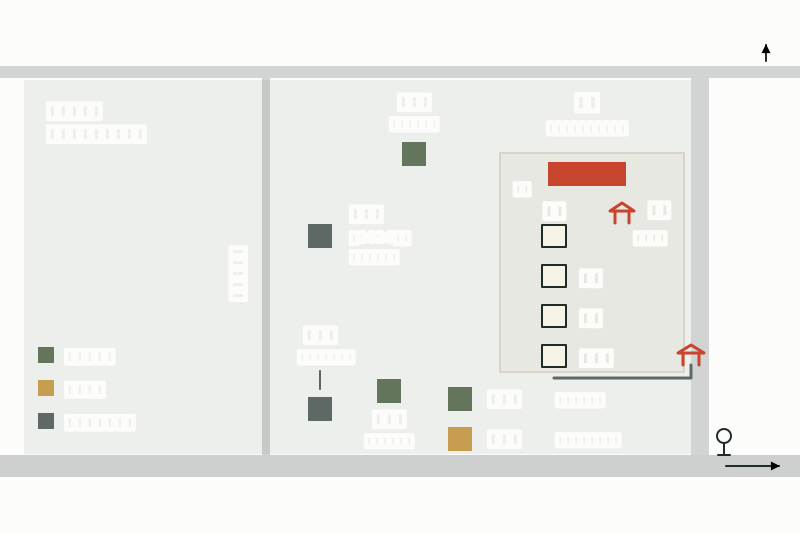
The grounds are bounded by Kitaōji-dōri on the south, Imamiya-dōri on the north, and Daitokuji-dōri (formerly Ōmiya-dōri) on the east, and they became a national Historic Site as the "Daitoku-ji Grounds" in 2016. Inside the Sōmon (main gate) on the east, the Chokushimon, Sanmon, Butsuden (Buddha Hall), and Hattō (Dharma Hall) stand in a line from south to north, with the Karamon and the Hōjō north of them. Daisen-in is northwest of the Hōjō, and Ryōgen-in is southwest of the Chokushimon, with Ōbai-in to its south and Zuihō-in to its west. Kōtō-in and Ryōkō-in stand in a north–south line on the west side of the grounds, east of Imamiya Monzen-dōri.
The Grounds and Main Subtemples of Daitoku-ji (Schematic)
Where can you see it now? / Getting there
The address is 53 Murasakino Daitokuji-chō, Kita Ward. From Kyoto Station, take city bus route 206 or another route and get off at "Daitokuji-mae," or take the Karasuma subway line to Kitaōji Station and change to a city bus to "Daitokuji-mae." Walking from Kitaōji Station takes about 20 minutes.
- Temple buildings in the grounds: you can walk the stone-paved path from the Sōmon and see the Chokushimon (Important Cultural Property) from outside. The Sanmon and Hattō are closed to the public, though the Hattō is sometimes opened specially at irregular times
- Ordinary visits: Daisen-in (500 yen for adults, 300 yen for elementary and junior high school students), Ryōgen-in, and Zuihō-in
- Special openings: as in the table. Sōken-in and Ōbai-in are free for children of elementary school age and under with a guardian; preschool children cannot enter Jukō-in
- National Treasure paintings and the yōhen tenmoku bowl: special exhibition at the Tokyo National Museum (October 14 – December 6, 2026). The yōhen tenmoku bowl and Kannon, Monkeys, and Cranes are shown in the first term until November 8, and Kōtō-in's landscape paintings in the second term from November 10. Closed on Mondays (open November 2, 23, and 30; closed November 24); 2,300 yen for general admission, free for junior high school students and younger
Mini quiz for this entry
Who added the upper story of Daitoku-ji's Sanmon gate, named it "Kinmōkaku," and placed a statue of himself there, which is said to have angered Toyotomi Hideyoshi?
Which subtemple of Daitoku-ji did Toyotomi Hideyoshi build to pray for Oda Nobunaga, and enshrines in its main hall the wooden seated statue of Oda Nobunaga (Important Cultural Property) that Hideyoshi dedicated?
Sources and verification
Content checked: October 28, 2026
Updated: October 28, 2026
References are in Japanese.
- 大本山 大徳寺「概略」
- 大本山 大徳寺「境内」(大徳寺山内図)
- 大本山 大徳寺「交通」
- 臨黄合議所「大徳寺」(臨黄ネット)
- 京都市観光協会「大徳寺」(京都観光Navi)
- 京都市観光協会「曝凉展(ばくりょうてん)【大徳寺本坊】」(京都観光Navi)
- 京都市観光協会「大仙院」(京都観光Navi)
- 大仙院「拝観案内」
- 京都市観光協会「龍源院」(京都観光Navi)
- 京都市観光協会「龍源院」駒札(京都観光Navi)
- 京都市観光協会「瑞峯院」(京都観光Navi)
- 京都市観光協会「瑞峯院」駒札(京都観光Navi)
- 京都市都市緑化協会「京の庭を訪ねて 大徳寺・瑞峯院庭園」
- 京都市観光協会「大徳寺」(きょうと修学旅行ナビ)
- 京都市観光協会「高桐院」(京都観光Navi)
- 京都市観光協会「総見院」(京都観光Navi)
- 京都市観光協会「大徳寺塔頭 総見院 秋の特別公開」(京都観光Navi)
- 京都市観光協会「大徳寺塔頭 黄梅院 秋の特別公開」(京都観光Navi)
- 京都春秋「大徳寺 黄梅院」
- 京都市観光協会「大徳寺塔頭 興臨院 秋の特別公開」(京都観光Navi)
- 京都市観光協会「大徳寺 聚光院 開創460年 特別公開」(京都観光Navi)
- MIHO MUSEUM「大徳寺龍光院 国宝 曜変天目と破草鞋」(2019年)
- JAANUS(日本建築・美術用語辞典)「tatchuu 塔頭」
- 東京国立博物館「開創700年記念 特別展『大徳寺 本朝無双之禅苑』」
- 東京国立博物館ほか「開創700年記念 特別展 大徳寺」(展覧会公式サイト)
- 特別展「大徳寺 本朝無双之禅苑」出品目録(PDF)
- 文化庁「国指定文化財等データベース 大徳寺(方丈)」
- 文化庁「国指定文化財等データベース 大徳寺(玄関)」
- 文化庁「国指定文化財等データベース 大徳寺唐門」
- 文化庁「国指定文化財等データベース 大徳寺勅使門」
- 文化庁「国指定文化財等データベース 大仙院本堂」
- 文化庁「国指定文化財等データベース 大仙院書院」
- 文化庁「国指定文化財等データベース 龍源院本堂」
- 文化庁「国指定文化財等データベース 龍光院書院」
- 文化庁「国指定文化財等データベース 大徳寺境内」
- 文化庁「国指定文化財等データベース 大徳寺方丈庭園」
- 文化庁「国指定文化財等データベース 大仙院書院庭園」
- 文化庁「国指定文化財等データベース 興臨院本堂」
- 文化庁「国指定文化財等データベース 絹本墨画淡彩観音図〈牧谿筆〉」(大徳寺)
- 文化庁「国指定文化財等データベース 絹本著色大燈国師像」
- 文化庁「国指定文化財等データベース 方丈障壁画」(聚光院)
- 文化庁「国指定文化財等データベース 絹本墨画山水図」(高桐院)