
Japanese島原・角屋(しまばら・すみや)
Shimabara and the Sumiya
Other spellings and namesNishi-Shinyashiki (西新屋敷)
Key points
The official place name is Nishi-Shinyashiki, divided into six town names
One theory links the name Shimabara to the commotion of the move, likened to the Shimabara Rebellion; another to the moated, walled town resembling Shimabara Castle
Okiya kept the tayū, while ageya called them from the okiya to host banquets
In the late Edo period both pro-imperial and pro-shogunate factions used the Sumiya; a marker for Kusaka Genzui's secret meetings and Serizawa Kamo's sword cuts remain
Nishi-Shinyashiki, the official name for "Shimabara"
Shimabara is the district to which the Nijō Yanagimachi pleasure quarter, officially licensed by Toyotomi Hideyoshi, moved by way of Rokujō Misujimachi. The move took place in 1641 (Kan'ei 18), and its new location was farmland west of Ōmiya-dōri.
"Shimabara" (島原) is a popular name, and the official place name is Nishi-Shinyashiki (西新屋敷). Even today there are six town names in Shimogyō Ward: Nishi-Shinyashiki Ageya-chō (揚屋町), Tayū-chō (太夫町), Naka-no-chō (中之町), Kami-no-chō (上之町), Chūdōji-chō (中堂寺町), and Shimo-no-chō (下之町). The neighborhoods are divided into north and south sides along each of the streets that cross the "Dōsuji" (道筋), the main street running west from the Ōmon gate. The district extends from the Shimabara Ōmon gate in the east to Senbon-dōri in the west, measuring 194.9 m east to west and 242.1 m north to south.
Two theories on the name "Shimabara"
The best-known theory is that the commotion at the time of the move reminded people of the Shimabara Rebellion, which had broken out in Kyushu a few years earlier (it ended in 1638, Kan'ei 15), and that people joked it was "just like the Shimabara Rebellion."
Another theory is that the appearance of the district was likened to Shimabara Castle in the Shimabara Rebellion. The relocated pleasure quarter was surrounded by a moat with an earthen wall built inside it, separating it from the surrounding farmland, and its only entrance was on the east side. Neither theory has conclusive evidence.
Ageya and okiya
Shimabara flourished as a town of banquets with songs and dances, and gatherings for waka and haikai poetry were also popular, so much so that a "Shimabara haikai circle" had formed by the mid-Edo period. Banquets involved a division of labor between the "okiya" (置屋), which kept and trained tayū and geiko (geisha), and the "ageya" (揚屋), which kept no performers of their own but called tayū and others from the okiya to hold banquets. An ageya also served food and corresponds to today's ryōtei (traditional high-class restaurant).
Tayū held the highest rank among the women of the hanamachi and acquired learning in tea, flower arrangement, waka, haikai, and so on, in addition to dance and music. At the same time, Shimabara was also a pleasure quarter officially recognized by the shogunate, and the Wachigaiya, too, was once an okiya that kept tayū and courtesans (yūjo). Shimabara's business as a hanamachi ended in 1977 (Shōwa 52), but the Wachigaiya has continued to operate and keep tayū since then, and tayū processions (tayū dōchū) are performed at events at Kyoto's temples and shrines.
The Sumiya
The Sumiya is an ageya that has passed down its building and family headship since Shimabara was opened, and tradition says it was moved here from Rokujō Misujimachi. It was extended to the north in the Enpō era (1673–81) and to the south in 1787 (Tenmei 7), reaching almost its present size. It is the only surviving example of ageya architecture and was designated a national Important Cultural Property on March 29, 1952 (Shōwa 27).
Ageya buildings were characterized by always having a tea room in the large garden facing the great banquet room, and a kitchen as large as the kuri (priests' quarters and kitchen) of a temple. The usual explanation for the name "ageya" is that ageya from the early to the mid-Edo period were buildings with narrow frontages, with the banquet rooms on the second floor, so guests were "raised" (ageru) to the second floor. The Sumiya operated as an ageya until 1872 (Meiji 5), and afterward continued holding banquets as an ochaya (teahouse) in the "Matsu no Ma" (Pine Room) until 1985 (Shōwa 60). Today's Matsu no Ma is a one-story annex built in 1926 (Taishō 15).
The paintings of red and white plum blossoms by Yosa Buson mounted on the sliding doors of the Ume no Ma (Plum Room) on the second floor were designated an Important Cultural Property on June 6, 1983 (Shōwa 58), together with a four-panel folding screen thought to have originally formed part of the same set of sliding-door paintings.
Main buildings remaining in Shimabara
| Name | What kind of building | Type of cultural property | Open to the public |
|---|---|---|---|
| Sumiya (角屋) | Ageya (banquet house) | National Important Cultural Property (main building and others). The Matsu no Ma is a national Registered Tangible Cultural Property, and the garden is a Kyoto City Designated Place of Scenic Beauty | Open only during opening periods |
| Shimabara Ōmon | The main gate at the eastern entrance to Shimabara. A kōraimon gate built in 1867 (Keiō 3) | Kyoto City Registered Tangible Cultural Property (registered 1986) | Stands along the street and can be seen from outside |
| Wachigaiya (輪違屋) | An okiya that keeps tayū and geiko. Founded in the Genroku era (1688–1704) | Kyoto City Designated Tangible Cultural Property | Closed to the public |
The Sumiya at the end of the Edo period
At the end of the Edo period, the Sumiya was used for meetings by both the pro-imperial and pro-shogunate sides. In 1984 (Shōwa 59), a stone marker was erected in front of the Sumiya as the place where Kusaka Genzui, a samurai of the Chōshū domain, held repeated secret discussions about "revere the emperor, expel the barbarians" (sonnō jōi). Kusaka later took his own life in the Hamaguri Gate Incident.
The Shinsengumi also amused themselves at the Sumiya, and it is known that Serizawa Kamo ran wild there while drunk; sword cuts said to be his remain, and he had been drinking at the Sumiya on the night he was assassinated. The Sumiya itself, however, was never the scene of a brawl.
Getting to the Sumiya and opening days
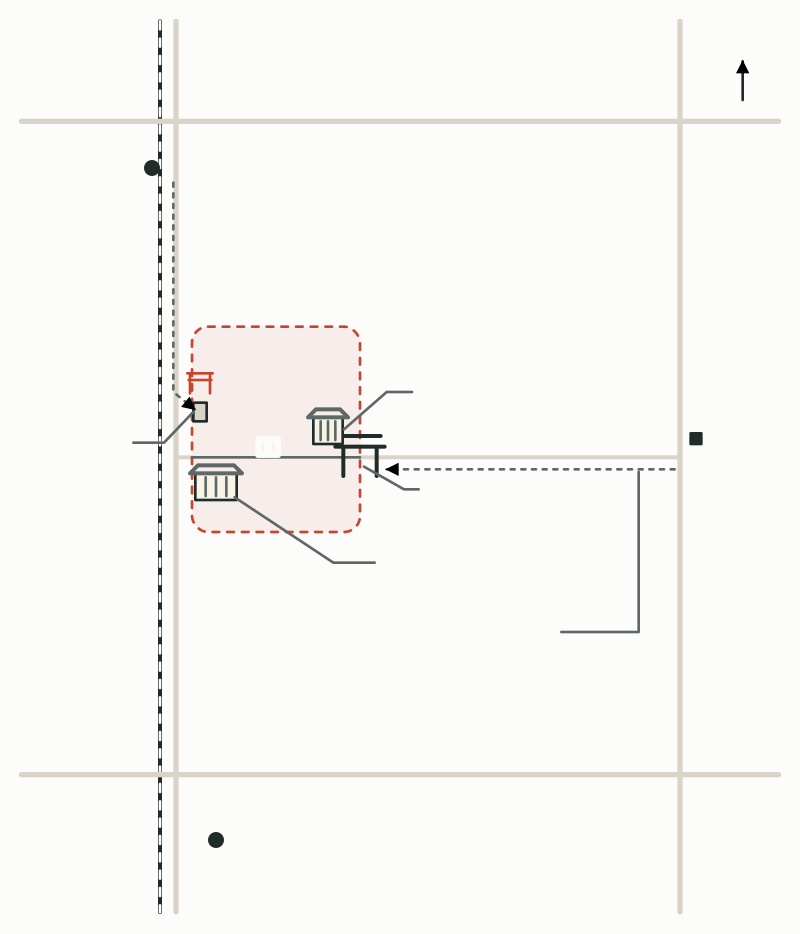
Shimabara is in Shimogyō Ward, between Senbon-dōri and Ōmiya-dōri and between Gojō-dōri and Shichijō-dōri. From JR Tanbaguchi Station, walk south along Senbon-dōri beside the raised tracks and enter at the site of the West Gate beside Shimabara Sumiyoshi Shrine; it is a 7-minute walk to the Sumiya. It is an 8-minute walk from JR Umekōji-Kyōtonishi Station. If you take City Bus Route 206 or 207 from Shijō-Ōmiya, get off at "Shimabaraguchi" on Ōmiya-dōri and walk straight west along Hanayachō-dōri for about 10 minutes. The Shimabara Ōmon stands at the eastern entrance of the street.
The Sumiya Motenashi Museum of Art and Culture (32 Nishi-Shinyashiki Ageya-chō, Shimogyō Ward) is open only during limited periods; in autumn 2026 (Reiwa 8) it opens on Fridays, Saturdays, Sundays, and public holidays from September 18 to December 13 (10:00 until reception closes at 15:30). The first floor (kitchen and great banquet room) and the exhibition room are shown on guided tours at set times with no reservation needed, for 1,000 yen for adults, 800 yen for junior high and high school students, and 500 yen for elementary school students (as of October 2026). The special opening of the second-floor rooms requires a reservation and costs an additional 1,000 yen for adults and 700 yen for junior high and high school students on top of the first-floor admission; elementary school students and younger cannot enter.
Shimabara (Nishi-Shinyashiki) and the Surrounding Streets and Stations
Mini quiz for this entry
When is Wachigaiya, the okiya in Shimabara that still keeps tayū, said to have been founded?
In an ageya building such as Sumiya, what was always placed in the large garden facing the main banquet room?
Sources and verification
Content checked: October 22, 2026
Updated: October 22, 2026
References are in Japanese.
- 文化庁「国指定文化財等データベース 角屋」
- 文化庁「国指定文化財等データベース 角屋松の間」
- 文化庁「国指定文化財等データベース 紙本金地墨画淡彩紅白梅図〈与謝蕪村筆/四曲屏風〉」
- 京都市・京都市埋蔵文化財研究所「京都歴史散策マップ13 京都駅北」
- 京都市都市計画局「歴史的資産周辺の景観情報(プロファイル)本願寺(西本願寺)周辺エリア」
- 京都市「いしぶみデータベース SI037 島原西門碑」
- 京都市「いしぶみデータベース SI020 長州藩士久坂玄瑞の密議の角屋」
- 京都市「いしぶみデータベース SI058 歌舞練場跡記念碑」
- 京都市教育委員会「京都市通学区町名一覧(下京区)」
- 公益財団法人角屋保存会「島原の文化史(島原のQ&A)」
- 公益財団法人角屋保存会「角屋保存の意義(角屋のQ&A)」
- 公益財団法人角屋保存会「島原の文芸碑紹介」
- 公益財団法人角屋保存会「角屋もてなしの文化美術館(令和8年企画展・開催概要)」
- 公益財団法人角屋保存会「交通案内」
- 京都市観光協会「京都観光Navi 角屋もてなしの文化美術館」
- 京都市産業観光局(「坂本龍馬と歩く京のまち」広域・南)
- 京阪グループ「京都ツウのススメ 第144回 島原の太夫(たゆう)」