
Japanese撞木町(しゅもくまち)
Shumoku-machi
Other spellings and namesShumoku-cho (しゅもくちょう) / Shumokumachi / Shumoku-machi pleasure quarter / 撞木町遊廓
In short
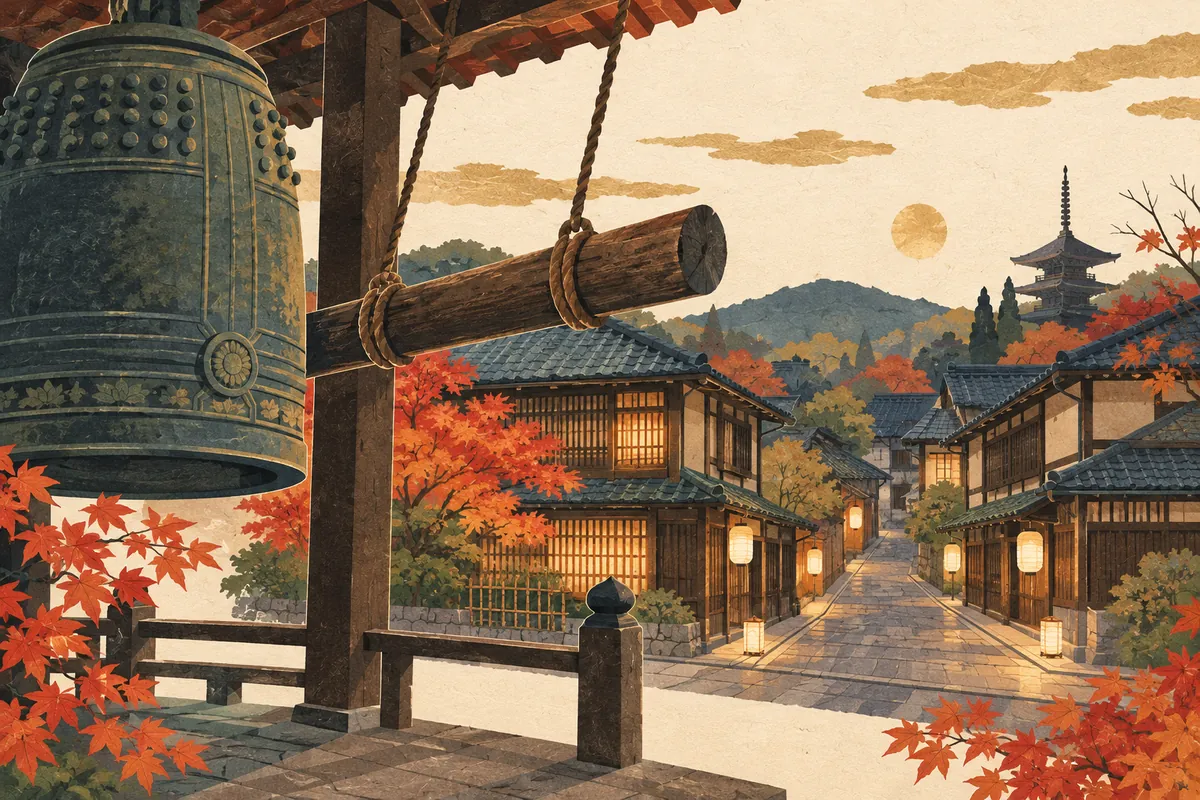
撞木町 is a town name in Fushimi Ward, read Shumoku-machi (しゅもくまち) as a town name. The name is said to have arisen because the pleasure quarter opened here in 1604 (Keichō 9) was shaped like a shumoku, the T-shaped striker used to ring a bell, and this is also carved on a monument erected in 1918 (Taishō 7).Key points in 30 seconds
As a town name it is read Shumoku-machi (しゅもくまち); as the name of the pleasure quarter and historic site it is also read Shumoku-chō (しゅもくちょう)
The name is said to come from the quarter's resemblance to a shumoku, a T-shaped bell striker
Opened in 1604 (Keichō 9) and flourished in the Genroku era
Known as the place where Ōishi Yoshio (Kuranosuke) amused himself
A Town Name Read "Machi"
撞木町 in Fushimi Ward is read Shumoku-machi (しゅもくまち) as a town name. Most town names in Kyoto City end in -chō, so this reading is somewhat unusual. It is in the school district of Fushimi Sumiyoshi Elementary School and Fushimi Junior High School.
However, as the name of the old pleasure quarter and the historic site, 撞木町 is also read Shumoku-chō (しゅもくちょう), and readings differ among sources. Dictionaries give the popular name of the pleasure quarter as Shumoku-machi and also list the form Shimoku-machi.
Readings and spellings of 撞木町
| Name | Reading or spelling |
|---|---|
| 撞木町 (current town name in Fushimi Ward) | Shumoku-machi (しゅもくまち) |
| 撞木町 (as the name of the pleasure quarter and historic site) | Shumoku-chō (しゅもくちょう) |
| 撞木町 (popular name of the Edo-period pleasure quarter) | Shumoku-machi or Shimoku-machi; the formal name was Ebisu-chō (夷町, えびすちょう) |
| 橦木町廓之碑 (monument to the quarter) | The monument's title uses 橦, with the tree radical 木 |
A Pleasure Quarter Shaped Like a Shumoku
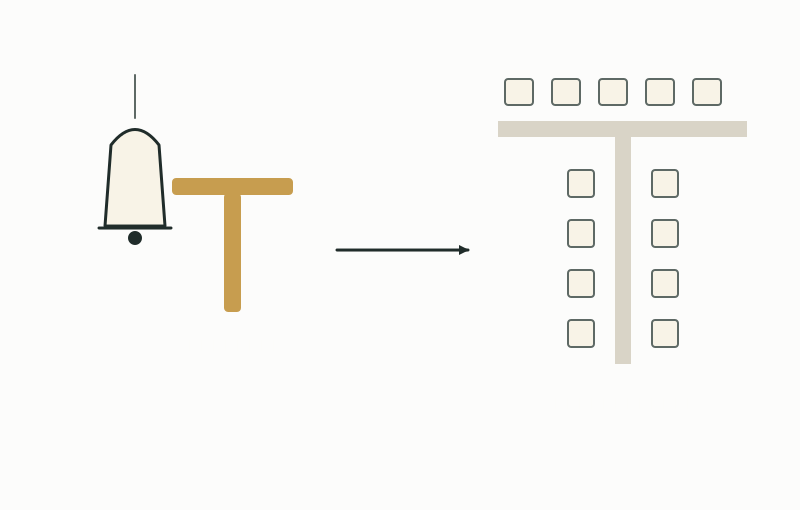
A shumoku (撞木) is a T-shaped stick used to strike a bell or gong. It also refers to the beam used to ring a hanging temple bell, and besides shumoku it can be read shimoku. The same word appears in the name of the hammerhead shark, shumokuzame (撞木鮫), whose head spreads out in a T shape.
The Shumoku-machi pleasure quarter was opened in 1604 (Keichō 9) by two men, Watanabe Kamon and Maehara Hachiemon. The inscription on the monument 橦木町廓之碑, erected in 1918 (Taishō 7), records that they petitioned the magistrate of Fushimi at the time and revived the quarter on the former site of the residence of Tomita Shinano-no-kami, and that the name Shumoku-machi came from the quarter being shaped like a shumoku.
Shumoku-machi was a pleasure quarter opened on the former site of Tomita Shinano-no-kami's residence in Ebisu-machi, Fushimi, and the name is said to have arisen because the quarter's layout resembled a shumoku (a T-shaped stick for ringing a bell). It is also said that it was popularly called Shumoku-machi because the town's layout resembled a T.
The Shumoku and a T-Shaped Townscape
The Pleasure Quarter Where Ōishi Yoshio Amused Himself
Shumoku-machi flourished along with the growth of Fushimi and reached its height in the Genroku era (1688–1704). It is known as the place where Ōishi Yoshio, leader of the Akō rōnin (the masterless samurai of the Forty-Seven Rōnin story), indulged in pleasure here to deceive his enemies. The monument's inscription names Sasaya Seizaemon's house as the establishment where Ōishi amused himself.
In the Genroku era there were 50 courtesans and five ageya (houses where guests entertained courtesans), and customers included people from nearby Kyoto and travelers between Kyoto and Osaka. The quarter gradually declined, however, and by the Kansei era (1789–1801) it had almost disappeared.
Ōishi was able to visit Shumoku-machi partly because he lived nearby. Ōishi Kuranosuke, who lived in Yamashina for a time, is said to have often visited Shumoku-machi. Iwaya-ji in Nishinoyama Sakuranobaba-chō, Yamashina Ward, is known as the place where he lived in retirement.
Other Shumoku-cho Place Names
Fushimi is not the only place where a T-shaped townscape was likened to a shumoku. Shumoku-chō (橦木町, しゅもくちょう) in Higashi Ward, Nagoya, is said to be named because the west end of the road running through the middle of the town forms a T, and Shimoku no Tsuji (撞木) in Mito is also said to be named because the town's shape resembled a shumoku.
The comparison is the same, but Fushimi's Shumoku-machi is distinctive in that it is known as the name of an Edo-period pleasure quarter, and that name still survives as a town name. When searching online, adding "Fushimi" or "Kyoto" makes it less likely to get mixed up with the town in Nagoya.
If You Visit
In Shumoku-machi stands the monument 橦木町廓之碑, erected in 1918 (Taishō 7). It is about 140 cm tall; the front is inscribed with the story of how the quarter was opened and of Ōishi's pleasure-seeking, and the back with the names of those who organized the monument.
Besides this monument, Fushimi also has stone markers for the site of the Fushimi magistrate's office and the site of the Satsuma Shimazu clan's Fushimi residence, as well as Shinchi-yu, a public bath near Chūshojima, a pleasure quarter dating from the Edo period. Stopping by on a walk exploring the remains of Fushimi's port town and castle town will help you understand the background of the place name.
Mini quiz for this entry
Check what you've read with 2 multiple-choice questions.
Shumoku-machi is said to be named because something resembled a shumoku, the T-shaped bell striker. What was it?
How does Kyoto City's town-name list read 撞木町 in Fushimi Ward?
Sources and verification
Content checked: October 11, 2026
Updated: October 11, 2026
References are in Japanese.