
Japanese墨染(すみぞめ)
Sumizome
Other spellings and namesSumizome Station (墨染駅) / Bokusen-ji (墨染寺) / Sumizome-zakura (墨染桜) / Sumizome cherry tree
In short
墨染, read Sumizome (すみぞめ), is a place name in Fushimi Ward used for Sumizome Station on the Keihan Main Line and for the town names Sumizome-chō and Fukakusa Sumizome-chō. The place name is said to come from the legend of Bokusen-ji (墨染寺), in which cherry blossoms bloomed in the ink-gray color of mourning after a poet offered a poem grieving the death of Fujiwara no Mototsune.Key points in 30 seconds
Read Sumizome (すみぞめ); Sumizome Station (KH31) is on the Keihan Main Line
The name is said to come from a legend that cherry blossoms bloomed ink-gray in response to a poem mourning Fujiwara no Mototsune
The temple that keeps the legendary cherry, 墨染寺, is read Bokusen-ji and is also called the "Cherry Temple"
Fushimi Ward has two towns, Sumizome-chō and Fukakusa Sumizome-chō, in different school districts
The Legend of the Cherry Blossoms in Mourning
There is a legend that in the Heian period, when the poet Kamitsuke no Mineo, grieving the death of Fujiwara no Mototsune, offered a poem, the cherry blossoms went into mourning and turned sumizome-iro ("ink-dyed color"), and this is said to be the origin of the surrounding place name Sumizome (すみぞめ). Sumizome-iro is the dark gray used for mourning clothes.
The poem is 深草の野辺の桜し心あらば今年ばかりは墨染めに咲け (Fukakusa no / nobe no sakura shi / kokoro araba / kotoshi bakari wa / sumizome ni sake). It means "Cherry trees of the fields of Fukakusa, if you have hearts, bloom in mourning gray this year alone," and it is said that cherry blossoms of a pale ink color bloomed in response to this poem.
The entry on "the village of Sumizome" in an Edo-period illustrated guide to famous places also says that the village of Sumizome is part of the Fukakusa district and is now called Sumizome in Fushimi. The same entry notes that the cherry tree of which Kamitsuke no Mineo sang "bloom in mourning gray this year alone" (ことしばかりは墨染にさけ) when Lord Shōsen (Mototsune) died is no longer there and survives only as the name of the area. Bokusen-ji is still known today as the temple of the Sumizome cherry, the tree behind the place name.
Bokusen-ji, the "Cherry Temple"
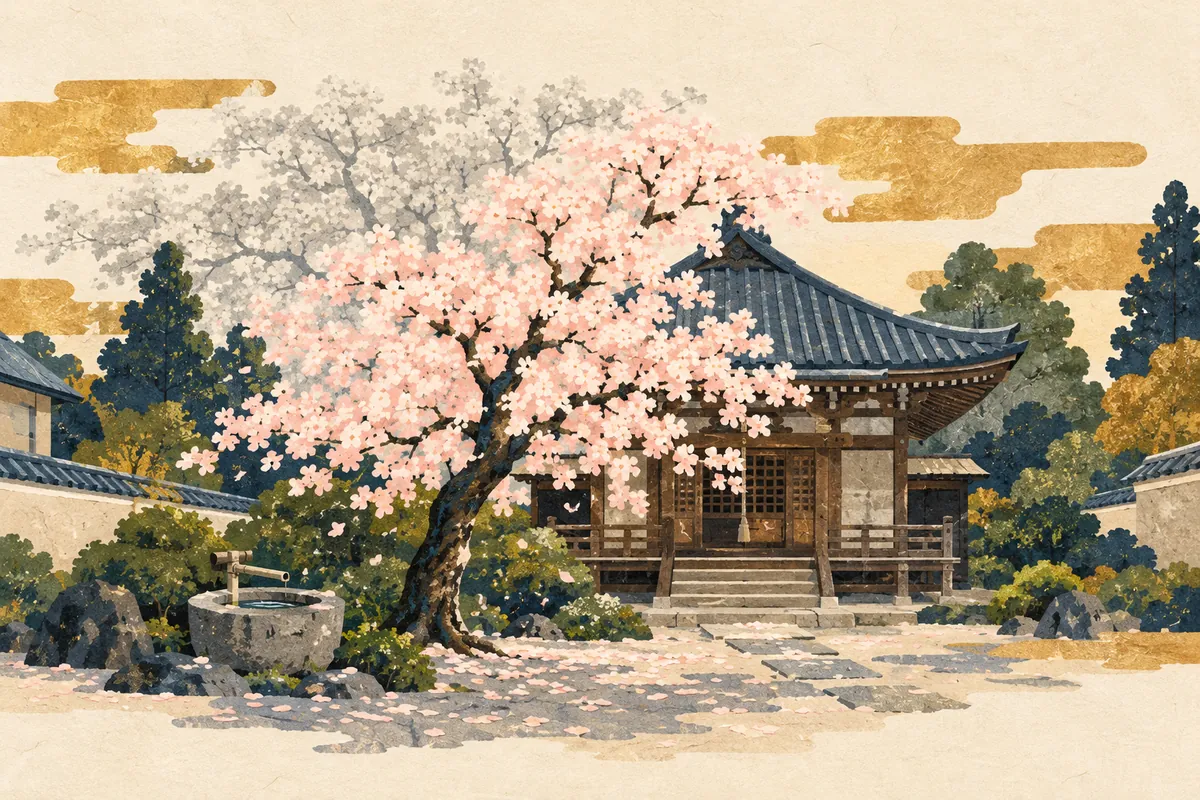
The temple that keeps the legendary cherry, 墨染寺, is read Bokusen-ji (ぼくせんじ). It is known for its beautiful Sumizome cherry tree and is also called Sakura-dera, the "Cherry Temple." The stone water basin in front of the main hall, called the Sumizome-i (墨染井), was donated in 1768 (Meiwa 5) by the kabuki actor Nakamura Utaemon II.
The temple's predecessor was Jōgan-ji, built by Fujiwara no Yoshifusa in the Heian period at the request of Emperor Seiwa. After falling into ruin during the Ōnin War, it was revived in the Azuchi-Momoyama period by the priest Nisshū, with temple lands donated by Toyotomi Hideyoshi, and given the name Sumizome Sakura-dera. After the Edo period it shrank, moved to its present site, and became Bokusen-ji.
Today's Sumizome cherry tree is the fourth generation, and its blossoms are pale pink rather than the pale ink color of the legend. You may be surprised if you go expecting ink-colored blossoms, but it is easier to understand if you think of the name as coming from the legend.
Where Can You See It Today? The Station and the Two Sumizome Towns
Sumizome Station is on the Keihan Main Line, station number KH31, between Tambabashi and Fujinomori. Its address is 691 Sumizome-chō, Fushimi Ward. Bokusen-ji is in the same Sumizome-chō, about a three-minute walk from Sumizome Station.
As town names, Fushimi Ward has Sumizome-chō (墨染町, すみぞめちょう) and, separately, Fukakusa Sumizome-chō (深草墨染町, ふかくさすみぞめちょう). The names are similar, but they are different towns in different school districts. When reading an address, check whether "Fukakusa" is included.
The two Sumizome towns in Fushimi Ward
| Town name | Reading | Elementary school district | Junior high school district |
|---|---|---|---|
| 墨染町 | Sumizome-chō | Fushimi Sumiyoshi | Fushimi |
| 深草墨染町 | Fukakusa Sumizome-chō | Fujinomori | Fujinomori |
Points That Are Easy to Mix Up
First, the readings. The station and town are Sumizome (すみぞめ), but the temple name uses the Chinese-derived reading Bokusen-ji (ぼくせんじ). Be careful not to read it "Sumizome-dera." Also, the nearby 欣浄寺 is read Gonjō-ji (ごんじょうじ), and it too has a "Sumizome well" (墨染の井戸).
Gonjō-ji is said to stand on the site of the residence of Fukakusa no Shōshō, who appears in the legend of the "hundred nights' visits" (momoyo-gayoi) associated with Ono no Komachi, and its Sumizome well is said to be one the Shōshō cherished. This is a separate story from the Sumizome cherry legend (Fujiwara no Mototsune and Kamitsuke no Mineo), and keeping the two "Sumizome" stories apart makes the local legends easier to sort out.
If You Walk: From Sumizome Station to Bokusen-ji and Gonjō-ji
When you get off at Sumizome Station, head first to Bokusen-ji. As of February 2025, visiting hours were 7:00 to 17:00, and the grounds were free to enter. During cherry blossom season the trees are lit up at night; in 2026 the illumination ran every night until 21:00 from March 27 until the blossoms fell. On March 29 of that year, the day of the Bokusen-ji Cherry Blossom Festival, a special viewing of the Fushimi Daibutsu (Great Buddha of Fushimi) was also held at Gonjō-ji.
Gonjō-ji is said to have been founded by Dōgen, and it houses a wooden great Buddha about 3.5 meters tall. The area beside the pond in its grounds is called the "Shōshō's path," and the Shōshō is said to have set out from here to visit Ono no Komachi in Yamashina. Temples and shrines are scattered from Sumizome across the Fukakusa area, so walking them together lets you trace the settings of the legends.
Mini quiz for this entry
Check what you've read with 2 multiple-choice questions.
How is 墨染, a Fushimi place name that is also a Keihan Main Line station, read?
In the legend behind the place name Sumizome, which flowers bloomed in ink-black mourning color for Fujiwara no Mototsune?
Sources and verification
Content checked: October 11, 2026
Updated: October 11, 2026
References are in Japanese.