
Kyoto's Five Kagai: Gion Kōbu, Miyagawa-chō, Pontochō, Kamishichiken, Gion Higashi, and Their Odori Dances
Other spellings and namesGokagai (五花街) / Kyoto's five geisha districts / Gion Kōbu (祇園甲部) / Miyagawa-chō (宮川町) / Kamishichiken (上七軒) / Gion Higashi (祇園東) / Miyako Odori (都をどり) / Kyō Odori (京おどり) / Kamogawa Odori (鴨川をどり) / Kitano Odori (北野をどり) / Gion Odori (祇園をどり) / Miyako no Nigiwai (都の賑い) / Ookini Zaidan (おおきに財団)
Key points
The readings are 祇園甲部 (Gion Kōbu), 宮川町 (Miyagawa-chō), 先斗町 (Pontochō), 上七軒 (Kamishichiken), and 祇園東 (Gion Higashi)
In autumn 2026, the Gion Odori runs November 1–10 and Kamishichiken's Kotobuki-kai November 12–18
The joint performance of the five kagai, "Miyako no Nigiwai," began in 1994 (Heisei 6), and in 2026 it was held at Minamiza on June 27 and 28
The Main Building, Annex, Entrance Hall, and Main Gate of the Gion Kōbu Kaburenjō are national Registered Tangible Cultural Properties
Where are the five kagai? Readings and locations
A kagai (花街) is a district of ochaya (teahouses), where geiko (Kyoto geisha) and maiko entertain guests with dance and song. Kyoto today has five kagai that belong to the Kyoto Kagai Association, and together they are called the Gokagai (five kagai).
Four of them are clustered near the Kamo River. Gion Kōbu straddles Shijō-dōri, extending south, centered on Hanamikōji-dōri, to just before Kennin-ji, and north to around Shinbashi-dōri between Yamatoōji-dōri and Hanamikōji-dōri; it is regarded as the largest kagai in Kyoto. Gion Higashi is north of Shijō-dōri, between Hanamikōji-dōri and Higashiōji-dōri. Both were originally Gion-machi, the town in front of the gate of Yasaka Shrine, which was divided in two in 1881 (Meiji 14). Miyagawa-chō is the Miyagawa-suji area east of the Kamo River, from south of Shijō-dōri to Gojō-dōri; its name is said to come from "Miyagawa," the name for the stretch of the Kamo River where Yasaka Shrine's mikoshi-arai (portable shrine washing) was held. Pontochō, west of the Kamo River, is a kagai along a narrow street running from one block south of Sanjō-dōri to Shijō-dōri.
Only Kamishichiken is set apart to the northwest, in Kamigyō Ward, east of Kitano Tenmangū. It is said to have begun in the Muromachi period, when seven teahouses were built with timber left over from the construction of Kitano Tenmangū, and it is also said to be the oldest kagai in Kyoto. Toyotomi Hideyoshi, presented with the local specialty, mitarashi dango, at the Kitano Grand Tea Ceremony, is said to have granted the teahouses trading rights, and its emblem of five dumplings comes from these dango.
Shimabara in Shimogyō Ward was once counted as one of the six kagai, but it left the Kyoto Kagai Association in 1976 (Shōwa 51), and its business as a kagai ended the following year, 1977. It is not among today's five.
Locations of Kyoto's Five Kagai (Schematic)
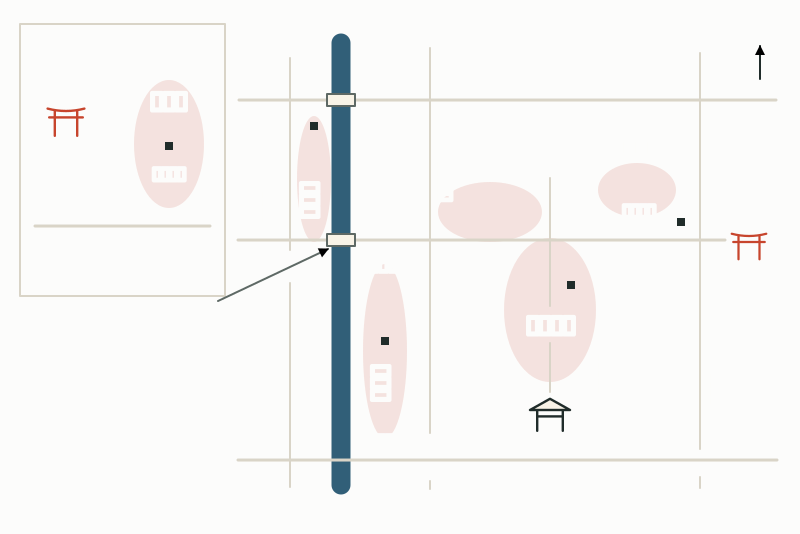
Readings, locations, and dance schools of the five kagai
| Kagai | Reading | Ward | Approximate area | Dance school |
|---|---|---|---|---|
| 祇園甲部 (Gion Kōbu) | ぎおんこうぶ | Higashiyama | South of Shijō-dōri, centered on Hanamikōji-dōri, up to just before Kennin-ji; north of it, around Shinbashi-dōri between Yamatoōji-dōri and Hanamikōji-dōri | Inoue school of Kyōmai |
| 宮川町 (Miyagawa-chō) | みやがわちょう | Higashiyama | Miyagawa-suji, east of the Kamo River, from south of Shijō-dōri to Gojō-dōri | Wakayagi school |
| 先斗町 (Pontochō) | ぽんとちょう | Nakagyō | Between the Kamo River and Kiyamachi-dōri, from one block south of Sanjō-dōri to Shijō-dōri | Onoe school |
| 上七軒 (Kamishichiken) | かみしちけん | Kamigyō | East of Kitano Tenmangū, west of Imadegawa-dōri Shichihonmatsu | Hanayagi school |
| 祇園東 (Gion Higashi) | ぎおんひがし | Higashiyama | North of Shijō-dōri, between Hanamikōji-dōri and Higashiōji-dōri | Fujima school |
When are the odori? Four spring performances and the autumn Gion Odori
Each kagai holds a dance performance in spring or autumn in which all its geiko and maiko appear. Gion Kōbu's Miyako Odori and Pontochō's Kamogawa Odori began in 1872 (Meiji 5) as entertainments for visitors to the Kyoto Exhibition. They were followed by Miyagawa-chō's Kyō Odori, first staged in 1950 (Shōwa 25), and Kamishichiken's Kitano Odori and Gion Higashi's Gion Odori, first staged in 1952 (Shōwa 27). Some performances are written をどり (in old kana spelling) and others, like the Kyō Odori, おどり; both are read "odori."
In spring the season runs from the Kitano Odori in mid-March to the Kamogawa Odori in May. In autumn, the other four kagai also hold dance recitals: the Onshūkai, Mizue-kai, Suimeikai, and Kotobuki-kai.
Dance performances and venues of the five kagai in 2026
| Kagai | Spring performance (2026) | Autumn performance (2026) | Venue |
|---|---|---|---|
| Gion Kōbu | 152nd Miyako Odori (April 1–30) | Onshūkai (October 1–6) | Gion Kōbu Kaburenjō |
| Miyagawa-chō | 75th Kyō Odori (April 4–19) | Mizue-kai (October 8–11) | Miyagawa-chō Kaburenjō Mitsuwaza |
| Pontochō | 187th Kamogawa Odori (May 5–22) | 111th Suimeikai (October 15–20) | Pontochō Kaburenjō |
| Kamishichiken | 74th Kitano Odori (March 20 – April 2) | 75th Kotobuki-kai (November 12–18) | Kamishichiken Kaburenjō |
| Gion Higashi | — | 67th Gion Odori (November 1–10) | Gion Kaikan |
"Miyako no Nigiwai," where all five kagai appear, and the Ookini Zaidan
The Kyoto Five Kagai Joint Performance, "Miyako no Nigiwai," began in 1994 (Heisei 6) as an event marking the 1,200th anniversary of the founding of Heian-kyō. It is held every June, and alongside each kagai's own program there is "Maiko no Nigiwai," in which maiko from all five kagai share the stage. In 2026 the 33rd performance was held at Minamiza on June 27 and 28, with about 70 geiko and maiko from the five kagai.
The organizer, the Kyoto Traditional Performing Arts Foundation (a public interest incorporated foundation), was established in 1996 (Heisei 8) to preserve and pass on the traditional arts of the kagai. Its nickname, "Ookini Zaidan," is made from the first syllables of "otagai ni" (mutually), "omoiyari" (consideration), "kikubari shite" (being attentive), and "nikoyaka ni" (with a smile).
The kaburenjō theaters, and maiko and geiko
Each kagai has a kaburenjō (歌舞練場), a theater that serves as the stage for its odori; Gion Higashi uses the Gion Kaikan as its kaburenjō. The Main Building, Annex, and Entrance Hall of the Gion Kōbu Kaburenjō date from 1913 (Taishō 2) and the Main Gate from 1936 (Shōwa 11), and they became national Registered Tangible Cultural Properties in 2001 (Heisei 13). The Yasaka Club at the same address is also a Registered Tangible Cultural Property. In Miyagawa-chō, the 2026 Kyō Odori was staged in the newly rebuilt kaburenjō, and the Kamishichiken Kaburenjō is raising donations for its renovation (as of October 2026).
To become a maiko, a girl lives in an okiya (geiko house) and learns the arts, etiquette, and Kyoto dialect (shikomi), goes through an apprenticeship attending banquets (minarai), and becomes a maiko at her misedashi (debut). Later, at the erikae (changing of the collar), she becomes a geiko and polishes her art either as a tachikata (立方), who dances, or as a jikata (地方), who sings and plays the shamisen or other instruments.
Things to keep in mind when walking in the kagai
The kagai are places where people live and work. Residents of Gion-machi Minamigawa, the Gion Kōbu teahouse association, and others ask visitors not to engage in nuisance behavior such as the following.
- Stopping, touching, following, or photographing geiko or maiko walking in the street without permission
- Taking photos on private property, such as in front of shops, or entering private property without permission
- Blocking the road, for example by stopping on the sidewalk for photos or stepping out into the roadway
- Littering, including cigarette butts, making loud noise, or walking spread out across the street
Where can you see them now? / Getting there
If you want to see a stage performance, as of October 29, 2026, the autumn performances still to come are the Gion Odori and the Kotobuki-kai. Both are charged, and if you are bringing children, note the age conditions. At the Gion Kouta Festival (Maruyama Park), held every year on November 23, maiko read the lyrics aloud in front of the song monument and offer flowers, and anyone can watch.
- Gion Odori (November 1–10, 2026): Gion Kaikan (at the foot of the stone steps of Yasaka Shrine). Twice a day, at 13:30 and 16:00, about 1 hour. 7,000 yen with tea ceremony, 6,000 yen for a viewing ticket; children under 3 are not admitted. About 5 minutes on foot east along Shijō-dōri from Exit 7 of Keihan Gion-Shijō Station
- Kotobuki-kai (November 12–18, 2026): Kamishichiken Kaburenjō (Shinsei-chō, Imadegawa-dōri Shichihonmatsu nishi-iru, Kamigyō Ward). Starts at 16:00; viewing ticket 10,000 yen; preschool children are not admitted. 3 minutes on foot from the "Kitano Tenmangū-mae" or "Kamishichiken" stops on city bus route 50 and others
- Gion Kōbu Kaburenjō (Gion-machi Minamigawa, Higashiyama Ward): 8 minutes on foot from Exit 6 of Keihan Gion-Shijō Station. In the small theater of the kaburenjō, "Gion Corner" offers about an hour of performances such as Kyōmai dance by maiko
- Miyagawa-chō Kaburenjō Mitsuwaza (Miyagawa-suji, Higashiyama Ward): 7 minutes on foot from Keihan Gion-Shijō Station
- Pontochō Kaburenjō (Nakagyō Ward, at the west end of Sanjō Ōhashi Bridge): 5 minutes on foot from Exit 6 of Keihan Sanjō Station
Mini quiz for this entry
The joint performance "Miyako no Nigiwai," in which geiko and maiko from all five kagai appear, began as an event marking what?
What is the emblem of Kamishichiken, "five dumplings" (itsutsu dango), said to come from?
Sources and verification
Content checked: October 29, 2026
Updated: October 29, 2026
References are in Japanese.
- 京都市「京都をつなぐ無形文化遺産 五花街の紹介」
- 京都市「京都をつなぐ無形文化遺産 花街が継承する伝統伎芸」
- 京都市「京都をつなぐ無形文化遺産 花街のまちなみ」
- 京都市「京都をつなぐ無形文化遺産 伝統伎芸とおもてなしの担い手「芸妓」「舞妓」」
- 京都市「京都をつなぐ無形文化遺産 もう一つの花街 ~島原~」
- 京都伝統伎芸振興財団(おおきに財団)「五花街の紹介・沿革」
- 京都伝統伎芸振興財団(おおきに財団)「第33回 京都五花街合同公演「都の賑い」」
- 京都伝統伎芸振興財団(おおきに財団)「おおきに財団とは」
- 京都伝統伎芸振興財団(おおきに財団)「祇園小唄祭」
- 京都市観光協会「2026年「春のをどり」一覧」
- 京都市観光協会「2026年「秋のをどり」一覧」
- 京都市観光協会「みずゑ會」
- 京都市観光協会「第67回 祇園をどり」
- 京都市観光協会「第33回 京都五花街合同公演「都の賑い」」
- 京都市観光協会「祇園町南側地区からのメッセージ」
- 京都市観光協会「マナーを守って素晴らしい京都観光を」
- 京都市観光協会 きょうと修学旅行ナビ「京の花街文化」リーフレット
- 祇園甲部歌舞会「都をどり」
- 祇園甲部歌舞会「アクセス」
- 祇園東歌舞会「祇園をどり」
- 上七軒歌舞会「上七軒の歴史・アクセス」
- 上七軒歌舞会「寿会」
- 先斗町歌舞会「鴨川をどり」
- 文化庁「国指定文化財等データベース 祇園甲部歌舞練場本館」
- 文化庁「国指定文化財等データベース 祇園甲部歌舞練場別館」
- 文化庁「国指定文化財等データベース 祇園甲部歌舞練場玄関」
- 文化庁「国指定文化財等データベース 祇園甲部歌舞練場正門」
- 文化庁「国指定文化財等データベース 八坂倶楽部」
- 京都伝統伎芸振興財団(おおきに財団)「ギオンコーナー」