
Japaneseおきばりやす
Okibariyasu
Other spellings and namesお気張りやす / Okibari-yasu
Key points
Means "please do your best"
Formed as o + kibari + yasu; here yasu means "please do…" with light respect
Kibaru in the sense of "to make an effort" appears in the Jūmon Saihishō of 1383
In the kagai, this phrase is used for send-offs instead of "ohayō okaeriyasu"
What okibariyasu means and how it is used
Okibariyasu is a Kyoto greeting that corresponds to "please do your best" (ganbatte kudasai). The word it is built on, kibaru, is Kyō-kotoba for "to try hard," used as in "Yō kibaru nā" (ようキバルなぁ, "You really do work hard").
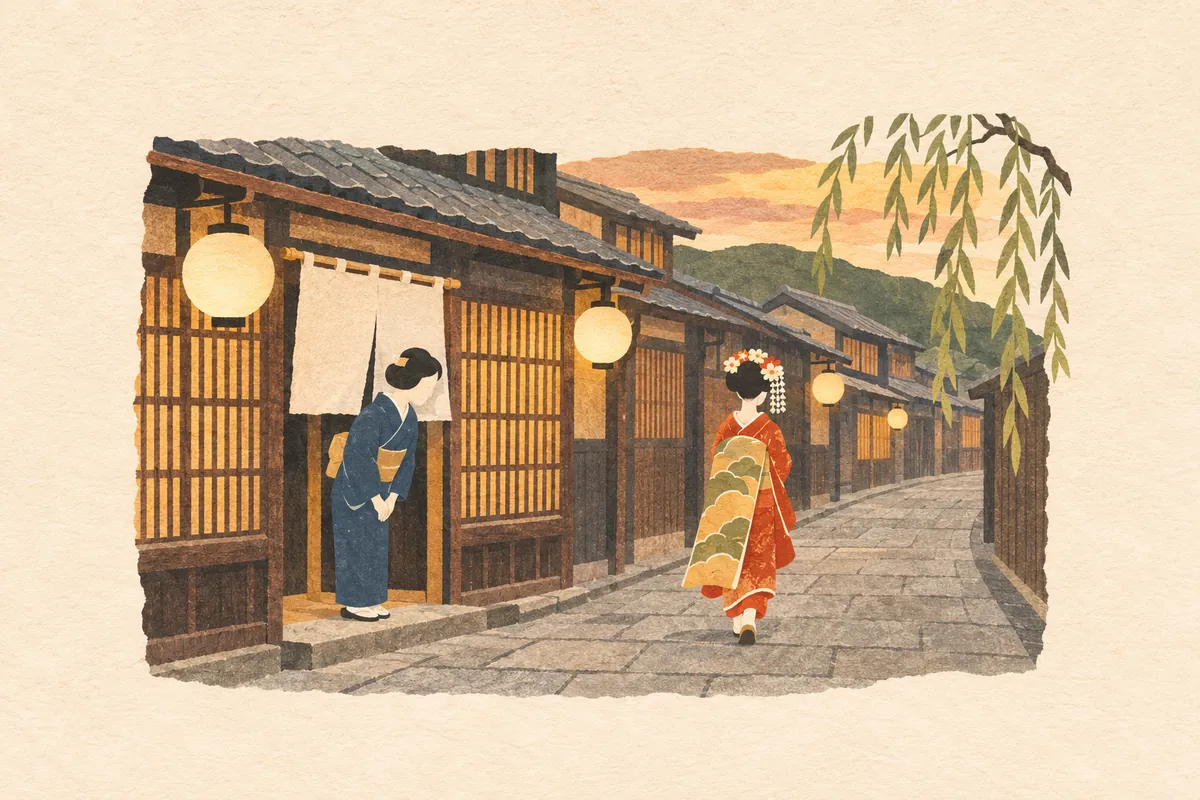
In the kagai, when geiko and maiko set out for an ozashiki, the proprietress of the okiya they belong to sends them off with "okibariyasu." It is encouragement to go and put their energy into the work.
"O…yasu" adds light respect
"O…yasu" is a form used in the Kyoto–Osaka area: placing the continuative form (ren'yōkei) of a verb in the middle expresses light respect. In this form, the auxiliary verb yasu means "please do…" with a touch of respect. Okibariyasu, with kibari, the continuative form of kibaru, in the middle, is a lightly respectful way of saying "do your best."
Oideyasu and okoshiyasu, used to welcome guests, and okaeriyasu ("welcome home") are greetings of the same form. The o…yasu form is old: the Kyōgenki of 1660 has an example of okaeriyasu (おかへりやす) used to urge someone to go home.
- o + kibari + yasu → okibariyasu ("please do your best")
- o + ide + yasu → oideyasu ("welcome")
- o + kaeri + yasu → okaeriyasu ("welcome home")
Kibaru (気張る): its meanings and early examples
Kibaru is written 気張る in kanji and is also listed in standard Japanese dictionaries. Its meanings include holding one's breath and straining (ikimu), summoning up one's spirit to make an effort, dressing up to show off, and spending money generously. The kibaru in okibariyasu is the one that means "to make an effort."
Examples of the "make an effort" sense go back a long way: the Jūmon Saihishō (十問最秘抄) of 1383 has the line "hitori kibarite sen nashi" ("there is no use straining alone"). The sense of straining with force appears in the Shiki-shō of 1477, and the sense of spending generously in the haikai collection Mōichi Senku of 1649.
In the Kamigata (Kyoto–Osaka) region of the Edo period, rice merchants and rice speculators also used kibaru for doing business: buying and selling rice and speculating on the rice market.
How it differs from "ohayō okaeri"
In everyday life, such as when seeing off family members, people say "ohayō okaeri" ("come back safely and soon"). In the kagai, however, a geiko or maiko coming back early from an ozashiki would hurt business, so the send-off has not been "ohayō okaeriyasu" but "okibariyasu" or "ittoinahai" ("off you go").
Both are words for seeing someone off, but "ohayō okaeri" looks forward to the person's return, while "okibariyasu" encourages their work at the place they are going.
Kyō-kotoba for seeing someone off
| Phrase | Meaning | When it is used |
|---|---|---|
| Okibariyasu (おきばりやす) | Please do your best | In the kagai, sending geiko and maiko off to an ozashiki |
| Ittoinahai (いっといなはい) | Off you go | In the kagai, sending geiko and maiko off |
| Ohayō okaeri (おはようおかえり) | Come back safely and soon | In everyday life, such as seeing off family |
Mini quiz for this entry
When okiya proprietresses in the kagai send geiko and maiko off, why have they said "okibariyasu" instead of "ohayō okaeriyasu" ("come back early")?
In Kamigata (Kyoto–Osaka) in the Edo period, what did kibaru (気張る) mean when said of rice merchants and rice speculators?
Sources and verification
Content checked: November 8, 2026
Updated: November 8, 2026
References are in Japanese.