
Japaneseおおきに
Ookini
Other spellings and namesŌkini / Okini / おおきに / おーきに
In short
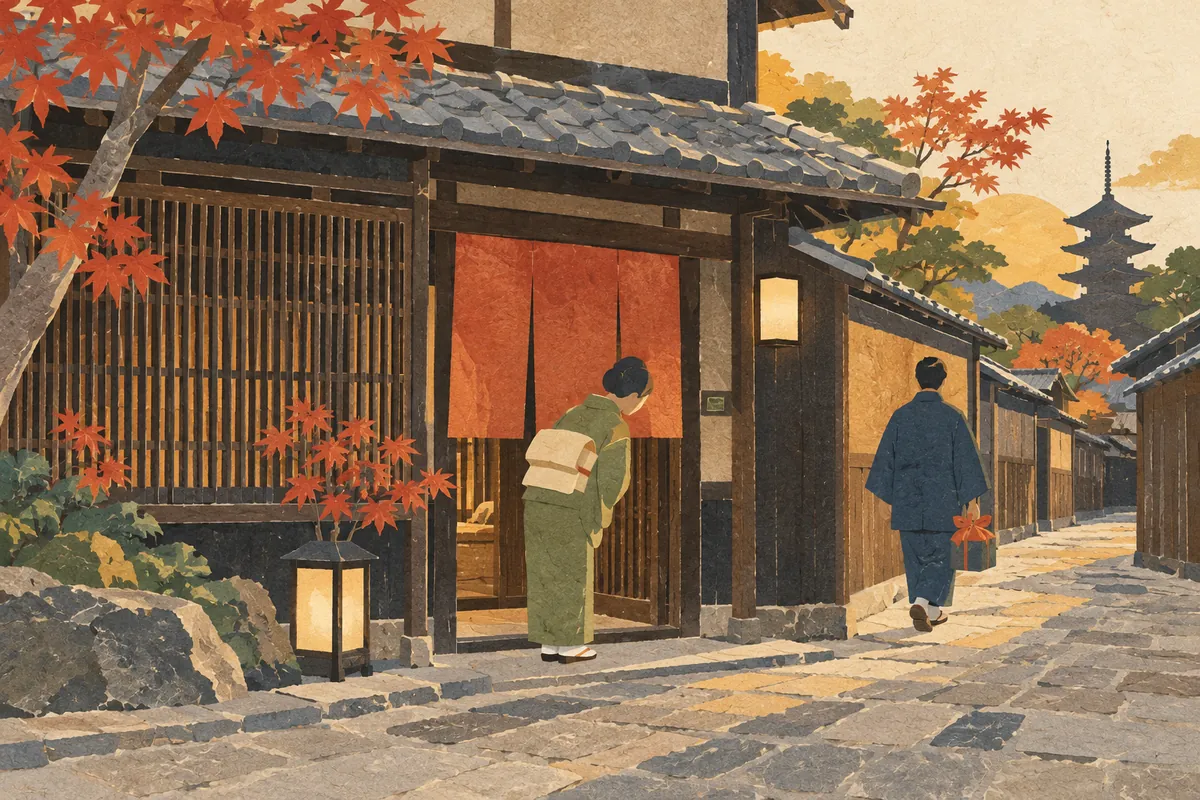
Ōkini (おおきに) is a Kyō-kotoba (Kyoto dialect) word meaning "thank you." It is used like this: "Tōi tokoro o wazawaza ōkini" ("Thank you for coming all this way"). It was originally an adverb meaning "greatly, very much," and one theory says it became a word of thanks by shortening phrases such as ōkini arigatō ("thank you very much").Key points in 30 seconds
Means "thank you"
Example: "Tōi tokoro o wazawaza ōkini." (遠いところをわざわざオーキニ。) — "Thank you for coming all this way."
Originally an adverb meaning "greatly"
Listed in dialect materials for Saga Prefecture as well as the Kansai region
What Ōkini Means, with Examples
The Kyō-kotoba dictionary defines ōkini (オーキニ) as "thank you" and gives the example "Tōi tokoro o wazawaza ōkini" (遠いところをわざわざオーキニ。, "Thank you for coming all this way"). It is an example of thanking someone who has come from far away.
In the same dictionary, the entry for habakarisan (ハバカリサン), defined as gokurōsan ("thanks for your trouble; good work"), includes the example "Ōkini, habakarisan" (おーきに、ハバカリサン。). The words for "thank you" and "good work" are used one after the other.
In explanations of Kyō-kotoba, "thank you" becoming ōkini is sometimes the very first example given. It is one of the words that comes to mind first as a representative of Kyō-kotoba.
Originally a Word Meaning "Greatly"
Ōkini was originally the continuative form of the adjectival verb ōki (nari), an adverb meaning "exceedingly, very much, greatly." It appears in the mid-17th-century sekkyōbushi (narrative chant) Oguri in the form ōkini hara o tate ("growing very angry").
The adverb ōkini had other meanings too. An example meaning "generously, magnanimously" appears in the ukiyo-zōshi novel Kōshoku Ichidai Onna (1686), and an example used for emphasis or agreement, meaning "exactly, quite so," appears in the Shiki-shō of 1477. This shows it was used in many situations before it became a word of thanks.
As a word of thanks, ōkini is listed in dictionaries as a separate interjection, described as possibly short for ōkini okatajike or ōkini arigatō ("thank you very much"). In this view, only the "very much" part of "thank you very much" remained and came to express thanks by itself.
As an example of the interjection, dictionaries cite a conversation in Takahama Kyoshi's Fūryū Senbō (1907). At the same time, as an adverb, there are uses such as ōkini gokurō datta ("you've worked very hard") and sore wa ōkini arisō na koto da ("that is quite likely"), so ōkini in the sense of "greatly" survives in standard Japanese as well.
Main uses of ōkini
| Use | Meaning | Example |
|---|---|---|
| Adverb | Exceedingly, very much, greatly | Ōkini gokurō datta ("You've worked very hard") |
| Adverb (agreement) | Indeed, quite so | Ōkini sō da ne ("Quite so") |
| Interjection | Thank you very much (a Kansai word of thanks) | A conversation in Fūryū Senbō (1907) |
Not Just "Thank You"?
Ōkini basically means "thank you," but it is said that it is also sometimes used to decline. If you invite someone and they reply only "ōkini," you need to judge from the flow of the conversation and the person's manner.
It is also said that Kyoto people value not causing friction in conversation, keeping their words gentle while hinting at their true feelings. Accepting with a word of thanks without refusing outright—ōkini is a handy word in such situations too. However, how far it is used this way varies by person and situation.
Is It Only Kyoto's Word?
Japanese dictionaries describe the interjection ōkini as "a word used in the Kansai region to mean 'thank you very much'" or "used as a word of thanks in Kansai." It is treated not as unique to Kyoto but as a word of thanks widely used in Kansai.
A book on the dialect of Saga Prefecture also lists ōkini as a word for "thank you." Although it is known as a Kyō-kotoba word, it is also found in dialect materials outside Kyoto.
Kyō-kotoba Words for Greetings
Besides ōkini, Kyō-kotoba has words for welcoming people, apologizing, and thanking them for their efforts. Lined up by situation, they show the shape of Kyō-kotoba greetings.
Kyō-kotoba words used in greetings
| Word | Meaning | Example |
|---|---|---|
| Ōkini (オーキニ) | Thank you | Tōi tokoro o wazawaza ōkini. (遠いところをわざわざオーキニ。) — "Thank you for coming all this way." |
| Habakarisan (ハバカリサン) | Thanks for your trouble; good work | Ōkini, habakarisan. (おーきに、ハバカリサン。) — "Thank you, and thanks for your trouble." |
| Okoshiyasu (オコシヤス) | Welcome; please come | Yōkoso, Kyōto ni okoshiyasu. (ようこそ、京都にオコシヤス。) — "Welcome to Kyoto." |
| Gomen'yasu (ゴメンヤス) | Hello, is anyone home? | Moshimoshi, gomen'yasu. (もしもし、ゴメンヤス。) — "Excuse me, is anyone home?" |
| Kannin (カンニン) | Sorry | Meiwaku kakete kannin na. (迷惑かけてカンニンな。) — "Sorry for the trouble." |
Mini quiz for this entry
Check what you've read with 2 multiple-choice questions.
What does the Kyō-kotoba (Kyoto dialect) word ōkini mean?
In the Kyō-kotoba (Kyoto dialect) phrase "Ōkini, habakarisan," what does habakarisan mean?
Sources and verification
Content checked: October 11, 2026
Updated: October 11, 2026
References are in Japanese.