
Japaneseはんなり
Hannari
Other spellings and namesハンナリ / Hannari shita (はんなりした)
In short
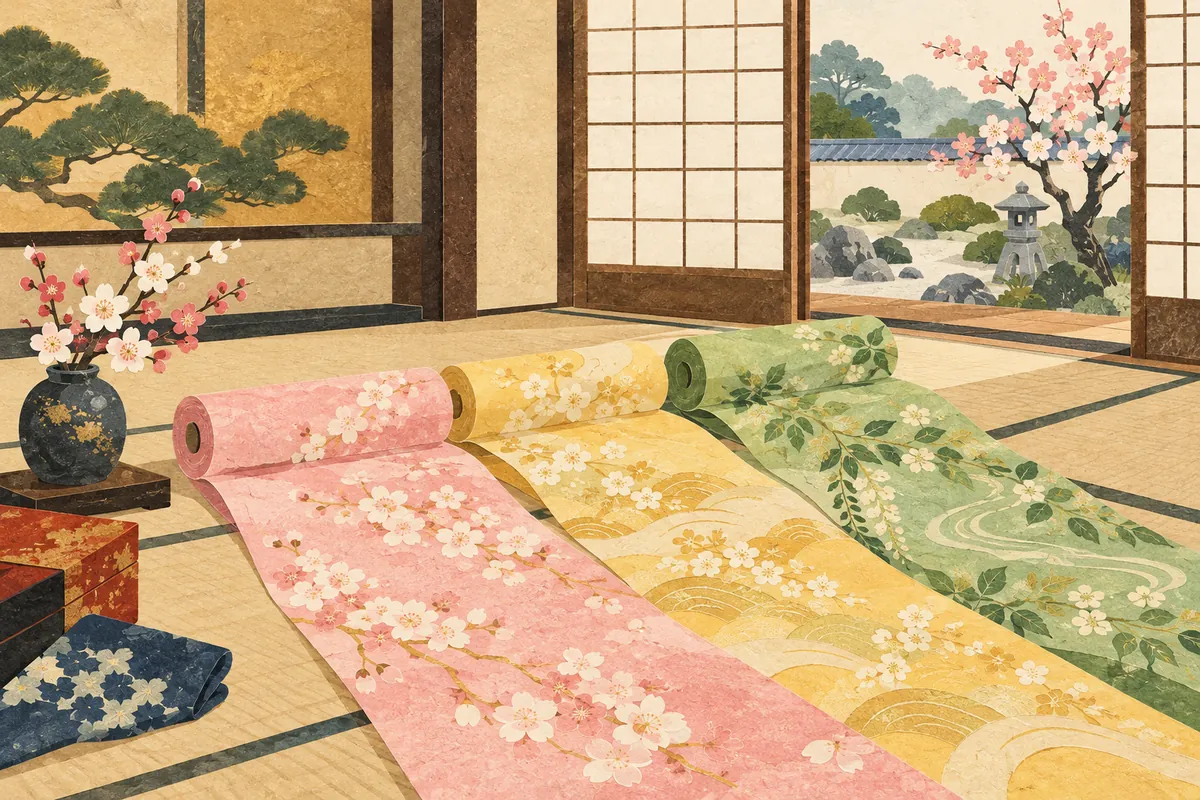
Hannari (はんなり) is a Kyō-kotoba (Kyoto dialect) word describing something elegant, bright, and cheerful. It is said to be used most often of colors and hues. Examples appear in documents from the Muromachi period, and it is still used today, mainly in the Kyoto–Osaka region.Key points in 30 seconds
Meaning: elegant, bright, and cheerful
Often used of colors and hues
Example: ハンナリした着物やな。 ("Hannari shita kimono ya na"—"What an elegantly bright kimono.")
Examples appear in 16th-century documents, and one theory says it comes from hana (花・華, "flower")
What hannari means and how it is used
A Kyō-kotoba dictionary defines hannari (ハンナリ) as "elegant, bright, and cheerful." It also notes that the word is often used of colors and hues, and gives the example ハンナリした着物やな。 ("Hannari shita kimono ya na"—"What an elegantly bright kimono.").
A standard Japanese dictionary explains it as "(in the Kansai region) elegant, bright, and showy," with examples such as はんなりしたおなごはん ("hannari shita onago-han," an elegantly bright woman) and はんなり(と)した味 ("a hannari flavor"). Colors are central, but there are also examples describing a person's air or a flavor.
Some dictionaries explain it as "showy; bright, cheerful, and gorgeous," and say it is mostly used with to, in the form hannari to. As in the Kyō-kotoba dictionary's example, it is also often used with suru, as in hannari shita.
It is worth noticing that the emphasis of the explanations differs slightly from dictionary to dictionary. Kyō-kotoba dictionaries and the like add "elegant," while large Japanese dictionaries that also cover old examples explain it as "showy" and "cheerful." It can be summed up this way: brightness and gorgeousness are at its core, and in Kyoto today it is introduced as an expression that also carries a sense of elegance.
A Kamigata word dating back to the Muromachi period
The oldest known example is in the Gyokujinshō of 1563. In the Edo-period ukiyozōshi (popular fiction) Shodō Kikimimi Sekenzaru (1764), it is used in a scene where someone asks not for gloomy music but for "something hannari"—that is, a cheerful piece.
From the late medieval period onward, examples of hannari appear mainly in Kamigata (Kyoto–Osaka) materials, and the word is still used today mainly in the Kyoto–Osaka region. It is not a buzzword that spread recently, but a word that has been used in Kamigata for hundreds of years.
Does it come from hana (花・華, "flower")?
As for its etymology, there is a theory that it comes from hana (花・華) with the suffix ri, which expresses a state, added and the sound changed to the moraic nasal n. According to this theory, hanayaka (gorgeous), hanabana (brilliant), and hannari all belong to the same family of words based on hana.
This is only one theory, and the etymology is not settled. Still, the way the meaning "bright and gorgeous" fits a word whose form recalls "flower" may be a useful aid to remembering it. Dictionaries also list the form hannara.
Not the same word as hokkori or mattari
The Kyō-kotoba dictionary explains hokkori suru (ホッコリスル) as "to feel relieved; to feel fatigue setting in," and mattari (マッタリ) as the smooth, mellow texture of food. Hannari differs in meaning in that it describes something "bright and cheerful."
Hokkori is widely used to mean feeling relieved or warmhearted, but in Kyō-kotoba it means "I'm a bit tired." Mattari, too, was originally a Kyō-kotoba word describing a rich flavor, and today it is said to be used mostly to mean "to take it easy."
It is also said that some Kyō-kotoba words became famous through TV programs and the like and spread nationwide with meanings different from the original. When using hannari, keeping in mind that its Kyoto meaning is different from hokkori and mattari will help you avoid misunderstandings.
In a Kyō-kotoba quiz for children, too, in a question asking which word means "to feel relieved," the correct answer is hokkori, while hannari and mattari appear as wrong choices. All three are soft-sounding words, but each refers to something different.
Three similar-sounding Kyō-kotoba words
| Word | Meaning | Example |
|---|---|---|
| ハンナリ (hannari) | Elegant, bright, and cheerful. Often used of colors and hues | ハンナリした着物やな。 (Hannari shita kimono ya na.—"What an elegantly bright kimono.") |
| ホッコリスル (hokkori suru) | To feel relieved; to feel fatigue setting in | 用事が終わって、ホッコリシたわ。 (Yōji ga owatte, hokkori shita wa.—"My errands are done; I'm relieved, and a bit tired.") |
| マッタリ (mattari) | The smooth, mellow texture of food | マッタリしておいしいわあ。 (Mattari shite oishii wā.—"It's so smooth and mellow—delicious.") |
Mini quiz for this entry
Check what you've read with 3 multiple-choice questions.
Which is closest to the meaning of the Kyō-kotoba (Kyoto dialect) word hannari?
The Kyō-kotoba (Kyoto dialect) word hannari is said to be used mostly to describe what?
From the late medieval period onward, examples of hannari are found mainly in materials from which region?
Sources and verification
Content checked: October 11, 2026
Updated: October 11, 2026
References are in Japanese.