
Japaneseほかす
Hokasu
Other spellings and nameshokasu / hokashi toite / ほかす / ほかしといて
In short
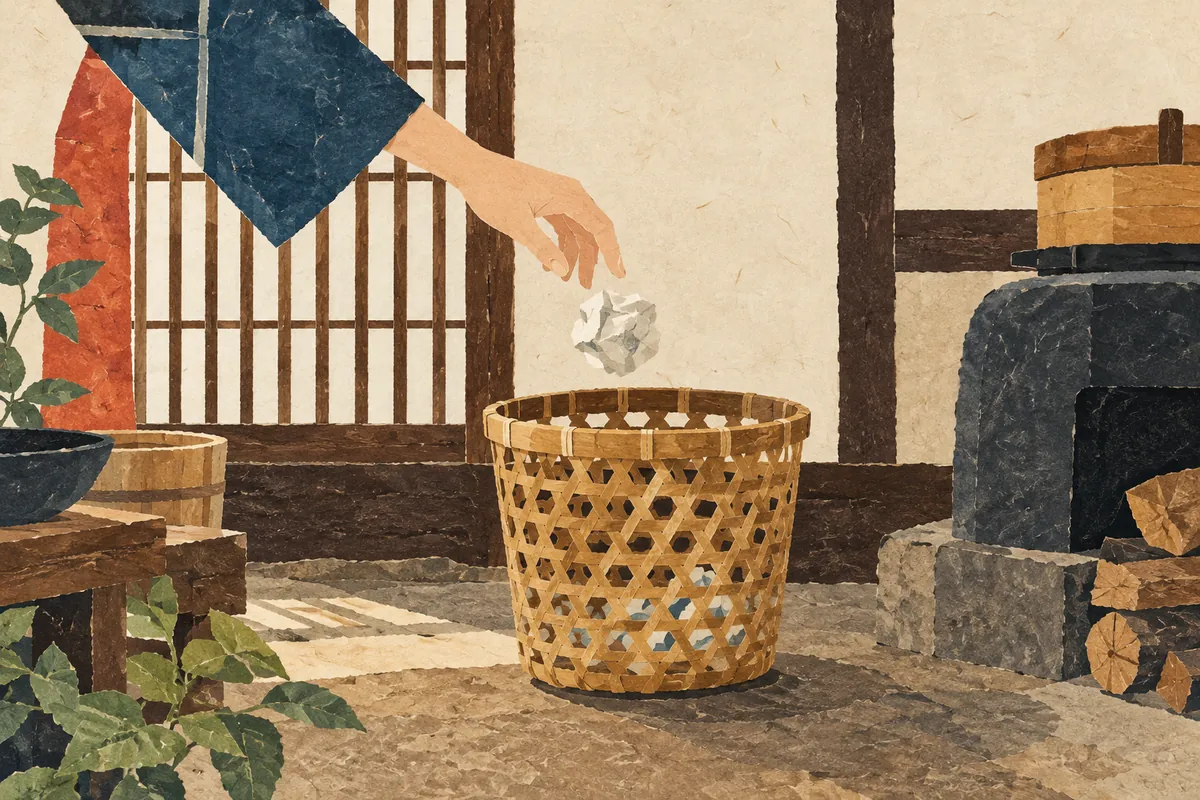
Hokasu (ほかす) is a Kyō-kotoba (Kyoto dialect) word meaning "to throw away." It is used as in "Sore wa hokashitara akan" (それはホカシたらあかん, "Don't throw that away"). Japanese dictionaries suggest it may have changed from hōka-su (放下す), and in an old nationwide survey it was a common expression in the central Kinki region.Key points in 30 seconds
Meaning: to throw away
Example: "Sore wa hokashitara akan." (それはホカシたらあかん。)
One theory says it changed from hōka-su (放下す)
Naosu, meaning "to put away," is a different word
The meaning of hokasu, with examples
A Kyō-kotoba dictionary gives the meaning of hokasu (ホカス) as "to throw away." The example "Sore wa hokashitara akan" (それはホカシたらあかん。) means "Don't throw that away." Hokashi toite (ほかしといて) is a request: "Throw it away for me."
The word also appears in general Japanese dictionaries, where it is explained as "to toss away; to discard." Large dictionaries also list a separate hokasu meaning to beat cotton to loosen and fluff it up, but that is treated as a different word from the hokasu that means "to throw away."
A shortened form of hōka-su (放下す)?
Japanese dictionaries explain hokasu as possibly a changed form of hōka-su (放下す), or a sound change from it. Since each of them phrases this with a "possibly," it is best to take this origin as one leading theory.
Hōka (放下) means throwing away or casting off. Hōka was also the name of a performing art, from the medieval to the early modern period, in which performers struck kokiriko bamboo clappers while singing, doing magic tricks, and performing acrobatics.
As an early example, hokasu appears in the kyōgen play Awasegaki in the Toraakira-bon kyōgen scripts, dating from the late Muromachi to the early Edo period. From the Muromachi period onward it appears frequently alongside hōkasu, and many Edo-period texts are said to contain passages suggesting that writers understood the word in connection with the Chinese-derived word hōka (放下).
There are also Meiji-era examples. In 1886 the magazine Marumaru Chinbun printed 放下 with the reading hoka, and the word also appears in a passage of Futabatei Shimei's translated novel Katakoi. This shows that it appeared not only in speech but also in writing.
What do people across Japan call "throwing away"?
Map 62, "suteru (to throw away)," of the Linguistic Atlas of Japan by the National Institute for Japanese Language and Linguistics charts how people across the country answered the question, "When you take something you no longer need to the rubbish heap, what do you say you do with it?" The survey was conducted from fiscal 1957 to 1964, asking one man at each location who was born before 1903 and had lived there all his life.
On the map, hokasu symbols cluster in the central Kinki region, mixed with forms beginning with ho such as horu and hōru. Meanwhile, suteru-type words stand out in the Chūgoku region, Kyushu, and the southern Kii Peninsula; utcharu and butcharu types in the Kantō region; and nageru in the Tōhoku region and Hokkaido. The words for "throw away" divide clearly by region.
However, this map shows results from more than 60 years ago, from speakers born before 1903. It cannot tell us which generations in Kyoto today use hokasu, or how much. Rather than assuming everyone in Kyoto uses it, it is enough to know that it means "throw away" when you hear it.
Main words for "throw away" in the nationwide survey (overview)
| Region | Prominent words |
|---|---|
| Central Kinki region | Hokasu (mixed with horu, hōru, etc.) |
| Eastern Shikoku | Hōru |
| Hokuriku region, etc. | Hokaru, hokkaru, etc. |
| Kantō region, etc. | Utcharu, butcharu, etc. |
| Tōhoku region and Hokkaido | Nageru |
| Chūgoku region, western Shikoku, Kyushu, southern Kii Peninsula | Suteru (including shiteru, etc.) |
Don't confuse it with naosu or irau
Kyō-kotoba has several words for handling things. Learning them alongside hokasu makes it less likely you will mishear a request.
In particular, hokashi toite (ほかしといて) and naoshi toite (なおしといて) look alike, but the first means "throw it away for me" and the second means "put it away for me." If someone hands you something important and says "naoshi toite," it means to put it away, not throw it out.
Kyō-kotoba words for handling things
| Word | Meaning | Example |
|---|---|---|
| Hokasu (ホカス) | To throw away | それはホカシたらあかん。(Sore wa hokashitara akan. "Don't throw that away.") |
| Naosu (ナオス) | To put away | その本、ナオシといて。(Sono hon, naoshi toite. "Put that book away for me.") |
| Irau (イラウ) | To touch | よごれてるし、イラワンときや。(Yogoreteru shi, irawan tokiya. "It's dirty, so don't touch it.") |
To look into it yourself
The National Institute for Japanese Language and Linguistics has published all 300 map images of the Linguistic Atlas of Japan as PDFs. If you open Map 62, you can check the symbols at each location with your own eyes. The map just before it, Map 61, surveyed whether naosu is used to mean "to tidy up or put away," so you can compare hokasu and naosu one after the other.
The Kyō-kotoba dictionary that Kyoto City publishes for children lists 25 words with example sentences. Besides hokasu, it includes everyday words for things and places such as naosu, irau, and neki (near, close by), so reading them together gives you a feel for everyday Kyoto dialect.
Mini quiz for this entry
Check what you've read with 1 multiple-choice questions.
In Kyō-kotoba (Kyoto dialect): "Sore wa hokashitara akan." What does hokasu mean?
Sources and verification
Content checked: October 11, 2026
Updated: October 11, 2026
References are in Japanese.