
Japaneseなおす
Naosu
Other spellings and namesNaoshi toite / なおす / なおしといて
In short
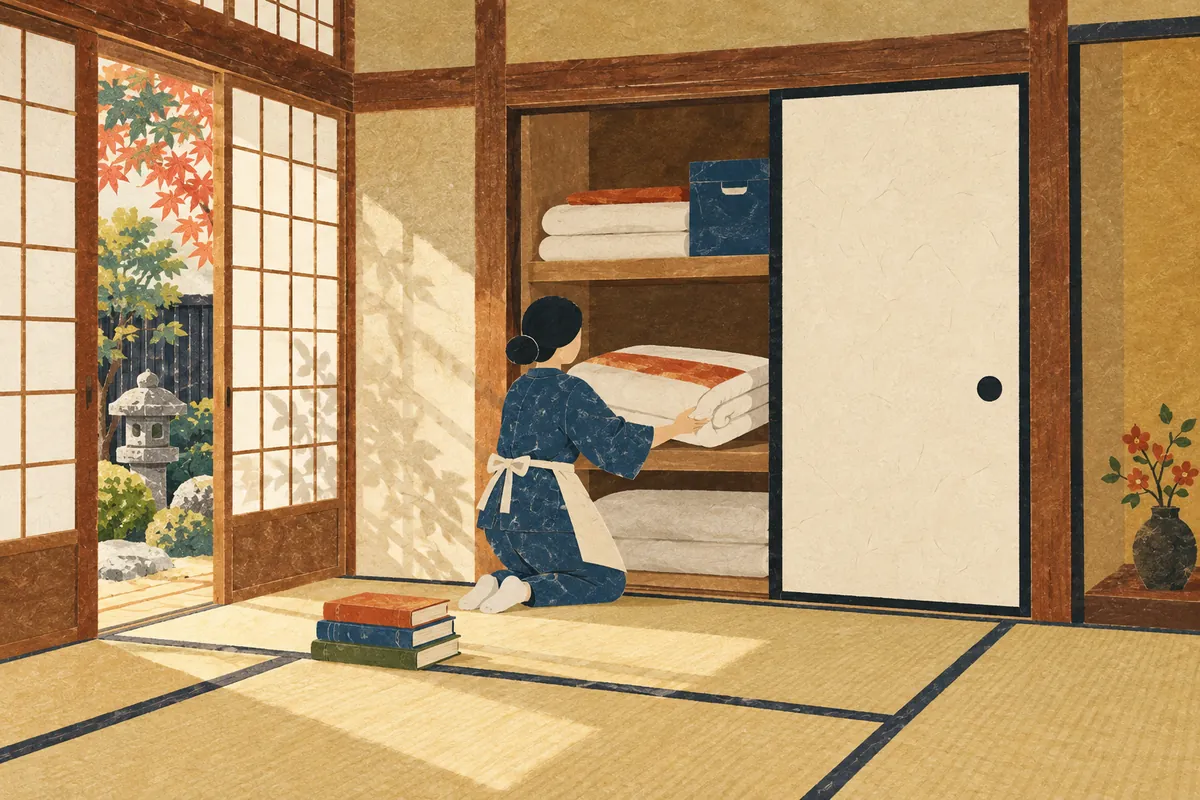
In Kyō-kotoba (Kyoto dialect), naosu (なおす) means "to tidy up" or "to put away." It is used like this: "Sono hon, naoshi toite" (その本、ナオシといて。, "Put that book away"). Japanese dictionaries describe this as a usage of the Kinki region, Kyushu, and other areas, and an old nationwide survey also found many "I use it" answers in Kinki and Kyushu.Key points in 30 seconds
Means "to tidy up" or "to put away"
Example: "Sono hon, naoshi toite." (その本、ナオシといて。) — "Put that book away."
In an old nationwide survey, "I use it" was common in Kinki, Kyushu, and elsewhere
"To throw away" is a different word: hokasu
What Naosu Means, with Examples
The Kyō-kotoba dictionary defines naosu (ナオス) as "to tidy up." Its example sentence, "Sono hon, naoshi toite" (その本、ナオシといて。), means "Put that book away"—not "Please repair that book."
The word also appears in standard Japanese dictionaries. Among the meanings of 直す (naosu) is "(in Kinki, Kyushu, and elsewhere) to tidy things up; to put away," with the example futon o naosu ("to put away the futon"). What stands out is that this meaning is listed under the same headword as the standard Japanese meanings "to repair" and "to restore to a good state."
A Usage Found in Edo-Period Writing
A large Japanese dictionary explains that one meaning of 直す is "to put away," used in the Kansai region in the early modern period. Its example comes from the 1826 sharebon (a genre of comic fiction) Iro Bukai Suimu (色深睡夢), in a scene where someone says nao shite oite (なをしておゐて, "put it away") about fifty ryō of money they have received.
The dictionary also lists a sailors' usage in which naosu means lowering the mast and laying it down when the sail is not in use. This shows that besides the standard meanings "to repair" and "to correct," naosu had several uses depending on region and occupation.
Is It Used Widely in Western Japan?
Map 61 of the Linguistic Atlas of Japan (Nihon Gengo Chizu) from the National Institute for Japanese Language and Linguistics collects answers from across Japan to the question, "Do you use the word naosu to mean tidying up or putting things away in a cupboard?" The survey was conducted in fiscal 1957–64, asking one man born in 1903 or earlier at each survey point.
On the map, red symbols meaning "I use it" cover almost all of the Kinki region and the area around Kyushu and Yamaguchi Prefecture. In the Chūgoku and Shikoku regions, "I use it" appears in scattered spots, such as along the Seto Inland Sea coast, mixed with "I don't use it." From the Chūbu region to the Kantō region, almost every point answered "I don't use it."
On the other hand, clusters of "I use it" answers also appear on the Pacific side of the Tōhoku region (around Iwate and Miyagi prefectures) and in the Nansei Islands. Naosu is often called "a word of western Japan," but this map shows that, while it centered on Kinki and Kyushu, people in distant regions used it too.
Besides "I use it" and "I don't use it," the legend also includes categories such as "used it in the past," "use it rarely," and "have started using it recently"; categories showing shifts in meaning, such as "but used to mean 'return to the original position'" and "but used to mean 'straighten the position'"; and a different word form, NAWASU (なわす). This suggests that even the same word naosu had slightly different ranges of meaning from region to region.
Overview of the nationwide survey "Do you use naosu to mean 'tidy up / put away'?"
| Region | Pattern of answers |
|---|---|
| Most of the Kinki region | "I use it" almost everywhere |
| Kyushu and around Yamaguchi Prefecture | "I use it" almost everywhere |
| Chūgoku and Shikoku regions | "I use it" along the Seto Inland Sea coast and elsewhere, mixed with "I don't use it" |
| Chūbu to Kantō regions | Mostly "I don't use it" |
| Pacific side of the Tōhoku region | Clusters of "I use it" |
| Sea of Japan side of the Tōhoku region and Hokkaido | Mostly "I don't use it" |
Don't Confuse It with Standard Japanese Naosu ("Fix")
Because naosu has the same form as standard Japanese 直す ("to fix"), people who do not know the "put away" meaning may hear it as "repair." If someone in Kyoto hands you a tool or piece of clothing that isn't broken and says "naoshi toite," understanding it as "please put it away" will make sense of the conversation.
In Japanese dictionaries, too, koshō o naosu ("to fix a breakdown") and futon o naosu ("to put away the futon") are listed as different meanings of the same 直す. Which meaning is intended has to be judged from the situation—whether the item is broken, or whether you are in the middle of tidying up.
The same naosu, many meanings
| Usage | Meaning | Example |
|---|---|---|
| Naosu in Kyō-kotoba and in Kinki, Kyushu, and elsewhere | To tidy up, to put away | "Sono hon, naoshi toite." (その本、ナオシといて。) / futon o naosu (ふとんを直す) |
| Standard Japanese 直す | To repair, to restore | koshō o naosu (故障を直す, "fix a breakdown") |
| Standard Japanese 直す | To correct, to amend | goki o naosu (誤記を直す, "correct a typo") |
Learn It Together with Hokasu
The Kyō-kotoba dictionary explains hokasu (ホカス) as "to throw away." Naoshi toite means "put it away," and hokashi toite means "throw it away." Both words describe what to do with things, so it is reassuring to learn to tell the two meanings apart.
In the Linguistic Atlas of Japan, Map 61 (naosu) is followed directly by Map 62, "suteru (to throw away)." Comparing the two maps confirms that both naosu and hokasu were used in the central part of the Kinki region.
Mini quiz for this entry
Check what you've read with 1 multiple-choice questions.
A Kyō-kotoba (Kyoto dialect) example sentence: "Sono hon, naoshi toite." Which fits the meaning of naosu here?
Sources and verification
Content checked: October 11, 2026
Updated: October 11, 2026
References are in Japanese.