
Kyoto After the Tokyo Tento
Other spellings and namesTokyo sento (transfer of the capital to Tokyo)
Key points
With no imperial rescript or government proclamation, Kyoto in effect ceased to be the capital when the emperor and the Daijōkan moved to Tokyo in 1869 (Meiji 2)
The population fell to about 240,000 in 1873 (Meiji 6) and, after the city's expansion in 1902, reached about 500,000 by 1912
Funds granted to Kyoto by the emperor at the time of the Tokyo tento were among the money used for the rebuilding
The emperor's move to Tokyo and "tento"
In the 7th month of Meiji 1 (1868), an imperial rescript renaming Edo as Tokyo was issued, and in the 9th month of that year Emperor Meiji traveled to Tokyo. The emperor returned to Kyoto once, but on the 28th day of the 3rd month of Meiji 2 (1869, lunar calendar) he arrived in Tokyo again, and the Daijōkan (Council of State), the center of government, was also moved inside Tokyo Castle. In this way Kyoto, the capital since Heian-kyō, in effect ceased to be the capital.
However, the Meiji government never officially announced a transfer of the capital (sento) to Tokyo, and neither an imperial rescript nor a government proclamation was issued. The Ishinshi (History of the Restoration), compiled by the Ministry of Education in 1941 (Shōwa 16), likewise uses not "sento" (遷都, transferring the capital) but "tento" (奠都), a word that simply means "establishing a capital."
The population's fall and recovery
In the Edo period, Kyoto was one of the largest cities in Japan, home to about 300,000 people. When court nobles (kuge) and officials moved to Tokyo after the Tokyo tento, merchants also left Kyoto, and the city faced a crisis of urban decline.
Kyoto's population (Kamigyō and Shimogyō) in 1873 (Meiji 6) was about a fifth below that of the Edo period, and it was slightly lower still in the survey for 1878 (Meiji 11). It turned upward only after that. The 1912 figure includes the areas added to Kyoto City when it expanded in 1902.
Changes in Kyoto's Population (1873–1912)
- 1873 (Meiji 6)
- 1878 (Meiji 11)
- 1889 (Meiji 22)
- 1912 (Taishō 1)
A revival that began with schools and industrial promotion
The first major move was in schools. In 1869 (Meiji 2), 64 bangumi elementary schools were opened, one for each bangumi, the units formed by reorganizing the machigumi (neighborhood associations), and Makimura Masanao, who later became the second governor of the prefecture, strongly pushed forward their construction. Nagatani Nobuatsu, the first governor of Kyoto Prefecture, also set about revival measures, for example in a memorial he submitted in 1870 (Meiji 3).
In Meiji 3, Kyoto Prefecture established the Seimikyoku (chemistry institute) and the Jusanjo (vocational center), and in 1871 (Meiji 4) it set up the Kangyōba (Industrial Promotion Office), using as capital funds such as those granted by the emperor at the time of the Tokyo tento. With the Kangyōba as a base, support for Nishijin weaving and Kiyomizu ware and the building of factories for beer, paper, and leather goods followed one after another.
Exhibitions were held early too. The exhibition held at Nishi Hongan-ji in Meiji 4 was the first exhibition in Japan, and the next year, 1872 (Meiji 5), the Kyoto Exhibition Company, formed by Kyoto Prefecture and private citizens, held the First Kyoto Exhibition with Nishi Hongan-ji, Kennin-ji, and Chion-in as its venues. The Gion song and dance performed as an entertainment there was the beginning of today's Miyako Odori.
Electricity from the canal and the trams
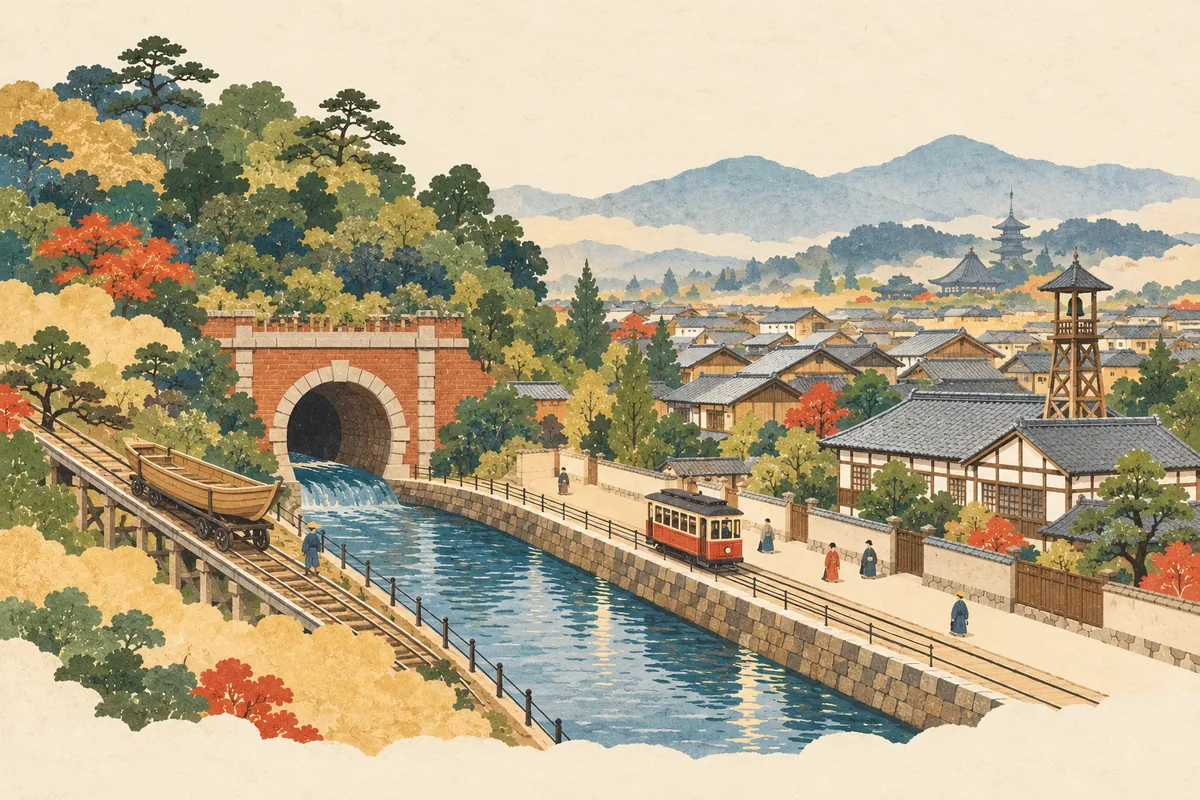
Kitagaki Kunimichi, who became the third governor of Kyoto Prefecture in February 1881 (Meiji 14), pushed ahead with building a canal to bring water from Lake Biwa, hoping to restore vitality to a Kyoto that had sunk low after the Tokyo tento. The plan aimed at transport, irrigation, power, and drinking water; construction began in 1885 (Meiji 18), the First Canal, from Ōtsu to the confluence with the Kamo River, was completed in 1890 (Meiji 23), with a completion ceremony on April 9.
During construction it was decided to adopt hydroelectric power, and the Keage Power Station was completed in 1891 (Meiji 24). On February 1, 1895 (Meiji 28), the Kyoto Electric Railway ran Japan's first city trams on its electricity. In the same year, Heian Shrine was founded on March 15 to coincide with the Commemorative Festival for the 1,100th Anniversary of the Transfer of the Capital to Heian-kyō, and on April 1 the Fourth National Industrial Exhibition opened in Okazaki. It drew more than 1.13 million visitors in four months, and the trams also carried people to the exhibition grounds.
After the canal was completed, holding the commemorative festival, hosting the National Industrial Exhibition, and building a railway between Kyoto and Maizuru were called the "Three Great Issues" in Kyoto, and the city's political and business leaders, seeing them as a chance to modernize, worked hard to make them happen.
The Three Great Projects at the end of the Meiji era
Kyoto City was born in 1889 (Meiji 22), and when the special municipal system (shisei tokurei), under which the prefectural governor performed the duties of mayor, was abolished at the end of September 1898 (Meiji 31), Naiki Jinzaburō became the first mayor. Naiki's plan for a Second Canal was carried on by the second mayor, Saigō Kikujirō (son of Saigō Takamori), and was realized as the "Three Great Projects": building the Second Lake Biwa Canal, laying a water supply system, and widening roads and laying municipal tram lines.
Construction of the Second Canal began in 1908 (Meiji 41) and it was completed in March 1912 (Meiji 45), and in April water supply began from the Keage Water Purification Plant. On June 11 the Kyoto City municipal trams began operating, and the completion ceremony for the Three Great Projects was held the same month.
Places to trace Kyoto's Meiji revival
The Kyoto Municipal Museum of School History (Gokōmachi-dōri Bukkōji sagaru, Shimogyō Ward) uses the building of the former Kaichi Elementary School and presents the history of education in Kyoto, centering on the 64 bangumi elementary schools. It is open 9:00–17:00 (last entry 16:30) and closed on Wednesdays (or the next weekday if Wednesday is a holiday). Admission is 400 yen for adults and 150 yen for elementary, junior high, and high school students, and elementary and junior high school students in Kyoto City are free on Saturdays and Sundays (as of October 2026).
The Lake Biwa Canal Museum of Kyoto (Nanzenji Kusagawa-chō, Sakyō Ward; a 7-minute walk from Keage Station on the Tōzai Subway Line) is free and open 9:00–17:00 (last entry 16:30); it is closed on Mondays (or the next weekday if Monday is a national or substitute holiday) and over the New Year period (December 29–January 3). Okazaki Park (Sakyō Ward) opened on the former exhibition site in 1904 (Meiji 37), and Heian Shrine, art museums, and a library now stand around it. The Former Main Building of the Kyoto Prefectural Office (Kamigyō Ward), completed on December 20 of the same year, is open free of charge Tuesday to Friday and on the 1st, 3rd, and 5th Saturdays, 10:00–17:00 (except holidays and the New Year period). A place connected with the municipal trams that opened in 1912 is the Tram Plaza (Shiden Hiroba) in Umekōji Park (Shimogyō Ward).
Mini quiz for this entry
What did the imperial rescript issued in the 7th month of Meiji 1 (1868) establish?
Which was NOT one of the "Three Great Projects" pushed forward at the end of the Meiji era by Saigō Kikujirō, the second mayor of Kyoto City?
Which temple was the venue of the exhibition held in Kyoto in 1871 (Meiji 4), the first exhibition in Japan?
Sources and verification
Content checked: October 19, 2026
Updated: October 19, 2026
References are in Japanese.
- 国土交通省「国会等の移転ホームページ ニューズレター『新時代』第77号 特集 東京遷都(奠都)の経緯」
- 国土交通省「国会等の移転ホームページ オンライン講演会 首都機能移転問題と『東京遷都』」
- 京都府「150年以上続く京都の酪農の歴史のはじまり」
- 京都府「明治時代の京都府の主な出来事」
- 京都府「京都府の年表 明治」
- 京都市「『明治150年・京都の奇跡プロジェクト』の推進について」(記者発表資料)
- 京都市埋蔵文化財研究所・京都市考古資料館「リーフレット京都 No.440 特別展示『洛中の江戸時代』によせて」
- 京都市会「京都市会のあらまし(令和7年版) 総記」
- 国立国会図書館デジタルコレクション「太政官正院地誌課編『日本地誌提要』巻之二 京都」
- 国立国会図書館デジタルコレクション「参謀本部『共武政表 明治十一年』山城 人口一百以上輻輳地」
- 京都市統計ポータル「推計人口(推計人口 長期時系列データ 明治22(1889)年以降)」
- 京都市「とうけいでみるきょうと 令和5(2023)年版」
- 京都市「都市史26 町組改正と小学校」
- 京都市「都市史27 琵琶湖疏水」
- 京都市「都市史29 京都の博覧会」
- 京都市「都市史30 平安遷都千百年紀念祭」
- 京都市上下水道局「琵琶湖疏水のご紹介」
- 京都市上下水道局「琵琶湖疏水の歴史(4)」
- 京都市交通局「市電保存館 on WWW」
- 平安神宮「由緒・歴史」
- 京都府「重要文化財 京都府庁旧本館」
- 京都府「旧本館の公開について」
- 京都市教育委員会「京都市学校歴史博物館 令和7年度企画展の開催について」
- 琵琶湖疏水記念館「利用案内・アクセス」