
The Former Main Building of the Kyoto Prefectural Office
Key points
A brick government building completed in 1904 and still used for offices and meeting rooms
A national Important Cultural Property and the first Kyoto Prefecture Designated Tangible Cultural Property
The Seichō hall, former governor's office, former assembly chamber, and courtyard are open free of charge (groups of 10 or more must book)
The site was the upper residence of the Kyoto Shugoshoku in the late Edo period
Japan's oldest government building still used in its original form
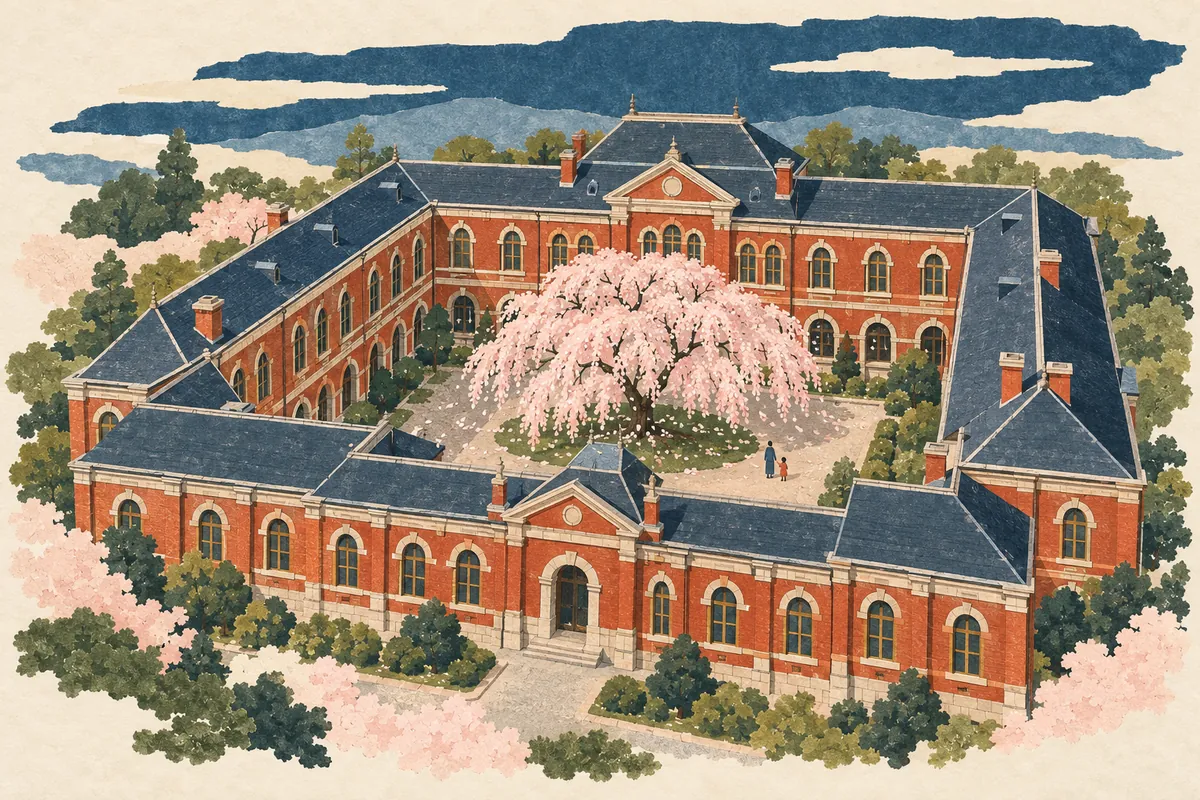
The former main building of the Kyoto Prefectural Office stands west of the Kyoto Imperial Palace, in Yabunouchi-chō, Shimodachiuri-dōri Shinmachi nishi-iru, Kamigyō Ward. A plan for a new government building was drawn up in 1899 (Meiji 32), the building was completed on December 20, 1904 (Meiji 37), and the ceremony marking the move took place in January of the following year. The design was handled by Kyoto Prefecture engineer Matsumuro Shigemitsu under the guidance of Ministry of Education engineer Kuru Masamichi, and the exterior is an eclectic style based mainly on the Renaissance.
In 1971 (Shōwa 46) it handed over its role as the main building to the new building (today's Building No. 2), hence the name "former main building," but it has continued in use since as offices and meeting rooms. It is the oldest government building in Japan still in use that retains its original form; in 1983 (Shōwa 58) it became the first Kyoto Prefecture Designated Tangible Cultural Property, and on December 10, 2004 (Heisei 16), the 100th anniversary of its completion, it was designated a national Important Cultural Property. It is a typical prefectural office building that integrated the assembly hall with the office building, and it became a model for later prefectural office architecture.
The brick building, the Seichō hall, and the former assembly chamber
The structure is a two-story brick building (partly stone) with a partial basement; the roof framing is wooden trusses and the roof is natural slate. The building area is about 2,822 m². The plan is a square ring around a courtyard, with a corridor running along the courtyard side, a carriage porch at the center of the front (south), a grand staircase beyond the entrance, and the assembly hall projecting from the rear (north).
The Seichō hall at the center of the second floor is a room for official ceremonies and receiving official guests, and cabinet meetings were held here at the time of the enthronement ceremonies of Emperor Taishō and Emperor Shōwa. The principal rooms, such as the governor's office and reception rooms, occupy the four corners of the second floor, and the former governor's office is also open to the public. The former assembly chamber at the rear of the first floor is where the Kyoto Prefectural Assembly actually met from 1905 (Meiji 38) to 1969 (Shōwa 44); the two-story-high chamber is surrounded on three sides by arcades whose upper level is the public gallery. After restoration, it has been opened as a venue for events since March 2015 (Heisei 27), and it can also be visited.
The courtyard cherry trees and the "Katamori-zakura"
The courtyard is attributed to Ogawa Jihei VII, the garden maker who created the gardens of Heian Shrine and the Murin-an villa. It holds seven cherry trees of six varieties, and the weeping cherry at the center is a seedling tree that is a grandchild of the original "Gion weeping cherry" in Maruyama Park.
The "Katamori-zakura" in the southwest is a mutation of a mountain cherry (yamazakura), a rare tree that carries the genes of the mountain cherry while also showing floral features of the Ōshima cherry group. In March 2010 (Heisei 22), at the prefecture's request, the cherry-tree guardian Sano Tōemon named it after Matsudaira Katamori, lord of Aizu, who served as Kyoto Shugoshoku (Kyoto Protector), because the upper residence of the Kyoto Shugoshoku had stood on this site. Also planted here are an Ōshima cherry, single- and double-flowered red weeping cherries, and a double-flowered cherry named "Haruka," presented by Fukushima Prefecture as a symbol of support for reconstruction. The usual peak is late March to early April, and a cherry blossom festival is held in spring.
Built on the site of the Kyoto Shugoshoku's upper residence
In the Heian period the area around the prefectural office was a district of government offices close to the Greater Imperial Palace (Daidairi), lined with aristocratic mansions that often served as satodairi (temporary imperial residences). In the late Edo period, the upper residence of the Kyoto Shugoshoku, a post created by the Tokugawa shogunate in 1862 (Bunkyū 2), was placed here. Matsudaira Katamori, lord of Aizu, took the post, and the following year about 99,000 m² (30,000 tsubo) of private land, covering what is now the Kyoto Prefectural Office, the Second Red Cross Hospital, and Umeya Elementary School, was purchased and the residence built. In the planting east of the main gate stands a stone monument reading "Site of the Kyoto Shugoshoku Residence."
Kyoto Prefecture reorganized the Kyoto Court and opened its office in 1868 (Keiō 4), and moved to the site of the Shugoshoku's upper residence in 1869 (Meiji 2). In 1871 (Meiji 4) it moved into Nijō Castle, and when it returned to this site in 1885 (Meiji 18), it used as its office the old school building of Kyoto Prefectural Middle School, which had opened on the residence site.
Visiting and access
It is about 10 minutes on foot from Marutamachi Station on the Karasuma subway line, or about 5 minutes from the "Bunkachō-mae / Fuchō-mae" city bus stop. Visitors can also enter through the east gate.
Viewing the former main building is free, and the Seichō hall, former governor's office, former dining room, former assembly chamber, and other rooms can be seen from 10:00 to 17:00 on Tuesdays through Fridays and the first, third, and fifth Saturdays, except public holidays and the year-end and New Year period (as of October 2026). No reservation is needed, but groups of 10 or more must book in advance, and viewing is not possible on some days because of prefectural events. There is also a café on the first floor. Free "Former Assembly Chamber Saturday Lectures" are also held six times a year.
Mini quiz for this entry
Which Kyoto Prefecture engineer designed the former main building of the Kyoto Prefectural Office, completed in 1904 (Meiji 37), under the guidance of a Ministry of Education engineer?
What kind of cherry tree is the Katamori-zakura in the southwest of the courtyard of the Kyoto Prefectural Office's Old Main Building?
The courtyard of the former main building of the Kyoto Prefectural Office is said to be the work of a garden maker who also created the gardens of Heian Shrine and the Murin-an villa. Who?
Sources and verification
Content checked: October 17, 2026
Updated: October 17, 2026
References are in Japanese.
- 京都府「重要文化財 京都府庁旧本館」
- 京都府「京都府庁旧本館の公開について」
- 京都府「府庁旧本館正庁、旧議場の貸付利用について」
- 京都府「令和8年京都府庁旧本館「観桜祭」の開催について」
- 京都府「府庁旧本館中庭の山桜の命名(容保桜)について」
- 京都府「京都府庁建築マップ(表面)」
- 京都府「京都府庁建築マップ(裏面)」
- 京都府・府庁旧本館利活用応援ネット「重要文化財 京都府庁旧本館 記念冊子」
- 京都府「重要文化財「京都府庁旧本館」120年の窓辺を、次の100年へ。」
- 京都府「旧議場土曜講座」
- 京都府「府庁へのアクセス」
- 文化庁 文化遺産オンライン「京都府庁旧本館」
- 文化庁 国指定文化財等データベース「京都府庁旧本館」
- 京都市上京区「滋野学区まち歩きマップ 古代より連なる政庁街の系譜、滋野を往く」
- 京都市観光協会 京都観光Navi「京都守護職屋敷跡」
- 京都市観光協会 京都観光Navi「京都府庁旧本館(桜)」
- 京都市観光協会 京都観光Navi「京都府庁旧本館 観桜祭 リーフレット」