
Heian Shrine and the National Industrial Exhibition
Key points
The shrine, the exhibition, and the anniversary festival came together in 1895 as the culmination of Kyoto's recovery after the capital moved to Tokyo and the population fell
The Fourth National Industrial Exhibition was held in Okazaki in 1895 and drew more than 1.13 million visitors
The Daigokuden and Ōtenmon began as exhibition venue buildings and became part of a shrine once a main sanctuary was built behind them
The Great Torii is 24 m high and 18 m wide. The shrine garden, by Ogawa Jihei VII (Ueji) and others, is a national Place of Scenic Beauty
Rebuilding Kyoto and the 1,100th anniversary of Heian-kyō
After the de facto transfer of the capital to Tokyo (Tōkyō tento) in 1869 (Meiji 2), Kyoto's population fell from about 340,000 to about 230,000. The people of Kyoto worked to revive their city by building 64 elementary schools, constructing the Lake Biwa Canal and the Keage Power Station, running trams on that electricity, and holding exhibitions. The culmination of these efforts was planned as three events: the founding of Heian Shrine, the Fourth National Industrial Exhibition, and the Commemorative Festival for the 1,100th Anniversary of the Transfer of the Capital to Heian-kyō.
1895 was the 1,100th year counting from 796 (Enryaku 15), when Emperor Kanmu first received the New Year's greetings at the Daigokuden (Great Hall of State). The festival's support association petitioned for a shrine dedicated to Emperor Kanmu, and Heian Shrine was founded on March 15, 1895. In 1940 (Shōwa 15), Emperor Kōmei, the last emperor to reign from Heian-kyō, was enshrined alongside him.
The Fourth National Industrial Exhibition
The National Industrial Exhibitions were domestic expositions held by the Meiji government to promote industry. Of the five, the first to third were held at Ueno in Tokyo and the fifth at Tennōji in Osaka; the fourth was awarded to Kyoto, to coincide with the commemorative festival, after a strong campaign to bring it there.
At the time, Okazaki was an area of rice paddies and turnip (kabura) fields. Buildings such as an industry hall, an art museum, and an animal hall went up there, and during the exhibition, from April 1 to July 31, 1895, there were 169,000 exhibits and more than 1.13 million visitors. On April 1, the Kyoto Electric Railway opened about 7 km of line from Shichijō Station (Kyoto Station) by way of the exhibition grounds to the Nanzen-ji boat basin, giving visitors a way to reach the grounds.
Okazaki Park opened on the former site in 1904 (Meiji 37), and the area later became a cultural district lined with a zoo, art museums, and a library. Keiryū Bridge, which opened on April 1, 1895, as the bridge to the exhibition's main gate, still stands today.
Designing the Daigokuden and Ōtenmon
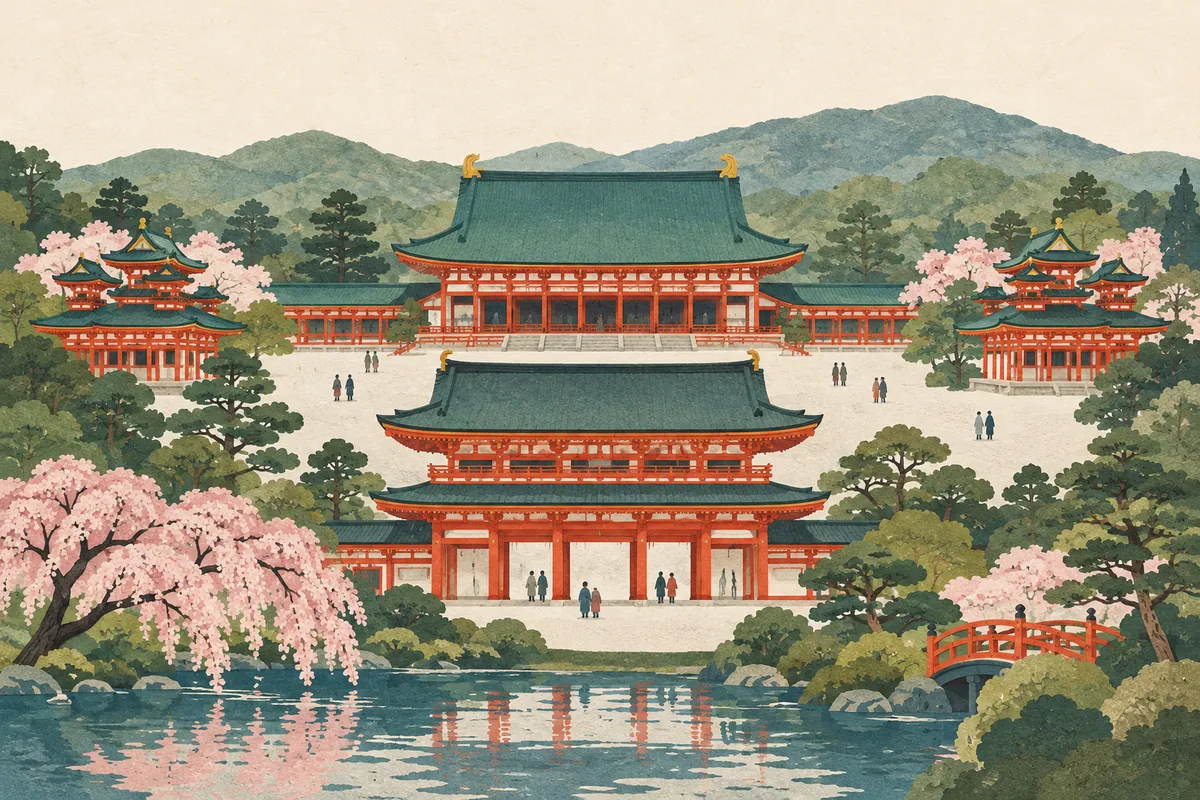
The Daigokuden and Ōtenmon were planned as venue buildings for the festival and the Fourth National Industrial Exhibition, known as "commemorative hall architecture" (kinenden kenchiku), modeled on the Daigokuden compound of the Heian Palace; a main sanctuary enshrining Emperor Kanmu was then built behind them, and they became shrine buildings. They were designed by Kiko Kiyoyoshi, an engineer of the Imperial Household Ministry, and Itō Chūta, then a graduate student at the Imperial University, built by the Shimizu-gumi construction company, and completed in March 1895.
Their model was the Daidairi Zu Kōshō, a study of the Heian Palace by the Edo-period scholar Uramatsu Kozen, and the scale was reduced several times because of limits on the site and budget before the final plan was reached. The halls recreate the Chōdōin at about five-eighths scale. The center of the original Daigokuden of the Heian Palace was near today's Senbon Marutamachi intersection.
Layout of the Heian Shrine Halls (Schematic Diagram)
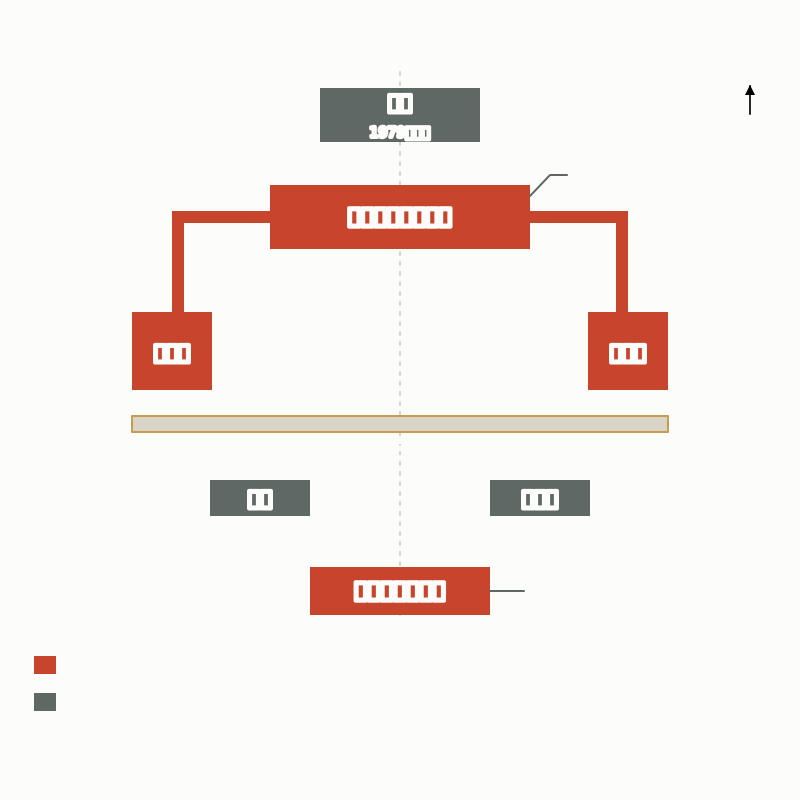
- Daigokuden (outer worship hall, gehaiden): modeled on the main hall of the Chōdōin of the Heian Palace. 11 bays (33.3 m) wide and 4 bays (12.1 m) deep
- Ōtenmon (shrine gate, shinmon): a large two-story gate modeled on the main south gate of the Chōdōin
- Sōryūrō (east) and Byakkorō (west): towers standing at the ends of the east and west corridors that extend in an L shape from the Daigokuden
- Ryūbidan: a raised terrace running east–west across the forecourt between the Daigokuden and the Ōtenmon
Heian Shrine in a timeline
In 1940 the main sanctuary, the Kaguraden (sacred dance hall), the Gakuden (votive plaque hall), and other buildings were extended and remodeled. The Kaguraden and Gakuden are modeled on the Chōshūdō, where officials waited at the Chōdōin. In 1976 (Shōwa 51), the east and west main sanctuaries and other buildings burned in an act of terrorism by extremists, and in April 1979 (Shōwa 54) a main sanctuary combining the two former buildings into one was rebuilt.
The reinforced-concrete Great Torii in Okazaki Park commemorates the enthronement ceremony of Emperor Shōwa and was the largest in Japan when it was built.
Timeline of Heian Shrine and Okazaki
| Date | Event |
|---|---|
| 1890 (Meiji 23) | The Lake Biwa Canal is completed (the Keage Power Station is completed the following year, 1891) |
| 1893 (Meiji 26) | The support association for the Commemorative Festival for the 1,100th Anniversary is founded. The Kyoto City Council votes to build the shrine, and a groundbreaking ceremony is held |
| 1913 (Taishō 2) | The East Garden is created, and the Shōbikan and Taiheikaku are moved from the Kyoto Gyoen |
| March 25, 1929 (Shōwa 4) | The Great Torii is completed (24 m high, 18 m wide) |
| June 1, 1983 (Shōwa 58) | The 1895 buildings become Kyoto City designated tangible cultural properties |
| August 21, 2002 (Heisei 14) | The Great Torii, the 1940 buildings, and others become national Registered Tangible Cultural Properties |
| December 24, 2010 (Heisei 22) | Six buildings, the Daigokuden, the East and West Corridors, the Sōryūrō, the Byakkorō, and the Ōtenmon, become national Important Cultural Properties |
| 2020 (Reiwa 2) | The Kyoto Electric Railway tram preserved in the grounds (Kyoto Municipal Transportation Bureau Car No. 2) becomes a national Important Cultural Property |
The Jidai Matsuri began as a side event of the Commemorative Festival
The Commemorative Festival for the 1,100th Anniversary was planned to be held during the exhibition with Emperor Meiji in attendance, but it was postponed and held for three days from October 22, 1895. October 22 is the date (the 22nd day of the 10th month) in 794 (Enryaku 13) on which Emperor Kanmu entered the new capital. The historical procession held as a side event on the 25th became the Jidai Matsuri the following year, 1896, when a procession of the deities was added, and it continues every October 22 as Heian Shrine's grand festival.
The shrine garden and water from the Lake Biwa Canal
The shrine garden (Shin'en) surrounding the halls is a pond-centered stroll garden created by Ogawa Jihei VII (Ueji) and others. It consists of four gardens, east, middle, west, and south, and became a national Place of Scenic Beauty in 1975. At its heart are the Middle Garden, around Sōryū Pond east of the main sanctuary, and the West Garden, around Byakko Pond to the west. The stepping stones of the Garyūkyō (Reclining Dragon Bridge) in the Middle Garden are made from the pillars of the Sanjō Ōhashi and Gojō Ōhashi bridges built by Toyotomi Hideyoshi.
The ponds use water from the Lake Biwa Canal, and because the canal water was filtered before being drawn in, many endangered species that have all but disappeared from Lake Biwa, such as the ichimonji tanago (a bitterling), live in them.
Heian Shrine's gate hours and the shrine garden
Heian Shrine is at 97 Okazaki Nishitennō-chō, Sakyō Ward. It is about a 10-minute walk from Exit 1 of Higashiyama Station on the Tōzai Subway Line; or take City Bus 5 or 100 from Kyoto Station to "Okazaki Kōen Bijutsukan/Heian Jingū-mae" and walk about 5 minutes north. There is no parking.
The gates open at 6:00 and close at 18:00 from March to September, 17:30 in October, and 17:00 from November to February (as of October 2026). You can worship free of charge in the grounds in front of the halls; the only paid area is the shrine garden, entered from within the grounds (adults 600 yen, junior high school age and younger 300 yen, preschoolers and younger free). The garden has two free-admission days a year, and on October 22, the day of the Jidai Matsuri, garden admission is limited to 9:30–11:30. You can visit with a stroller, but there are steps and stairs, and photographing toward the main sanctuary from the Daigokuden is prohibited.
Mini quiz for this entry
In 1895, Heian Shrine was built for a festival commemorating what?
At Heian Shrine, what does the building modeled on the Daigokuden of the Heian Palace serve as?
1895 (Meiji 28) was regarded as the "1,100th anniversary of the transfer of the capital to Heian-kyō" because it was the 1,100th year counting from which event?
Sources and verification
Content checked: October 18, 2026
Updated: October 18, 2026
References are in Japanese.
- 平安神宮「由緒・歴史」
- 平安神宮「社殿・境内案内」
- 平安神宮「平安神宮神苑」
- 平安神宮「時代祭」
- 平安神宮「ご参拝の方へ」
- 平安神宮「ご来宮の皆様へ(よくあるご質問)」
- 平安神宮「アクセス」
- 平安神宮「About Heian Jingu」(英語)
- 平安神宮「京都電気鉄道事業、『IEEEマイルストーン』に正式認定!!」(令和8年9月28日)
- 文化庁「国指定文化財等データベース 平安神宮 大極殿」
- 文化庁「国指定文化財等データベース 平安神宮 東西歩廊(東歩廊)」
- 文化庁「国指定文化財等データベース 平安神宮 蒼龍楼」
- 文化庁「国指定文化財等データベース 平安神宮 白虎楼」
- 文化庁「国指定文化財等データベース 平安神宮 應天門」
- 文化庁「国指定文化財等データベース 平安神宮大鳥居」
- 文化庁「国指定文化財等データベース 平安神宮神楽殿」
- 文化庁「国指定文化財等データベース 平安神宮額殿」
- 文化庁「国指定文化財等データベース 平安神宮神苑」
- 文化庁 文化遺産オンライン「京都電気鉄道電車(京都市交通局二号電車)」
- 文化庁 文化遺産オンライン「京都岡崎の文化的景観」
- 京都市「都市史29 京都の博覧会」
- 京都市「都市史30 平安遷都千百年紀念祭」
- 京都市観光協会 京都観光Navi「平安神宮」