
The Kyoto City Tram
Key points
Power came from the Lake Biwa Canal's Keage power station, so the trams also stopped on the canal's weed-cutting days
The city tram started on a wider gauge than Kyōden, and the narrow-gauge Kyōden lines kept after the 1918 buyout were called "N-den"
Lines were cut back as buses and cars increased, and the whole system closed in 1978 after 83 years
Cars survive in Umekōji Park and at Heian Shrine, and the paving stones in the pavements of Sannenzaka and the Philosopher's Path
Japan's first commercial electric train
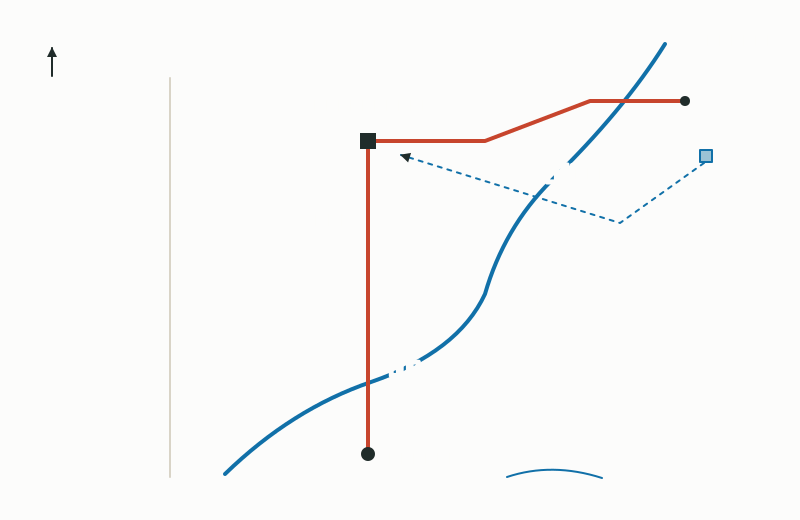
The first electric train in Japan to carry paying passengers began running in Kyoto on February 1, 1895 (Meiji 28). The privately owned Kyoto Electric Railway Company (Kyōden) opened its Fushimi Line, about 6 km between Shichijō Station (today's Kyoto Station) at Higashinotōin-dōri Shiokōji-sagaru and Shimoaburakake in the town of Fushimi.
The electricity came from the Keage power station of the Lake Biwa Canal, which had begun transmitting power in 1891. Because the trams stopped whenever the canal was shut off, New Year's Day and the weed-cutting days on the 1st and 15th of each month were regular non-operating days. In 1899 (Meiji 32) a coal-fired power station was built in Higashikujō village, increasing the line's capacity. In 2026 the Kyoto Electric Railway was recognized as an "IEEE Milestone," honoring historic achievements in electrical engineering.
The Kyoto Electric Railway Lines Opened in 1895 (Schematic)
The same year as the exhibition and Heian Shrine
The year 1895 marked 1,100 years since the capital was moved to Heian-kyō. Heian Shrine, dedicated to Emperor Kanmu, was founded on March 15, and the Fourth National Industrial Exhibition was held in Okazaki from April 1 to July 31. In April of that year Kyōden also opened a line from Shichijō Station to Nanzen-ji, linking Kyoto Station with the exhibition grounds in Okazaki by tram.
One Kyōden car built in 1911 was given to Heian Shrine and moved into its garden in December 1961; as one of the oldest surviving streetcars, it became a national Important Cultural Property, the "Kyoto Electric Railway car (Kyoto Municipal Transportation Bureau car No. 2)," on September 30, 2020. Its restoration was completed in March 2026. Heian Shrine (97 Okazaki Nishitennō-chō, Sakyō Ward) is a 10-minute walk from Higashiyama Station on the Tōzai subway line, and there is an admission fee for the shrine garden.
The boy "forerunners" who ran ahead of the trams
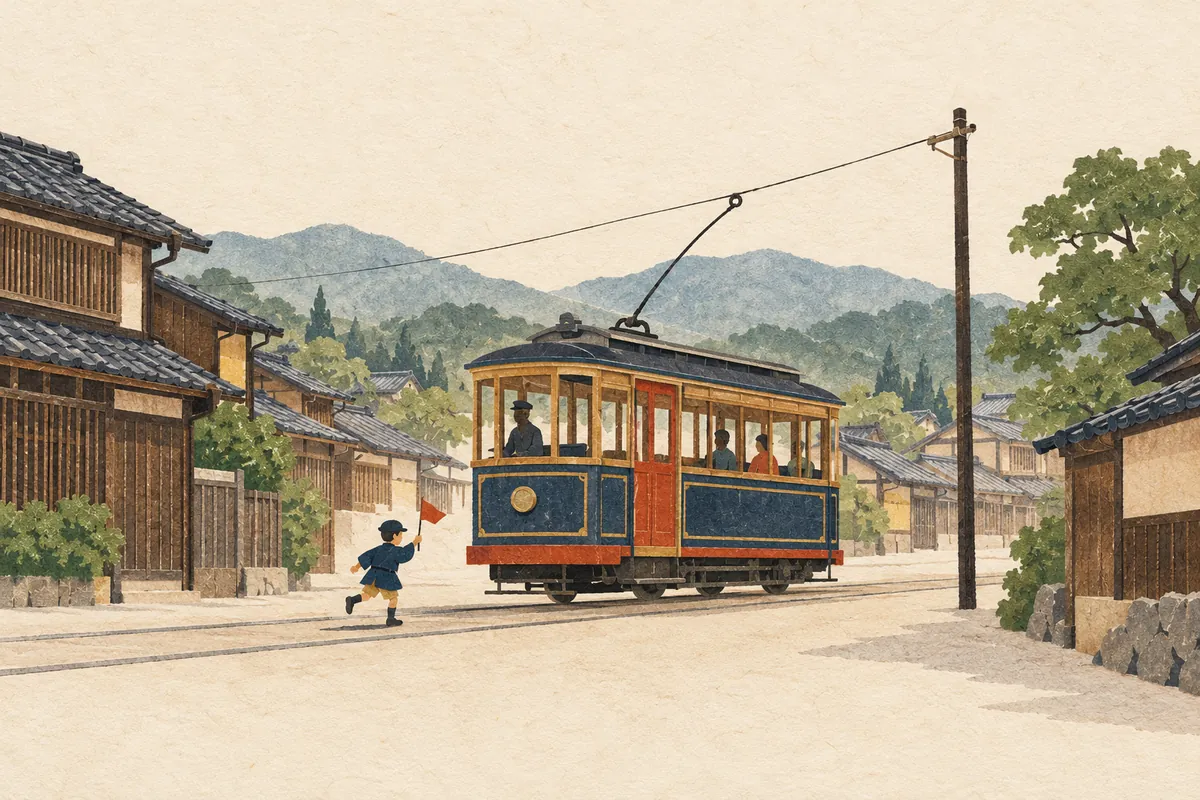
In August 1895, six months after the opening, Kyoto Prefecture's electric railway regulations established the post of "announcer" (kokuchinin). Their job was to run within 5 ken (about 9 m) ahead of the tram, carrying a flag by day and a lantern by night, shouting in Kyoto dialect "Densha ga kimassē, abunōssē" ("The tram is coming, watch out!"). They were boys aged 12 to 15 and were called "sakibashiri" (forerunners). After a series of accidents in which boys were run over by the trams, the system was abolished.
The city tram opens and takes over the Kyoto Electric Railway
On June 11, 1912 (Meiji 45), Kyoto City also began operating its own municipal tram. The first sections, including Mibu Depot to Karasuma Shiokōji, totaled 7.7 km; the city adopted a wider track gauge than Kyōden, and the two companies' trams competed for passengers. Kyoto City bought Kyōden on July 1, 1918 (Taishō 7), and unified the network. Kyōden's narrow-gauge lines came to be called "N-den," from the English word "narrow." The Kitano Line, completed between Kyoto Station and Kitano on December 28, 1905 (Meiji 38), was one of these N-den lines.
The network kept growing after the war, reaching its maximum of 76.83 km of route and 351 cars in FY1958 (Shōwa 33). At its peak in the late 1950s and early 1960s, about 600,000 people rode it each day.
Line closures and the end of service in 1978
As buses and cars multiplied from the early 1960s, the tram, tied to its rails and unable to change routes, ran into financial trouble. The narrow-gauge Kitano Line was closed on July 31, 1961 (Shōwa 36), and at the end of March 1970 (Shōwa 45) the Fushimi Line (Shiokōji Takakura to Chūshojima), Japan's oldest line, and the Inari Line disappeared.
On September 30, 1978 (Shōwa 53), the last remaining outer lines, the Kitaōji, Nishiōji, Kujō, Higashiyama, Shichijō, and Kawaramachi Lines, were closed, bringing down the curtain on 83 years of streetcars in Kyoto since Kyōden's opening. Most of the Kawaramachi Line had been closed in 1977, and only the section between Kyoto-ekimae and Shichijō Kawaramachi survived to the end. The 877 items of drawings and records known as the "Kyoto City Tram materials" became Kyoto City designated tangible cultural properties on March 31, 2021.
A monument and the paving stones underfoot
At the southwest corner of Shiokōji-dōri and Higashinotōin in front of Kyoto Station, Shimogyō Ward, stands the "Birthplace of Electric Railways" monument marking the starting point of the Fushimi Line. The stone marker was erected in 1975 (Shōwa 50) for the 80th anniversary of the opening, and a marker with the same purpose was erected the same year in Shimoaburakake-chō, Fushimi Ward.
The granite paving stones laid in the roadways were reused after the closure as paving at elementary schools and universities, on temple and shrine approaches, and on park paths. The stone pavements of Ninenzaka, Sannenzaka (Sannei-zaka), Ishibe-kōji, and Shinbashi-dōri in Higashiyama, and of the Philosopher's Path, are tram paving stones.
The tram plaza in Umekōji Park
At the "Shiden Hiroba" (Tram Plaza) in Umekōji Park (Kankiji-chō, Shimogyō Ward, right by JR Umekōji-Kyōtonishi Station), four cars, Nos. 505, 703, 890, and 1605, are preserved; the two at the front house the Tram Cafe and Tram Shop, and the two behind are free rest areas anyone can enter. Along the roughly 210 m to the neighboring "Suzaku Yume Hiroba," a battery-powered "chin-chin densha," narrow-gauge Type 1 car No. 27 restored to its Kyōden-era appearance, runs on Saturdays, Sundays, and public holidays from 10:00 to 16:00; the fare for elementary school age and older is 150 yen one way or 310 yen for a day ticket (as of April 2026). The Kyoto Railway Museum is in the same park.
The Randen still runs
The Kyoto City Tram is gone, but the Arashiyama Main Line of the Keifuku Electric Railroad (Shijō Ōmiya to Arashiyama, 7.2 km), known by the nickname Randen, began service on March 25, 1910 (Meiji 43), and together with its Kitano Line (Katabiranotsuji to Kitano Hakubaichō, 3.8 km) still runs through the city's streets today.
Mini quiz for this entry
In 1895, Japan's first commercial electric streetcar ran in Kyoto from the Kyoto Station area to where?
In the early days of the Kyoto Electric Railway, "forerunners" (sakibashiri) ran ahead of the trams shouting "Densha ga kimassē, abunōssē" ("The tram is coming, watch out!") to warn of danger. Who were they?
The Kyoto City Tram closed entirely on September 30, 1978 (Shōwa 53). Which of these lines was NOT among those still running until that day?
Sources and verification
Content checked: October 18, 2026
Updated: October 18, 2026
References are in Japanese.
- 京都市「都市史28 京都の市電」
- 京都市交通局「市電保存館 on WWW」
- 京都市交通局「京都市交通局のあゆみ」
- 京都市交通局「『百年分の、ありがとう』〜京都市公営交通100周年〜」
- 京都市交通局「市電保存館 on WWW(狭軌I型〜2000型)」
- 京都市交通局「おふたいむ 2022年6月号(京都市公営交通110周年)」
- 文化庁 文化遺産オンライン「京都電気鉄道電車(京都市交通局二号電車)」
- 平安神宮「歴史・由緒」
- 平安神宮「神苑」
- 平安神宮「京都電気鉄道事業、『IEEEマイルストーン』に正式認定!!」(令和8年9月28日)
- 文化庁 文化遺産オンライン「京都岡崎の文化的景観」
- 京都市上下水道局 琵琶湖疏水記念館「琵琶湖疏水 年表」
- 京都市「京都市営電車の車両と敷石」(琵琶湖疏水沿線の見どころ)
- 京都市上京区:市電(N電・北野線)の跡の案内
- 京都市建設局「梅小路公園に新広場がオープンします!」(平成26年2月5日広報資料)
- 京都市都市緑化協会「梅小路公園」
- 京都市都市緑化協会「チンチン電車運行再開のお知らせ(令和8年4月29日〜)」
- 京都市「京都市教育委員会告示第5号(京都市指定有形文化財の指定・京都市電関係資料)」(令和3年3月31日)
- 京福電気鉄道「会社概況」
- 熊本日日新聞(共同通信配信)「京都の最古級路面電車、雄姿戻る 平安神宮保管、修繕完了」(2026年3月6日)