
Kotohajime
Other spellings and namesShōgatsu kotohajime (正月事始め) / Okotohajime (お事始め) / 事始
Key points
Every year on December 13; in 2026 it falls on a Sunday
In the Edo period, Kamigata and other areas began New Year preparations with soot-sweeping on the 13th day of the 12th month, and Edo on the 8th
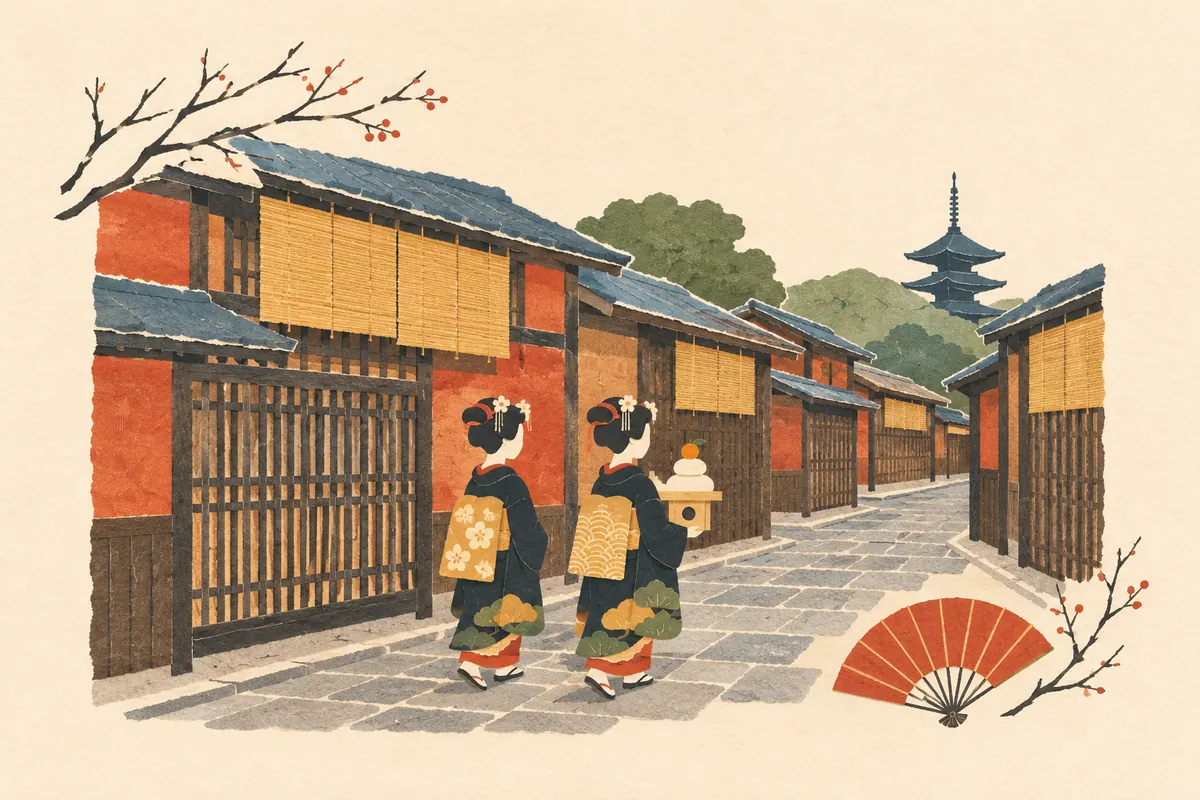
Gion Kōbu's geiko and maiko visit the iemoto with kagami-mochi and receive a fan from her
At Kitano Tenmangū, the distribution of Ōfuku-ume plums begins on Kotohajime
Kotohajime is December 13: the day to begin New Year preparations
Kotohajime is the day to start preparing to welcome the New Year. In Kyoto, December 13 is Kotohajime, and it is customary to begin from this day the preparations to welcome Toshitokujin, the deity who comes at the New Year. In 2026, December 13 falls on a Sunday.
In Kyoto's kagai, Kotohajime is one of the traditional events handed down in the five kagai of Gion Kōbu, Miyagawa-chō, Pontochō, Kamishichiken, and Gion Higashi. Geiko and maiko deliver kagami-mochi to those who have supported them, thanking them for the year and greeting them ahead of the New Year. In townspeople's lives, too, there was once a custom of taking kagami-mochi to the head family (honke) or to one's elders as a greeting.
What "shōgatsu kotohajime" means: the 13th in Kamigata, the 8th in Edo
Kotohajime (literally "the beginning of things") originally meant starting on something. Among its uses, sweeping out soot (susuharai) at the end of the year and starting preparations for the New Year was called "shōgatsu kotohajime" or "okotohajime." In the Edo period, Kamigata (Kyoto–Osaka) and other areas are said to have done the susuharai and begun New Year preparations on the 13th day of the 12th month, and Edo on the 8th day of the 12th month.
In Edo, both the 8th day of the 12th month and the 8th day of the 2nd month were called "koto no hi," and books differed over which of the two was Kotohajime. There is also a usage in which the 8th day of the 2nd month (old calendar) is the Kotohajime that starts the year's farm work.
Kotohajime in Gion Kōbu: kagami-mochi and "omedetō-san dosu"
The dance school of Gion Kōbu is the Inoue school of Kyōmai. Its iemoto has inherited the name "Inoue Yachiyo" from generation to generation, and the present iemoto is Inoue Yachiyo V, who took the name in 2000.
On Kotohajime, Gion Kōbu's geiko and maiko visit the practice studio of their teacher, the iemoto of the Inoue school, with kagami-mochi and thank her for her support over the year. It is the custom on this day to exchange the greeting "Omedetō-san dosu" ("Congratulations") a little early, without waiting for the new year to arrive. The iemoto says "Rainen mo okibariyasu" ("Keep up the good work next year too") and hands each geiko and maiko a fan. In 2017, some 300 people, including geiko, maiko, and students of Kyōmai, are said to have come to greet her between about 10 a.m. and about 3 p.m.
Besides the iemoto, geiko and maiko also visit the homes of their teachers of other arts and the ochaya (teahouses) to give thanks for the year and New Year greetings.
The kagai calendar of greetings, and the year-end that follows Kotohajime
The kagai have several events at turning points of the year when geiko and maiko make greeting rounds: Hassaku on August 1, Kotohajime on December 13, "Okotō-san" on New Year's Eve, and the Shigyōshiki (opening ceremony) on January 7 in the new year (January 9 in Kamishichiken). On New Year's Eve, geiko and maiko of Gion Kōbu, Miyagawa-chō, and Gion Higashi make year-end rounds of the ochaya, saying "Okotō-san dosu," and at night they receive okera-bi fire at Yasaka Shrine. Although it is also in December, the Kotohajime greeting is "omedetō-san dosu," celebrating the New Year.
In town, too, the year-end gets moving toward the New Year from Kotohajime. At Kitano Tenmangū in Kamigyō Ward, the distribution (for a fee) of "Ōfuku-ume," plums prepared in the shrine grounds, begins on Kotohajime, December 13, and continues until around Shimai-Tenjin on December 25. Ōfuku-ume is a good-luck item: on the morning of New Year's Day it is put in hot water and drunk with prayers for good health.
Etiquette when going to see it
Kotohajime is an occasion for greeting teachers and ochaya, not an event held for spectators. The streets of Gion Kōbu are where people live and work. When walking with children, too, please take care not to block the way of people going back and forth with their greetings.
Blocking someone's way, following them, or pulling at their hands or clothes are acts punishable under laws and ordinances. The residents of Gion-machi Minamigawa, the ochaya association, the geiko association, and others ask visitors at all times not to behave in the following ways (as of December 5, 2023).
- Stopping, touching, following, or photographing walking geiko or maiko without permission
- Lying in wait on the sidewalk, standing still, or stepping out into the roadway for photos
- Entering private property other than shops and roads, or places that temples and shrines have closed off, without permission
- Littering or making loud noise
Getting to Gion Kōbu, and where to see dance
The Gion Kōbu Kaburenjō theater (Gion-machi Minamigawa, Higashiyama Ward), at the center of Gion Kōbu, is about an 8-minute walk from Exit 6 of Keihan Gion-Shijō Station and about a 10-minute walk from Exit 1 of Hankyū Kyoto-Kawaramachi Station. If you want to see maiko perform Kyōmai, there are paid performances such as Gion Corner, held in the small theater of the Gion Kōbu Kaburenjō.
Mini quiz for this entry
On Kotohajime, December 13, what do Gion Kōbu's geiko and maiko bring to the practice studio of the iemoto (head) of their Kyōmai school?
On Kotohajime, what New Year greeting do Gion Kōbu's geiko and maiko exchange ahead of the new year?
At Kitano Tenmangū, what good-luck item begins to be given out on Kotohajime, December 13, and is put in hot water and drunk on the morning of New Year's Day?
Sources and verification
Content checked: November 8, 2026
Updated: November 8, 2026
References are in Japanese.