
Japanese柳馬場通(やなぎのばんばどおり)
Yanaginobamba-dori
Other spellings and namesYanaginobamba (柳馬場) / Nijō Yanagimachi (二条柳町) / Yanagimachi (柳馬場二条) / Yanaginobanba-dori
In short
柳馬場通, read Yanaginobamba-dōri (やなぎのばんばどおり), is a north–south street in central Kyoto that runs between Tominokōji-dōri and Sakaimachi-dōri. There are two theories about its name: that it comes from Nijō Yanagimachi, a pleasure quarter lined with willows (yanagi), or that willows were planted for a horse parade at the Hōkoku Festival. Nijō Yanagimachi is regarded as the beginning of the later Shimabara pleasure quarter.Key points in 30 seconds
馬場 is read bamba (ばんば), not baba
One theory traces the name to Nijō Yanagimachi, a willow-lined pleasure quarter
Another says willows were planted for a horse parade at the special Hōkoku Festival
Called "yanagi" in the street-name song (north–south version), and the name survives in the Ryūchi school district
Not "Baba" but "Bamba"
柳馬場通 is read Yanaginobamba-dōri (やなぎのばんばどおり). The characters 馬場 ("horse-riding ground") are usually read baba, but here they are read bamba. The introduction to the Ryūchi school district in Nakagyō Ward also writes the street on the district's west side as 柳馬場(やなぎのばんば)通.
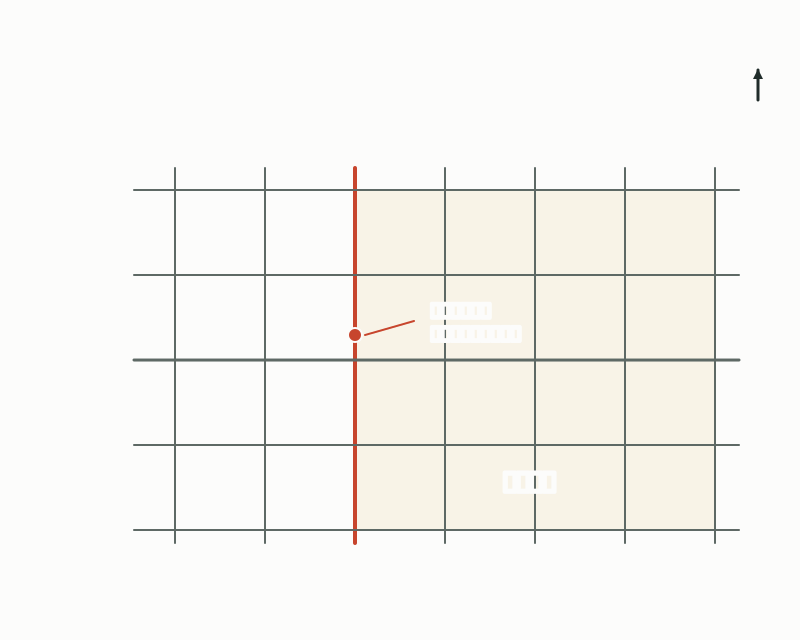
In the "Kyoto street-name song (north–south version)" posted on the stairs of subway stations, the streets are sung in order from the east: "tera (Teramachi), goko (Gokomachi), fuya (Fuyachō), tomi (Tominokōji), yanagi (Yanaginobamba), sakai (Sakaimachi)." In the song it is shortened to "yanagi," and you can see that it lies one block west of Tominokōji-dōri and one block east of Sakaimachi-dōri.
Location of Yanaginobamba-dōri and the Ryūchi School District
Two Theories About the Name
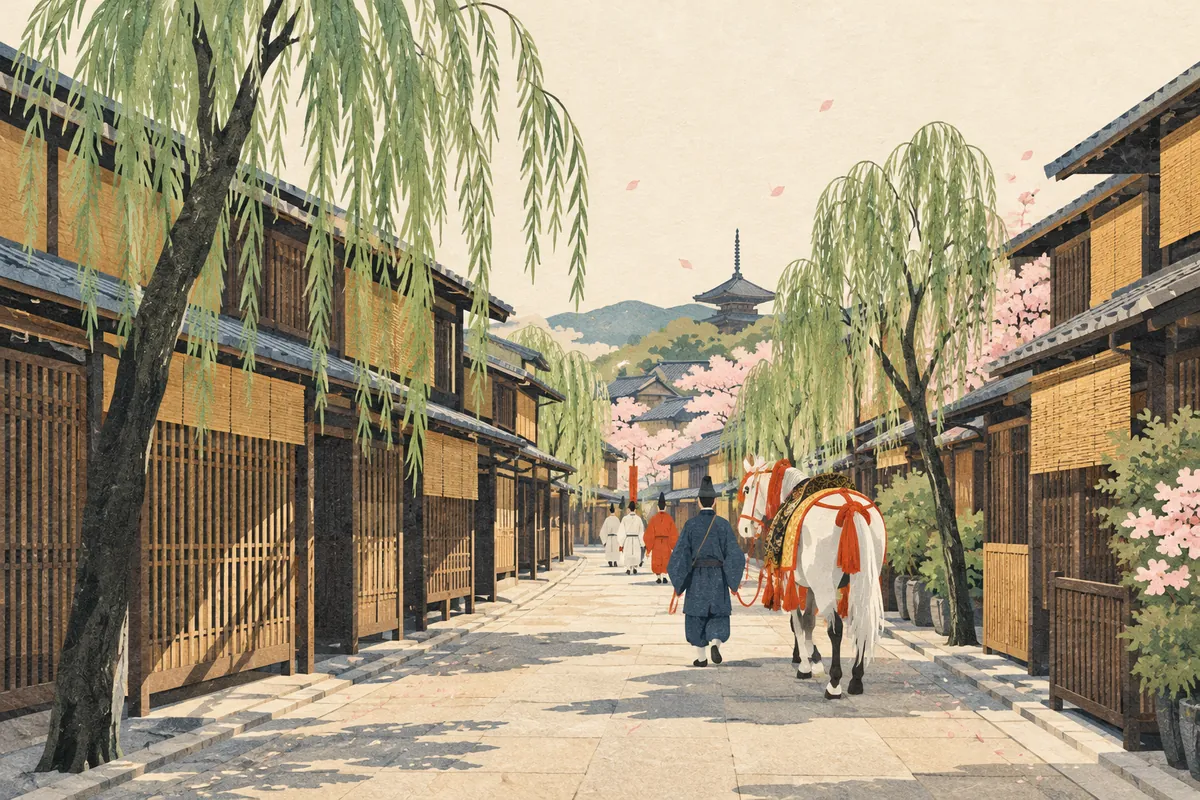
The name Yanaginobamba-dōri is said to come from a pleasure quarter called Nijō Yanagimachi, which once stood here surrounded by beautiful rows of willows. On the other hand, it is also said that willows were planted when a horse parade (umazoroe) to compare the merits of horses was held at the special Hōkoku Festival for the seventh anniversary of Hideyoshi's death.
Two origins are told for the name: the willow rows of Nijō Yanagimachi, and the large horse parade held at the special Hōkoku Festival for the seventh anniversary of Toyotomi Hideyoshi's death. Both theories try to explain why "willow" (yanagi) and "horse ground" (bamba) appear together, and neither has been settled as correct.
Two theories about the origin of the name Yanaginobamba-dōri
| Theory | Explanation |
|---|---|
| Nijō Yanagimachi theory | Because the pleasure quarter Nijō Yanagimachi, surrounded by beautiful rows of willows, stood here |
| Hōkoku Festival horse parade theory | Because willows were planted when a horse parade was held at the special Hōkoku Festival for the seventh anniversary of Hideyoshi's death |
What Was the Special Hōkoku Festival?
The special Hōkoku Festival that appears in the second theory was held in the eighth month of 1604 to mark the seventh anniversary of Hideyoshi's death. The Hōkoku Festival Screens (Hōkoku Sairei-zu Byōbu) at Toyokuni Shrine, which depict this festival, show a procession of Shinto priests riding horses provided by the warlords.
However, contemporary records could not confirm that the festival's horse parade was held where Yanaginobamba-dōri is today, or that willows planted on that occasion gave the street its name. Here it is treated as one of the theories about the name's origin.
Yanagimachi: The Beginning of Shimabara
The Shimabara pleasure quarter is said to have begun when Toyotomi Hideyoshi officially licensed the Yanagimachi quarter at Nijō Yanaginobamba. Shimabara was licensed by Hideyoshi in 1589 (Tenshō 17) and was first located at Yanagimachi (Yanaginobamba Nijō). Yanagimachi later moved to Rokujō Misujimachi and then to Shimabara.
In 1641, the quarter was moved by government order to the present site of Shimabara, and because the commotion of the move reminded people of the Shimabara Rebellion in Kyushu, it came to be called Shimabara. Its official name is Nishi-Shinyashiki. The "Exit Willow" (Deguchi no Yanagi) is still planted in front of the Shimabara Ōmon gate, so the bond between willows and the pleasure quarter continues in a new place.
From Nijō Yanagimachi to Shimabara
| Period | Location |
|---|---|
| 1589 (Tenshō 17) | Officially licensed at Yanagimachi (Yanaginobamba Nijō) |
| Later | Moved to Rokujō Misujimachi |
| 1641 | Moved by government order to present-day Shimabara (official name: Nishi-Shinyashiki) |
Where Can You See It Today? The Ryūchi School District
The Ryūchi school district is bounded by Nijō-dōri to the north, Sanjō-dōri to the south, Yanaginobamba-dōri to the west, and Teramachi-dōri to the east. In 1873 (Meiji 6), when the elementary school moved to Yanaginobamba-dōri Oike agaru, the district was named Ryūchi by taking 柳 ("willow," read ryū) and 池 ("pond," read chi) from the street names Yanaginobamba and Oike.
Japan's first school-district elementary school opened in this district. The site of the former Ryūchi Elementary School is now Kyoto Oike Sōseikan (Oike Junior High School). It is an example of a street name carried on into the names of a school district and a school.
"Yanaginobamba-dōri Oike agaru" is the Kyoto way of saying "north along Yanaginobamba-dōri from its intersection with Oike-dōri." Yanaginobamba Nijō, where Yanagimachi is said to have stood, is around the intersection at the northwest corner of today's Ryūchi school district. If you walk here, head south down Yanaginobamba-dōri from Nijō-dōri and look for the site of the former Ryūchi Elementary School just before Oike-dōri; you can feel how the names are connected.
- Read Yanaginobamba (やなぎのばんば); in the song it is "yanagi"
- One block west of Tominokōji-dōri and one block east of Sakaimachi-dōri
- Nijō Yanagimachi (Yanaginobamba Nijō) is regarded as the beginning of Shimabara
- The 柳 in the Ryūchi school district and the former Ryūchi Elementary School comes from Yanaginobamba-dōri
Mini quiz for this entry
Check what you've read with 2 multiple-choice questions.
How is 柳馬場通, a north–south street in central Kyoto, read?
Which is one of the theories given for the origin of the name Yanagi-no-banba-dōri?
Sources and verification
Content checked: October 11, 2026
Updated: October 11, 2026
References are in Japanese.