
Ninna-ji's Kondō and the Shishinden
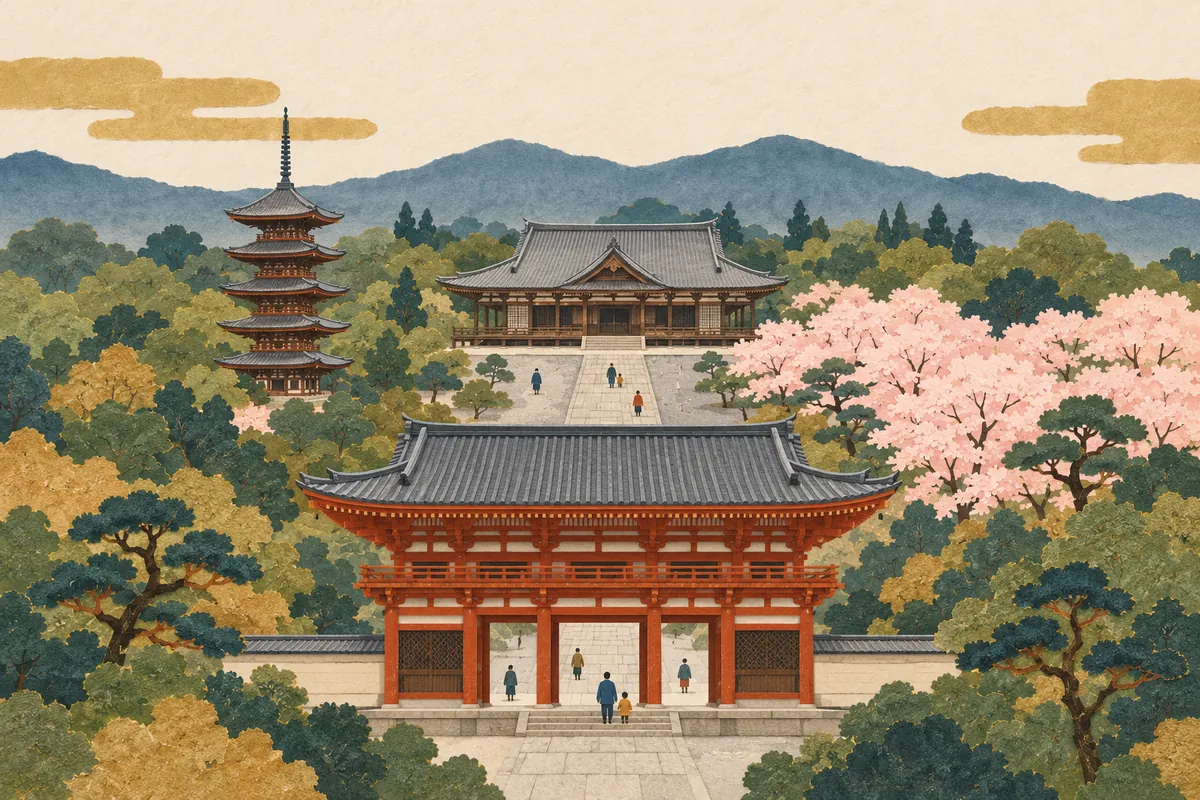
Key points
The Kondō is the palace Shishinden, moved here; its ridgepole was raised in 1643 (Kan'ei 20). National Treasure in 1953
The Important Cultural Properties are 1 five-story pagoda and 13 buildings, including the Niōmon. Most date from the Kan'ei rebuilding
The Omuro cherries became the Place of Scenic Beauty "Omuro (Sakura)" in 1924, and the Ninna-ji Gosho Garden a Place of Scenic Beauty in 2021
The Kondō, the moved Keichō-era Shishinden, has a tiled roof, while the Shishinden of today's palace, built in the Ansei era, is single-story with a cypress-bark roof
The Kondō was once the palace's Shishinden
The Kondō is the hall that enshrines the principal images, an Amida triad, and it was originally the Shishinden, the main ceremonial hall of the Dairi (the imperial palace, or Gosho). The Shishinden built in the first palace construction carried out by the Edo shogunate from 1611 (Keichō 16), and completed in 1613 (Keichō 18), was granted to Ninna-ji, and its ridgepole was raised as the Kondō in 1643 (Kan'ei 20).
When it was moved, the aisle (hisashi) on the west side was removed, the cypress-bark roof was changed to full tile roofing (hongawarabuki), and the interior fittings and partitions were altered slightly, but there was no fundamental change. The interior, where kōryō (rainbow beams) and kaerumata (frog-leg struts) are assembled to leave the roof structure exposed, and the kōhai (porch roof) decorated with carvings preserve the features of an early modern Shishinden well. It is the oldest surviving Shishinden, and it is also the only surviving example of a Shishinden that was moved elsewhere.
The Kenjō no Sōji (賢聖障子, sliding screens of the sages) that stood in the Shishinden were also handed down at Ninna-ji. Painted in 1614 (Keichō 19), they are the oldest surviving example, and as an Important Cultural Property they are kept at the Kyoto National Museum. On the roof of the Kondō is a tile of Kōan (黄安), a Taoist immortal riding a turtle, which is considered a symbol of eternity.
Differences from today's Shishinden at the Kyoto Imperial Palace
The present buildings of the Kyoto Imperial Palace were built in 1855 (Ansei 2), and their Shishinden is a single-story hall with a cypress-bark roof. Ninna-ji's Kondō is the Keichō-era Shishinden from about 240 years earlier, which survives in changed form as a tile-roofed Buddhist hall.
The Kan'ei rebuilding
In the Ōnin War, which began in 1467 (Ōnin 1), Ninna-ji lost almost all of its buildings to fire. In 1634 (Kan'ei 11), Imperial Prince Kakushin (Kakushin Hosshinnō) of Ninna-ji petitioned the third shogun, Tokugawa Iemitsu, who was then visiting Kyoto, for the temple's revival. Iemitsu approved, and reconstruction began under him.
This happened to coincide with the rebuilding of the palace, and in 1641 (Kan'ei 18), with the construction of the palace for Empress Meishō, the main palace halls, including the Shishinden, Seiryōden, and Tsune Goten, were granted to Ninna-ji. The Mieidō was built with part of the Seiryōden that was given to the temple, with metal fittings from the Seiryōden used on its shitomido (latticed shutters) as well. The Tsune Goten served as the center of the temple's palace buildings but burned in 1887 (Meiji 20); the present Shinden is a building of 1914 (Taishō 3).
The five-story pagoda, Niōmon, Chūmon (Middle Gate), Kannondō, Kyōzō (sutra repository), and other buildings were also built together during this rebuilding.
Ninna-ji's National Treasure and Important Cultural Property buildings
The nationally designated buildings are the National Treasure Kondō and the Important Cultural Properties designated together under the name "Ninna-ji": the five-story pagoda (1 structure) and 13 buildings.
Ninna-ji's National Treasure and Important Cultural Property buildings
| Building | Date | Designation (year) | Features |
|---|---|---|---|
| Kondō | 1613 (Keichō 18) | National Treasure (1953) | Irimoya roof, full tile roofing |
| Five-story pagoda | 1644 (Kan'ei 21) | Important Cultural Property (1900) | Total height 36.18 m |
| Niōmon | 1641–1645 | Important Cultural Property (1931) | A two-story double gate standing at the front of the grounds. 18.7 m high |
| Chūmon (Middle Gate) | 1641–1645 | Important Cultural Property (1973) | An eight-legged gate (hakkyakumon) between the Niōmon and the Kondō |
| Kannondō | 1641–1645 | Important Cultural Property (1973) | Interior normally closed to the public |
| Mieidō | 1641–1645 | Important Cultural Property (1908) | Cypress-bark roof |
| Mieidō Chūmon | 1641–1645 | Important Cultural Property (1973) | The gate in front of the Mieidō |
| Kyōzō (sutra repository) | 1641–1645 | Important Cultural Property (1973) | Inside is an octagonal revolving sutra case (rinzō) |
| Bell tower | 1644 (Kan'ei 21) | Important Cultural Property (1973) | Has a hakamagoshi (skirt-like lower enclosure), so the bell cannot be seen from outside |
| Main sanctuaries of Kusho Myōjin (3 buildings) | 1641–1645 | Important Cultural Property (1973) | The shrine that protects the temple complex. Central, left, and right halls |
| Honbō Omote-mon | Keichō era (c. 1596–1615) | Important Cultural Property (1973) | Said to be the palace's Odaidokoro-mon, moved here |
| Ryōkakutei (遼廓亭) | Mid-Edo period | Important Cultural Property (1937) | A tea house of the palace buildings |
| Hitōtei (飛濤亭) | Late Edo period | Important Cultural Property (1937) | A tea house in the north garden of the palace buildings |
Omuro Gosho and the Omuro cherries
Ninna-ji was vowed by Emperor Kōkō in 886 (Ninna 2) and completed in 888 (Ninna 4) by Emperor Uda, who carried on the wishes of Kōkō after his death the following year. Emperor Uda abdicated in 897 (Kanpyō 9), took holy orders, and in 904 (Engi 4) built a monk's residence (the Omuro, 御室) in the southwest of the grounds and lived there. From then on Ninna-ji was called the "Omuro Gosho," and abbots of imperial lineage (monzeki) continued until 1867 (Keiō 3). "Omuro" is still used in place names such as Omuro Ōuchi.
On the west side inside the Chūmon is a grove of late-blooming, low-growing Omuro cherries, designated in 1924 (Taishō 13) as the Place of Scenic Beauty "Omuro (Sakura)." There are about 130 trees in the cherry grove northwest of the Chūmon and south of the Kannondō, and about 200 in the grounds as a whole, of the variety Omuro Ariake. The Ninna-ji Gosho site became a Historic Site in 1938, the palace garden was designated the Place of Scenic Beauty "Ninna-ji Gosho Garden" in 2021, and in 1994 the temple became a component of the World Heritage property "Historic Monuments of Ancient Kyoto."
The temple buildings from the Niōmon to the Kondō
Passing through the Niōmon, which faces the road, the approach runs straight north, and the Kondō stands directly ahead beyond the Chūmon. Between the Niōmon and the Chūmon, the palace buildings (Goten) lie west of the approach and the Reihōkan (treasure hall) to the east. Inside the Chūmon, the Omuro cherries and the Kannondō are to the west and the five-story pagoda to the east; to the west of the Kondō are the bell tower and the Mieidō, and to the east the Kyōzō and Kusho Myōjin.
Layout of the Ninna-ji Temple Complex (Schematic Diagram)
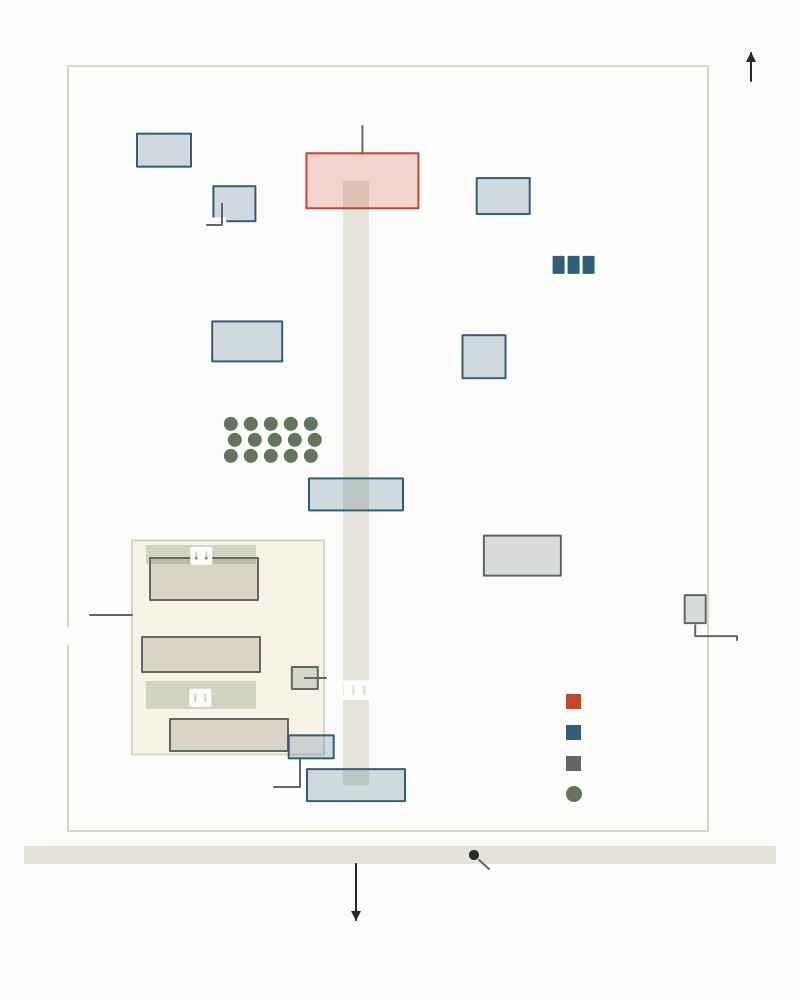
Omuro-Ninnaji Station and the Kondō and pagoda seen from the grounds
The address is Omuro Ōuchi, Ukyō Ward. It is about a 3-minute walk from Omuro-Ninnaji Station on the Randen (Keifuku Electric Railroad) Kitano Line, or right by the "Omuro Ninnaji" stop of city buses and JR buses (about 40 minutes on City Bus Route 26 from Kyoto Station). Visiting hours are 9:00–17:00 from March to November and 9:00–16:30 from December to February, with reception closing 30 minutes earlier (as of October 2026). Indoor and outdoor wheelchairs can be borrowed.
The grounds can be walked free of charge except during the Omuro cherry season, and you can see the Kondō, five-story pagoda, and Niōmon from outside. During the Omuro Hana Matsuri in spring, a special entry fee (800 yen for adults, free for high school students and younger) is required to enter the temple complex inside the Chūmon. The Gosho Garden (Shinden, Shiroshoin, and others) is 800 yen for adults, and the Reihōkan, open for limited periods, is 500 yen for adults; both are free for high school students and younger. The inside of the Kondō is not normally open to the public, but the rear hall (uradō) of the Kondō has been opened during "Kyō no Fuyu no Tabi," a special winter opening of normally closed cultural properties.
Mini quiz for this entry
When the palace's Shishinden was moved and rebuilt as Ninna-ji's Kondō, its roofing changed. How did it change?
Which of Ninna-ji's Important Cultural Property buildings was built with part of the Seiryōden of the palace built in the Keichō era, given to the temple, and uses metal fittings from the Seiryōden for its shitomido (latticed shutters) and other parts?
Sources and verification
Content checked: October 19, 2026
Updated: October 19, 2026
References are in Japanese.
- 文化庁「国指定文化財等データベース」(国宝・重要文化財(建造物)、仁和寺で検索)
- 文化庁「国指定文化財等データベース 仁和寺金堂」
- 文化庁「国指定文化財等データベース 仁和寺 五重塔」
- 文化庁「国指定文化財等データベース 仁和寺 二王門」
- 文化庁「国指定文化財等データベース 仁和寺 御影堂」
- 文化庁「国指定文化財等データベース 仁和寺 本坊表門」
- 文化庁「国指定文化財等データベース 絹本著色賢聖障子〈狩野孝信筆〉」
- 文化庁「国指定文化財等データベース 御室(サクラ)」
- 文化庁「国指定文化財等データベース 仁和寺御所跡」
- 文化庁「国指定文化財等データベース 仁和寺御所庭園」
- 文化庁「世界遺産 古都京都の文化財 推薦書 建造物・庭園目録(仁和寺)」
- 仁和寺「仁和寺について」
- 仁和寺「境内のご案内」
- 仁和寺「境内ルートマップ」(2026年9月)
- 仁和寺「御室桜について」
- 仁和寺「拝観・交通案内」
- 仁和寺「よくあるご質問」
- 仁和寺「Ninnaji Temple」(英語版トップ・Open Hours)
- 仁和寺「御室桜エリアデッキ改修工事および特別入山料改定のお知らせ」(2025年10月16日)
- 京都市観光協会「京都観光Navi 特別入山期間 御室花まつり」
- 京都市観光協会「『京の冬の旅』デジタルスタンプラリー(令和6年1月5日〜3月17日開催)スタンプスポット一覧」
- 宮内庁「よくあるご質問」(京都御所について)
- 宮内庁 京都御所「紫宸殿」
- 京都市・京都観光推進協議会「きょうと修学旅行ナビ 仁和寺」