
The Rock Garden of Ryōan-ji: 15 Stones and the Hōjō Garden
Other spellings and namesRyōan-ji (龍安寺) / Ryōan-ji (竜安寺) / Ryōan-ji rock garden / Ryōan-ji Hōjō Garden / Tora no Ko Watashi (虎の子渡し) / Kyōyōchi Pond (鏡容池) / Abura-dobei (油土塀) / Zōroku-an (蔵六庵)
Key points
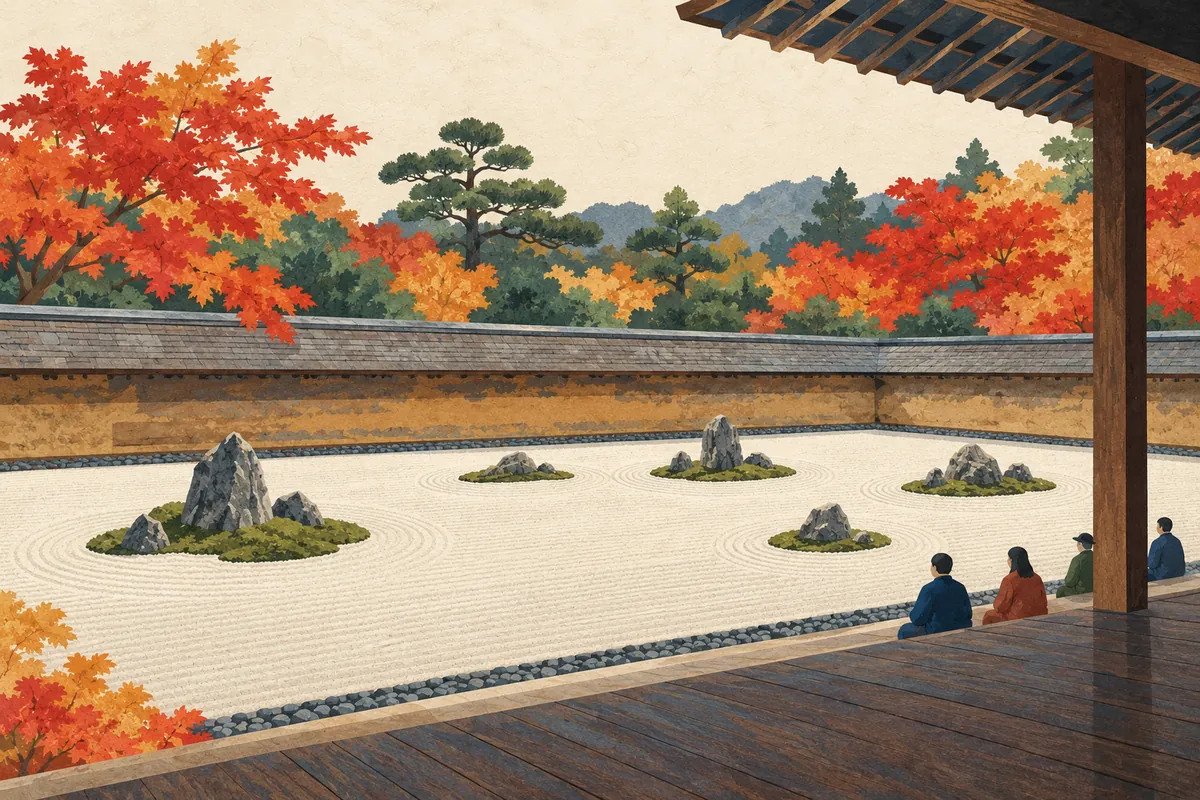
The rock garden has 15 stones in 5 groups on about 250 m² of white sand. It became a Historic Site and Place of Scenic Beauty in 1924 and a Special Place of Scenic Beauty in 1954
The Hōjō (designated name: Ryōan-ji Hondō) is the hōjō of Seigen-in, built in 1606 (Keichō 11), moved here in 1797 (Kansei 9); it became an Important Cultural Property in 1967
Viewing hours are 8:00–17:00 from March to November and 8:30–16:30 from December to February, open every day
In autumn 2026, on Saturdays and Sundays from September 26 to November 29, all 92 panels of the "Cloud Dragon" painting by Hosokawa Morihiro are shown in an after-hours special viewing (advance reservation, junior high school students and older)
15 stones in 5 groups: how the rock garden is made
The rock garden is on the south side of the Hōjō. It is a flat dry landscape garden in which 15 stones, large and small, are set in 5 groups on a rectangular bed of white sand of about 250 m², enclosed by earthen walls (tsuiji-bei) on the east, south, and west. No trees are planted; mountains and water are expressed with white sand and stones alone. It is regarded as the ultimate form of the dry landscape garden, in which nature is condensed into a small space and made abstract.
This arrangement of stones has long been known as "Tora no Ko Watashi" (虎の子渡し, a tigress carrying her cubs across a river), and various symbolic interpretations have been offered of what it represents. It is also said that you cannot see all 15 stones at once from any viewpoint.
The earthen wall around the rock garden is called an abura-dobei (油土塀, oil-and-clay wall). Part of the wall collapsed in heavy rain in 1976, and excavation and repairs were carried out the following year, 1977. At that time the roof of the wall was changed from tile to kokerabuki (wooden shingles), restoring its original form.
Who made it, and when? Theories on its maker and date
Ryōan-ji began in 1450 (Hōtoku 2), when Hosokawa Katsumoto, kanrei (shogunal deputy) of the Muromachi shogunate who later led the Eastern Army in the Ōnin War, took over a villa of the Tokudaiji family, invited Giten (義天) of Myōshin-ji as founding priest, and made it a Zen temple.
The maker of the rock garden is not known. One explanation says that, at the time of the founding, Katsumoto ordered a man named Shinsō (真相) to build it in front of the Hōjō. On the other hand, it is dated to the Muromachi period and is thought to have been made by around the middle of the 15th century (some accounts say the end of the 15th century). The temple's halls were put in order after the Hōjō was rebuilt in 1488 (some accounts say 1499), but the Hōjō and other buildings were lost in a fire in 1797 (Kansei 9). Even so, the rock garden is said to have come down to the present keeping its old appearance well.
The Hōjō overlooking the rock garden, and the front garden with Kyōyōchi Pond
The Hōjō from which you view the rock garden is designated an Important Cultural Property under the name "Ryōan-ji Hondō" (竜安寺本堂). After the fire of 1797, the hōjō of Seigen-in (西源院), a temple closely tied to Ryōan-ji, was moved here, and the building itself dates from 1606 (Keichō 11). It measures 21.0 m by 18.0 m, with a hip-and-gable (irimoya) roof of wooden shingles, and is regarded as an especially large example of a main hall in the hōjō style.
The garden east of the Hōjō has a Ryōanji-gaki fence and a Wabisuke camellia said to have been praised by Toyotomi Hideyoshi. Northeast of the Hōjō is the tea room Zōroku-an (蔵六庵), and there is also a stone water basin (tsukubai) said to have been donated by Tokugawa Mitsukuni (Mito Mitsukuni). Zōroku-an is normally not open to the public.
Kyōyōchi Pond (鏡容池), which spreads out on the way from the Sanmon gate to the Hōjō, is said to be a remnant of the time when the site was an aristocrat's villa. Together with the approach and the surrounding woods, it is a Place of Scenic Beauty as the "Ryōan-ji Garden," and it is regarded as an essential part of the surroundings of the rock garden.
The Grounds of Ryōan-ji: the Sanmon, Kyōyōchi Pond, the Hōjō, and the Rock Garden
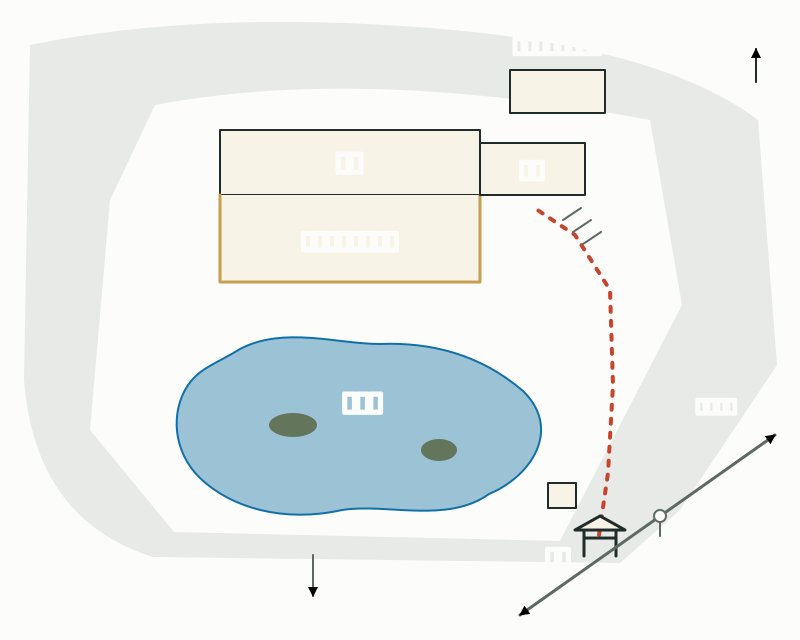
National designated cultural properties of Ryōan-ji
| Designated name | Extent | Type (year designated) |
|---|---|---|
| Ryōan-ji Hōjō Garden (龍安寺方丈庭園) | The rock garden south of the Hōjō | Historic Site and Place of Scenic Beauty (1924), Special Place of Scenic Beauty (1954) |
| Ryōan-ji Garden (龍安寺庭園) | The approach, Kyōyōchi Pond, and the surrounding woods | Place of Scenic Beauty (1955) |
| Ryōan-ji Hondō, with entrance hall (竜安寺本堂 附 玄関) | The Hōjō | Important Cultural Property (1967) |
The Cloud Dragon paintings in the Hōjō and the after-hours special viewing in autumn 2026
Former prime minister Hosokawa Morihiro (細川護熙), a descendant of the Hosokawa family, painted the "Cloud Dragon" (Unryū-zu) wall and sliding-door paintings for the Hōjō (main hall). The first 40 panels were dedicated in 2022 (Reiwa 4), and the remaining 52 were completed in May 2025 (Reiwa 7). It is a large work of 92 panels in all, more than 110 m long, depicting nine dragons from a young dragon to an old one.
In autumn 2026, all 92 panels are shown together on Saturdays and Sundays from September 26 to November 29 as an after-hours special viewing. It runs about 2 hours 30 minutes, from 16:00 to 18:30, and besides the rock garden in the evening, visitors are guided to the Butsuden (Buddha hall) and Zōroku-an, which are normally closed. It requires advance reservation and is limited to 20 people a day; the fee is 5,000 yen for junior high school students and older, and children of elementary school age and younger cannot take part.
Where can you see it now? / Getting there
Ryōan-ji is at 13 Ryōanji Goryōnoshita-chō, Ukyō Ward. The rock garden is viewed from the veranda of the Hōjō, and you can also walk around Kyōyōchi Pond. Admission is charged, and the temple is open every day of the year. It is linked to Kinkaku-ji and Ninna-ji by the "Kinukake-no-michi" road.
- Randen (Keifuku Electric Railroad): about 8 minutes on foot from Ryōanji Station
- City bus: route 59 to "Ryōanji-mae," right by the stop (JR Bus also stops at "Ryōanji-mae"). From "Ritsumeikan Daigaku-mae" on routes 50, 52, and 55, 7 minutes on foot
- Viewing hours: 8:00–17:00 from March to November, 8:30–16:30 from December to February
- Admission: 500 yen for high school students, 300 yen for elementary and junior high school students. Check the adult fee with the temple
- One of the component sites of the World Heritage "Historic Monuments of Ancient Kyoto" (inscribed in December 1994)
Mini quiz for this entry
From the arrangement of its stones, by what name has the rock garden of Ryōan-ji long been known?
Part of the earthen wall around the rock garden of Ryōan-ji collapsed in heavy rain in 1976. In the repairs the following year, what was the roof of the wall changed to?
Sources and verification
Content checked: October 29, 2026
Updated: October 29, 2026
References are in Japanese.
- 文化庁「国指定文化財等データベース 龍安寺方丈庭園」
- 文化庁「国指定文化財等データベース 龍安寺庭園」
- 文化庁「国指定文化財等データベース 竜安寺本堂」
- 文化庁「世界遺産推薦書 古都京都の文化財 3(b) 内容説明及び目録 O 龍安寺」
- 京都市「京都の庭園文化」(京都を未来に伝える文化遺産)
- 京都市「眺望景観 龍安寺周辺エリア」
- 京都市観光協会「京都観光Navi 龍安寺」
- 京都市観光協会「京都観光Navi 龍安寺(桜)」
- 京都市観光協会「京都観光Navi 龍安寺 細川護熙氏揮毫「雲龍図」完成記念!閉門後特別拝観」(2026年)
- 京都市観光協会「Kyoto City Official Travel Guide: Ryoan-ji Temple」
- 京都市・京都観光推進協議会「きょうと修学旅行ナビ 龍安寺」