
Chion-in: The National Treasure Mieidō and Sanmon, and the "Seven Wonders"
Other spellings and namesChion-in (知恩院) / Chion Kyōin Ōtani-dera / Kachōzan / Chion-in Mieidō / Chion-in Hondō / Seven Wonders of Chion-in / Wasure-gasa (Forgotten Umbrella) / Uryū-seki (Uryū Stone)
Key points
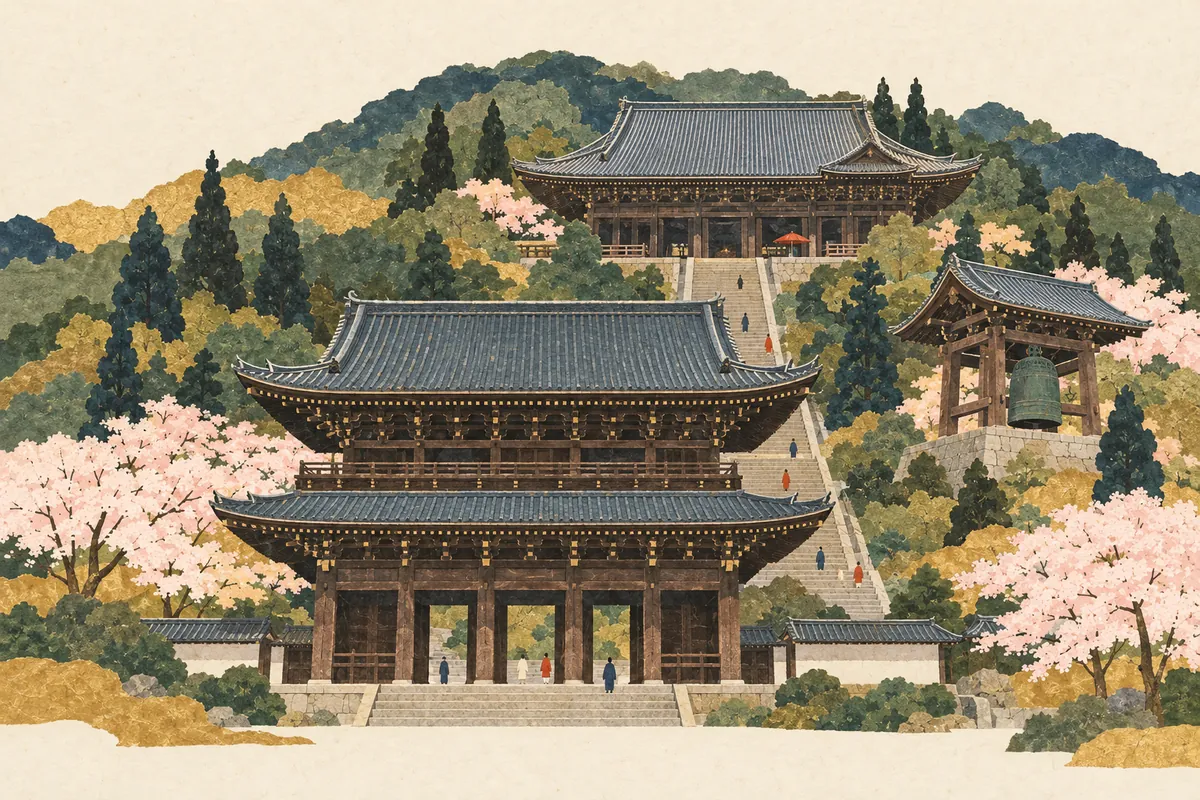
The National Treasure buildings are 2 items, the Mieidō (1639) and the Sanmon (1621). There are 9 Important Cultural Property buildings, including the Seishi-dō, the Kyōzō, and the Ōhōjō
The oldest building is the Seishi-dō of 1530 (Kyōroku 3), standing on the site of the Ōtani hermitage where Hōnen spent his last years
Of the Seven Wonders, the Forgotten Umbrella and the Uryū Stone can be seen at any time, and the Nuke-suzume, the Great Ladle, and others are displayed on the Hōjō Garden viewing route
Admission is charged for Yūzen-en and the Hōjō Garden; elementary and junior high school students pay 150–250 yen (as of October 2026)
The head temple of the Jōdo school, which began with Hōnen's hermitage
In 1175 (Jōan 5), Hōnen began teaching senju nenbutsu (専修念仏), the teaching that anyone can be saved by reciting the nenbutsu; he came down from Mount Hiei and built a thatched hermitage at Yoshimizu in Higashiyama. The hermitage stood near today's Mieidō. From 1211 (Kenryaku 1), when he returned to Kyoto from exile, he lived in the Ōtani hermitage, on the site of today's Seishi-dō, and he died there at the age of 80 on the 25th day of the first month of the following year.
In 1234 (Bunryaku 1), his disciple Genchi (源智) put his grave in order, built a Buddha hall and a hall for his portrait, and established the temple.
The great building project of three Tokugawa shoguns, and grounds in three levels
In 1603 (Keichō 8), Tokugawa Ieyasu made Chion-in his family's temple in perpetuity, and to pray for his late mother Dentsū-in (伝通院) he enlarged the temple grounds to almost their present size. From 1619 (Genna 5) the shogunate built the Sanmon and the Kyōzō (sutra repository), completing them in 1621 (Genna 7). A fire in 1633 (Kan'ei 10) burned everything except the Sanmon and the Kyōzō, but under the third shogun, Iemitsu, the Mieidō was rebuilt in 1639 (Kan'ei 16), and the Hōjō, the Kuri (priests' quarters), and the Karamon gate in 1641 (Kan'ei 18).
The grounds are divided into three levels on the slope at the foot of Kachōzan: the lower level, with the Sanmon and the subtemples (tatchū); the middle level, with the central buildings such as the Mieidō; and the upper level, with the Seishi-dō and Hōnen's mausoleum (gobyō). From the Sanmon, a flight of 51 stone steps, the "Otoko-zaka" (Men's Slope), climbs to the middle level, and the Onna-zaka (Women's Slope) runs beside it to the south. Going north along Jingū-michi in front of the Sanmon takes you to Shōren-in, and Maruyama Park is southwest of the Sanmon.
Layout of the Buildings of Chion-in (Schematic)
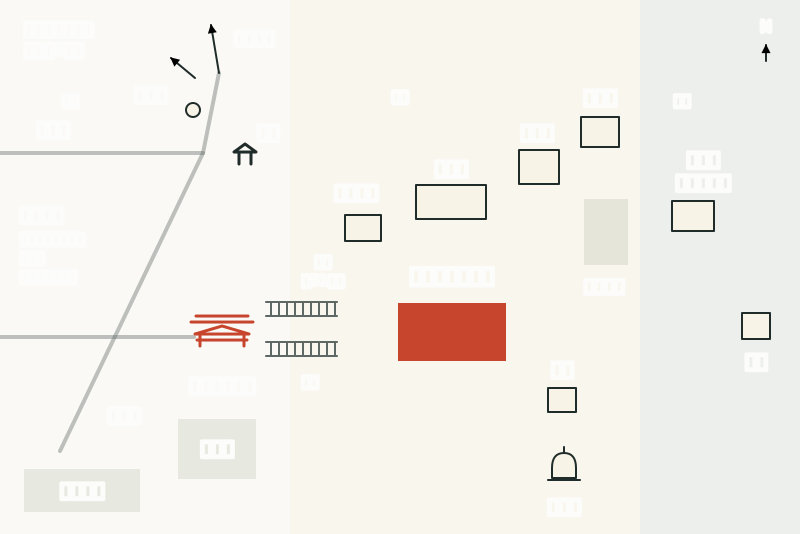
The National Treasure Mieidō and Sanmon, and the 9 Important Cultural Property buildings
The Mieidō is the main hall, enshrining the image (miei) of Hōnen. Built by Iemitsu in 1639 (Kan'ei 16), it is 11 bays wide and 9 bays deep, with a hip-and-gable (irimoya) roof of full tile roofing; the outside is finished in the Japanese (wayō) style, while the inside uses Zen-style methods, with many columns standing in rows. As a project marking the 800th memorial of Hōnen (2011), a major repair including the complete re-roofing of its tiles was carried out over about 9 years until 2020 (Reiwa 2), and a completion ceremony was held in April of that year. Four tiles left unlaid at the center of the main ridge are thought to have been left deliberately to show that the building is unfinished.
The Sanmon is a gate 24 m tall built in 1621 (Genna 7) on Hidetada's orders. The 9 Important Cultural Property buildings are the Seishi-dō, the oldest building at Chion-in; the Kyōzō, built in the same year as the Sanmon; the Shūe-dō (assembly hall), rebuilt by Iemitsu; the Ōhōjō, Kohōjō, Ōkuri, and Kokuri (large and small abbot's quarters and kitchens) and the Karamon of 1641 (Kan'ei 18); and the Daishōrō (great bell tower) of 1678 (Enpō 6). The great bell, weighing about 70 tons, is covered in the entry on temple bells.
National Treasure and Important Cultural Property buildings of Chion-in
| Building (national designation name / building name) | Date | Type of cultural property (year designated) |
|---|---|---|
| Chion-in Hondō (Mieidō) | Early Edo, 1639 (Kan'ei 16) | National Treasure (2002) |
| Chion-in Sanmon | Early Edo, 1621 (Genna 7) | National Treasure (2002) |
| Chion-in Seishi-dō | Late Muromachi, 1530 (Kyōroku 3) | Important Cultural Property (1899) |
| Chion-in Kyōzō | Early Edo, 1621 (Genna 7) | Important Cultural Property (1900) |
| Chion-in Shūe-dō | Early Edo, 1635 (Kan'ei 12) | Important Cultural Property (1997) |
| Chion-in Ōhōjō | Early Edo, 1641 (Kan'ei 18) | Important Cultural Property (1910) |
| Chion-in Kohōjō | Early Edo, 1641 (Kan'ei 18) | Important Cultural Property (1910) |
| Chion-in Ōkuri | Early Edo, 1641 (Kan'ei 18) | Important Cultural Property (1997) |
| Chion-in Kokuri | Early Edo, 1641 (Kan'ei 18) | Important Cultural Property (1997) |
| Chion-in Karamon | Early Edo, 1641 (Kan'ei 18) | Important Cultural Property (1910) |
| Chion-in Daishōrō | Mid-Edo, 1678 (Enpō 6) | Important Cultural Property (1997) |
Seven stories handed down as the "Seven Wonders"
Chion-in has long had the following Seven Wonders.
- Nightingale floor (uguisu-bari): a 550 m corridor linking the Mieidō with the Shūe-dō, the Ōhōjō, and the Kohōjō. The floor chirps like a bush warbler when stepped on, and it is said this let people hear anyone sneaking in
- Forgotten Umbrella (Wasure-gasa): an umbrella with only its ribs left, visible under the eaves at the front right (east side) of the Mieidō. One story says the master carpenter Hidari Jingorō put it there to ward off evil; another says a white fox put it there in thanks for being given a home
- Plain wooden coffins: coffins kept in the upper story of the Sanmon together with wooden statues of the construction magistrate Gomi Kin'emon (五味金右衛門) and his wife. The couple are said to have taken their own lives to take responsibility for going over budget
- Nuke-suzume (sparrows that flew away): sparrows in Kanō Nobumasa's sliding-door paintings in the Kiku no Ma (Chrysanthemum Room) of the Ōhōjō are said to have come to life and flown away
- Sanpō Shōmen Makō no Neko (the cat facing three ways): Kanō Nobumasa painted this cat on cedar doors along a Hōjō corridor. Stand in front of it or move to either side, and the cat still seems to be staring straight at you
- Great Ladle (Ōshakushi): a ladle 2.5 m long and weighing about 30 kg, placed on a beam of the corridor at the entrance to the Ōhōjō. It is said to carry the meaning of "scooping up" (sukuu, which also means "saving") people
- Uryū Stone (Uryū-seki): a stone in the road where you start up toward the Kuromon gate. Stories say that melons (uri) grew on it though no one planted them, and that digging there leads to a secret passage to Nijō Castle
The National Treasure Hayaraigō and the Illustrated Biography of Hōnen are normally not on view
Chion-in also owns 5 National Treasures among fine arts and crafts. The Kamakura-period "Descent of Amida with Twenty-Five Bodhisattvas" is called "Hayaraigō" (早来迎, Swift Descent) because Amida and the bodhisattvas are shown hurrying down along the mountain to welcome a believer reciting the nenbutsu. The "Illustrated Biography of Hōnen Shōnin" is a Kamakura-period picture scroll in 48 scrolls depicting Hōnen's life, also called "Hōnen Shōnin Gyōjō Ezu."
Among calligraphy and books, the "Jōgū Shōtoku Hōō Teisetsu" (上宮聖徳法王帝説), a biography of Prince Shōtoku, the "Bosatsu Shotai-kyō" sutra, which includes an album with a colophon dated 550, and scroll 3 of the "Dairōtan-kyō" sutra are National Treasures. These treasures are normally not on view and are not shown in the grounds of Chion-in.
Where can you see it now? / Getting there
Chion-in is at 400 Rinka-chō, Higashiyama Ward. It is an 8-minute walk from Higashiyama Station on the Tōzai subway line, or from Kyoto Station take city bus route 206 to "Chion-in-mae" and walk 5 minutes. The gates are open from 6:00 to 16:00, with changes on the days of some events. Admission is charged for Yūzen-en and the Hōjō Garden (as of October 2026).
- Mieidō: you can go up from the front and pray. The covered corridor to the Hōjō Garden starts here
- Sanmon: the upper story (with the plain wooden coffins) is normally closed and is opened during special viewing periods and at other times
- Seven Wonders: the Forgotten Umbrella (under the eaves at the front right, on the east side, of the Mieidō) and the Uryū Stone (at the intersection in front of the Kuromon) can be seen at any time. The Nuke-suzume, the cat, the Great Ladle, and a model of the nightingale floor are displayed on the Hōjō Garden viewing route
- Garden admission: Yūzen-en 300 yen for adults (high school students and older) and 150 yen for elementary and junior high school students; Hōjō Garden 400 yen and 200 yen; combined ticket 500 yen and 250 yen. Reception from 9:00
- The Seishi-dō has been under repair since 2024 (Reiwa 6). In the meantime, the mausoleum can be visited from 9:00 to 16:00
- Free shuttle bus from the Sanmon to the Mieidō (9:00–16:00, except during the 13:00 hour)
Mini quiz for this entry
One of the Seven Wonders of Chion-in is the "Forgotten Umbrella" (Wasure-gasa). Where can you see the umbrella, with only its ribs left?
At the center of the main ridge of Chion-in's National Treasure Mieidō, what is thought to have been left deliberately to show that the building is unfinished?
Sources and verification
Content checked: October 28, 2026
Updated: October 28, 2026
References are in Japanese.
- 知恩院「法然上人とお念仏」
- 知恩院「知恩院の歴史」
- 知恩院「知恩院の建造物」
- 知恩院「御影堂【建造物】」
- 知恩院「国宝御影堂 落慶法要」
- 知恩院「国宝・御影堂ものがたり 第5回 御影堂の瓦の歴史」
- 知恩院「三門【建造物】」
- 知恩院「集会堂【建造物】」
- 知恩院「経蔵【建造物】」
- 知恩院「方丈【建造物】」
- 知恩院「大鐘楼【建造物】」
- 知恩院「勢至堂【建造物】」
- 知恩院「勢至堂修理事業」
- 知恩院「御廟【建造物】」
- 知恩院「知恩院の七不思議」
- 知恩院「知恩院の宝物」
- 知恩院「拝観情報」
- 知恩院「交通アクセス」
- 知恩院「よくあるご質問」
- 文化庁「国指定文化財等データベース 知恩院本堂(御影堂)」
- 文化庁「国指定文化財等データベース 知恩院三門」
- 文化庁「国指定文化財等データベース 知恩院勢至堂」
- 文化庁「国指定文化財等データベース 知恩院経蔵」
- 文化庁「国指定文化財等データベース 知恩院(集會堂)」
- 文化庁「国指定文化財等データベース 知恩院(大方丈)」
- 文化庁「国指定文化財等データベース 知恩院(小方丈)」
- 文化庁「国指定文化財等データベース 知恩院(大庫裏)」
- 文化庁「国指定文化財等データベース 知恩院(小庫裏)」
- 文化庁「国指定文化財等データベース 知恩院唐門」
- 文化庁「国指定文化財等データベース 知恩院大鐘楼」
- 文化庁「国指定文化財等データベース 良正院(本堂)」
- 文化庁「国指定文化財等データベース 絹本著色阿弥陀二十五菩薩来迎図(早来迎)」
- 文化庁「国指定文化財等データベース 紙本著色法然上人絵伝」
- 文化庁「国指定文化財等データベース 上宮聖徳法王帝説」
- 文化庁「国指定文化財等データベース 菩薩処胎経」
- 文化庁「国指定文化財等データベース 大楼炭経〈巻第三〉」