
Shōren-in and the Blue Fudō (Ao Fudō): A National Treasure at Shōgunzuka Seiryūden and a Monzeki Temple at Awataguchi
Other spellings and namesShōren-in (青蓮院) / Shōren-in Monzeki / Awata Gosho / Blue Fudō (Ao Fudō, 青不動) / Fudō Myōō and Two Attendants, in color on silk / Shōgunzuka / Shōgunzuka Seiryūden / Seiryūden wooden stage (Ōbutai)
Key points
The Blue Fudō is a Heian-period Buddhist painting, designated a National Treasure on March 29, 1952 (Shōwa 27). It is 203 cm tall and 149 cm wide
Shōgunzuka Seiryūden was completed in October 2014 (Heisei 26). Its address is Zushioku Kachō-chō, Yamashina Ward
Admission to both Shōren-in and Seiryūden is 600 yen for adults and 200 yen for elementary school students. At Seiryūden, elementary school students visiting individually are free with a guardian
All of Shōren-in's grounds are the national Historic Site "Shōren-in Former Temporary Palace" (designated 1942)
Why is it called a monzeki? From Shōren-bō on Mount Hiei to the palace at Awata
It is said to have begun as Shōren-bō, one of the monks' residences that Saichō set up on Mount Hiei. At the end of the Heian period, Cloistered Emperor Toba, a devotee of Gyōgen (行玄) of Shōren-bō, made his seventh son Gyōgen's disciple and had halls built in Kyoto, renaming it Shōren-in; this is regarded as the beginning of the temple as a monzeki temple (a temple headed by an imperial or noble abbot). Until the Meiji era almost all of its head priests were members of the imperial family or sons of the five regent families, and it is counted with Sanzen-in and Myōhō-in as one of the three monzeki temples of the Tendai school.
The third head priest, Jien (慈円), was the monk who wrote the Gukanshō, and Shinran, founder of Jōdo Shinshū, is said to have been ordained under Jien. On the north side of the grounds is the Shokuhatsu-dō, which enshrines the hair shaved off at that time. When the imperial palace burned in the great fire of 1788 (Tenmei 8), Shōren-in became the temporary palace of Retired Empress Go-Sakuramachi, and it is still called "Awata Gosho" (the Awata Palace).
The National Treasure Blue Fudō: why "blue," and what kind of painting it is
"Fudō Myōō and Two Attendants, in color on silk" (絹本著色不動明王二童子像, Kenpon chakushoku Fudō Myōō Nidōji-zō) is a Heian-period Buddhist painting called the "Blue Fudō" because the figure's body is a bluish black (shōkoku). It is thought to date from around the 11th century. On silk 203 cm tall and 149 cm wide, Fudō Myōō sits on a rock holding a sword and a rope (kensaku), against blazing flames painted in vermilion and red. It was designated a National Treasure on March 29, 1952 (Shōwa 27).
On the right as you face Fudō is the attendant Kongara Dōji with his palms together, and at lower left the attendant Seitaka Dōji holding a staff; the three figures form a triangle. Another feature is that the left and right sides are shown differently, as with the "tenchigan" (天地眼) eyes, the right eye glaring at heaven and the left at the earth. Together with the Red Fudō of Mount Kōya and the Yellow Fudō of Mii-dera, it is counted as one of the "Three Great Fudō Paintings of Japan."
Fudō Myōō is sometimes shown in five colors, blue, yellow, red, white, and black, and because blue is said to be at the center of the five colors, the Blue Fudō is explained as the highest among images of Fudō Myōō. It is said to have been enshrined at the imperial court originally and given to Shōren-in at the end of the Heian period as a reward for its prayers.
Shōgunzuka and Seiryūden: detached grounds on a hilltop in Higashiyama
Shōgunzuka (将軍塚, the General's Mound) is a mound on a hilltop in Higashiyama. Emperor Kanmu is said to have climbed this hill with Wake no Kiyomaro, looked down on the Kyoto Basin, and decided on the site of the capital. What the emperor is said to have had buried in the mound as a guardian of the capital was a general made of clay, roughly 2.5 m tall, clad in armor and a helmet and holding an iron bow and arrows and a sword. Legends in the Genpei Jōsuiki and the Taiheiki also say that the mound rumbled whenever something grave was about to happen to the country. The mound, about 20 m across, still remains.
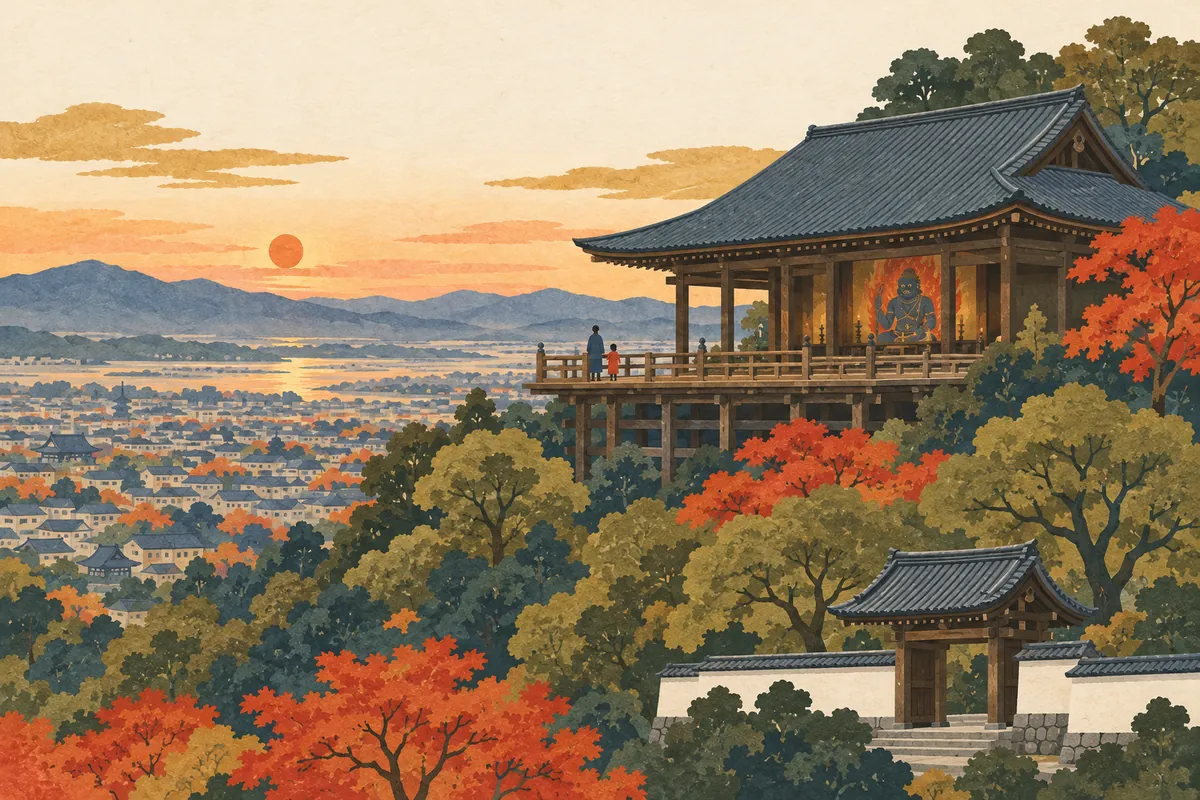
Shōren-in holds Shōgunzuka as a detached part of its grounds, and in October 2014 (Heisei 26) it completed the Seiryūden (青龍殿), a large hall for goma fire rituals. The building was the Butokuden of the Kyoto branch of the Dai Nippon Butokukai, built in front of Kitano Tenmangū to commemorate the enthronement of Emperor Taishō; after the war it was used by the police for judo and kendo as Kyoto Prefecture's "Heian Dōjō." After Kyoto Prefecture decided to close and demolish it, Shōren-in moved it to the hilltop and rebuilt it.
A new wooden "Ōbutai" (large stage) was built in front of Seiryūden. Its total floor area is 1,046 m², said to be 4.6 times the size of the stage of Kiyomizu-dera. From the observation deck on the west side, it is said you can see as far as the buildings of Osaka.
The gardens, the camphor trees, and special night viewings
The main garden of the temple is a stroll garden with a pond centered on Ryūshin-ike Pond, using Mount Awata as borrowed scenery, and is said to be the work of Sōami (相阿弥) in the Muromachi period. East of the Kachōden is the "Kirishima Garden," said to be the work of Kobori Enshū in the Edo period. The Shinden was built by the Edo shogunate by moving a former residence of Tōfukumon-in.
The great camphor trees standing in a row before the gate are Registered Natural Monuments of Kyoto City. They rise to more than 20 m, and their trunks reach roughly 6 m in girth. They probably date from after Shōren-in relocated here in the 13th century.
The timing of the special night viewing (illumination) changes from year to year. In autumn 2025 it was held from November 7 to December 7 for the first time in five years, and in 2026 the summer "Shōrenge no Natsu Akari" was held (July 17 – August 23; 1,500 yen for adults and 1,000 yen for elementary school students; main temple only). Check the temple's announcements for that year's schedule.
Highlights of Shōren-in and Shōgunzuka Seiryūden
| Place | What is there | Type of cultural property | Viewing |
|---|---|---|---|
| Shinden and Kachōden (main temple) | Buildings such as the Shinden, made by moving a former residence of Tōfukumon-in | All of the grounds are the national Historic Site "Shōren-in Former Temporary Palace" (designated March 7, 1942) | 9:00–17:00, admission required |
| Ryūshin-ike garden (main temple) | Stroll garden with a pond, said to be by Sōami | Part of the grounds of the Historic Site | You can walk through it with main temple admission |
| Kirishima Garden (east of the Kachōden) | Garden said to be by Kobori Enshū | Part of the grounds of the Historic Site | Can be seen with main temple admission |
| Kōbuntei (main temple) | Tea house Retired Empress Go-Sakuramachi used as her study (rebuilt in 1995) | — | Special viewings on Saturdays, Sundays, and holidays in spring and autumn (1,800 yen, plus admission) |
| Camphor trees at the gate | A row of large trees over 20 m tall with trunks about 6 m around | Registered Natural Monument of Kyoto City | Can be seen in front of the gate |
| Inner hall of Shōgunzuka Seiryūden | Original of the Blue Fudō (with a reproduction in front) | National Treasure (March 29, 1952) | 9:00–17:00, admission required. Visitors pray before the reproduction |
| Seiryūden's large stage | Wooden stage looking down over the city of Kyoto | — | Open with Seiryūden admission |
| Shōgunzuka | Mound where a general's figure is said to be buried | — | Can be seen with Seiryūden admission |
Where can you see it now? / Getting there
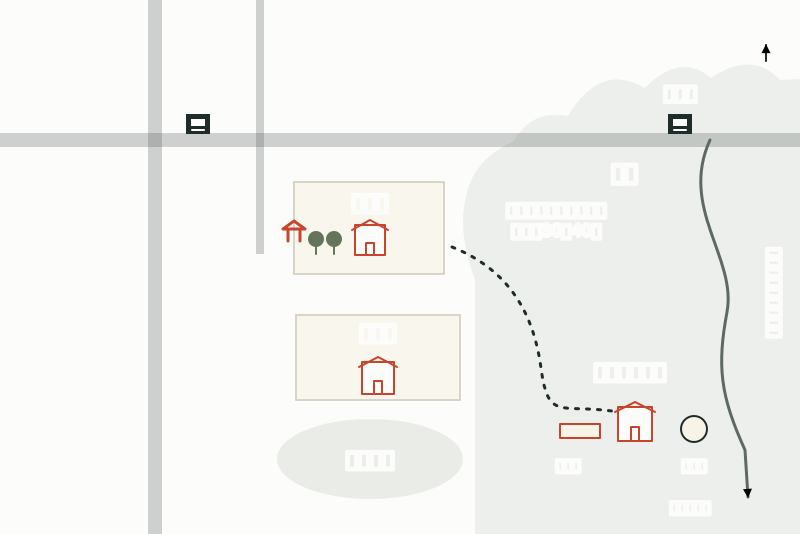
Shōren-in (Awataguchi Sanjōbō-chō, Higashiyama Ward) is a 5-minute walk from Higashiyama Station on the Tōzai subway line, or a 3-minute walk from the "Jingū-michi" stop on city bus routes 5, 46, and 100, and it stands just north of Chion-in. The large camphor trees at the gate are a good landmark. Awataguchi, where the temple stands, was one of the entrances to Kyoto counted among the "Seven Entrances to Kyoto" (Kyō no Nanakuchi).
Shōgunzuka Seiryūden is at the top of the Higashiyama Driveway, which runs from Keage on Sanjō-dōri to Gojō-dōri, and its address is in Yamashina Ward. It takes about 20 minutes by taxi from Kyoto Station, about 10 minutes from Shōren-in, and about 5 minutes from Keage Station on the Tōzai line, and taxis and ordinary cars can park inside the Fukutoku-mon gate. Walking the mountain path of the Higashiyama Trail from Shōren-in takes about 30 to 40 minutes. Many people mistake the city parking lot on the hilltop for Shōgunzuka, but the gate of Seiryūden is about 100 m north of it.
Locations of Shōren-in and Shōgunzuka Seiryūden (Schematic)
- Shōren-in: 9:00–17:00 (reception until 16:30). 600 yen for adults, 400 yen for junior high and high school students, 200 yen for elementary school students
- Shōgunzuka Seiryūden: 9:00–17:00 (reception until 16:30). 600 yen for adults, 400 yen for junior high and high school students, 200 yen for elementary school students. Elementary school students visiting individually are free with a guardian
- Blue Fudō: the original is enshrined in the inner hall of Seiryūden, and visitors pray before the finely made reproduction enshrined in front of it. A goma fire ritual is performed once a month, on the day of the full moon
Mini quiz for this entry
Shōren-in has a National Treasure Buddhist painting, the "Blue Fudō" (Ao Fudō). Where is the original enshrined today?
The "Three Great Fudō Paintings of Japan" are the Blue Fudō of Shōren-in, the Red Fudō of Mount Kōya, and which other one?
Shōgunzuka Seiryūden stands on a hilltop in Higashiyama. What was this wooden building originally?
Sources and verification
Content checked: October 28, 2026
Updated: October 28, 2026
References are in Japanese.
- 文化庁「国指定文化財等データベース 絹本著色不動明王二童子像」
- 文化庁「国指定文化財等データベース 青蓮院旧仮御所」
- 文化庁「国指定文化財等データベース」(史跡名勝天然記念物・国宝重要文化財、名称・所有者「青蓮院」で検索)
- 青蓮院門跡「青蓮院について」
- 青蓮院門跡「拝観のご案内」
- 青蓮院門跡「境内と庭園」
- 青蓮院門跡「国宝としての青不動」
- 青蓮院門跡「国宝『青不動尊』」
- 青蓮院門跡「信仰としての青不動」
- 青蓮院門跡「夜間の特別拝観」
- 青蓮院門跡「天台宗 青蓮院門跡」(お知らせ・2025年のライトアップ)
- 青蓮院門跡「茶室 好文亭」
- 青蓮院門跡 将軍塚青龍殿「青不動」
- 青蓮院門跡 将軍塚青龍殿「青龍殿」
- 青蓮院門跡 将軍塚青龍殿「大舞台」
- 青蓮院門跡 将軍塚青龍殿「将軍塚」
- 青蓮院門跡 将軍塚青龍殿「拝観アクセス」
- 青蓮院門跡 将軍塚青龍殿「天台宗青蓮院門跡 将軍塚青龍殿」(所在地・所要時間)
- 青蓮院門跡「将軍塚の由緒」(青龍殿落慶記念 国宝青不動御開帳 特設ページ)
- 京都市「区民の誇りの木一覧(東山区)」
- 京都市「区民の誇りの木 東山区」(解説)