
Historic Sites and Special Historic Sites in Kyoto City
Key points
The Saiji Temple Site, the Toba Palace Site, and the Yamashina Hongan-ji Site can be seen inside parks
A little over half are temple gardens and the grounds of temples and shrines
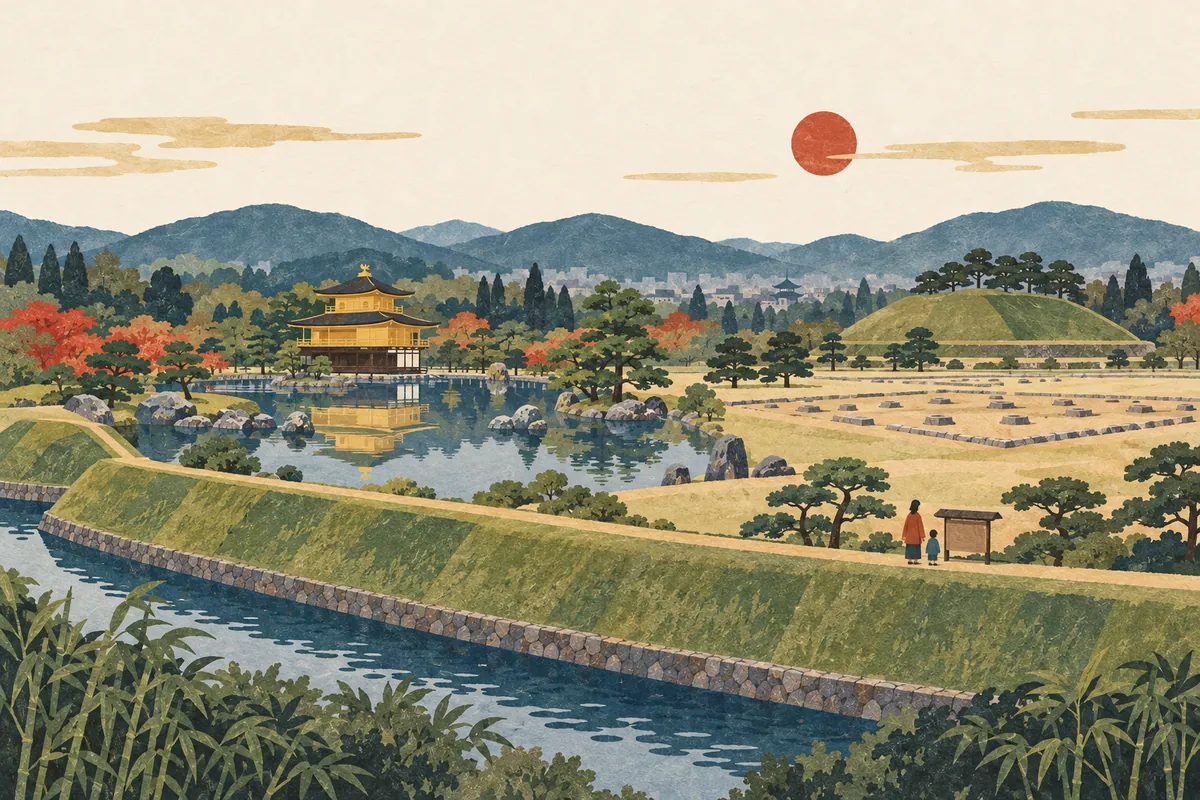
The 3 Special Historic Sites are the gardens of Rokuon-ji (Kinkaku-ji), Jishō-ji (Ginkaku-ji), and Daigo-ji Sanbō-in
The earliest designated is the Saiji Temple Site (1921) and the most recent is the Daitoku-ji Grounds (2016)
How Historic Sites differ from places of Scenic Beauty and Natural Monuments
Among archaeological and historical sites of high historical or scholarly value, such as shell mounds, ancient burial mounds (kofun), capital and castle sites, and former residences, the national government designates important ones as "Historic Sites" and especially important ones as "Special Historic Sites." Scenic places such as gardens and gorges are "Places of Scenic Beauty," and animals, plants, and geological features and minerals are "Natural Monuments"; these three are together called "Monuments."
The same place is sometimes designated both a Historic Site and a Place of Scenic Beauty, and in that case each is counted as 1. The 3 Special Historic Sites in Kyoto City are all gardens and are also Special Places of Scenic Beauty, so they are also among the 12 Special Places of Scenic Beauty. The Ryōan-ji Hōjō Garden and the Tenryū-ji Garden are gardens that are Historic Sites and also Special Places of Scenic Beauty.
Counts by ward and type
According to the Kyoto City Cultural Properties Protection Section's count as of April 1, 2026, the city has 58 Historic Sites and Special Historic Sites (including 3 Special Historic Sites), about 3% of the 1,923 nationwide (including 66 Special Historic Sites). The Otokuni Kofun Group, which extends into Mukō City and elsewhere, and the Enryaku-ji Grounds and the Lake Biwa Canal, which extend into Ōtsu City, are each counted as 1.
In Ukyō Ward, the grounds and gardens of Myōshin-ji and its subtemples alone account for 7. Sorted by content, there are 19 temple gardens, 12 temple and shrine grounds, 8 sites of imperial palaces, detached palaces, and the like, 8 temple sites, kofun, and kiln sites, 6 former residences and graves associated with historical figures, and 5 civil-engineering remains and landforms, such as the Odoi, Funaokayama, and the Lake Biwa Canal.
Number of Historic Sites and Special Historic Sites in Kyoto City (by Ward)
- Ukyō
- Sakyō
- Kita
- Fushimi
- Nakagyō
- Higashiyama
- Nishikyō
- Kamigyō
- Shimogyō
- Minami
- Yamashina
- Spanning 2 or more wards or another prefecture
List (1): Kita, Kamigyō, Nakagyō, Shimogyō, and Minami wards and beyond
Kita Ward has the Kinkaku-ji garden, and 5 sites for the grounds and gardens of Daitoku-ji alone. The Heian Palace Site went through designations such as that of the Burakuden site in 1990 and is now combined into a single Historic Site.
Historic Sites and Special Historic Sites in Kyoto City (1): 21 sites in Kita, Kamigyō, Nakagyō, Shimogyō, and Minami wards and beyond
| Name | Ward | Type | Year designated | What it is |
|---|---|---|---|---|
| Rokuon-ji (Kinkaku-ji) Garden | Kita | Special Historic Site (Special Place of Scenic Beauty) | 1925 | Garden of Rokuon-ji, the temple made from the Kitayama villa that Ashikaga Yoshimitsu acquired from the Saionji family |
| Daitoku-ji Grounds | Kita | Historic Site | 2016 | Grounds of Daitoku-ji, a Rinzai temple founded by Shūhō Myōchō |
| Daitoku-ji Hōjō Garden | Kita | Historic Site (Special Place of Scenic Beauty) | 1924 | White-sand garden in front of the hōjō, with standing stones representing a dry waterfall |
| Daisen-in Shoin Garden | Kita | Historic Site (Special Place of Scenic Beauty) | 1924 | Dry landscape garden of Daisen-in, a subtemple of Daitoku-ji, depicting mountains and water with many stones |
| Shinju-an Garden | Kita | Historic Site (Place of Scenic Beauty) | 1924 | Moss garden of a subtemple that began as Ikkyū's hermitage, and the tea garden of the Tsūsen-in |
| Kohō-an Garden | Kita | Historic Site (Place of Scenic Beauty) | 1924 | Tea garden of the hermitage built by Kobori Masakazu (Enshū) in 1640 (Kan'ei 17) |
| Funaokayama | Kita | Historic Site | 1968 | A hill used for Ne-no-hi outings and as a funeral ground, which also became a battlefield in the Ōnin War |
| Kamo Wakeikazuchi Shrine Grounds | Kita | Historic Site | 1993 | Grounds of Kamigamo Shrine, and part of the shrine priests' quarter (shake-machi) along the Myōjin River |
| Rai San'yō's Study (Sanshi Suimei-sho) | Kamigyō | Historic Site | 1922 | The study remaining at Suiseisō, Rai San'yō's residence |
| Site of Itō Jinsai's House (Kogidō) and Library | Kamigyō | Historic Site | 1922 | Site of the house of the Confucian scholar Itō Jinsai, and a two-story library from Jinsai's time |
| Former Nijō Detached Palace (Nijō Castle) | Nakagyō | Historic Site | 1939 | Castle built by Tokugawa Ieyasu in 1603 (Keichō 8). It became a detached palace in 1884 (Meiji 17) |
| Shinsen-en | Nakagyō | Historic Site | 1935 | Imperial garden laid out south of the palace when Heian-kyō was built |
| Takase River Ichinofunairi | Nakagyō | Historic Site | 1934 | Boat basin on the Takase River, opened by Suminokura Ryōi, where boats' cargo was loaded and unloaded |
| Hongan-ji Grounds | Shimogyō | Historic Site | 1994 | Grounds of Nishi Hongan-ji |
| Hongan-ji Daishoin Garden | Shimogyō | Historic Site (Special Place of Scenic Beauty) | 1934 | The dry landscape "Kokei Garden" east of the Daishoin |
| Kyōōgokoku-ji Grounds | Minami | Historic Site | 1934 | Grounds of Tō-ji, built as a temple to protect the capital when Heian-kyō was built |
| Saiji Temple Site | Minami | Historic Site | 1921 | Site of an official temple built west of the Rajōmon gate as a pair with Tō-ji |
| Odoi | Kita, Kamigyō, and Nakagyō | Historic Site | 1930 | Earthen ramparts and moat built around Kyoto by Toyotomi Hideyoshi in 1591 (Tenshō 19) |
| Heian Palace Site (Dairi, Chōdōin, and Burakuin Sites) | Nakagyō and Kamigyō | Historic Site | 1979 | Sites of the Dairi, Chōdōin, and Burakuin of the Heian Palace |
| Arashiyama | Ukyō and Nishikyō | Historic Site (Place of Scenic Beauty) | 1927 | Gorge and mountains on both sides of the Ōi River, known as a famous scenic spot since ancient times |
| Lake Biwa Canal | Kyoto City and elsewhere (Ōtsu City) | Historic Site | 1996 | Waterway built in the Meiji period to bring water from Lake Biwa to Kyoto, used for boat transport, hydroelectric power, and more |
List (2): Higashiyama, Sakyō, Yamashina, and Fushimi wards
Sakyō Ward has the Ginkaku-ji garden and former grounds, the Nanzen-ji grounds, and the Enryaku-ji Grounds on Mount Hiei, as well as a cluster of Historic Sites associated with historical figures, such as Shisendō and Iwakura Tomomi's former residence. When the imperial palace burned in the great fire of 1788 (Tenmei 8), Shōren-in in Higashiyama Ward became the temporary residence of Retired Empress Go-Sakuramachi and Shōgo-in that of Emperor Kōkaku, and both are Historic Sites.
Historic Sites and Special Historic Sites in Kyoto City (2): 20 sites in Higashiyama, Sakyō, Yamashina, and Fushimi wards
| Name | Ward | Type | Year designated | What it is |
|---|---|---|---|---|
| Kōdai-ji Garden | Higashiyama | Historic Site (Place of Scenic Beauty) | 1927 | Garden centered on two ponds, made when the temple was founded in 1605 (Keichō 10) |
| Shōren-in Former Temporary Palace | Higashiyama | Historic Site | 1942 | Temple that became the temporary palace of Retired Empress Go-Sakuramachi |
| Hōkō-ji Great Buddha Hall Site, Stone Walls, and Stone Pagodas | Higashiyama | Historic Site | 1969 | Site of the Great Buddha Hall of Hōkō-ji, built by Toyotomi Hideyoshi, with its stone walls and stone monuments such as the Mimizuka |
| Jishō-ji (Ginkaku-ji) Garden | Sakyō | Special Historic Site (Special Place of Scenic Beauty) | 1925 | Garden of the mountain villa Ashikaga Yoshimasa built in Higashiyama |
| Jishō-ji (Ginkaku-ji) Former Grounds | Sakyō | Historic Site | 1931 | Former grounds of Jishō-ji, the temple made from Yoshimasa's villa |
| Nanzen-ji Grounds | Sakyō | Historic Site | 2005 | Grounds of Nanzen-ji, converted into a temple from Emperor Kameyama's detached palace |
| Nanzen-in Garden | Sakyō | Historic Site (Place of Scenic Beauty) | 1923 | Pond garden said to have been made when Emperor Kameyama lived there |
| Kamo Mioya Shrine Grounds | Sakyō | Historic Site | 1983 | Grounds of Shimogamo Shrine |
| Shisendō | Sakyō | Historic Site | 1928 | Secluded residence built by Ishikawa Jōzan in 1641 (Kan'ei 18) |
| Grave of Ishikawa Jōzan | Sakyō | Historic Site | 1928 | Jōzan's grave on the hilltop southeast of Shisendō |
| Former Residence of Iwakura Tomomi in Seclusion | Sakyō | Historic Site | 1932 | House where Iwakura Tomomi hid from 1862 (Bunkyū 2) to 1867 (Keiō 3) |
| Kurisuno Tile Kiln Sites | Sakyō | Historic Site | 1934 | Sites of climbing kilns that fired roof tiles on a hillside slope |
| Shōgo-in Former Temporary Imperial Palace | Sakyō | Historic Site | 1935 | Temple that became Emperor Kōkaku's temporary palace |
| Enryaku-ji Grounds | Sakyō and elsewhere (Ōtsu City) | Historic Site | 1934 | Grounds of Enryaku-ji on Mount Hiei, head temple of the Tendai school and a seat of prayer for the protection of the state |
| Zuishin-in Grounds | Yamashina | Historic Site | 1966 | Grounds of a temple restored in the early Edo period on the former site of Mandara-ji, the head temple of the Ono school |
| Yamashina Hongan-ji Site and Nanden Site | Yamashina | Historic Site | 2002 | The temple town Rennyo built from 1478 (Bunmei 10), and the site of his retirement residence, the Nanden |
| Daigo-ji Sanbō-in Garden | Fushimi | Special Historic Site (Special Place of Scenic Beauty) | 1927 | Garden laid out by Toyotomi Hideyoshi himself in 1598 (Keichō 3) |
| Daigo-ji Grounds | Fushimi | Historic Site | 1967 | Grounds of Daigo-ji, founded by Shōbō, on the mountaintop and at the foot of the mountain |
| Toba Palace Site | Fushimi | Historic Site | 1978 | Site of the detached palace where three retired emperors, Shirakawa, Toba, and Go-Shirakawa, ruled as cloistered emperors (Nanden site) |
| Former Residence of Kada no Azumamaro | Fushimi | Historic Site | 1922 | Former home of Kada no Azumamaro. The shoin and gate from his time remain |
List (3): Ukyō and Nishikyō wards
Ukyō Ward centers on the temples of Saga, Omuro, and Hanazono, and in Uzumasa there are the 6th-century Amazuka Kofun and the Hebizuka Kofun, whose stone chamber of huge rocks remains. At the Katagihara Temple Site in Nishikyō Ward, traces of an octagonal pagoda have been confirmed, a type of which very few examples have been found in Japan.
Historic Sites and Special Historic Sites in Kyoto City (3): 17 sites in Ukyō and Nishikyō wards
| Name | Ward | Type | Year designated | What it is |
|---|---|---|---|---|
| Ryōan-ji Hōjō Garden | Ukyō | Historic Site (Special Place of Scenic Beauty) | 1924 | Rock garden with 15 stones set in white sand south of the hōjō |
| Tenryū-ji Garden | Ukyō | Historic Site (Special Place of Scenic Beauty) | 1923 | Front and inner gardens made when Musō Soseki founded the temple |
| Myōshin-ji Grounds | Ukyō | Historic Site | 1969 | Halls and subtemples of Myōshin-ji, founded by Cloistered Emperor Hanazono |
| Myōshin-ji Garden | Ukyō | Place of Scenic Beauty (Historic Site) | 1931 | The Hōjō-ike pond between the Chokushimon and the Sanmon, and the gardens of the Ōhōjō and Kohōjō |
| Gyokuhō-in Garden | Ukyō | Place of Scenic Beauty (Historic Site) | 1931 | Garden of Gyokuhō-in at Myōshin-ji (mid-Edo period) |
| Tōkai-an Shoin Garden | Ukyō | Place of Scenic Beauty (Historic Site) | 1931 | Dry landscape garden of the shoin, made in 1814 (Bunka 11) |
| Reiun-in Garden | Ukyō | Place of Scenic Beauty (Historic Site) | 1931 | Small garden of the hōjō and the Miyuki-no-ma room (mid-Edo period) |
| Taizō-in Garden | Ukyō | Place of Scenic Beauty (Historic Site) | 1931 | Dry landscape garden west of the hōjō, conceived like a painting |
| Keishun-in Garden | Ukyō | Place of Scenic Beauty (Historic Site) | 1931 | Garden extending from the hōjō to the front of the shoin (early Edo period) |
| Ninna-ji Gosho Site | Ukyō | Historic Site | 1938 | Former temple grounds of Ninna-ji, where Cloistered Emperor Uda made his residence, the Omuro |
| Daikaku-ji Gosho Site | Ukyō | Historic Site | 1938 | Site of Daikaku-ji, the temple made from Saga-in, Emperor Saga's detached palace. Ōsawa Pond and the site of the Nakoso Waterfall remain |
| Kōzan-ji Grounds | Ukyō | Historic Site | 1966 | Grounds of the temple that Myōe Shōnin received from Retired Emperor Go-Toba |
| Amazuka Kofun | Ukyō | Historic Site | 1978 | A keyhole-shaped burial mound |
| Hebizuka Kofun | Ukyō | Historic Site | 1977 | The largest late-period burial mound in Sagano |
| Saihō-ji Garden | Nishikyō | Historic Site (Special Place of Scenic Beauty) | 1923 | Garden of the temple revived by Musō Soseki. Known by its popular name, Koke-dera (Moss Temple) |
| Katagihara Temple Site | Nishikyō | Historic Site | 1971 | Site of a Hakuhō-period temple |
| Otokuni Kofun Group | Nishikyō and elsewhere (Mukō City, Nagaokakyō City, Ōyamazaki Town) | Historic Site | 1922 | A group of 13 burial mounds, including the Tennō no Mori Kofun (Nishikyō Ward) |
Historic Sites in parks and along streets
Most Historic Sites are the grounds or gardens of temples and shrines, and whether you can visit and the fees differ from one temple or shrine to another.
- Saiji Temple Site (Karahashi Saiji-chō, Minami Ward): The raised earthen platform (Kondo-yama), the first part to be designated, is in today's Karahashi Saiji Park, where a stone monument also stands. About 200 m from the "Saiji-mae" city bus stop.
- Toba Palace Site (Nakajima Gosho-no-uchi-chō, Fushimi Ward): The Toba Detached Palace site is a historic park, where the artificial hill "Aki no Yama" (Autumn Hill) remains. Right by the "Jōnangū-michi" city bus stop.
- Yamashina Hongan-ji Site (Yamashina Ward): In Yamashina Chūō Park, earthen ramparts remain over 75 m east–west and 60 m north–south.
- Takase River Ichinofunairi (Kami-Korikimachi, Kiyamachi-dōri Nijō-sagaru, Nakagyō Ward): The canal cut extending into the west side of the Takase River is the Ichinofunairi.
- Odoi: There are designated areas at Hirano Toriimae-chō in Kita Ward, in the grounds of Rozan-ji in Kamigyō Ward, and elsewhere. The Odoi on the west side of the grounds of Kitano Tenmangū is open to the public as the "Historic Site Odoi Maple Garden"; in autumn 2026 it is open from October 31 to December 6, at 1,500 yen for adults and 700 yen for children (including tea and a sweet).
- Heian Palace Site: The designated areas are in residential neighborhoods, and there is an explanatory board at the site of the inner corridor of the Dairi. The remains of the Burakuden are preserved underground.
Mini quiz for this entry
At Daigo-ji Sanbō-in Garden, a Special Historic Site and Special Place of Scenic Beauty, who personally laid out the garden in 1598 (Keichō 3)?
At the Katagihara Temple Site, a Historic Site in Nishikyō Ward, traces were confirmed of a pagoda of a type with very few examples found in Japan. What shape was it?
After the imperial palace burned in the great fire of 1788 (Tenmei 8), which temple in Higashiyama Ward became the temporary palace of Retired Empress Go-Sakuramachi and is now a national Historic Site?
Sources and verification
Content checked: October 22, 2026
Updated: October 22, 2026
References are in Japanese.
- 京都市文化財保護課「京都市内文化財件数」(令和8年4月1日現在)
- 文化庁「記念物」
- 文化庁「国指定文化財等データベース」(史跡名勝天然記念物、史跡・特別史跡、京都府で検索)
- 文化庁 国指定文化財等データベース「御土居」
- 文化庁 国指定文化財等データベース「平安宮跡 内裏跡 朝堂院跡 豊楽院跡」
- 文化庁 国指定文化財等データベース「鹿苑寺(金閣寺)庭園」
- 文化庁 国指定文化財等データベース「慈照寺(銀閣寺)庭園」
- 文化庁 国指定文化財等データベース「醍醐寺三宝院庭園」
- 文化庁 国指定文化財等データベース「西寺跡」
- 文化庁 国指定文化財等データベース「大徳寺境内」
- 文化庁 国指定文化財等データベース「青蓮院旧仮御所」
- 文化庁 国指定文化財等データベース「聖護院旧仮皇居」
- 文化庁 国指定文化財等データベース「樫原廃寺跡」
- 文化庁 国指定文化財等データベース「蛇塚古墳」
- 文化庁 国指定文化財等データベース「乙訓古墳群」
- 文化庁 国指定文化財等データベース「山科本願寺跡及び南殿跡」
- 文化庁 国指定文化財等データベース「鳥羽殿跡」
- 文化庁 国指定文化財等データベース「延暦寺境内」
- 文化庁 国指定文化財等データベース「琵琶湖疏水」
- 京都市「史跡 御土居」
- 北野天満宮「史跡御土居のもみじ苑」
- 京都市文化財保護課「京都市内の埋蔵文化財発掘調査速報 史跡西寺跡」(2021年)
- 京都市文化財保護課「京都市内の埋蔵文化財発掘調査速報 山科本願寺跡」
- 京都市文化財保護課「京都市内の埋蔵文化財発掘調査速報 平安宮豊楽院跡・鳳瑞遺跡」
- 京都市埋蔵文化財研究所・京都市考古資料館「リーフレット京都 No.91 古墳時代 京都の遺跡3」
- 京都市観光協会 京都観光Navi「西寺跡」
- 京都市観光協会 京都観光Navi「鳥羽離宮跡」
- 京都市観光協会 京都観光Navi「高瀬川一之船入」