
The Hondō of Kiyomizu-dera and Kakezukuri
Other spellings and namesButai-zukuri
Key points
Burned and rebuilt more than ten times; most of today's buildings date from the Kan'ei-era rebuilding
"To jump off the Kiyomizu Stage" comes from a real custom of leaping from it after praying to Kannon
In 2017–2020 the Hondō's cypress-bark roof and the stage floorboards were renewed
A step-free path leads to the Hondō, so the grounds can be toured with a stroller or a wheelchair
Kakezukuri supported by 18 zelkova pillars and ties
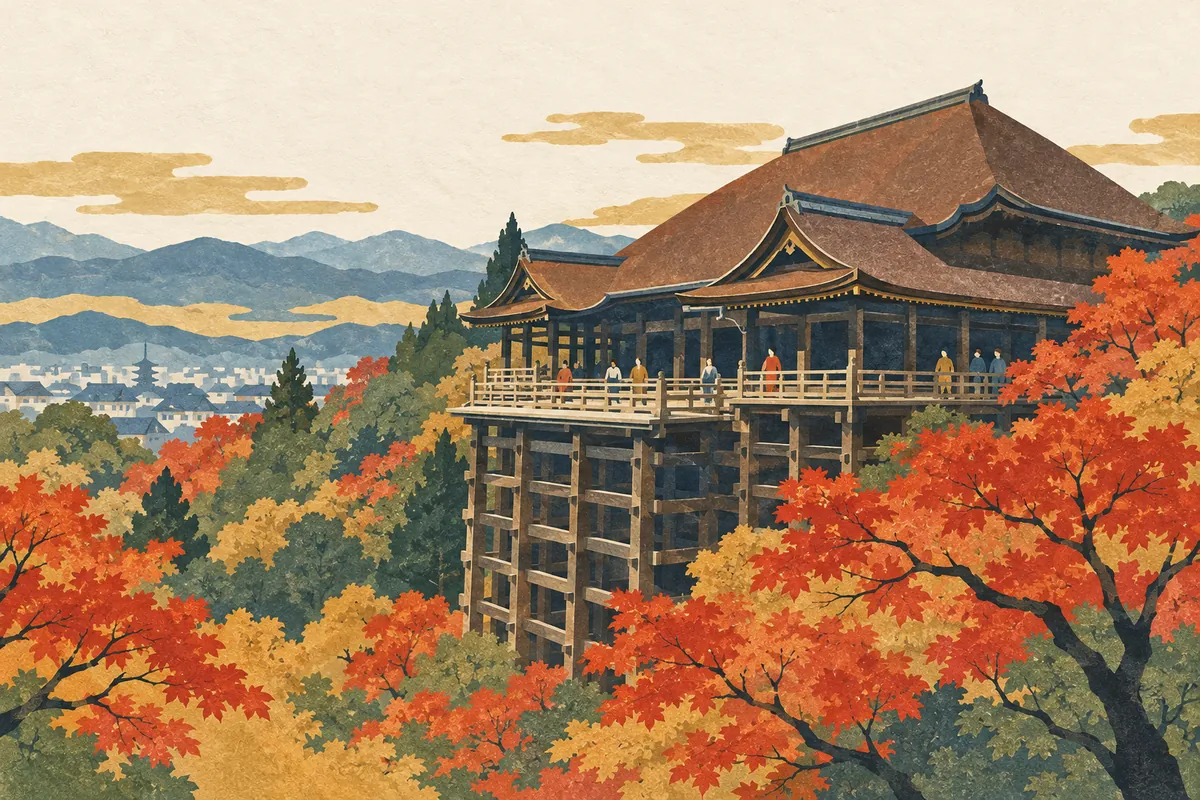
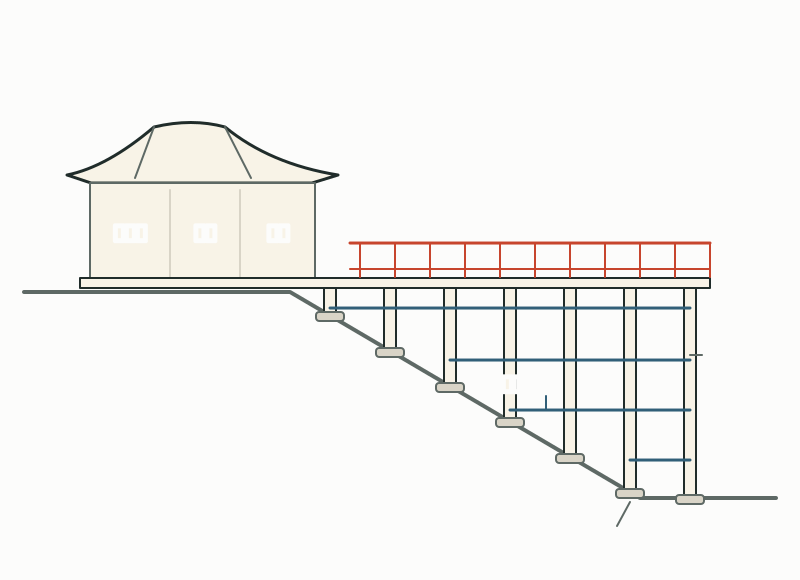
The Hondō of Kiyomizu-dera stands on the steep cliff of Mount Otowa (Otowa-yama) in Higashiyama. The front half of the building projects out beyond the cliff, supported by long pillars standing beneath it, a method of building called kakezukuri (懸造, stage construction). The projecting part is the "Kiyomizu Stage" (Kiyomizu no butai), and from the foundation stones at the foot of the cliff to the floor of the stage is about 13 m, the equivalent of a four-story building.
The stage is supported by 18 pillars standing beneath the floor. They are made of zelkova (keyaki) more than 400 years old, and the largest are about 12 m long and about 2 m around. Many horizontal ties (nuki) run through the pillars in both directions, and because the timbers assembled in a lattice brace one another, the structure is earthquake-resistant even on top of a cliff. These joints are called tsugite, and not a single nail is used. From around the Otowa Waterfall below the stage, you can look up at the lattice of pillars and ties standing on the cliff.
The stage has a floor area of about 200 m² and is laid with cypress (hinoki) boards. The stage was originally a place for offering performing arts such as gagaku court music, Noh, and kyōgen to the Kannon enshrined deep inside the Hondō, and even today performances are dedicated on the stage during special services.
The Hondō measures nine bays along the front (ketayuki) and seven bays deep (harima), with a hip roof (yosemune-zukuri) thatched with cypress bark (hiwadabuki). Inside, from front to back, it is divided into the outer sanctuary (gejin), the inner sanctuary (naijin), and the innermost sanctuary (nainaijin), where the principal image, the Eleven-Headed Thousand-Armed Kannon, is enshrined at the very back. Kakezukuri is also used for the Okunoin, which stands directly above the Otowa Waterfall.
Cross-Section of Kakezukuri (Stage Construction): How the Kiyomizu Stage Is Supported
The Hondō rebuilt in 1633
The temple dates its founding to 778. According to the Kiyomizu-dera Engi, the account of the temple's beginnings, the monk Kenshin (later Enchin), who had trained in Nara, received a sacred log from the hermit Gyōei Koji beside the waterfall on Mount Otowa, and two years later Sakanoue no Tamuramaro, who came there hunting deer, helped to build the temple. The temple was named after the pure water (kiyomizu) of the Otowa Waterfall.
Since its founding, Kiyomizu-dera has lost its halls and pagodas in more than ten great fires and has been rebuilt each time. The present Hondō was completed in 1633 (Kan'ei 10), after the great fire of 1629 (Kan'ei 6), with the support of the third Tokugawa shogun, Iemitsu, and most of the buildings on the grounds date from this rebuilding.
In 1897 (Meiji 30) the Hondō was designated a Specially Protected Building (the National Treasure category of the time) under the Ancient Shrines and Temples Preservation Law, and under the present Law for the Protection of Cultural Properties it became a National Treasure on November 22, 1952. In addition, 15 buildings including the Niōmon gate, the three-story pagoda, the Okuin (Okunoin), and the Koyasu Pagoda are Important Cultural Properties.
National Treasure and Important Cultural Property Buildings at Kiyomizu-dera (by Year of Gazette Notice)
- National Treasure (Hondō, 1952)
- Important Cultural Property, 1908 notice
- Important Cultural Property, 1952 notice
- Important Cultural Property, 1966 notice
The first re-roofing in about 50 years (2017–2020)
Starting in 2008, Kiyomizu-dera carried out the "Great Heisei Repair," repairing in turn nine buildings: the Hondō and eight Important Cultural Properties. After work on the Umatodome, Koyasu Pagoda, Todorokimon, Amidadō, Okunoin, and others was finished, work on the Hondō began in spring 2017, and the whole building, stage included, was covered by a temporary roof (suyane).
The previous re-thatching of the Hondō's cypress-bark roof had been in 1964–1967 (Shōwa 39–42), so this was the first in about 50 years. The roof covers about 2,050 m². The aim was to return the roof to its original form by using mainly cypress bark of the length recorded in Edo-period documents, and to improve durability as well.
The re-roofing was completed in February 2020, after which the stage's floorboards were replaced with 166 boards of Kiso cypress, and a service marking completion was held on December 3 of that year.
Where the saying "jump off the Kiyomizu Stage" comes from
"Kiyomizu no butai kara tobioriru" (to jump off the Kiyomizu Stage) is an expression for taking a bold, momentous decision.
Behind it lies a once-famous custom of actually jumping off the high stage after making a vow to Kannon. The belief was that if you entrusted your life to Kannon and jumped, you would survive and your wish would be granted, and tales of people jumping from the Kiyomizu Stage and surviving appear in ancient and medieval story collections such as the Konjaku Monogatarishū.
The Kiyomizudera Jōjuin Diary, an Edo-period temple record found in the 1990s, records cases of people who actually jumped, and publication of a transcription began in 2015.
One of the "Historic Monuments of Ancient Kyoto" World Heritage sites
In 1994 Kiyomizu-dera was inscribed as one of the 17 components of the UNESCO World Cultural Heritage site "Historic Monuments of Ancient Kyoto." On grounds of 130,000 m² stand more than 30 halls and pagodas, including the National Treasure Hondō and the Important Cultural Properties.
Kiyomizu-dera hours and access
Kiyomizu-dera is at 1-294 Kiyomizu, Higashiyama Ward. The gates open at 6:00, and closing time varies by season; apart from the special night viewing periods, it is 18:00 for most of the year, or 18:30 in July and August (as of October 2026). Admission is charged for the Hondō (stage). The special night viewing on November 21–30, 2026, costs 500 yen for adults and 200 yen for elementary and junior high school students.
From JR Kyoto Station, take city bus route 206 or 100 to "Gojōzaka"; from Keihan Gion-Shijō Station or Hankyū Kyoto-Kawaramachi Station, take city bus route 207 to "Kiyomizu-michi"; either way it is a 10-minute walk. From Keihan Kiyomizu-Gojō Station it is about 25 minutes on foot. City buses from Kyoto Station tend to be crowded, so you can also walk from Shijō Kawaramachi past Yasaka Shrine. There is no parking on the grounds.
To the left of the main pilgrimage route there is a step-free path leading to the Hondō, so you can go around the grounds with a stroller. Diapers can be changed in the accessible restroom, and wheelchair users can enter from the Chawanzaka entrance and follow a route with few steps.
Mini quiz for this entry
What was the "Kiyomizu Stage" at Kiyomizu-dera originally built for?
What wood are the floorboards of the Kiyomizu Stage at Kiyomizu-dera made of?
Which shogun supported the 1633 rebuilding of the present Hondō of Kiyomizu-dera (a National Treasure) after the great fire of 1629?
Sources and verification
Content checked: October 17, 2026
Updated: October 17, 2026
References are in Japanese.
- 音羽山清水寺「歴史」
- 音羽山清水寺「交通・参拝案内」
- 音羽山清水寺「よくあるご質問」
- 音羽山清水寺「積層する時間〜本堂工事の現場から〜 過去の確認、未来への歩み。」
- 音羽山清水寺「積層する時間〜本堂工事の現場から〜 これまでの400年、これからの400年。」
- 音羽山清水寺「積層する時間〜本堂工事の現場から〜 過去と現在が混在する修理」
- 文化庁「国指定文化財等データベース 清水寺本堂」
- 文化庁「日本遺産ポータルサイト 清水寺 本堂」
- 京都市「京都市歴史的風致維持向上計画(2期)資料編 別表1 国指定等文化財の一覧」
- 京都市観光協会「京都観光Navi 清水寺(ライトアップ&夜間特別拝観)」
- 京都市観光協会「京都観光Navi 主要観光地への快適なアクセス 東山(清水寺)」
- 国立国会図書館「国立国会図書館のランドマーク コラム 清水寺」
- 国際日本文化研究センター「NICHIBUNKEN NEWSLETTER No.95」
- 林野庁近畿中国森林管理局「檜皮(ひわだ)採取実演見学会が開催されました」
- 京都新聞「建造物編(2)国宝清水寺本堂(京都市東山区)」(2017年4月26日)
- 日本経済新聞「清水寺「創建当初の姿に」 屋根と舞台板工事終え法要」(2020年12月3日)