
Japanese釜座通(かまんざどおり)
Kamanza-dori
Other spellings and namesKamanza-dōri / Kamanza-chō (釜座町) / Sanjō Kamanza / Shin-Kamanza-chō (新釜座町) / 釜座通
In short
釜座通, read Kamanza-dōri, is a north–south street in central Kyoto. Its name is said to come from the Sanjō Kamanza, a guild that cast temple bells and tea kettles. It runs between Nishinotōin-dōri and Shinmachi-dōri and is considered one of the streets opened through the middle of the city blocks in Toyotomi Hideyoshi's rebuilding of the city.Key points in 30 seconds
The street is read Kamanza-dōri; the Nakagyō Ward town name 釜座町 is read Kamanza-chō
Said to be named after the Sanjō Kamanza, a guild of metal casters
Runs north–south between Nishinotōin-dōri and Shinmachi-dōri
Considered one of the streets opened in Hideyoshi's rebuilding of the city
Kamanza, not Kamaza
釜座通 is read Kamanza-dōri (かまんざどおり). In town names too, 釜座町 in Nakagyō Ward is read Kamanza-chō and 新釜座町 in Shimogyō Ward is read Shin-Kamanza-chō, so the reading of 釜座 as kamanza lives on.
Seeing it for the first time, you may be tempted to read it kamaza, but in both street and town names the established reading includes an n. In Kyoto, street names are used as part of addresses, as in 釜座通夷川上ル (Kamanza-dōri Ebisugawa agaru), so being able to read them makes it easier to get a sense of where an address is.
Names containing 釜座 and their readings
| Name | Reading |
|---|---|
| 釜座通 | Kamanza-dōri (かまんざどおり) |
| 釜座町 (Nakagyō Ward) | Kamanza-chō (かまんざちょう) |
| 新釜座町 (Shimogyō Ward) | Shin-Kamanza-chō (しんかまんざちょう) |
| 三条釜座 | Sanjō Kamanza (さんじょうかまんざ; 釜座 = kamanza) |
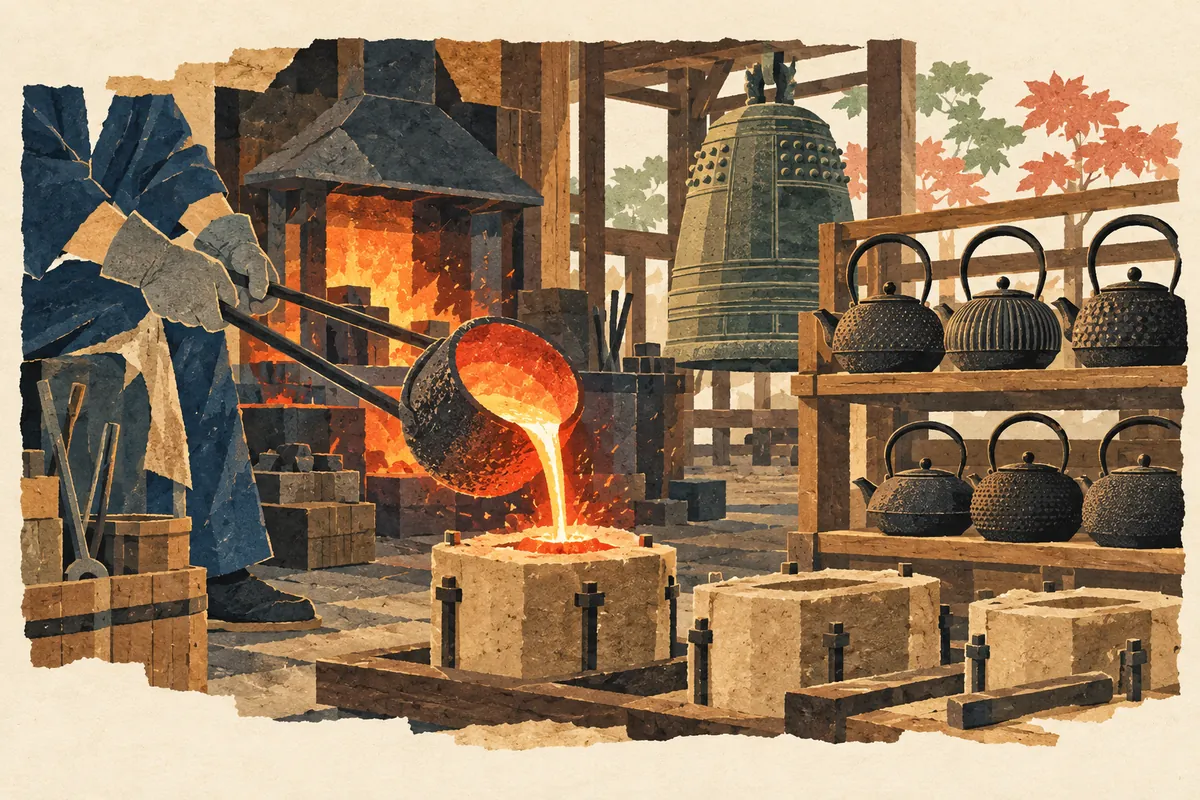
The Sanjō Kamanza, casters of temple bells and tea kettles
The name Kamanza-dōri is said to come from the Sanjō Kamanza, which cast temple bells and tea kettles, and from the fact that the Ōnishi family, the oldest kettle makers, still work here today. A za (座) was a guild of craftsmen or merchants in the same trade.
The town name Kamanza-chō comes from a group of metal casters (imoji) who settled here and produced a wide range of goods, including kettles, pots, lanterns, hanging bells, farm tools, and other tools, forming the Kamanza (kettle guild) on this site. Its history is said to go back to the move of the capital to Heian-kyō, and it continued until just before the Meiji Restoration as a distinguished guild with an imperial charter; at its height there are said to have been 70 to 80 workshops in the trade.
The hanging bell of the Great Buddha Hall of Kyoto (Hōkō-ji), known for the inscription that triggered the Siege of Osaka, was also cast at this Kamanza.
A street Hideyoshi opened through the middle of the blocks
Toyotomi Hideyoshi opened north–south streets through the middle of the square blocks, each one chō on a side and bounded by roads, that dated from Heian-kyō, turning the area linking Kamigyō and Shimogyō into long, narrow rectangular blocks. The streets of Ryōgaemachi, Koromonotana, and Kamanza are given as examples.
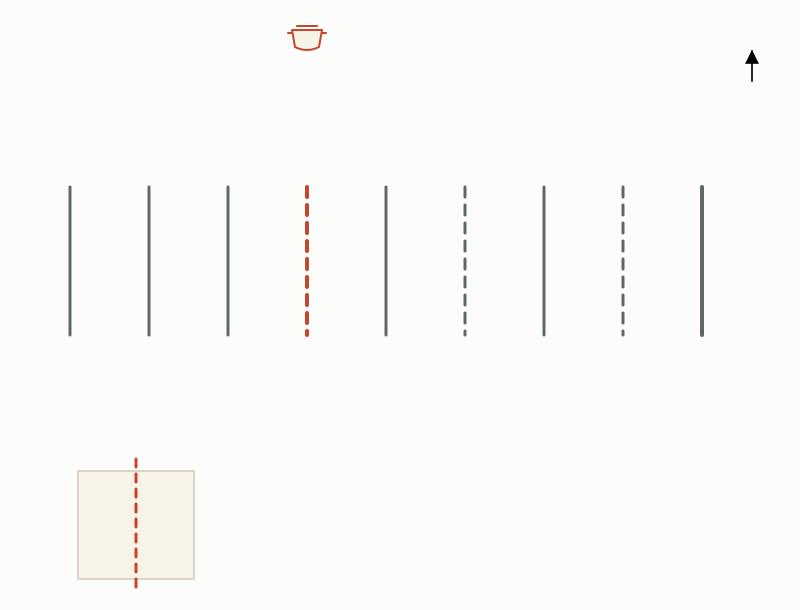
On a map, Kamanza-dōri lies between Nishinotōin-dōri to the west and Shinmachi-dōri to the east. East of it come Koromonotana-dōri, Muromachi-dōri, and Ryōgaemachi-dōri, so you can see streets inserted in Hideyoshi's time alternating with streets dating from Heian-kyō.
Where is Kamanza-dōri? The order of north–south streets
Where to see it today: town names, a tree-lined street, and a museum
For school attendance zones, Kamanza-chō in Nakagyō Ward belongs to Takakura Elementary School and Kyoto Oike Junior High School, and Shin-Kamanza-chō in Shimogyō Ward to Rakuō Elementary School and Shimogyō Junior High School. Nakagyō Ward also has towns located by reference to Kamanza-dōri, such as Kameya-chō at "Kamanza-dōri Ebisugawa agaru" and Masuya-chō at "Kamanza-dōri Marutamachi sagaru."
The townhouse of Kamanza-chō is a building facing Sanjō-dōri that was donated to the neighborhood around the end of the 19th century and has since been called a chōie (町家), the neighborhood's shared house. Along Kamanza-dōri from Shimodachiuri-dōri to Marutamachi-dōri there is a row of zelkova trees, said to have been planted around 1978 (Shōwa 53) as a row of trees "leading to the prefectural office."
In the Sanjō area is the Ōnishi Seiemon Museum, which displays tea kettles made by successive generations of the Ōnishi family, Kyoto kettle makers for about 400 years since the late Muromachi period. Ōnishi Seiemon is counted among the Senke Jisshoku, the ten craft families that serve the three Sen schools of tea. The Ōnishi family is also called "the kettle makers of the Sanjō Kamanza."
For a walk
Starting near the Kyoto Prefectural Office in the north and walking south under the trees down to Sanjō-dōri, you arrive at the town of kettle makers that gave the street its name. As of 2015, access to the Ōnishi Seiemon Museum was given as about a 5-minute walk from the Horikawa Sanjō city bus stop, or about a 5-minute walk from Karasuma Oike subway station. Opening days and exhibitions change by season, so check before you go.
Mini quiz for this entry
Check what you've read with 2 multiple-choice questions.
How is 釜座通, a north–south street in central Kyoto, read?
Kamanza-dōri is said to be named after the Sanjō Kamanza guild. What did its craftsmen make?
Sources and verification
Content checked: October 11, 2026
Updated: October 11, 2026
References are in Japanese.