
Japanese衣棚通(ころものたなどおり)
Koromo-no-tana-dōri
Other spellings and namesKoromotana-dōri / Koromonotana-dori / Koromo-no-tana-chō (衣棚町) / Sanjō Koromo-no-tana
In short
衣棚通 is a north–south street in central Kyoto, read Koromo-no-tana-dōri or Koromotana-dōri. The name is said to come from the many shops in the area that sold monks' robes and similar garments from shelves (tana). It is said to be one of the streets opened during Toyotomi Hideyoshi's reshaping of the city, and it runs between Shinmachi-dōri and Muromachi-dōri.Key points in 30 seconds
There are two readings: Koromo-no-tana and Koromotana
The name is said to come from the many shops that sold monks' robes from shelves
One of the north–south streets Hideyoshi opened through the middle of town blocks
Runs between Shinmachi-dōri and Muromachi-dōri; the Nakagyō Ward town name is Koromo-no-tana-chō (衣棚町)
Two readings
衣棚通 has two readings: Koromo-no-tana-dōri (ころものたなどおり) and Koromotana-dōri (ころもたなどおり). The town name 衣棚町 in Nakagyō Ward is read Koromo-no-tana-chō (ころものたなちょう).
Both use the plain native Japanese readings of the characters: 衣 as koromo (garment) and 棚 as tana (shelf). The only difference is whether the linking sound no (の) is inserted between them. Because the town name 衣棚町 includes no, a good rule of thumb is to remember Koromo-no-tana if you are unsure.
A street of robe shops with shelves
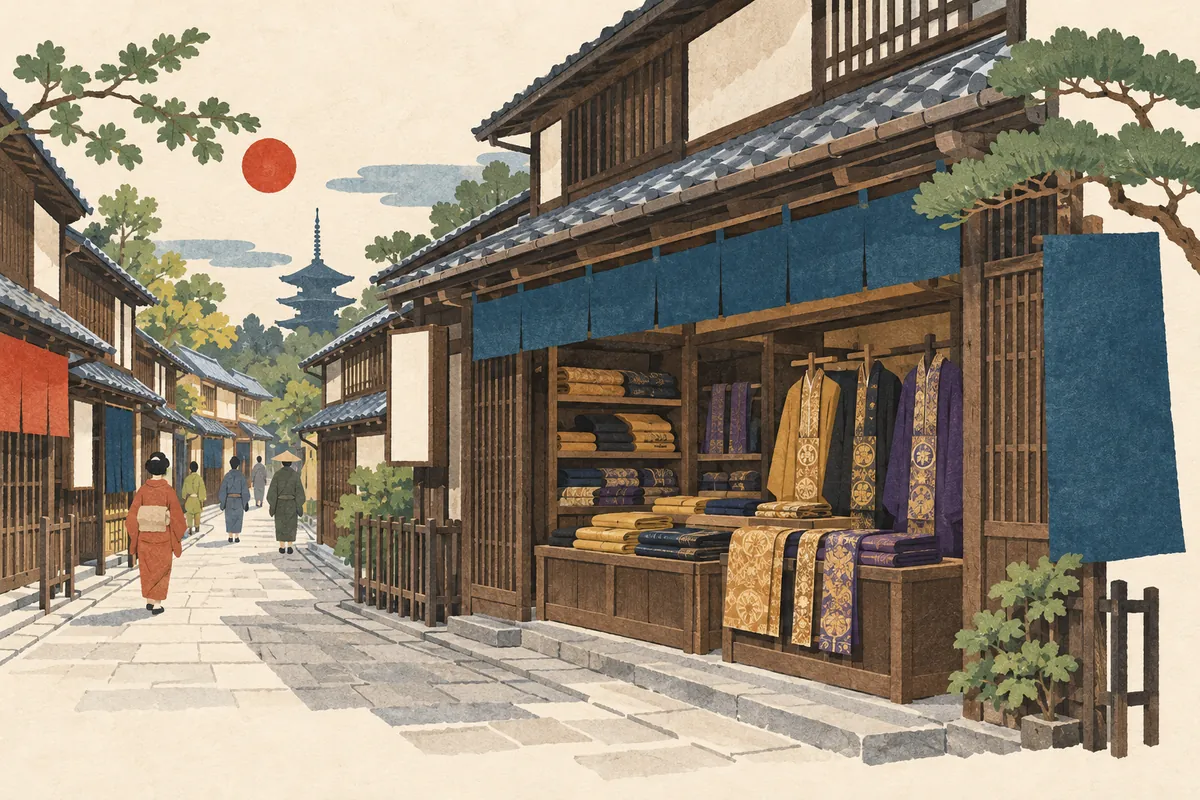
The name 衣棚通 comes from the many shops in the area that sold monks' robes and similar garments displayed on shelves.
The painter Tomioka Tessai was born in 1836 (Tenpō 7) as the second son of Jūichiya Denbei, a dealer in monks' robes at Sanjō-dōri Koromo-no-tana in Kyoto. This suggests that robe merchants had shops along this street. Because he was hard of hearing and loved learning, Tessai did not follow the merchant's path and set his sights on scholarship from an early age.
A north–south street opened by Hideyoshi
Toyotomi Hideyoshi opened north–south streets through the middle of square blocks, which had roads on every side, turning them into long, narrow strip-shaped blocks. Streets such as Ryōgaemachi, Koromo-no-tana, and Kamanza are given as examples. This was part of his reshaping of the city to rebuild it after the Ōnin War.
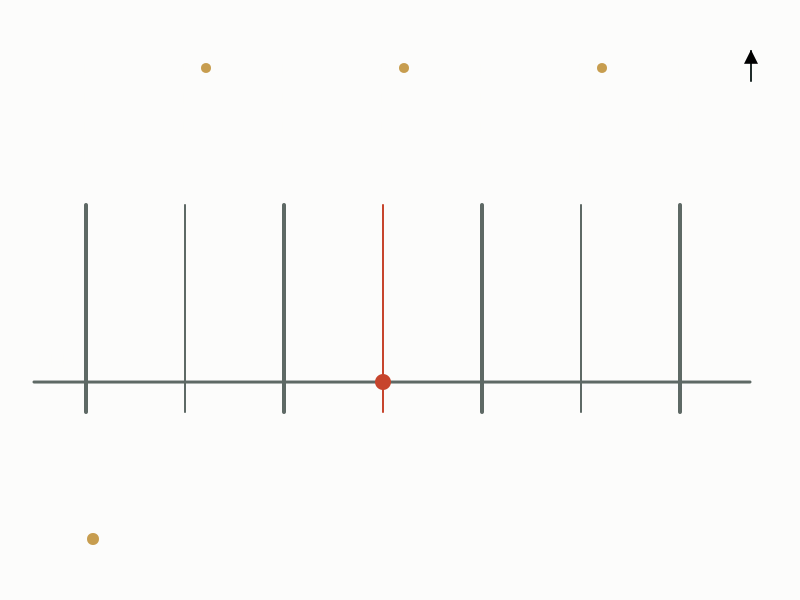
On a map of Kamigyō Ward, the north–south streets line up from west to east as Nishinotōin-dōri, Kamanza-dōri, Shinmachi-dōri, Koromo-no-tana-dōri, Muromachi-dōri, Ryōgaemachi-dōri, and Karasuma-dōri. Koromo-no-tana-dōri is the one running between Shinmachi-dōri and Muromachi-dōri. Keeping in mind that it was opened through the middle of town blocks makes its position easier to picture.
Where is Koromo-no-tana-dōri? The order of north–south streets
Other street names named after shops and craftspeople
The grid-like streets of central Kyoto began with the construction of Heian-kyō in 794, and by the end of the Sengoku period the streets had come to be called by names ending in tōri/dōri (通, street). Although the layout changed through Hideyoshi's Tenshō-era land division, the Meiji-era Three Great Projects of Kyoto City, and later city planning, the street names are still in use today.
Like Koromo-no-tana-dōri, many street names come from the shops, craftspeople, or facilities that once stood there. Lined up together, they show how street names reflect the work of the town in earlier times.
Street names said to come from shops, crafts, and trades
| Street name | Reading | Said to come from |
|---|---|---|
| 衣棚通 | Koromo-no-tana-dōri / Koromotana-dōri | Many shops in the area sold monks' robes and similar garments from shelves |
| 釜座通 | Kamanza-dōri | The Sanjō Kamanza guild of casters, who made temple bells and tea kettles, was located here |
| 鞘町通 | Sayamachi-dōri | Many scabbard makers (saya-shi, craftsmen who made sword scabbards) lived nearby |
| 両替町通 | Ryōgaemachi-dōri | A gold mint (kinza) was set up here in the Edo period, and financial businesses lined the street |
| 上長者町通 | Kamichōjamachi-dōri | From the Edo period, the mansions of chōja (wealthy money changers who dealt in currency) stood in a row |
Where can you see it today? Walking the street
The name 衣棚通 survives not only in the street itself but also in town names and the way addresses are written. In Nakagyō Ward, besides Koromo-no-tana-chō, there is a Tsukinuke-chō whose location is given as "衣棚通姉小路下ル" (Koromo-no-tana-dōri, south of Aneyakōji). The street continues from Kamigyō Ward into Nakagyō Ward.
If you walk it, look for the north–south road between Shinmachi-dōri and Muromachi-dōri, and follow it north from around its crossing with Sanjō-dōri. Starting from the Sanjō-dōri Koromo-no-tana area where Tessai was born, and imagining the robe shops remembered in the street's name, will change the way you see the townscape.
Mini quiz for this entry
Check what you've read with 2 multiple-choice questions.
Which reading is given for 衣棚通, a north–south street in central Kyoto?
What is said to be the origin of the name Koromo-no-tana-dōri (衣棚通)?
Sources and verification
Content checked: October 11, 2026
Updated: October 11, 2026
References are in Japanese.