
Japanese醒ケ井通(さめがいどおり)
Samegai-dori
Other spellings and names醒ヶ井通 / Samegai Street / Samegai well (佐女牛井) / Samegai-cho (佐女牛井町)
In short
醒ケ井通, read Samegai-dōri (さめがいどおり), is a north–south street in Shimogyō Ward that runs just east of Horikawa-dōri. Its name is said to come from the Samegai (佐女牛井), a well known for having the finest water in the land. The well disappeared when Horikawa-dōri was widened, but a stone monument marking the site and the town name Samegai-chō (佐女牛井町) remain.Key points in 30 seconds
Read Samegai-dōri (さめがいどおり); also written 醒ヶ井通
Said to be named after the Samegai (佐女牛井), a well famous for its water
The Samegai is one of Kyoto's three famous waters and is said to have been the well of Minamoto no Yoriyoshi's Rokujō Horikawa residence
The well vanished when Horikawa-dōri was widened; a monument and the town name Samegai-chō (佐女牛井町) remain
A Street Named After the Famous Samegai Well
The name Samegai-dōri comes from the Samegai (佐女牛井), a well favored by renowned tea masters and known for having the finest water in the land. The name of the famous well simply became the name of the street.
Spellings vary from document to document: the street is written 醒ケ井 or 醒ヶ井, and the well 佐女牛井 or 左女牛井. All of them are read samegai. In addresses the street appears as 醒ケ井通, as in 醒ケ井通松原下ル (Samegai-dōri Matsubara sagaru, "south of Matsubara on Samegai-dōri").
The different ways of writing samegai
| Name | Example spellings |
|---|---|
| Street name | 醒ケ井通 / 醒ヶ井通 |
| The famous well | 佐女牛井 / 左女牛井 / 醒ヶ井 |
| Monument at the well site | 左女牛井之跡 |
| Town name in Shimogyō Ward | 佐女牛井町 (Samegai-chō) |
The Well of a Minamoto Residence, Water for Tea Masters
The Samegai well (written 左女牛井, 佐女牛井, or 醒ヶ井) is one of Kyoto's three famous waters and is said to have been a well within the Rokujō Horikawa residence that Minamoto no Yoriyoshi (988–1075) built here. The tea masters Murata Jukō and Sen no Rikyū are among those who used its water.
Kyoto's three famous waters are listed as the Somei, Kakei, and Samegai wells. The Samegai is said to have been at the Minamoto clan's Horikawa Rokujō residence, and Murata Jukō is said to have used its water to serve tea to the shogun Ashikaga Yoshimasa. Of the three, only the Somei well at Nashinoki Shrine still has water today.
The entry on the Samegai in Miyako Meisho Zue, an illustrated guide to Kyoto's famous sites, also records that Ashikaga Yoshimasa loved this water and that the well curb bore an inscription saying Uraku rebuilt it in 1616 (Genna 2). The fact that it appeared in an Edo-period sightseeing guide shows how well known the well was.
The Well Is Gone, but a Monument and Town Name Remain
The Samegai well disappeared when Horikawa-dōri was widened. A monument inscribed 左女牛井之跡 ("Site of the Samegai Well") stands at the site, and the block here is called Samegai-chō after the well. Samegai-chō (佐女牛井町) in Shimogyō Ward is read さめがいちょう and is in the school district of Shimogyō Miyabi Elementary School and Shimogyō Junior High School.
The street name also survives in addresses. Sumiyoshi-chō is at 醒ケ井通高辻下ル (south of Takatsuji on Samegai-dōri), Sasaya-chō at 醒ケ井通松原下ル (south of Matsubara), and Sensui-chō at 醒ケ井通五条下ル (south of Gojō), among others. The name is also used to describe crossings with east–west streets, as in Tachibana-chō at 松原通醒ケ井 (Matsubara-dōri at Samegai). These show that Samegai-dōri serves as a landmark for many towns from around Takatsuji-dōri to south of Gojō-dōri.
Just East of Horikawa-dōri: Where Does It Run?
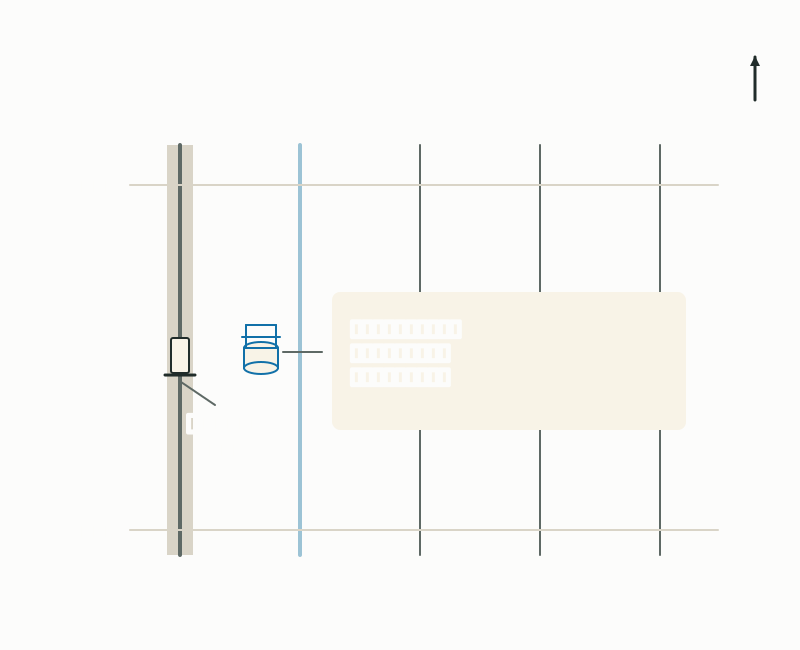
North of Kyoto Station, the north–south streets line up from west to east as Horikawa-dōri, Samegai-dōri, Aburanokōji-dōri, Higashinakasuji-dōri, and Nishinotōin-dōri. Samegai-dōri is a narrow street one block east of the broad Horikawa-dōri.
The Rokujō Horikawa residence, where the well stood, was built by Minamoto no Yoriyoshi on the spot where the monument now stands. If you keep in mind that the well disappeared when Horikawa-dōri was widened, the relationship between the street name and the well site becomes easy to grasp. After visiting the monument, step into Samegai-dōri one block east to see the street and the well site one after the other.
Samegai-dōri Is One Block East of Horikawa-dōri
Not the Same as Samegai in Shiga, and a Samegai Water That Still Flows
Although it is also read samegai, Samegai (醒井) in Maibara City, Shiga Prefecture, is a different place. It is the name of the former Samegai Village, which had a post town on the Nakasendō road, and it is linked to the legend of the Isame spring (居醒清水, isame shimizu), where Yamato Takeru is said to have cooled his body in clear water after falling ill with a fever on Mt. Ibuki. It has nothing to do with the origin of Kyoto's Samegai-dōri.
Within Kyoto City, there is also water that carries on the name. At the front of Kameya Yoshinaga, a Japanese confectionery shop in Shimogyō Ward, water called Samegai (醒ヶ井) still wells up and is used for making sweets, including cooking bean paste. The memory of the famous water lives on not only in the street name but also in everyday life.
Mini quiz for this entry
Check what you've read with 2 multiple-choice questions.
How is 醒ケ井通, a north–south street in Shimogyō Ward, read?
Samegai-dōri is said to be named after the Samegai (佐女牛井). What was it?
Sources and verification
Content checked: October 11, 2026
Updated: October 11, 2026
References are in Japanese.