
Japanese天使突抜(てんしつきぬけ)
Tenshitsukinuke
Other spellings and namesTenshitsukinuke-dori (天使突抜通) / Tenshitsukinuke 1-chome to 4-chome / Otenshi-san (お天使さん) / Angel Breakthrough
In short
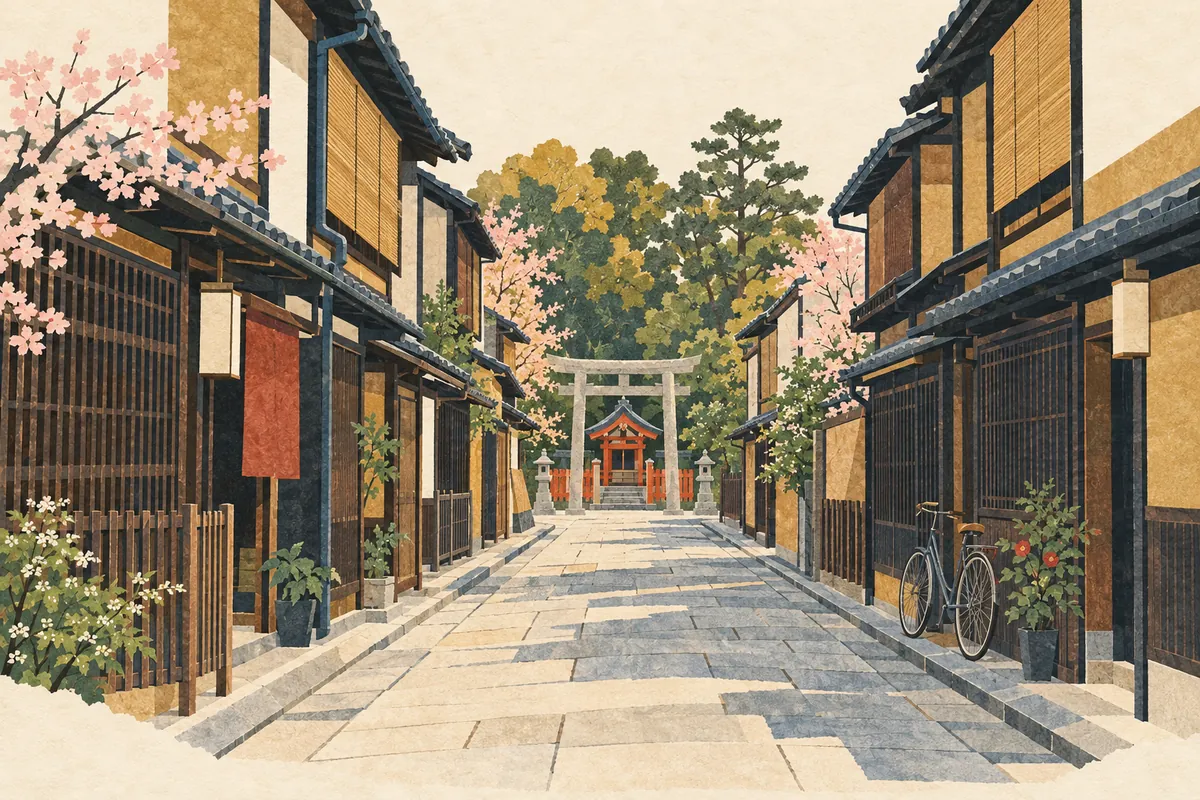
天使突抜, read Tenshitsukinuke (てんしつきぬけ), is a town name in Shimogyō Ward, with 1-chōme to 4-chōme on both sides of Higashinakasuji-dōri. "Tenshi" refers to Gojō Tenjin Shrine, known as Tenshi no Miya, and the name is said to come from a north–south road that was driven straight through (tsukinuke) the shrine grounds during Toyotomi Hideyoshi's remodeling of Kyoto around 1590 (Tenshō 18).Key points in 30 seconds
A town name in Shimogyō Ward, with 1-chōme to 4-chōme on both sides of Higashinakasuji-dōri
"Tenshi" refers to Gojō Tenjin Shrine (Tenshi no Miya, or Otenshi-san)
A north–south road is said to have been cut through the shrine grounds during Hideyoshi's remodeling of Kyoto
Today the street is mainly called Higashinakasuji-dōri, and Tenshitsukinuke survives as a town name
"Tenshi" Means Gojō Tenjin Shrine
天使突抜 is read Tenshitsukinuke (てんしつきぬけ) and is a town name in Shimogyō Ward, Kyoto. The reading is just what the characters suggest, but tenshi (天使) here does not mean a winged angel, as the word usually does in Japanese; it refers to Gojō Tenjin Shrine at Matsubara-dōri Nishinotōin. Gojō Tenjin Shrine has long been affectionately called Otenshi-san.
The popular name of Gojō Tenjin Shrine is Tenshi no Miya (天使の宮). It is said to have been founded in 794 when Emperor Kanmu ordered a deity to be invited here from Uda District in Yamato Province, and it is considered the oldest shrine in central Kyoto. It enshrines three deities—Sukunahikona-no-Mikoto, Ōnamuchi-no-Mikoto, and Amaterasu Ōmikami—and has been worshiped as a shrine of agriculture and medicine.
The Edo-period Miyako Meisho Zue, an illustrated guide to Kyoto's famous sites, also says of Gojō Tenjin Shrine at Matsubara-dōri Nishinotōin that it "is called the Tenshi shrine." In other words, the shrine's popular name was placed directly at the head of the town name.
Why "Tsukinuke"? A North–South Road Through the Shrine Grounds
In 1590 (Tenshō 18), as part of Toyotomi Hideyoshi's remodeling of Kyoto, the grounds of Gojō Tenjin Shrine were opened up and a street running north–south was put through them. This road came to be called Tenshitsukinuke-dōri, and the towns formed on both sides are said to have been named Tenshitsukinuke 1-chōme to 4-chōme, from north to south.
The name Tenshitsukinuke-dōri comes from the road having been built straight through (tsukinuke) the grounds of Gojō Tenjin Shrine, known as Tenshi no Miya or the Tenshi shrine. Miyako Meisho Zue states that the shrine's former lands extended four chō east to west and five chō north to south, which suggests that the grounds were quite large before the road went through.
Opinions differ on what the people who named it felt. One theory holds that the name carries irony about forcing a road through a well-loved shrine. However, this remains only one theory and has not been confirmed.
Where Can You See It Today? Town Names and School Districts
Tenshitsukinuke 1-chōme to 4-chōme run along Higashinakasuji-dōri, from Matsubara-dōri in the north to Hanayachō-dōri in the south. Tenshitsukinuke is a ryōgawa-machi ("two-sided town") straddling the north–south Higashinakasuji-dōri, and Tenshitsukinuke-dōri corresponds to today's Higashinakasuji-dōri. As a street it is now mainly called Higashinakasuji-dōri, while Tenshitsukinuke survives in daily life as a town name.
Tenshitsukinuke 1-chōme to 4-chōme are read てんしつきぬけ, and all are in the school district of Shimogyō Miyabi Elementary School and Shimogyō Junior High School. Tenjinmae-chō, where Gojō Tenjin Shrine stands, is in the same school district.
A sign showing the town name has also been found in Tenshitsukinuke 1-chōme. Walking around while looking for the characters 天使突抜 in addresses and on town-name signs is a pleasure unique to this neighborhood.
Tenshitsukinuke Runs Along Both Sides of Higashinakasuji-dōri
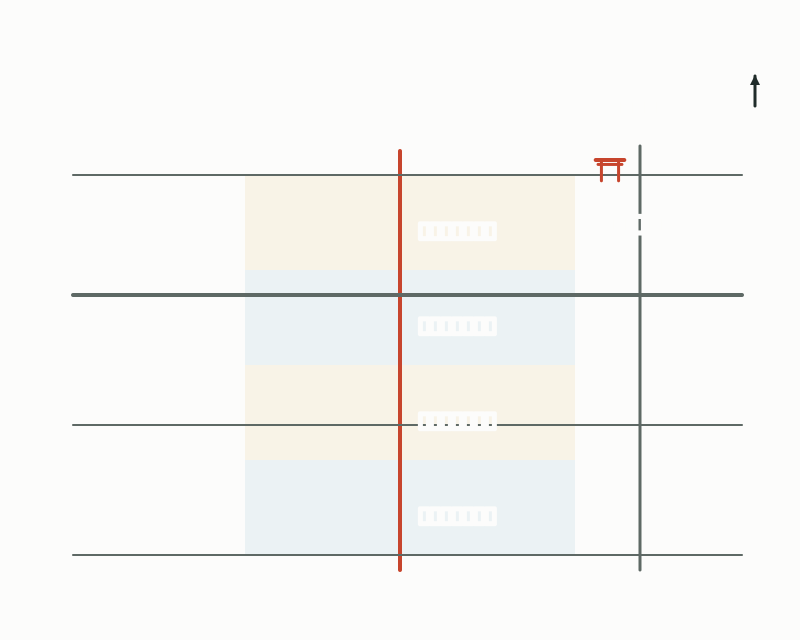
Tenshitsukinuke and nearby town names (Shimogyō Ward)
| Town name | Reading | Elementary school district | Junior high school district |
|---|---|---|---|
| 天使突抜一丁目 | Tenshitsukinuke 1-chōme (Ichi-chōme) | Shimogyō Miyabi | Shimogyō |
| 天使突抜二丁目 | Tenshitsukinuke 2-chōme (Ni-chōme) | Shimogyō Miyabi | Shimogyō |
| 天使突抜三丁目 | Tenshitsukinuke 3-chōme (San-chōme) | Shimogyō Miyabi | Shimogyō |
| 天使突抜四丁目 | Tenshitsukinuke 4-chōme (Yon-chōme) | Shimogyō Miyabi | Shimogyō |
| 天神前町 (location of Gojō Tenjin Shrine) | Tenjinmae-chō | Shimogyō Miyabi | Shimogyō |
| 突抜壱丁目 | Tsukinuke 1-chōme (Ichi-chōme) | Shimogyō Miyabi | Shimogyō |
| 突抜弐丁目 | Tsukinuke 2-chōme (Ni-chōme) | Shimogyō Miyabi | Shimogyō |
Common Misunderstandings and Similar Names
First, tenshi here is not an angel but the name of a shrine. Also, because the shrine's name contains "Tenjin," some people think of the Tenmangū shrines dedicated to Sugawara no Michizane, but Gojō Tenjin Shrine enshrines Sukunahikona-no-Mikoto, Ōnamuchi-no-Mikoto, and Amaterasu Ōmikami, and Michizane is not among them.
Shimogyō Ward also has towns called Tsukinuke 1-chōme and 2-chōme (突抜壱丁目・弐丁目, つきぬけ), without "Tenshi." They are in the same Shimogyō Miyabi Elementary School district as Tenshitsukinuke but are separate towns. No materials confirming the origin of this "Tsukinuke" could be found, so it is not covered here.
One more point to watch is the difference between Tenshitsukinuke-dōri and Tenshitsukinuke as a town name. The former is a former street name and corresponds to today's Higashinakasuji-dōri. The latter is a town name still in use.
If You Walk: From Gojō Tenjin Shrine to Higashinakasuji-dōri
Start at Gojō Tenjin Shrine. As of October 2026, its address is Tenjinmae-chō, Matsubara-dōri Nishinotōin nishi-iru, Shimogyō Ward; it is right by the Nishinotōin Matsubara stop on city bus route 50, and it is open from 7:00 to 19:00. After visiting the grounds, follow Higashinakasuji-dōri, which runs north–south nearby, to the south, and you can walk through Tenshitsukinuke 1-chōme to 4-chōme in order.
Every year at Setsubun, Gojō Tenjin Shrine gives out a picture of a treasure ship (takarabune) said to be the oldest in Japan. It is a simple design showing just a single sheaf of rice on a ship, and it is said to protect against misfortune and illness. In addition, the Gikeiki (Chronicle of Yoshitsune) names this as the place where Minamoto no Yoshitsune and Benkei met.
- Main events at Gojō Tenjin Shrine (as of October 2026): Saitan-sai, January 1; Setsubun-sai, on the day of Setsubun; Reitai-sai (annual grand festival), May 10; Ujiko-sai (parishioners' festival), Sports Day
- To find the town name: the characters 天使突抜 appear in addresses and on town-name signs
Mini quiz for this entry
Check what you've read with 2 multiple-choice questions.
How is 天使突抜, a town name in Shimogyō Ward, read?
In the town name 天使突抜 (Tenshi-tsukinuke), what does tenshi refer to?
Sources and verification
Content checked: October 11, 2026
Updated: October 11, 2026
References are in Japanese.