
Japanese仁丹の町名表示板
Jintan Town-Name Signs
Other spellings and namesJintan signs / Jintan address signs / Jintan enamel signs / 仁丹町名表示板
In short
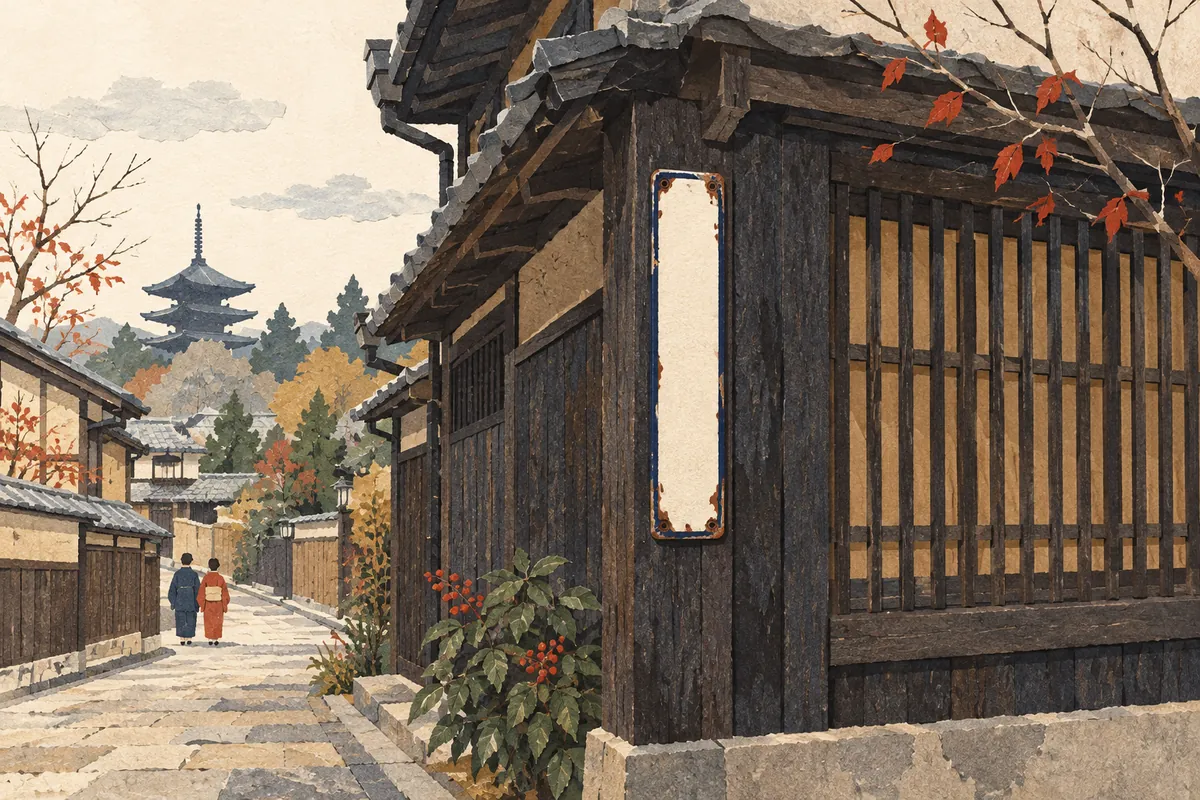
Jintan town-name signs are street signs showing town names along with the mark of Jintan, a breath-freshening pill brand. The maker, Morishita Jintan, says it began putting up town-name signs around 1910 (Meiji 43), but there are also theories that they were installed in Kyoto in 1915 (Taishō 4) or 1928 (Shōwa 3), and no single date has been settled. Signs that show addresses by combining street names still remain on Kyoto street corners.Key points in 30 seconds
Town-name signs bearing the Jintan trademark (the court-dress uniform mark)
One theory dates their installation to around 1910 (Meiji 43); others say 1915 (Taishō 4) or 1928 (Shōwa 3)
Many enamel signs showing street names remain in Kyoto
In 2011 the first revived sign since the war was put up at Kyoto City Hall
When were they installed?
Accounts differ on when the Jintan town-name signs were installed in Kyoto. Some local-history materials say they were installed around 1910 (Meiji 43).
On the other hand, there is a theory that they were installed in 1915 (Taishō 4) to celebrate Emperor Taishō's enthronement ceremony, and another that they were installed to celebrate Emperor Shōwa's enthronement ceremony in 1928 (Shōwa 3). The installation date cannot be pinned down to one.
The maker, Morishita Jintan, says that its founder, Morishita Hiroshi, began putting up town-name signs around 1910 (Meiji 43). It is best to understand this as the company's explanation standing alongside the theories in local-history materials.
Main theories on when they were installed
| Date | Details |
|---|---|
| Around 1910 (Meiji 43) | When the company began putting up town-name signs |
| 1915 (Taishō 4) | Theory that they were installed to celebrate Emperor Taishō's enthronement ceremony |
| 1928 (Shōwa 3) | Theory that they were installed to celebrate Emperor Shōwa's enthronement ceremony |
Why did a medicine company put up town names?
At the time, town names were not properly displayed, and visitors and mail carriers had trouble finding houses. The founder, Morishita Hiroshi, is said to have begun putting up town-name signs bearing the company's trademark, the court-dress uniform mark, at street corners as part of activities based on his idea of kōkoku ekisei (広告益世, "advertising should also benefit society and people").
The signs are said to have been put up starting in cities such as Osaka, Tokyo, Kyoto, and Nagoya and then spread nationwide. What makes them distinctive is that a single sign served both the public role of showing the town name and the purpose of advertising a product.
Why do so many remain in Kyoto?
A great many town-name signs burned in the war, but in Kyoto City, where many of the signs were made of enamel, you can still see many town-name signs that show addresses by combining street names, and they remain useful today.
Enamel signs are said to have first been made around the end of the Meiji era and produced from the Taishō era to the late Shōwa era, with most of them used as outdoor signs. Being a material that lasts a long time outdoors is thought to be one reason signs nearly 100 years old still remain on street corners.
Enamel is made by firing a glassy glaze onto iron at a high temperature of about 800 degrees Celsius, and it is a glossy material with high durability and weather resistance. Even so, the town-name enamel signs that had survived in large numbers in Kyoto are said to have decreased by about 40% over the preceding ten-plus years as of 2011, due to changes in social conditions and lifestyles, leaving a total of just under 750.
2011: the first revival since the war
Morishita Jintan launched the Kyoto Town-Name Enamel Sign Project in August 2010, and on February 10, 2011, it put up the first revived town-name enamel sign since the war at Kyoto City Hall. The plan was to go on to install new signs at 18 locations in 12 neighborhood associations. Kyoto Jintan Rakukai, a group of enthusiasts who walk the city looking for Jintan signs and record them in photos and blogs, advised on where to place the signs and the rules for what they display.
In September 2025, at a summer camp held at Kyoto Municipal Shōran Elementary School, the enthusiasts' group Kyoto Jintan Rakukai used the town-name signs for local studies, and Morishita Jintan provided a sign design bearing the address of Kashiwano and Shōran Elementary School. It was handed out as stickers to the 98 participating students in grades 3 to 6.
As a clue for looking into town names
One book about Kyoto's town names based on the Jintan town-name signs is Kyōto: Mō Hitotsu no Chōmei-shi (京都・もう一つの町名史, "Kyoto: Another History of Town Names"). It includes a list of the Jintan address signs in Kyoto City.
If you find a sign on a street corner, it also makes good practice for reading addresses. By comparing the street names, the directions such as agaru (上ル, "go north") and nishi-iru (西入, "go west"), and the town name, you can tell which way from the intersection the sign's location lies. When taking photos, be careful not to get in the way of passersby or bother residents.
Mini quiz for this entry
Check what you've read with 1 multiple-choice questions.
Which statement about when Kyoto's town-name signs bearing the Jintan (仁丹) mark were installed is correct?
Sources and verification
Content checked: October 11, 2026
Updated: October 11, 2026
References are in Japanese.