
Chōjū-giga and Kōzan-ji
Other spellings and namesChōjū-jinbutsu-giga
Key points
One of the four scrolls shows anthropomorphic animals at play; the others are a bestiary and scenes of human games and contests
Seven of the temple's 8 National Treasures are paintings and calligraphy; the only building is the Sekisuiin, surviving from Myōe's time
What you see at the temple are reproductions; the originals are sometimes shown at museum special exhibitions
In the autumn-leaf season an entrance fee is charged in addition to the Sekisuiin admission
What each scroll depicts
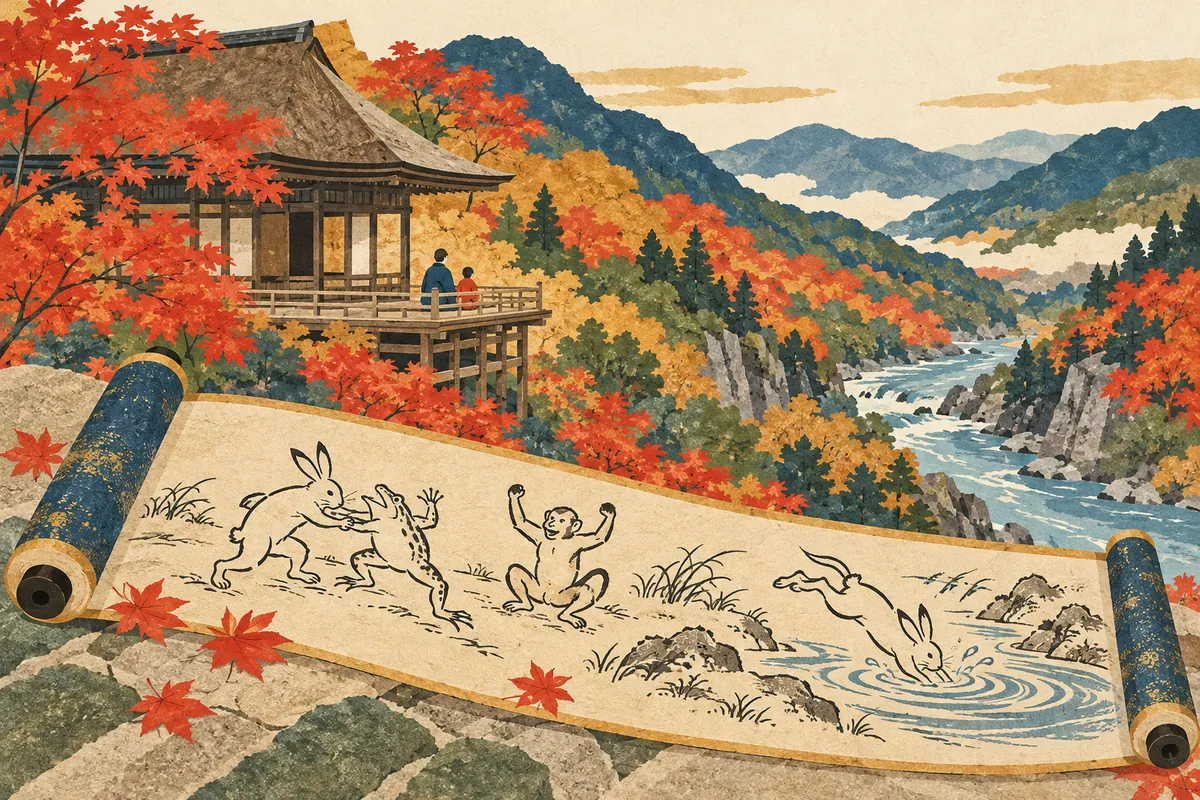
The Chōjū-jinbutsu-giga is a set of picture scrolls drawn in ink alone on paper, in four scrolls: Kō (甲), Otsu (乙), Hei (丙), and Tei (丁). The best known is the Kō scroll (30.4 cm high, 1,148.4 cm long), with scene after scene of anthropomorphic rabbits, monkeys, deer, and frogs playing in the water and competing with one another. The Otsu scroll is a bestiary depicting real and imaginary animals, such as lions and a blue dragon, in a sketch-like manner; like the Kō scroll, it appears to date from the late Heian period.
The first half of the Hei scroll shows human pastimes such as go, gambling with dice, and ear-pulling and neck-pulling contests, and the second half anthropomorphic animals; the Tei scroll depicts people only, with many scenes of contests and games. These two scrolls are Kamakura-period works.
Theories of the artist: Toba Sōjō and others
The scrolls are traditionally attributed to the brush of Toba Sōjō Kakuyū (1053–1140), but there is no firm evidence, and the artist is unknown. Other theories name the Buddhist painter Jōchi or the priest Gisei Ajari. The work is thought to belong to the tradition of "okoe," comic pictures drawn impromptu by monks of the Tendai school.
What you see at Kōzan-ji are reproductions
The originals are not on permanent display at the temple. What is exhibited in the Sekisuiin are reproductions of the Kō scroll and others. The originals are occasionally shown at museum exhibitions; all the scrolls were displayed at the Kyoto National Museum in autumn 2014 and at a special exhibition at the Tokyo National Museum in 2021.
Myōe and the revival of 1206
Kōzan-ji is in Toganoo, along the Kiyotaki River in the northwest of Ukyō Ward. Takao (Jingo-ji), Makinoo (Saimyō-ji), and Toganoo (Kōzan-ji) are known together as the "Sanbi" (Three Hills). The temple's chronology dates its founding to 774 (Hōki 5), at the wish of Emperor Kōnin, under the name "Shingan-ji Togao-bō"; it was originally a branch of Jingo-ji.
In 1206 (Ken'ei 1), the priest Myōe (1173–1232), a monk of the Kegon school from Kishū (Wakayama), was granted this land by Retired Emperor Go-Toba and made it the central training hall of the Kegon school. The name Kōzan-ji comes from the plaque the retired emperor gave him, reading "Hi idete mazu terasu kōzan no tera" ("the temple on the high mountain that the rising sun lights first"). The grounds were designated a national Historic Site in 1966 (Shōwa 41) and inscribed as a World Heritage Site in December 1994 (Heisei 6) as one of the "Historic Monuments of Ancient Kyoto." The temple has been famous for autumn leaves since the Muromachi period.
The Sekisuiin
The Sekisuiin (Goshodō) is Kōzan-ji's only National Treasure building, dating from the early Kamakura period. It was designated under the system of the time on December 28, 1898 (Meiji 31). It is a residential-style building roofed with thin wooden shingles (kokera-buki).
It was originally a sutra repository called the "Higashi Kyōzō" (East Sutra Hall). After the first Sekisuiin, Myōe's living quarters built in 1216 (Kenpō 4), was lost in a flood in 1228 (Antei 2), this building inherited the name Sekisuiin and has been handed down as Myōe's hermitage. It was moved to its present site in 1889 (Meiji 22) and remodeled into a residential form, but it is the only surviving structure dating back to Myōe's revival of the temple. In the veranda room stands a small statue of Zenzai Dōji (the youth Sudhana), whom Myōe revered, and from the south veranda you can look out over the greenery and autumn colors of the Kiyotaki River valley.
National Treasures of Kōzan-ji
| Name | Category | Date designated National Treasure |
|---|---|---|
| Chōjū-jinbutsu-giga, ink on paper, 4 scrolls | Painting (Heian–Kamakura period) | March 29, 1952 (Shōwa 27) |
| Portrait of Myōe (Meditating in a Tree), color on paper, 1 hanging scroll | Painting (Kamakura period) | November 22, 1952 (Shōwa 27) |
| Butsugen Butsumo (Buddha-Eye Mother), color on silk, 1 hanging scroll | Painting (Kamakura period) | June 9, 1951 (Shōwa 26) |
| Illustrated Biographies of the Kegon Patriarchs (Kegon Engi), color on paper, 7 scrolls | Painting (Kamakura period) | November 22, 1952 (Shōwa 27) |
| Yupian (Gyokuhen) dictionary, volume 27 (first half), 1 scroll | Calligraphy (Tang dynasty) | March 29, 1952 (Shōwa 27) |
| Mingbaoji (Meihōki), 3 scrolls | Calligraphy (Tang dynasty) | November 22, 1952 (Shōwa 27) |
| Tenrei Banshō Meigi dictionary, 6 volumes | Calligraphy (Heian period, 1114) | November 22, 1952 (Shōwa 27) |
| Kōzan-ji Sekisuiin (Goshodō), 1 building | Building (early Kamakura period) | March 31, 1953 (Shōwa 28) |
The tea garden said to be Japan's oldest
Tradition holds that Kōzan-ji is where tea was first cultivated in Japan. Tea seeds brought back from Song China by the monk Eisai were given to Myōe, who grew them on the temple's hillside and recommended tea to the monks for their practice because it keeps away drowsiness. The oldest tea garden was at Fukase Sanbongi on the opposite bank of the Kiyotaki River, and from the medieval period onward tea from Toganoo was called "honcha" (true tea) to distinguish it from all other tea, called "hicha." Today's tea garden is on what is held to be the site of the former monks' residence Jūmujin-in, and a stone marker reading "Japan's Oldest Tea Garden" stands there. The tea is picked in mid-May every year, and on November 8 a tea-offering ceremony is held in the Kaisandō (Founder's Hall), presenting new tea to Myōe, with officers of the Uji tea growers' association attending.
Buses to Toganoo and Sekisuiin admission
Kōzan-ji is at 8 Umegahata Toganoo-chō, Ukyō Ward, about 5 minutes on foot from the "Toganoo" stop served by JR Bus and city buses. From Kyoto Station, take the JR Bus Takao-Keihoku Line bound for "Toganoo" or "Shūzan," about 55 minutes (via Shijō Ōmiya, Nijō Station, and Enmachi); from Shijō Station on the Karasuma subway line, city bus route 8 takes about 50 minutes. There is a municipal car park (50 spaces) near the bus stop, charged only in November.
Visiting hours are 8:30 to 17:00 (as of October 2026). Admission to the Sekisuiin is 1,000 yen for adults, 500 yen for elementary school students, and 600 yen for visitors with disabilities and school trip students. In the autumn-leaf season a separate entrance fee (500 yen for adults, 300 yen for elementary school students) is charged at the entrance to the grounds; in 2026 this runs from October 3 to early December. The tea-offering ceremony on November 8 is one of the few chances to see the seated statue of Myōe in the Kaisandō (Important Cultural Property), and the garden of the Ikōan tea house built in 1931 (Shōwa 6), a Kyoto City designated Place of Scenic Beauty, is normally closed.
Mini quiz for this entry
Which of the four Chōjū-jinbutsu-giga scrolls contains the famous scenes of anthropomorphic rabbits, monkeys, and frogs playing in the water and competing with one another?
Which statement about the Sekisuiin (Goshodō), the National Treasure building of Kōzan-ji, is correct?
Sources and verification
Content checked: October 18, 2026
Updated: October 18, 2026
References are in Japanese.
- 高山寺「高山寺について」
- 高山寺「国宝・重要文化財」
- 高山寺「歴史」
- 高山寺「鳥獣人物戯画」
- 高山寺「日本最古の茶園」
- 高山寺「拝観・境内のご案内」
- 高山寺「アクセス」
- 高山寺「秋期拝観のご案内」
- 文化庁「国指定文化財等データベース 紙本墨画鳥獣人物戯画」
- 文化庁「国指定文化財等データベース 高山寺石水院(五所堂)」
- 文化庁「国指定文化財等データベース 紙本著色明恵上人像」
- 文化庁「国指定文化財等データベース 紙本著色華厳宗祖師絵伝」
- 文化庁「国指定文化財等データベース 絹本著色仏眼仏母像」
- 文化庁「国指定文化財等データベース 玉篇巻第廿七」
- 文化庁「国指定文化財等データベース 冥報記」
- 文化庁「国指定文化財等データベース 篆隷万象名義」
- 文化庁「文化遺産オンライン 紙本墨画鳥獣人物戯画」
- 京都市観光協会 京都観光Navi「高山寺<右京区栂尾>」
- 京都市都市計画局「高山寺周辺エリア(歴史的資産と守っていきたい眺め)」
- 京都国立博物館「特別展覧会 国宝 鳥獣戯画と高山寺」
- 観光庁 多言語解説文データベース「鳥獣人物戯画(栂尾山高山寺)」
- 東京国立博物館「特別展 国宝 鳥獣戯画のすべて」