
Japanese和束(わづか)
Wazuka
Other spellings and namesWazuka Town / 和束町
Key points
The town is Wazuka-chō (わづかちょう); the reading registered for its postal code is also ワヅカチョウ
A poem by Ōtomo no Yakamochi in Book 3 of the Man'yōshū mentions 和豆香杣山 (Wazuka somayama)
The Japan Heritage component properties are three: the Yubune and Harayama tea fields; the Ishitera, Shirasu, Erihara, and Kamatsuka tea fields; and Kontai-ji on Mount Jubu
About 15 minutes by Nara Kotsu bus from JR Kamo Station to the Wazuka Town Office
Read Wazuka, in the town name Wazuka-chō
和束 is read Wazuka (わづか), and the town name is 和束町 (Wazuka-chō, わづかちょう). From the character 束 you might want to read it Wasoku or Wataba, but as a place name it is Wazuka, and the reading registered for its postal code is also ワヅカチョウ. Place names in the town include 石寺 (Ishitera, いしてら), 撰原 (Erihara, えりはら), 釜塚 (Kamatsuka, かまつか), and 湯船 (Yubune, ゆぶね).
Wazuka is a town in Sōraku District in southeastern Kyoto Prefecture. Flat land opens along the Wazuka River, a tributary of the Kizu River, and tea fields spread over the surrounding mountain slopes. Wazuka Town was born in 1954 (Shōwa 29) from the merger of the villages of Nishi-Wazuka, Naka-Wazuka, and Higashi-Wazuka, and it absorbed Yubune Village in 1956 (Shōwa 31).
The nearest station is JR Kamo Station. Seika Town, also in Sōraku District, has another hard-to-read place name: 祝園 (Hōsono, ほうその).
History of the name: 和豆香 in the Man'yōshū, and the soma timber mountains
The place name Wazuka first appears in historical sources in the Man'yōshū. In a poem (Book 3, No. 476) by Ōtomo no Yakamochi, composed when Prince Asaka (あさかしんのう), a son of Emperor Shōmu, was buried on Mount Wazuka on the 3rd day of the 2nd month of 744 (Tenpyō 16), the words 和豆香杣山 (wazuka somayama) appear. In the town is a mausoleum regarded as Prince Asaka's tomb (the Taikoyama Kofun).
和豆香 is written in man'yōgana, which borrowed the sounds of kanji to write Japanese pronunciation: 和 stands for wa, 豆 for zu, and 香 for ka. Shōsōin documents of 760 (Tenpyō Hōji 4) also show the spelling 輪束山 (Wazuka-yama), and a document of 1331 (Genkō 1) shows 輪塚 (wazuka); the characters 和束 have been used since around the end of the Heian period.
A soma (杣) is a mountain from which timber is cut to build or repair palaces and temples. The mountains in this area are thought to have been used as soma from around the time Emperor Shōmu built the Kuni-kyō capital (くにきょう), and later Wazuka became a soma of Kōfuku-ji in Nara. From the Heian to the Kamakura period it was called Wazuka Soma-no-shō (わづかそまのそう), Wazuka-no-shō (わづかそう), and similar names, and its timber was rafted from Koya (木屋) down the Kizu River, landed at Kizu, and carried overland to Nara.
A producing area of Uji tea, and its Japan Heritage tea fields
Wazuka Town is a main producing area of Uji tea, with especially large output of sencha, accounting for about half of the prefecture's sencha production (2021). Tea growing here goes back to the Kamakura period: tradition says it began when Jishin Shōnin of Kaijūsen-ji (かいじゅうせんじ) received tea seeds from Myōe Shōnin of Kōzan-ji in Kyoto and grew them at Harayama, at the foot of Mount Jubu (じゅうぶざん).
"A Walk through the 800-Year History of Japanese Tea," which brings together the history and culture of tea in the Yamashiro region, was recognized on April 24, 2015 (Heisei 27), as one of the first Japan Heritage stories, and Wazuka Town is one of the eight municipalities listed from the start. With an additional recognition in April 2016 (Heisei 28), the number of municipalities with component properties rose to 12.
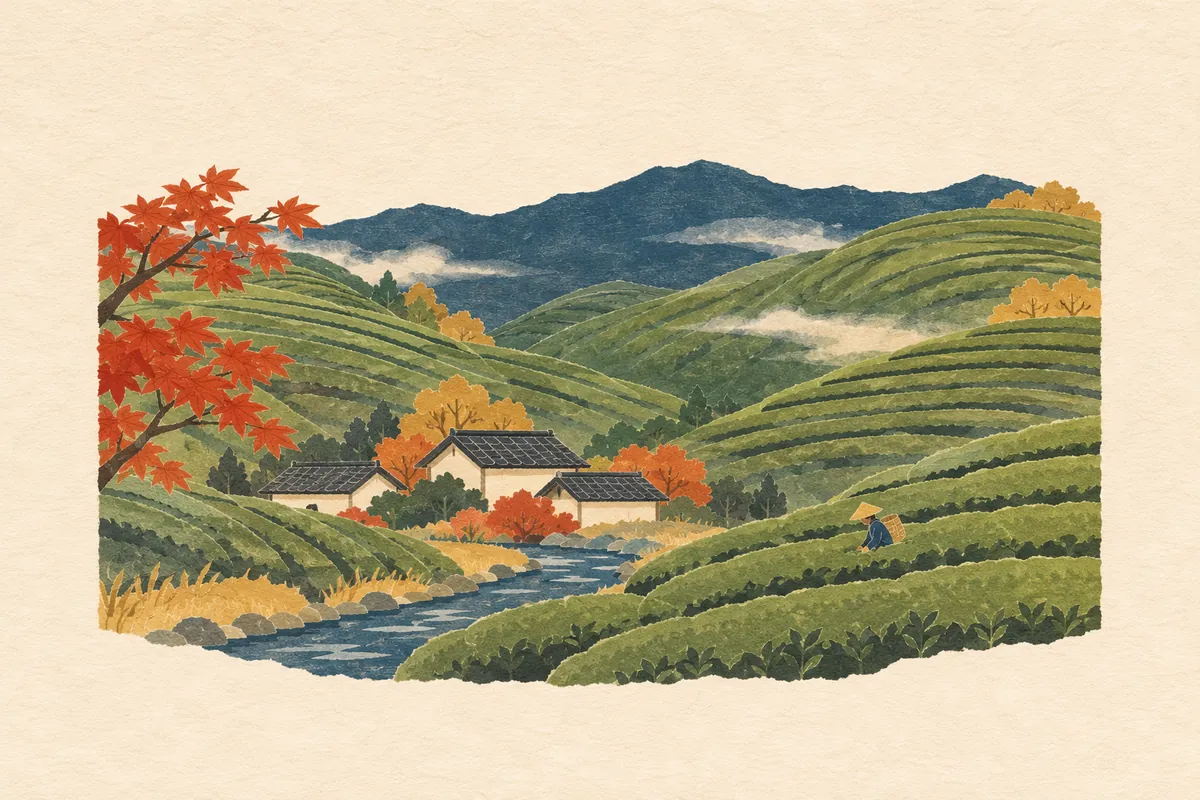
The Ishitera and Erihara tea fields on the two sides of the Wazuka River are barely visible from the road along the valley. Climb the sloping lanes through the hamlets, and yamanari chaen, rows of tea bushes following the contours of the mountain, spread out before you. All the tea fields are private land, so do not enter them without permission or touch the tea shoots.
Wazuka Town's component cultural properties of the Japan Heritage "A Walk through the 800-Year History of Japanese Tea"
| Component property | Designations |
|---|---|
| Yubune and Harayama tea fields | Kyoto Prefecture Landscape Asset; Cultural Landscape (Harayama) |
| Ishitera, Shirasu, Erihara, and Kamatsuka tea fields | Kyoto Prefecture Landscape Asset (Ishitera, Erihara, Kamatsuka); Cultural Landscape of Kyoto Prefecture |
| Kontai-ji on Mount Jubu | The tahōtō pagoda, hōkyōintō stone pagoda, wooden seated Miroku Bosatsu (Maitreya), and others are Important Cultural Properties, and the temple grounds are a national Historic Site |
Getting there: about 15 minutes by bus from JR Kamo Station
By train and bus, take the Miyakoji Rapid from JR Kyoto Station to Kizu Station (about 35 minutes) and change to the Yamatoji Rapid to Kamo Station (about 6 minutes). From JR Osaka Station, the Yamatoji Rapid reaches Kamo Station in about 66 minutes. From Kamo Station, a Nara Kotsu bus takes about 15 minutes to the Wazuka Town Office. On holidays, Kyoto Keihan Bus also runs services from the Uji area (as of November 2026).
By car, it is about 15 minutes from Kamo via Prefectural Road 5. Some stretches of the roads to Wazuka and within the town are narrow.
Mini quiz for this entry
How is 和束町, a town in Sōraku District, Kyoto Prefecture, read?
Roughly what share of the sencha produced in Kyoto Prefecture comes from Wazuka Town, a main producing area of Uji tea? (2021)
Sources and verification
Content checked: November 8, 2026
Updated: November 8, 2026
References are in Japanese.