
Japanese祝園(ほうその)
Hosono
Other spellings and namesHōsono / Hōsono Station / Hafurisono / Hōsono Shrine / 祝園
In short
祝園 is read Hōsono and is a place name in Seika Town, Sōraku District. It was anciently called Hafurisono (波布理曽能, 羽振苑), and it appears in the legend of Takehaniyasuhiko (武埴安彦) in the Kojiki and Nihon Shoki. Hōsono Shrine preserves the Igomori Festival, linked to that legend and designated an intangible folk cultural property of Kyoto Prefecture.Key points in 30 seconds
Read Hōsono; also the name of JR Hōsono Station and Kintetsu Shin-Hōsono Station
Anciently called Hafurisono and written 羽振苑 in the Nihon Shoki
The area around Hōsono Shrine is considered the Hahaso no Mori, a poetic place name (utamakura) since the Heian period
Hōsono Shrine's Igomori Festival, also called the "festival of silence," is a designated intangible folk cultural property of Kyoto Prefecture
Hōsono, not Iwaizono
祝園 is read Hōsono (ほうその). The character 祝 ("celebrate") tempts people to read it Iwaizono or Shukuen, but as a place name it is Hōsono. It is also a familiar name from stations: in 1994 the elevated station buildings of JR Hōsono Station and Kintetsu Shin-Hōsono Station were completed, and in 2000 express trains began stopping at Shin-Hōsono.
The mid-Heian dictionary Wamyō Ruijushō lists seven townships (gō) in ancient Sōraku District, and two of them, Shimokoma-gō and Hōsono-gō, correspond to today's Seika Town. Hōsono is therefore a very old place name that continues the name of an ancient township.
Hafurisono in the Kojiki and Nihon Shoki
Hōsono was anciently called Hafurisono (波布理曽能, 羽振苑), and it appears in the legend of Takehaniyasuhiko (武埴安彦) recorded in the Kojiki and the Nihon Shoki.
Passages on the origin of the place name appear in the section on Emperor Sujin in the middle volume of the Kojiki, and in the entry for the ninth month of the tenth year of Emperor Sujin in Book 5 of the Nihon Shoki ("故号其処曰羽振苑," "so the place was named Hafurisono"). Commentaries take both to refer to Hōsono in Seika Town.
Hōsono Shrine's traditional history says that in the reign of Emperor Sujin, Takehaniyasuhiko, a son of Emperor Kōgen, plotted a rebellion against the court and was killed here. The place where Takehaniyasuhiko was beheaded is said to be Idemori.
The Hahaso no Mori near Hōsono Shrine
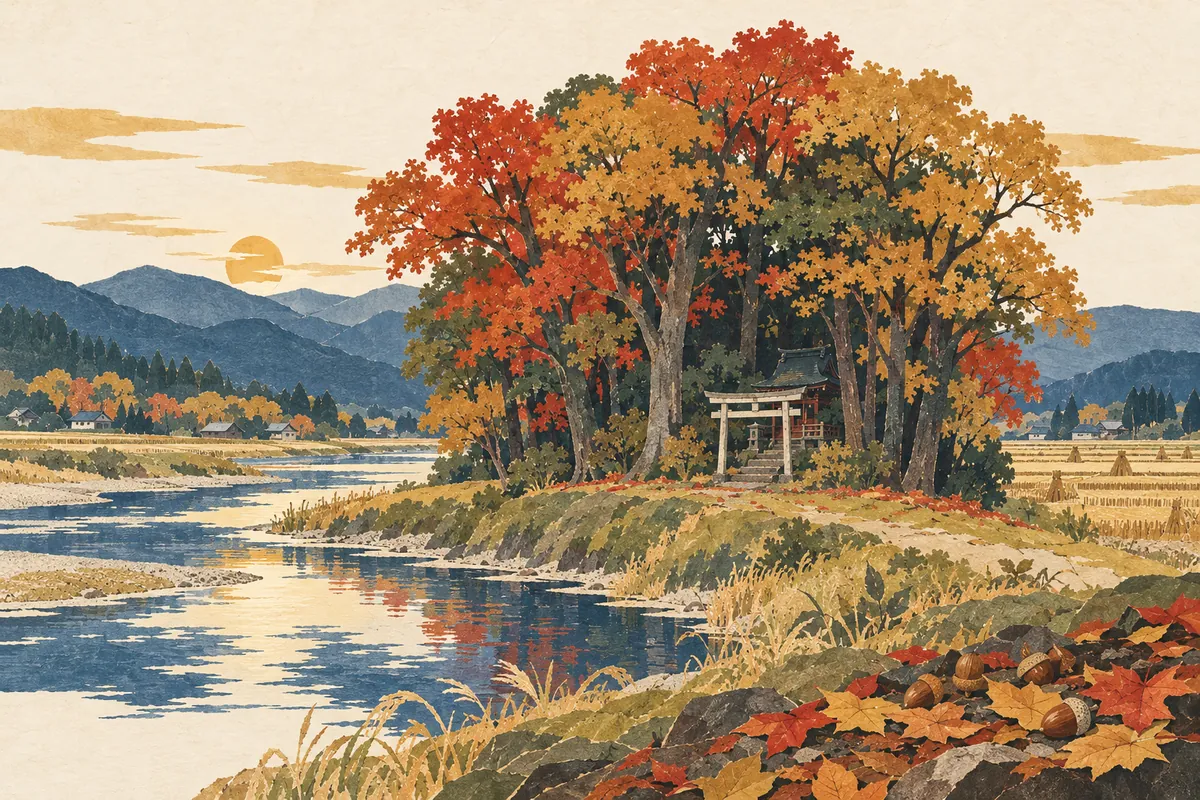
Hahaso no Mori (柞の杜), meaning a grove of acorn-bearing deciduous trees, was a famous spot for autumn leaves and is believed to correspond to the area around today's Hōsono Shrine. Hahaso is a general term for acorn-bearing deciduous trees such as konara oak and sawtooth oak.
The Hahaso no Mori was sometimes a resting place for emperors, retired emperors, and nobles on their way to worship at Kasuga Shrine in Nara, the clan shrine of the Fujiwara, and from the Heian to the Kamakura period it was used as a poetic place name (utamakura) in many waka poems. One of them is this poem by Fujiwara no Teika: 「時わかぬ浪さへ色にいづみ河はゝその杜に嵐吹らし」 (Even the Izumi River's waves, which know no season, take on color; a storm must be blowing through the Hahaso no Mori).
Hōsono Shrine and the Igomori Festival, the "festival of silence"
Hōsono Shrine's traditional history says that because the ghost of the slain Takehaniyasuhiko lingered in the Hahaso no Mori and troubled the people, the great deity of Kasuga was invited and enshrined here in Jingo-keiun 4 (770). It is also said that the shrine was given the divine rank of Junior Fifth Rank, Lower Grade, in Jōgan 1 (859), and that it was later listed as a major shrine in the Engishiki.
Hōsono Shrine is the guardian shrine (ubusunagami) of the Hōsono district. The Hōsono Igomori Festival (祝園の居籠祭, igomori matsuri), held for three days starting on the first day of the monkey (saru) in the new year, was designated an intangible folk cultural property of Kyoto Prefecture on April 14, 1984 (Shōwa 59).
The Igomori Festival is also called the "festival of silence." In the past, for the three days, people are said to have used only water drawn in advance instead of drawing it from the well, did no cleaning inside or outside the house, tied pot lids shut with rope in a cross to avoid making noise, and lived on vegetarian food prepared the day before. The custom of making no noise has faded, but the festival itself has continued without interruption.
The three days of the Igomori Festival
| Day | Main rites |
|---|---|
| Day 1 (day of the monkey) | Purifying sand is scattered along the roughly 2 km route of the deity's procession, and the festival begins in the evening. In the Furo-no-i rite, people carrying small torches escort the deity to the Furo-no-i well |
| Day 2 (day of the rooster) | A large torch is lit with sacred fire and carried through the darkened grounds to the sacred field in Sai-no-mori. In the Onda rite, participants mime farm work with wooden tools and sow the seeds of the five grains |
| Day 3 (day of the dog) | Splitting into north and south sides with the torii gate at the center, people pull against each other on a bamboo rope representing evil spirits, and the rope is then burned at Idemori |
Where to see it today, and walking tips
The place name survives in the names of JR Hōsono Station and Kintetsu Shin-Hōsono Station, and in the name of Hōsono Shrine. The station names, Hōsono and Shin-Hōsono, differ by one character (新, shin, "new"), so take care when transferring or arranging to meet.
Hōsono Shrine stands in a dense shrine forest near the embankment on the left bank of the Kizu River, surrounded by large oak and sawtooth oak trees. As a forest of acorn trees, it still overlaps with the image of the Hahaso no Mori sung in old poems. If you visit during the Igomori Festival, remember that it is a local religious rite and watch quietly.
Mini quiz for this entry
Check what you've read with 2 multiple-choice questions.
How is 祝園, a place name in Seika Town, Sōraku District, that is also a JR station name, read?
What was Hōsono anciently called—written 羽振苑 in the Nihon Shoki?
Sources and verification
Content checked: October 11, 2026
Updated: October 11, 2026
References are in Japanese.