
The Kyoto National Museum and the Meiji Kotokan
Other spellings and namesKyōhaku / Imperial Museum of Kyoto
Key points
The Meiji Kotokan is closed to exhibitions while a basic plan for seismic-isolation retrofitting goes ahead
Exhibitions are held in the Heisei Chishinkan, where the Meihin Gallery shows works owned by the museum together with items on deposit
In 2014 the Heisei Chishinkan opened, and the same year the main building was renamed the Meiji Kotokan
High school students and younger enter the Meihin Gallery and the garden free; special exhibitions are priced separately
The 1897 opening and the changing names
In 1888 (Meiji 21), a large-scale survey began of more than 210,000 treasures handed down at temples and shrines. Alongside it, preparations went ahead to build new museums in Kyoto and Nara, where fine works of art and craft were concentrated, and in May 1889 (Meiji 22) an imperial ordinance established the Imperial Museum, the Imperial Museum of Kyoto, and the Imperial Museum of Nara.
In October 1890 (Meiji 23), the site was fixed on land known as Shichijō Goryō (Shichijō imperial land). The exhibition hall (today's Meiji Kotokan) was completed in October 1895 (Meiji 28), and the museum opened in May 1897 (Meiji 30). Its name later changed to the Kyoto Imperial Household Museum (1900), the Onshi Kyoto Museum after it was granted to Kyoto City (1924), and the Kyoto National Museum after it was transferred to the national government (1952).
The Meiji Kotokan and the front gate
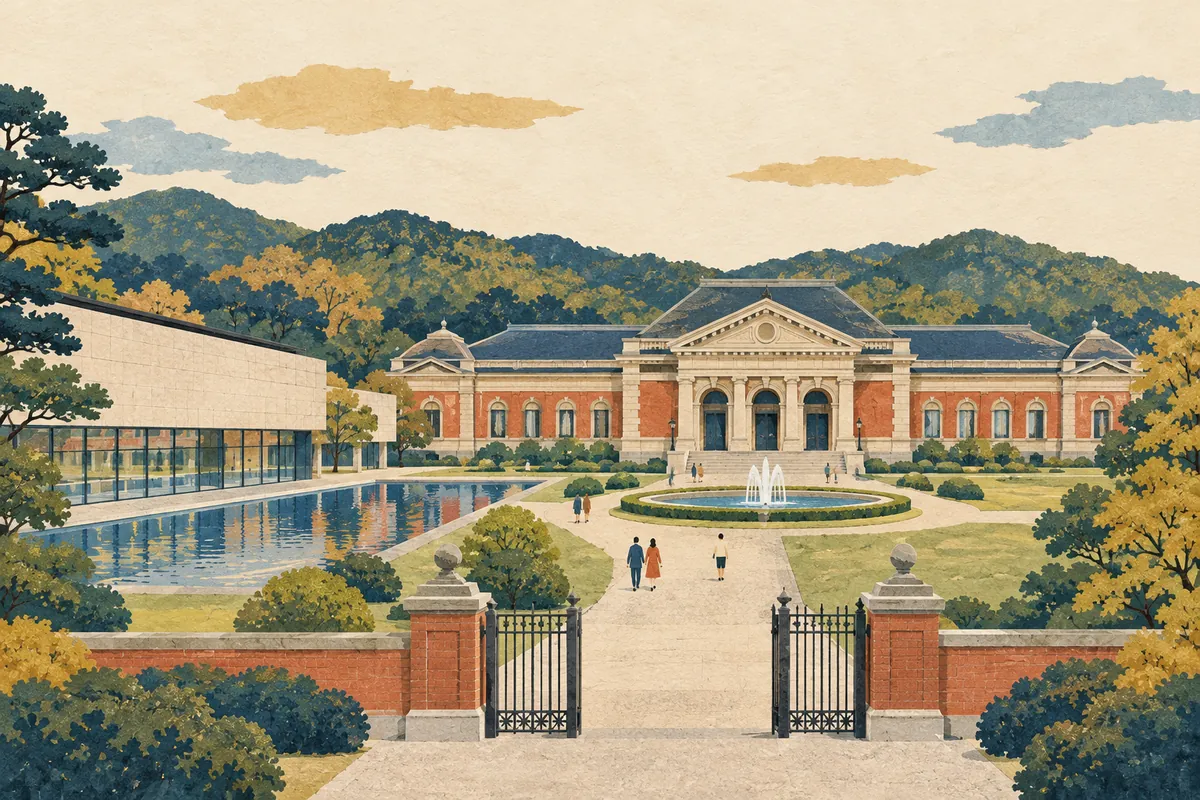
The Meiji Kotokan was designed by Katayama Tōkuma, an engineer of the Takumiryō (Bureau of Construction) of the Imperial Household Ministry. Katayama was an architect who also designed the Akasaka Palace (State Guest House) and the Hyōkeikan of the Tokyo National Museum. Adopting the French Renaissance–Baroque style, he arranged a single-story brick building symmetrically, with an entrance hall, a central hall, 10 large and small galleries, and courtyards.
The front gate (west gate) facing Yamato-ōji-dōri and the wall running from it to the south gate on Shichijō-dōri were built at the same time, and together with the main building they became Important Cultural Properties on March 12, 1969 (Shōwa 44). The building used to be the venue for special exhibitions; the "Chōjū-giga and Kōzan-ji" exhibition in autumn 2014 was held here. In the same year, 2014, it was renamed from the "Special Exhibition Hall (Main Building)" to the Meiji Kotokan. It now holds no exhibitions while a basic plan for seismic-isolation retrofitting and other work goes ahead, and it is normally closed to the public. The front gate cannot be used as an entrance or exit either. The entrance hall and central hall can be viewed in a VR video online, but the VR has been suspended for system maintenance since October 22, 2026.
Main buildings of the Kyoto National Museum
| Building | Year built | Design | Type of cultural property |
|---|---|---|---|
| Meiji Kotokan (Former Main Building of the Imperial Museum of Kyoto) | Completed October 1895 (Meiji 28) | Katayama Tōkuma | Important Cultural Property |
| Front gate (west gate), ticket booth, and wing walls (north and south) | 1895 (Meiji 28) | Katayama Tōkuma (built together with the main building) | Important Cultural Property |
| Technical Reference Hall | 1930 (Shōwa 5) | — | Registered Tangible Cultural Property (2008) |
| Heisei Chishinkan | Completed 2013 (Heisei 25); opened September 2014 | Taniguchi Yoshio | None |
The Heisei Chishinkan and the Meihin Gallery
The center of today's exhibitions is the Heisei Chishinkan, opened in September 2014 (Heisei 26). It was designed by Taniguchi Yoshio, who also designed the Gallery of Hōryū-ji Treasures at the Tokyo National Museum, and the entire gallery area is protected by a seismic-isolation structure. In the Meihin Gallery (regular exhibition), works owned by the museum and items on deposit are displayed together in rooms by field: ceramics, archaeology, paintings, calligraphy, decorative arts, and sculpture. How often the displays change depends on the field: about once a month for paintings and calligraphy, about every month and a half for decorative arts, and about every three months for ceramics, archaeology, and sculpture.
Special exhibitions are held in the same building about twice a year. During them the Meihin Gallery is closed, and in the preparation periods before and after, only the garden is open. The museum marks its 130th anniversary in spring 2027, and a commemorative special exhibition, "The Great Kano School," opens on April 20.
Items on deposit from temples and shrines
Kyōhaku is a facility whose purpose is to collect, store, and exhibit tangible cultural properties as defined in the Law for the Protection of Cultural Properties, and to carry out research on them. Besides works owned by the museum, its collection includes items on deposit from temples, shrines, and others. More than 9,000 works owned by the museum can be searched in an online database, but items on deposit, whose owners are not the museum, are not published there.
Items on deposit and kept at Kyōhaku include Kennin-ji's National Treasure "Wind God and Thunder God" folding screens (the temple displays a reproduction), the National Treasure seated Five Wisdom Buddhas of Anshō-ji in Yamashina Ward (designated in 2019), and the Important Cultural Property Kenjō no Sōji (sliding screens of the Sages) handed down at Ninna-ji. Even when a temple displays a reproduction, the original is sometimes on display at the museum.
Layout of the grounds
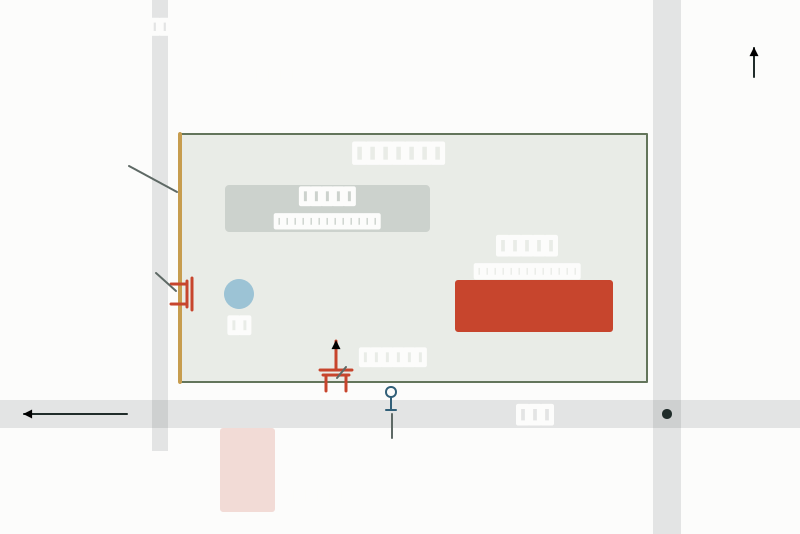
The grounds face Yamato-ōji-dōri on the west and Shichijō-dōri on the south, and extend east to near the Higashiyama-Shichijō intersection on Higashiōji-dōri. Entering through the west front gate, you see the Meiji Kotokan facing west beyond a fountain, and the Heisei Chishinkan stands to its northwest. Today's entrance is the south gate on Shichijō-dōri, and Sanjūsangen-dō is on the south side across the street. On the west side of the grounds remain the stone walls of Hōkō-ji, built by Toyotomi Hideyoshi (a national Historic Site), and to the north are Toyokuni Shrine and Hōkō-ji.
The Kyoto National Museum Grounds and Surroundings (Schematic)
Admission to the Meihin Gallery and special exhibitions
The address is 527 Chaya-machi, Higashiyama Ward. It is a 7-minute walk east from Keihan Shichijō Station; from Kyoto Station, take city bus 206 or 208 to "Hakubutsukan Sanjusangendo-mae," which is right by the museum. It is closed on Mondays (if Monday is a national holiday or other holiday, it opens and closes the following Tuesday instead) and over the New Year holidays (December 28 to January 1 in fiscal 2026), among other days. You can visit in a wheelchair or with a stroller, and both are lent free of charge.
Admission depends on the type of exhibition that day.
- Meihin Gallery (regular exhibition): 700 yen for adults and 350 yen for university students (as of October 2026). Free for high school students and younger, anyone under 18, and anyone 70 or older. The next periods are December 22–27, 2026, and January 2 to March 22, 2027
- Garden-only periods: 300 yen for adults and 150 yen for university students (free for high school students and younger, among others). Only the outdoor exhibits can be seen
- Special exhibitions: separate fees for each exhibition. The current "The Tale of Genji: The Splendor of the Court" (October 6 to November 29, 2026) costs 2,200 yen for adults, 1,200 yen for university students, and 700 yen for high school students, and is free for junior high school students and younger
- Anyone who shows a disability certificate or similar, plus one caregiver, enters free during any period
Mini quiz for this entry
Who designed the Heisei Chishinkan of the Kyoto National Museum?
When the Kyoto National Museum was granted to Kyoto City in 1924, what was it renamed?
Which street does the Kyoto National Museum's front gate (west gate), an Important Cultural Property, face?
Sources and verification
Content checked: October 22, 2026
Updated: October 22, 2026
References are in Japanese.
- 京都国立博物館「館の概要」
- 京都国立博物館「建物概要」
- 京都国立博物館「博物館ディクショナリー 京都国立博物館 特別展示館<旧帝国京都博物館 本館>」
- 京都国立博物館「博物館ディクショナリー 正門(重要文化財)」
- 京都国立博物館「休館日・開館時間・観覧料」
- 京都国立博物館「交通アクセス」
- 京都国立博物館「よくあるご質問」
- 京都国立博物館「コレクション」
- 京都国立博物館「屋外展示」
- 京都国立博物館「平成知新館 展示案内」(2026年3月)
- 京都国立博物館「京都国立博物館周辺マップ」
- 京都国立博物館「京都国立博物館開館130周年記念 特別展 大狩野派」
- 京都国立博物館「明治古都館VR・京博庭園ナビ 一時停止のお知らせ」
- 京都国立博物館「修理完成記念 国宝 鳥獣戯画と高山寺」(2014年)
- 京都国立博物館「五智如来坐像(京都・安祥寺所蔵)が国宝に指定されます」(2019年)
- 京都国立博物館「名品紹介 風神雷神図屏風」
- 文化庁「国指定文化財等データベース 旧帝国京都博物館 本館」
- 文化庁「国指定文化財等データベース 旧帝国京都博物館 表門」
- 文化庁「国指定文化財等データベース 旧帝国京都博物館 札売場及び袖塀(南)」
- 文化庁「国指定文化財等データベース 木造五智如来坐像」(安祥寺)
- 文化庁「国指定文化財等データベース 絹本著色賢聖障子〈狩野孝信筆〉」